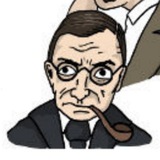
Avicenna, an 11th century Islamic philosopher, gave his "floating man" thought experiment to prove the existence of a soul, or a transcendent self. He asks us to imagine a person with no sensory experience at all:
One of us must suppose that he was just created at a stroke, fully developed and perfectly formed but with his vision shrouded from perceiving all external objects - created floating in the air or in the space, not buffeted by any perceptible current of the air that supports him, his limbs separated and kept out of contact with one another, so that they do not feel each other. Then let the subject consider whether he would affirm the existence of his self. There is no doubt that he would affirm his own existence, although not affirming the reality of any of his limbs or inner organs, his bowels, or heart or brain or any external thing. Indeed he would affirm the existence of this self of his while not affirming that it had any length, breadth or depth. And if it were possible for him in such a state to imagine a hand or any other organ, he would not imagine it to be a part of himself or a condition of his existence.
David Hume, six hundred years later, ran through basically the same thought experiment, but came to the opposite conclusion. That there was no such thing as a self without some experience attached to it:
There are some philosophers, who imagine we are every moment intimately conscious of what we call our self [...] For my part when I enter most intimately into what I call myself, I always stumble on some particular perception or other, of heat or cold, light or shade, love or hatred, pain or pleasure. I never can catch myself at any time without a perception, and never can observe anything but the perception.
This lead him to his Bundle Theory of the self, where we are nothing more than the sum of our experiences. While it seems that most people come down on Avicenna's side, it is unclear how to resolve a dispute between two people who come to opposite conclusions from such a thought experiment.
One of us must suppose that he was just created at a stroke, fully developed and perfectly formed but with his vision shrouded from perceiving all external objects - created floating in the air or in the space, not buffeted by any perceptible current of the air that supports him, his limbs separated and kept out of contact with one another, so that they do not feel each other. Then let the subject consider whether he would affirm the existence of his self. There is no doubt that he would affirm his own existence, although not affirming the reality of any of his limbs or inner organs, his bowels, or heart or brain or any external thing. Indeed he would affirm the existence of this self of his while not affirming that it had any length, breadth or depth. And if it were possible for him in such a state to imagine a hand or any other organ, he would not imagine it to be a part of himself or a condition of his existence.
David Hume, six hundred years later, ran through basically the same thought experiment, but came to the opposite conclusion. That there was no such thing as a self without some experience attached to it:
There are some philosophers, who imagine we are every moment intimately conscious of what we call our self [...] For my part when I enter most intimately into what I call myself, I always stumble on some particular perception or other, of heat or cold, light or shade, love or hatred, pain or pleasure. I never can catch myself at any time without a perception, and never can observe anything but the perception.
This lead him to his Bundle Theory of the self, where we are nothing more than the sum of our experiences. While it seems that most people come down on Avicenna's side, it is unclear how to resolve a dispute between two people who come to opposite conclusions from such a thought experiment.
Carnap: "But if we made an exact scientific language the usage would never be unclear!"
Wittgenstein: "No, if you made an exact scientific language, it would always be unclear, because no one is going to learn your nerd language."
Wittgenstein: "No, if you made an exact scientific language, it would always be unclear, because no one is going to learn your nerd language."
Frege was an early philosopher of language, who formulated a theory of semantics that largely had to do with how we form truth propositions about the world. His theories were enormously influential for people like Russel, Carnap, and even Wittgenstein early in his career. They all recognized that the languages we use are ambiguous, so making exact determinations was always difficult. Most of them were logicians and mathematicians, and wanted to render ordinary language as exact and precise as mathematical language, so we could go about doing empirical science with perfect clarity. Russell, Carnap, and others even vowed to create an exact scientific language (narrator: "they didn't create an exact scientific language").
Later on, Wittgenstein and other philosophers such as J.L. Austin came to believe that a fundamental mistake was made about the nature of language itself. Language, they thought, doesn't pick out truth propositions about the world at all. Speech acts were fundamentally no different than other actions, and were merely used in social situations to bring about certain effects. For example, in asking for a sandwich to be passed across the table, we do not pick out a certain set of facts about the world, we only utter the words with the expectations that it will cause certain behavior in others. Learning what is and isn't a sandwich is more like learning the rules of a game than making declarations about what exists in the world, so for Wittgenstein, what is or isn't a sandwich depends only on the success or failure of the word "sandwich" in a social context, regardless of what actual physical properties a sandwich has in common with, say, a hotdog.
Later on, Wittgenstein and other philosophers such as J.L. Austin came to believe that a fundamental mistake was made about the nature of language itself. Language, they thought, doesn't pick out truth propositions about the world at all. Speech acts were fundamentally no different than other actions, and were merely used in social situations to bring about certain effects. For example, in asking for a sandwich to be passed across the table, we do not pick out a certain set of facts about the world, we only utter the words with the expectations that it will cause certain behavior in others. Learning what is and isn't a sandwich is more like learning the rules of a game than making declarations about what exists in the world, so for Wittgenstein, what is or isn't a sandwich depends only on the success or failure of the word "sandwich" in a social context, regardless of what actual physical properties a sandwich has in common with, say, a hotdog.
Premise: desire leads to suffering.
Conclusion: we have to get revenge on Hegel.
Conclusion: we have to get revenge on Hegel.
Schopenhauer came to a lot of the same conclusions that Buddha did, in part because he supposedly read some of the first Buddhist texts that had been translated into German. In particular, his ideas about suffering being caused by desire were very similar, although he thought it was impossible to completely elimiate desire. However, the result that these ideas had on his behavior seemed to be quite different. Schopenhauer was a generally bitter person, lashing out at his perceived rivals, and at one point kicking a woman down the stairs who was making too much noise while he trying to write. The court ordered him to pay her for the rest of their lives. Whereas Buddha, on the other hand, well...became the Enlightened one and all.
Premise: desire leads to suffering.
Conclusion: we have to get revenge on Hegel.
Conclusion: we have to get revenge on Hegel.
Schopenhauer came to a lot of the same conclusions that Buddha did, in part because he supposedly read some of the first Buddhist texts that had been translated into German. In particular, his ideas about suffering being caused by desire were very similar, although he thought it was impossible to completely elimiate desire. However, the result that these ideas had on his behavior seemed to be quite different. Schopenhauer was a generally bitter person, lashing out at his perceived rivals, and at one point kicking a woman down the stairs who was making too much noise while he was trying to write. The court ordered him to pay her for the rest of their lives. Whereas Buddha, on the other hand, well...became the Enlightened one and all.
What if a lightning bolt created an identical Kant, but he wasn't the most boring person alive.
Based on the Swampman thought experiment By Donald Davdison.
Suppose Davidson goes hiking in the swamp and is struck and killed by a lightning bolt. At the same time, nearby in the swamp another lightning bolt spontaneously rearranges a bunch of molecules such that, entirely by coincidence, they take on exactly the same form that Davidson's body had at the moment of his untimely death.
This being, whom Davidson terms "Swampman," has, of course, a brain which is structurally identical to that which Davidson had, and will thus, presumably, behave exactly as Davidson would have. He will walk out of the swamp, return to Davidson's office at Berkeley, and write the same essays he would have written; he will interact like an amicable person with all of Davidson's friends and family, and so forth.
Suppose Davidson goes hiking in the swamp and is struck and killed by a lightning bolt. At the same time, nearby in the swamp another lightning bolt spontaneously rearranges a bunch of molecules such that, entirely by coincidence, they take on exactly the same form that Davidson's body had at the moment of his untimely death.
This being, whom Davidson terms "Swampman," has, of course, a brain which is structurally identical to that which Davidson had, and will thus, presumably, behave exactly as Davidson would have. He will walk out of the swamp, return to Davidson's office at Berkeley, and write the same essays he would have written; he will interact like an amicable person with all of Davidson's friends and family, and so forth.
One day I'm going to intentionally make a comic that misinterprets Stoicism so bad that it'll piss off all the Stoicism nerds, and I'll be like "ha, got you!"