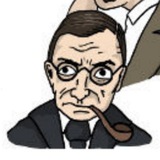
What if a lightning bolt created an identical Kant, but he wasn't the most boring person alive.
Based on the Swampman thought experiment By Donald Davdison.
Suppose Davidson goes hiking in the swamp and is struck and killed by a lightning bolt. At the same time, nearby in the swamp another lightning bolt spontaneously rearranges a bunch of molecules such that, entirely by coincidence, they take on exactly the same form that Davidson's body had at the moment of his untimely death.
This being, whom Davidson terms "Swampman," has, of course, a brain which is structurally identical to that which Davidson had, and will thus, presumably, behave exactly as Davidson would have. He will walk out of the swamp, return to Davidson's office at Berkeley, and write the same essays he would have written; he will interact like an amicable person with all of Davidson's friends and family, and so forth.
Suppose Davidson goes hiking in the swamp and is struck and killed by a lightning bolt. At the same time, nearby in the swamp another lightning bolt spontaneously rearranges a bunch of molecules such that, entirely by coincidence, they take on exactly the same form that Davidson's body had at the moment of his untimely death.
This being, whom Davidson terms "Swampman," has, of course, a brain which is structurally identical to that which Davidson had, and will thus, presumably, behave exactly as Davidson would have. He will walk out of the swamp, return to Davidson's office at Berkeley, and write the same essays he would have written; he will interact like an amicable person with all of Davidson's friends and family, and so forth.
One day I'm going to intentionally make a comic that misinterprets Stoicism so bad that it'll piss off all the Stoicism nerds, and I'll be like "ha, got you!"
This is exactly how interviews go for philosophy professors and no one can convince me otherwise.
The other cops don't know how ignorant they are of what justice really is.
The Vienna Circle was a group of intellectuals in the early 20th century who were radically committed to the idea that empirical science was the only knowledge (known as "Logical Positivism"). They were heavily influenced by Wittgenstein's Tractatus Logico-Philosophicus, which gave a similar account of knowledge, and likewise rejected metaphysics. One of their big dreams was to construct an "exact scientific language", which would be able to describe scientific observations in a precise way with no ambiguities (similar to how mathematical languages can make proofs where there are no disputes on the meaning of what is being said). They thought most of the philosophical disagreements arose from the inexactness of natural language, and would dissolve if their dream project could be completed.
Wittgenstein later came to believe that this sort of project was impossible, because language fundamentally wasn't the sort of thing that could be rigorously defined. He came to think that language wasn't merely a tool used to describe the world, but a kind of human activity that could take arbitrary forms. In fact he said that language could take an infinite number of forms, besides the merely denoscriptive truth functions that the Vienna Circle wanted to fit it into. He said language could be anything, such as "giving orders and obeying them, making up a story and reading it, play-acting, making a joke and telling it; translating from one language into another; asking, thanking, cursing, greeting, praying". John Searle later pointed out that, in typical philosopher fashion, he claimed that something was "an infinite number of things" and then went on to list twelve or so things.
Whether or not an "exact scientific language" is ultimately possible, and whether or not one would be able to tell jokes in such a language is an exercise left to the reader, but we do know that if it is possible to make such a language and tell jokes, the jokes would probably be pretty lame, at best.
Wittgenstein later came to believe that this sort of project was impossible, because language fundamentally wasn't the sort of thing that could be rigorously defined. He came to think that language wasn't merely a tool used to describe the world, but a kind of human activity that could take arbitrary forms. In fact he said that language could take an infinite number of forms, besides the merely denoscriptive truth functions that the Vienna Circle wanted to fit it into. He said language could be anything, such as "giving orders and obeying them, making up a story and reading it, play-acting, making a joke and telling it; translating from one language into another; asking, thanking, cursing, greeting, praying". John Searle later pointed out that, in typical philosopher fashion, he claimed that something was "an infinite number of things" and then went on to list twelve or so things.
Whether or not an "exact scientific language" is ultimately possible, and whether or not one would be able to tell jokes in such a language is an exercise left to the reader, but we do know that if it is possible to make such a language and tell jokes, the jokes would probably be pretty lame, at best.