"Meinong's Jungle" is the term used to make fun of Alexius Meinong's ontology. He believed that when we make references to objects in language, the meaning of the words is grounded by the existence the object being referred to. So if we say "Pegasuses have wings", in order for that sentence to be true, Pegasuses must in some sense exist, in order to even have properties and be referred to by language. Russell and others thought this was absurd, and coined the term "Meinong's Jungle" as the place where all these non-existant things where said to exist.
The rest of the comic is references various other reference problems and language thought experiments that puzzled philosophers at that time, such as the "morning star / evening star" problem, or "cicero is tully", the "Twin Earth thought experiment", the "possible bald man", Avicenna's distinctions between different types of Existence and Essence, and the discussion of tautolgies in sentences like "Married bachelor" or logical impossibilites of "Unmarried bachelor".
The rest of the comic is references various other reference problems and language thought experiments that puzzled philosophers at that time, such as the "morning star / evening star" problem, or "cicero is tully", the "Twin Earth thought experiment", the "possible bald man", Avicenna's distinctions between different types of Existence and Essence, and the discussion of tautolgies in sentences like "Married bachelor" or logical impossibilites of "Unmarried bachelor".
"Meinong's Jungle" is the term used to make fun of Alexius Meinong's ontology. He believed that when we make references to objects in language, the meaning of the words is grounded by the existence the object being referred to. So if we say "Pegasuses have wings", in order for that sentence to be true, Pegasuses must in some sense exist, in order to even have properties and be referred to by language. Russell and others thought this was absurd, and coined the term "Meinong's Jungle" as the place where all these non-existant things where said to exist.
The rest of the comic is references various other reference problems and language thought experiments that puzzled philosophers at that time, such as the "morning star / evening star" problem, or "cicero is tully", the "Twin Earth thought experiment", the "possible bald man", Avicenna's distinctions between different types of Existence and Essence, and the discussion of tautolgies in sentences like "unmarried bachelor" or logical impossibilites of "married bachelor".
The rest of the comic is references various other reference problems and language thought experiments that puzzled philosophers at that time, such as the "morning star / evening star" problem, or "cicero is tully", the "Twin Earth thought experiment", the "possible bald man", Avicenna's distinctions between different types of Existence and Essence, and the discussion of tautolgies in sentences like "unmarried bachelor" or logical impossibilites of "married bachelor".
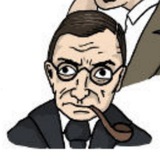
In Existentialism is a Humanism, Sartre recounts a story of a student who asked him for advice. As the comic says, the student was torn between two paths, to stay with his mother, or to join the army and fight the Germans to avenge his brother and protect France. Sartre explain that no moral system, be it religious or philosophical, could tell him what to do. Abstract systems were too divorced from reality to answer such concrete, human questions. Sartre advised the student, rather vaguely, that he was free, and only he could make the decision - he could not defer to a system to make it for him. Sartre also claimed that the student choose him specifically knowing that he would give such advice. If the student had wanted Christian advice, he would have gone to a priest, etc.
We can imagine, of course, that the student didn't specifically seek out Sartre because he knew ahead of time that Sartre would advice him that the choice was his alone, and instead actually wanted some kind of concrete moral advice from a his philosophy professor. Perhaps, in this case, he would found to the advice of "well you are free so the choice is yours" to be quite lame.
We can imagine, of course, that the student didn't specifically seek out Sartre because he knew ahead of time that Sartre would advice him that the choice was his alone, and instead actually wanted some kind of concrete moral advice from a his philosophy professor. Perhaps, in this case, he would found to the advice of "well you are free so the choice is yours" to be quite lame.
So actually...making people understand what they are talking about is censorship of their ignorant views. Making me read a book is censorship.
There are a large number of people who spend a good majority of their time and energy worrying about something called "postmodern neo-marxists", while rather amazingly, not being able to name a single one, or describe what they believe. Apparently though, these mysterious postmodernists think that "everything is as true as everything else" (a position that no one has ever held), and are engaged in some kind of systematic plot to destroy Western Civilization, by using...linguistic relativism, or something? It's kind of hard to say.
Actually, the phrase "drug seeking behavior" doesn't denote anything in the world, per se...
In order to lose all your money to this scam, first you have to lose half of it. Oh and by the way you already lost half of it.