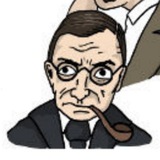
Francis Bacon was an early 17th century philosopher, best known for being one of the earlier philosophers who believed all knowledge had to be systematically empirical. He believed that through a system something like what we now think of as the "scientific method", we could come to understand the world. He was skeptical about all passed down dogmas which were not empirically tested.
Zera Yacob was also a 17th century philosopher, from Ethiopia. Like Bacon, he was very skeptical of dogmas, and thought all things needed to be considered. However, unlike Bacon, he believed it was human reason that was the primary method of examining the world. Obviously we needed to observe the world too, but he was also skeptical of moral, social, and religious institutions which asked us to believe things only because we were told them. He thought all beliefs should be subject to the examination of human reason and rationality. He believed that the best morality was harmonizing among different people along the ultimate principle of reason.
Hegel believed that reason operated quite differently from earlier philosophers like Yacob, who thought reason was a sort of absolute thing that you could use to come to a truth about a set beliefs. Instead, Hegel found reason or rationality more like a conversation that interrogates a given circumstances and moves towards a better set of ideas, rather than something immediately called the "truth" in the moment. In other words, reason was more like a debate or a courtroom verdict, rather than merely a way of thinking that produces truth.
Zera Yacob was also a 17th century philosopher, from Ethiopia. Like Bacon, he was very skeptical of dogmas, and thought all things needed to be considered. However, unlike Bacon, he believed it was human reason that was the primary method of examining the world. Obviously we needed to observe the world too, but he was also skeptical of moral, social, and religious institutions which asked us to believe things only because we were told them. He thought all beliefs should be subject to the examination of human reason and rationality. He believed that the best morality was harmonizing among different people along the ultimate principle of reason.
Hegel believed that reason operated quite differently from earlier philosophers like Yacob, who thought reason was a sort of absolute thing that you could use to come to a truth about a set beliefs. Instead, Hegel found reason or rationality more like a conversation that interrogates a given circumstances and moves towards a better set of ideas, rather than something immediately called the "truth" in the moment. In other words, reason was more like a debate or a courtroom verdict, rather than merely a way of thinking that produces truth.
"Here's a bit of free career advice: whenever your boss tries to extract your surplus value, instead of giving it to him punch him in the throat."
You could have seen this comic early if you subscribed to Commune Magazine.
"Whereof one cannot speak, thereof you know I'm right because...come on."
"In the ideal city there would be no poets. Why? Because if people won't go to my show than they won't get to go to anyone's! I'm the philosopher king and I make the rules."
In The Republic, Plato described the ideal city, and said that the Poets would be cast out of the city, along with the rhetoricians. It can be sort of hard to understand why he hated the poets so much, or thought they were so dangerous as to be exiled entirely, which seems a little extreme to us today. He seemed to think that, like the rhetoricians, because poetry doesn't make its aim to understand the truth, it was a dangerous way to spread ideas. It worked by inciting grand feelings or emotions, rather than engaging in a sort of ration, platonic dialogue. This sort of thing he held up as being fundamentally opposed to philosophy, which is what he believed should be governing the city, and governing our lives.
You can read more about Plato's views on Poetry in the Stanford Encyclopedia of Philosophy.
You can read more about Plato's views on Poetry in the Stanford Encyclopedia of Philosophy.