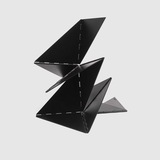
But what if, instructed by the new animisms, we refuse to confine the category of personhood to humanity? What if anything we can call agential—which is to say anything in active relation with other things, anything that participates in the ongoing creation, destruction, and re-worlding of worlds—can from some perspective also be called a person? In that case, there would be an alternative to the equally unpalatable theologemes of anthropocentrism on the one hand and impersonalism on the other. In that case, to call all things divine would be to call divinity omnipersonal, taking shape as every kind of person, depending on the circumstance. Such a reconfiguration of personhood would unsettle the theistic notion that humanity is the pinnacle of creation, along with the attendant assumption that divinity looks more like a human being than a dingo, an ocean, or the electromagnetic force.
Mary-Jane Rubenstein, Pantheologies: Gods, Worlds, Monsters (2018, pp.181-182)
Mary-Jane Rubenstein, Pantheologies: Gods, Worlds, Monsters (2018, pp.181-182)
❤1
"It's hard not to talk about something that's constantly on your mind."
Through a Glass Darkly (1961), dir. Ingmar Bergman
Through a Glass Darkly (1961), dir. Ingmar Bergman
❤3
Some plates from James Sowerby, A new elucidation of colours, original and material, 1809.
❤2
Nehemiah Grew’s Anatomy of Plants, 1680
In the 82 illustrated plates included in his 1680 book The Anatomy of Plants, the English botanist Nehemiah Grew revealed for the first time the inner structure and function of plants in all their splendorous intricacy.
In the 82 illustrated plates included in his 1680 book The Anatomy of Plants, the English botanist Nehemiah Grew revealed for the first time the inner structure and function of plants in all their splendorous intricacy.
❤1