Forwarded from Sagittarius Granorum (Sagittarius Hyperboreius)
1. The Library of Ignition and the Pyramids
2. Interior Landscape
3. The Tendency of Aesthetic Idealism
4. Unnoscriptd
5. The Forge, A Study of Nosie
6. Abstraction
7. Composition
2. Interior Landscape
3. The Tendency of Aesthetic Idealism
4. Unnoscriptd
5. The Forge, A Study of Nosie
6. Abstraction
7. Composition
Forwarded from The Exaltation of Beauty
Fire.jpg
1.1 MB
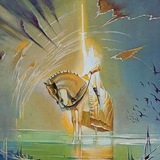
This canvas by a late 17th-century painter is part of a group of four works, all at the Museo del Prado, that express the idea of the Elements through motives drawn from classical mythology. The image that embodies Fire might be taken for Jupiter, given his handful of lightening bolts and the shining star that accompanies him. However, it is more likely to be Prometheus, who has just stolen one of the Sun’s rays. His beardless and youthful appearance certainly does not belong to Jupiter, and the salamander at his feet is not related to the father of the gods, either. In fact, this reptile is a well-known embodiment of fire and is often present in allusions to that element.
Air.jpg
1.1 MB
The female figure that represents Air is accompanied by the Winds. In her right hand, she carries a bag that sprinkles water, representing rain, while the ray of light represents storms and lightning. Her exact identity is unclear, however. It was thought she might represent Dawn, but she is not accompanied by the proper attributes. Another possibility is Juno, who embodied Air on other occasions, but her traditional iconography is not present. It was also thought she represents the birds-of-paradise.
Earth.jpg
1.1 MB
Here, the element Earth is represented with total clarity by the goddess Ceres. The summer fruit she carries, especially sheaves of wheat, and the fact that she is suckling a baby—an expression of fecundity—make her immediately recognizable. The lion and tortoise are also attributes of Earth, although they are associated with the Cybele rather than Ceres. In that sense, Ripa’s analogy between the lion and the farmer is well known: the lion erases its footprints with its tail, while the farmer, when sowing, erases his prints as he covers the seeds.
Water.jpg
1.1 MB
Water is embodied here by Ocean’s sister and wife, Thetis, who was queen of the seas. A crown and scepter underline her royal character, and she is accompanied by a dolphin and an enormous conch shell, as well as small seashells and snails that allude to the oceanic realm, and thus, to water.
The source of these four works is the Madrid circle of painters, but cannot be confidently attributed to any known artist and there are even some differences among them. The Air is attributed to Luca Giordano, while the other three are always listed as anonymous, without mention of their school or possible circle.
The source of these four works is the Madrid circle of painters, but cannot be confidently attributed to any known artist and there are even some differences among them. The Air is attributed to Luca Giordano, while the other three are always listed as anonymous, without mention of their school or possible circle.
👍4
Forwarded from Archive (Ex)
I do not wish to dwell on my analysis of the existential problem posed by Nietzsche in any detail. After all, if Nietzsche's definition of the problem is clear, the solutions he suggested are both hazy and dangerous — particularly in the case of his theory of the Übermensch and the will to power, and his naturalistic, almost physical praise of 'life'. To 'be oneself' and to follow one's own law as an absolute law can certainly be a positive and legitimate option — or, rather, the only remaining option: but this is true only in the case of the human type I addressed in Ride the Tiger: an individual possessing two natures, one 'personal' and one transcendent.
Julius Evola from The Path of Cinnabar
Julius Evola from The Path of Cinnabar
Forwarded from Sagittarius Granorum (Sagittarius Hyperboreius)
"The point according to this thinker(Heidegger), presents itself as follows: existence in time means existing as an individual and as an individualized being.
But individuality signifies particularity, it signifies the affirmation and assumption of a certain group of possibilities, to the exclusion of others, the whole of the others; but these subsist, they live within the individual, they constitute the sense of the infinite within him, and tend to find expression, to realize themselves.
This solution of Heidegger’s thus ends in a sort of metaphysical justification of sanctification of that which, in Hindu terms, might be called the samsara, the samsaric consciousness.
This seems to us a dangerous position, inasmuch as it goes towards the various modern Western philosophies of immanency, of “Life,” of becoming, a position which, in our opinion, can with difficulty be linked up with any traditional conception of the world. Indeed, a non-concealed gloomy pessimism broods over the whole of Heidegger’s philosophy." - Excerpts from Julius C. Evola's Svadharma and Existentialism on Heidegger
But individuality signifies particularity, it signifies the affirmation and assumption of a certain group of possibilities, to the exclusion of others, the whole of the others; but these subsist, they live within the individual, they constitute the sense of the infinite within him, and tend to find expression, to realize themselves.
This solution of Heidegger’s thus ends in a sort of metaphysical justification of sanctification of that which, in Hindu terms, might be called the samsara, the samsaric consciousness.
This seems to us a dangerous position, inasmuch as it goes towards the various modern Western philosophies of immanency, of “Life,” of becoming, a position which, in our opinion, can with difficulty be linked up with any traditional conception of the world. Indeed, a non-concealed gloomy pessimism broods over the whole of Heidegger’s philosophy." - Excerpts from Julius C. Evola's Svadharma and Existentialism on Heidegger
Halls of the Hyperboreads
(0/2)
To be frank and a bit personal, the two above quotes are an apt criticism for the position I came from, one which is common and expressed in such memes as these. I cannot in good conscience share these without disclaiming them; even when their messages are 'close enough' and potentially useful in guiding others towards Truth, it is in fact their proximity to the truth that makes them so dangerous and misleading. The almost (or explicitly) Gnostic diefication of the individual can only fulfill itself in a state of daemonic possessions; it is inherently chthonic/telluric if not outright materialistic when it indulges phenomena emergent from the physical body and mind. Its mistake is pursuing a degenerated and incomplete Dionysian transcendence of these phenomena instead of a true and unified Transcendence through them.
(1/2)
(1/2)
Halls of the Hyperboreads
To be frank and a bit personal, the two above quotes are an apt criticism for the position I came from, one which is common and expressed in such memes as these. I cannot in good conscience share these without disclaiming them; even when their messages are…
This seems to be the sickness of the 'dammed saints' of Jung, Nietzsche, Heidegger, etc. The various forces of 'will' and 'the unconscious' and 'vril' and such are not ends in themselves and must be tempered with divine wisdom and virtue lest they become agents of Titanic forces. The Promethean hubris of the übermensch justifies his wielding of forces that enslave or destroy himself. In a 'genealogy of spirituality' so to speak one corrupts the primordial Uranian principle with such Prometheanism, and accordingly it is the duty of Olympians to re-assert Solar order and punish those who indulge in its violation. The true übermensch is then not a man at all but a god—an Olympian—and he can only be one because he has given up his false individuality to unite with the ultimate One. This is invariably the goal of all Traditional spirituality: to become a conduit for the Divine. Here one's particular personality becomes merely circumstantial, illusory, and ultimately irrelevant.
(2/2)
(2/2)
(Telegram posted the text of the first post as an image caption, and some viewers could not read the first post)
Prometheus by Johann Wolfgang von GoetheCover your heaven, Zeus,
With cloudy vapours,
And test your strength, like a boy
Beheading thistles,
On oaks and mountain peaks;
Yet you must leave
My earth alone,
And my hut you did not build,
And my hearth,
Whose fire
You envy me.
I know nothing more paltry
Beneath the sun than you, gods!
Meagrely you nourish
Your majesty
On levied offerings
And the breath of prayer,
And would starve, were
Not children and beggars
Optimistic fools.
When I was a child,
Not knowing which way to turn,
I raise my misguided eyes
To the sun, as if above it there were
An ear to hear my lament,
A heart like mine,
To pity me in my anguish.
...
...
Who helped me
Withstand the Titans’ insolence?
Who saved me from death
And slavery?
Did you not accomplish all this yourself,
Sacred glowing heart?
And did you not – young, innocent,
Deceived – glow with gratitude for your deliverance
To that slumber in the skies?
I honour you? Why?
Did you ever soothe the anguish
That weighed me down?
Did you ever dry my tears
When I was terrified?
Was I not forged into manhood
By all-powerful Time
And everlasting Fate,
My masters and yours?
Did you suppose
I should hate life,
Flee into the wilderness,
Because not all
My blossoming dreams bore fruit?
Here I sit, making men
In my own image,
A race that shall be like me,
That shall suffer, weep,
Know joy and delight,
And ignore you
As I do!
Who helped me
Withstand the Titans’ insolence?
Who saved me from death
And slavery?
Did you not accomplish all this yourself,
Sacred glowing heart?
And did you not – young, innocent,
Deceived – glow with gratitude for your deliverance
To that slumber in the skies?
I honour you? Why?
Did you ever soothe the anguish
That weighed me down?
Did you ever dry my tears
When I was terrified?
Was I not forged into manhood
By all-powerful Time
And everlasting Fate,
My masters and yours?
Did you suppose
I should hate life,
Flee into the wilderness,
Because not all
My blossoming dreams bore fruit?
Here I sit, making men
In my own image,
A race that shall be like me,
That shall suffer, weep,
Know joy and delight,
And ignore you
As I do!
👍1
Forwarded from Sagittarius Granorum (Sagittarius Hyperboreius)
In Nietzsche, the will to power is turned from the will to dominate another to the will to dominate oneself.
Forwarded from Archive (Ex)
Monologue XXXII: An introduction into Nietzsche’s philosophy of the Ubermensch
The philosophy of the Ubermensch is not one of lawlessness, meaninglessness, and hedonism. Nor is it of mindless display of brute force. Far from either, the philosophy is one that invokes a higher type of being beyond the confines of the all too many. It is calling for a free spirit seldom seen. Noble and strong in mind and instinct, it is calling for the liberation of man’s nature that which the lesser man reaches for in vain by way of ideals.
Now this redemption of one’s naturalism is a motif that runs throughout his work, first politically in works like beyond good and evil then later almost esoterically in works like thus spoke Zarathustra. Nevertheless, it is only a first step.
Yes! The “barbarian” ranks infinitely higher than the weakling. But infinitely lower than Ubermensch. In any case, this barbarian is noteworthy because we can, on the one hand, recognize in him a childlike joy that accompanies discharge of strength; but also the mere lowliness of pure nihilistic terrorism as seen in the works of American Psycho.
Thus, the Ubermensch is calling for a refined possession and at times, expression of strength. And not just of strength, but also of one self. Where typical moral codes and conduct preach for castration of the passions and extirpation of the animal, for Nietzsche the first step is returning to this “savage” and “primitive” point.
Nietzschean Nobility, then, implies refining this aspect that has been for so long, repressed by civilizations. Passion and frenzy – with decisive rationality as the impetus, that is the crux of the matter here.
Prometheus may have been punished, but man will always have fire. As Goethe seemed to say in Prometheus, neither titan nor god can touch man now; all are effectively equals under Time and Fate. Perhaps the lesson is not to never play with fire but to not get burned.
And of course, Solar virtue is the means to cultivating the ideal form of fire, which destroys all that is not pure. If one is careful, wielding it will burn away one's impurities; if not, one will be totally destroyed.
And of course, Solar virtue is the means to cultivating the ideal form of fire, which destroys all that is not pure. If one is careful, wielding it will burn away one's impurities; if not, one will be totally destroyed.
🔥1