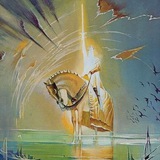
Halls of the Hyperboreads
"In Wolfram these meanings are detailed and confirmed in relation to Gawain and Amfortas. In Wolfram, Trevrizent is the brother of the fallen king of the Grail, who withdrew to ascetic life by the Wild Fountain (Fontane la Salvatsche), trying to alleviate…
Having defined in these terms the union with his woman and her occult efficiency, Gawain undertakes the adventure of the 'Castle of the Maiden' or Schastel Marveil. ...
Gawain succeeds and makes Orgeluse his bride, instead of ending up like Amfortas. It is also a significant symbol that Gawain reaches Orgeluse's kingdom just when he finally finds the man who had previously 'wounded' a knight whom he found in the arms of a woman: in other words, the same path is traveled again, the same cause is sought after, but the deed is successful.
In relation to this, we notice the double aspect that, in conformity with what I have already discussed, the theme of the 'woman' assumes. On the one hand, here we find the distinction between an earthly knighthood, which is inspired by a woman, and a heavenly knighthood, the object of which is the Grail. This can be seen, for instance, in the Queste du Graal, in which the knights about to leave in search of the Grail wish to take their women along but are prevented from doing so by an anchorite who declares that 'the earthly knighthood must be transformed into a spiritual knighthood.' "
- Julius Evola, The Mystery of the Grail
Gawain succeeds and makes Orgeluse his bride, instead of ending up like Amfortas. It is also a significant symbol that Gawain reaches Orgeluse's kingdom just when he finally finds the man who had previously 'wounded' a knight whom he found in the arms of a woman: in other words, the same path is traveled again, the same cause is sought after, but the deed is successful.
In relation to this, we notice the double aspect that, in conformity with what I have already discussed, the theme of the 'woman' assumes. On the one hand, here we find the distinction between an earthly knighthood, which is inspired by a woman, and a heavenly knighthood, the object of which is the Grail. This can be seen, for instance, in the Queste du Graal, in which the knights about to leave in search of the Grail wish to take their women along but are prevented from doing so by an anchorite who declares that 'the earthly knighthood must be transformed into a spiritual knighthood.' "
- Julius Evola, The Mystery of the Grail
Halls of the Hyperboreads
"In these legends, no matter how free of religious overtones, we find again the connection of the Grail, conceived as a heavenly stone, with a mysterious legacy and power associated with a primordial state that was somehow preserved during a period of exile.…
Evola uses 'Luciferian' entirely symbolically, extracting a valuable lesson from the myth of Lucifer. Much like Prometheus, the symbol of Lucifer describes a Titanic tragedy. However, this cycle is not always ultimately destructive, and Titanism can be an important part of the development of heroes if it is overcome and tempered. The stories of Percival and Gawain represent such cases as both attempt quests that have destroyed lesser knights. Percival falls into anger at God and goes down a 'pagan' (or non-Christian) path, against all expectations coming closer to the Grail by chasing wild adventure and combat. Having used his anger to realize great changes within himself, Percival's path is the other side of the romantic path that Gawain takes. Gawain takes refuge in a woman, specifically the Pround One who causes the ruin of the Wounded King. He bears all her insults and even a perilous quest for the woman who seems to hate him. Gawain, pure of heart, perseveres through the great trial and eventually wins her love. Lucifer's fall was caused by pride, and Gawain's chastity triumphs where before the weak destroyed themselves.
It is these Titanic heroes who are to restore the King, whom Evola tentatively identifies with the Olympian symbol we've described before. The corrupted Olympian requires a renewed transcendence; a new path is to be blazed for him. In the Grail cycle it is this new sort of hero who restores the condition of the royalty. These heroes are not by nature fully Olympian but find heroism in defeating the Titan within themselves, which succeeds in reviving the King and all his land.
It is these Titanic heroes who are to restore the King, whom Evola tentatively identifies with the Olympian symbol we've described before. The corrupted Olympian requires a renewed transcendence; a new path is to be blazed for him. In the Grail cycle it is this new sort of hero who restores the condition of the royalty. These heroes are not by nature fully Olympian but find heroism in defeating the Titan within themselves, which succeeds in reviving the King and all his land.
❤2
Forwarded from Ghost of de Maistre
“What is this law of the greatest number which modern governments invoke and in which they claim to find their sole justification? It is simply the law of matter and brute force, the same law by which a mass, carried down by its weight, crushes everything that lies in its track. It is precisely here that we find the point of junction of the democratic conception and materialism...”
- 𝑹𝒆𝒏𝒆́ 𝑮𝒖𝒆́𝒏𝒐𝒏, 𝑪𝒓𝒊𝒔𝒊𝒔 𝒐𝒇 𝒕𝒉𝒆 𝑴𝒐𝒅𝒆𝒓𝒏 𝑾𝒐𝒓𝒍𝒅, 𝒑. 𝑳𝑿𝑿𝑽𝑰.
- 𝑹𝒆𝒏𝒆́ 𝑮𝒖𝒆́𝒏𝒐𝒏, 𝑪𝒓𝒊𝒔𝒊𝒔 𝒐𝒇 𝒕𝒉𝒆 𝑴𝒐𝒅𝒆𝒓𝒏 𝑾𝒐𝒓𝒍𝒅, 𝒑. 𝑳𝑿𝑿𝑽𝑰.
❤4
Forwarded from Der Schattige Wald 🇬🇱
"The creative process of nations in Europe has always followed this rhythm:
First movement.—The peculiar Western instinct which causes the State to be felt as the fusion of various peoples in a unity of political and moral existence, starts by acting on the groups most proximate geographically, ethnically, and linguistically. Not that this proximity is the basis of the nation, but because diversity among neighbors is easier to overcome.
Second movement.—A period of consolidation in which other peoples outside the new State are regarded as strangers and more or less enemies. This is the period, when the nationalizing process adopts an air of exclusiveness, of shutting itself up inside the State; in short, what today we call nationalism. But the fact is that whilst the others are felt politically to be strangers and opponents, there is economic, intellectual, and moral communion with them. Nationalist wars serve to level out the differences of technical and mental processes. Habitual enemies gradually become historically homogeneous. Little by little there appears on the horizon the consciousness that those enemy peoples belong to the same human circle as our own State. Nevertheless, they are still looked on as foreigners and hostile.
Third movement.—The State is in the enjoyment of full consolidation. Then the new enterprise offers itself to unite those peoples who yesterday were enemies. The conviction grows that they are akin to us in morals and interests, and that together we form a national group over against other more distant, stranger groups. Here we have the new national idea arrived at maturity."
~ José Ortega y Gasset
First movement.—The peculiar Western instinct which causes the State to be felt as the fusion of various peoples in a unity of political and moral existence, starts by acting on the groups most proximate geographically, ethnically, and linguistically. Not that this proximity is the basis of the nation, but because diversity among neighbors is easier to overcome.
Second movement.—A period of consolidation in which other peoples outside the new State are regarded as strangers and more or less enemies. This is the period, when the nationalizing process adopts an air of exclusiveness, of shutting itself up inside the State; in short, what today we call nationalism. But the fact is that whilst the others are felt politically to be strangers and opponents, there is economic, intellectual, and moral communion with them. Nationalist wars serve to level out the differences of technical and mental processes. Habitual enemies gradually become historically homogeneous. Little by little there appears on the horizon the consciousness that those enemy peoples belong to the same human circle as our own State. Nevertheless, they are still looked on as foreigners and hostile.
Third movement.—The State is in the enjoyment of full consolidation. Then the new enterprise offers itself to unite those peoples who yesterday were enemies. The conviction grows that they are akin to us in morals and interests, and that together we form a national group over against other more distant, stranger groups. Here we have the new national idea arrived at maturity."
~ José Ortega y Gasset
Forwarded from Der Schattige Wald 🇬🇱
The change in nations across time is very easily seen through iconography. In the old regimes whole books were filled with the images of gods, idols, and symbols for each generation. Today a variation of three colours is enough for every nation in the world, and throughout the centuries.
Then two colours. Then one.... But let's not speak of dissolution.
Then two colours. Then one.... But let's not speak of dissolution.
👍2🤔1
Forwarded from The way of the warrior
The dismantling of the present scientific industrial structure, even if it can be envisaged, involves of course a great deal more than the mere destruction of its external features,
and it will not be achieved either simply by a return to nature or by the cultivation of one’s own garden.
One of the things we are forced to recognize is that the form of society we build around us is the mirror of our own inner world; it is the extra version of our inward dimension.
In it the state of our consciousness and our attitude to the fundamental realities of human existence take shape and are given an external form.
~ Philip Sherrard, Modern Science
and it will not be achieved either simply by a return to nature or by the cultivation of one’s own garden.
One of the things we are forced to recognize is that the form of society we build around us is the mirror of our own inner world; it is the extra version of our inward dimension.
In it the state of our consciousness and our attitude to the fundamental realities of human existence take shape and are given an external form.
~ Philip Sherrard, Modern Science
Forwarded from Chrysopoeia ☀️
"[...] the sword of righteousness has no scabbard; always he must threaten or strike. " - Joseph de Maistre
Forwarded from Āryāvarta ᛟ Archive
"The second idea, aristocratic heroism encourages our higher hopes, for it is not a matter of morals or civilization, where the heroic and hence aristocratic sense of life is wanting. The author Evola does well to warn us that when he speaks of aristocracy, he is referring to a certain vision of the world: an aristocracy of character, not economic nor even intellectual, for intellectuality exists in a sphere separated from living wholeness of the individual , and above all from everything that is character, spiritual, courage, and inner decision. It is precisely this aristocracy of character that the best Italians (and Europeans) desire and must constitute, beyond the ruins that surround us"
-Junio Valerio Borghese, from the introduction to Men Among The Ruins
-Junio Valerio Borghese, from the introduction to Men Among The Ruins
Forwarded from Léon Degrelle Archive
“We will emerge from this decay only through an immense moral rectification, teaching men again to love, to sacrifice themselves, to live, to fight and to die for a higher ideal.”
— Léon Degrelle
— Léon Degrelle
❤5
Forwarded from Ghost of de Maistre
"Pacifism will remain an ideal, war a fact." - Oswald Spengler, "Is World Peace Possible?"
Ghost of de Maistre
"Pacifism will remain an ideal, war a fact." - Oswald Spengler, "Is World Peace Possible?"
War will always be reality. The modern pacifist delusion is not even consistent with modernity's own tendency to inflict the most terrible sort of empty and vain bloodshed. This war is not always a literal violence, although that too is an inescapable contingency. Jesus came not to bring peace but a sword; life truly lived is constant spiritual warfare. The Beast will not be brought down by physical weapons, but by a Solar spirit that must be greater and more virtuous than its decadence is evil.
Forwarded from Diary of an Underground Ronin
“These are my enemies: they want to overthrow things and not to develop themselves. They say: ‘all of this is worthless’ – and do not want to create any value themselves.”
— Nietzsche
— Nietzsche
👍3
Forwarded from The Exaltation of Beauty
Head of King David, ca. 1145, French, The Met
Because it was thought they represented the ancient rulers of France, all of the monumental kings decorating the portals of the famed Cathedral of Notre-Dame of Paris were decapitated and presumably destroyed during the French Revolution. Until recently, this head of King David was the only known surviving head from this rich decorative program. Carved of a fine-grained limestone from the Paris region, the highly expressive face was originally more emphatic, as the eyes were inlaid with lead. The head comes from the right-hand portal of the west façade dedicated to themes of the life of Saint Anne and to the genealogy and early life of Jesus. David was regarded as an ancestor of Jesus. Carved about the middle of the twelfth century, the portal was not installed until the early years of the thirteenth century.
Because it was thought they represented the ancient rulers of France, all of the monumental kings decorating the portals of the famed Cathedral of Notre-Dame of Paris were decapitated and presumably destroyed during the French Revolution. Until recently, this head of King David was the only known surviving head from this rich decorative program. Carved of a fine-grained limestone from the Paris region, the highly expressive face was originally more emphatic, as the eyes were inlaid with lead. The head comes from the right-hand portal of the west façade dedicated to themes of the life of Saint Anne and to the genealogy and early life of Jesus. David was regarded as an ancestor of Jesus. Carved about the middle of the twelfth century, the portal was not installed until the early years of the thirteenth century.