Forwarded from ⫷ Bouillon ⫸
Jean-Georges Cornélius
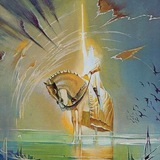
Charlemagne Discovers the Body of Roland
from the "Chanson de Roland"
Charlemagne Discovers the Body of Roland
from the "Chanson de Roland"
"Obtaining the sword or mending it means proving to be virtually qualified—or 'invested'—to be admitted to the vision of the Grail, to assume the power of the Stone of Light or Foundation Stone, and thus to resurrect the king and to restore the ravaged or deserted kingdom. A first test may fail, and the sword may break; then it is necessary to mend it by the Fountain. In that event, it is necessary to go again through a cycle of adventures whose meaning is best expressed by the symbolism of the previously mentioned Celtic legend, the key to which is the 'test of the fountain.' This legend resembles the test of the Chastel Marveil indicated by Kundry to those who have been at the Grail's castle without achieving the supreme goal.
The hero, to whom the sword has already been entrusted once, thereupon experiences an invincible nostalgia. Percival says: 'Whether close at hand or far away the hour in which I will again behold the Grail, until then I will not know joy. All my thoughts go to the Grail. Nothing will distract me from it until I live.' Little by little the hero will rise from the still passive and lunar quality, which is symbolized by the silver chess pieces, and will eventually attain the active and (in a transcendent sense) virile quality, proving worthy of it. It is a progressive growth, simultaneously Promethean and Olympian, along the way on which Heracles and Jacob, the winner of angels, won, but on which Lucifer, Prometheus, and Adam were vanquished. It is the same transformation indicated by the Hermetic ars regia with this formula: 'Our Work is the conversion and change of one being into another being, as from one thing into another thing, from debility to strength ... from corporeality to spirituality.'
Having accomplished this much, the regal crown of the Grail is acquired once and for all and the true Lord of the Two Swords is now awake and alive. Here a fundamental point must be remembered: in the theological-political literature, and especially the Ghibelline one dating from the time of the struggle for the investitures, the evangelical image of the two swords symbolized nothing else but the double power, namely, the political and the spiritual."
- Julius Evola, The Mystery of the Grail
The hero, to whom the sword has already been entrusted once, thereupon experiences an invincible nostalgia. Percival says: 'Whether close at hand or far away the hour in which I will again behold the Grail, until then I will not know joy. All my thoughts go to the Grail. Nothing will distract me from it until I live.' Little by little the hero will rise from the still passive and lunar quality, which is symbolized by the silver chess pieces, and will eventually attain the active and (in a transcendent sense) virile quality, proving worthy of it. It is a progressive growth, simultaneously Promethean and Olympian, along the way on which Heracles and Jacob, the winner of angels, won, but on which Lucifer, Prometheus, and Adam were vanquished. It is the same transformation indicated by the Hermetic ars regia with this formula: 'Our Work is the conversion and change of one being into another being, as from one thing into another thing, from debility to strength ... from corporeality to spirituality.'
Having accomplished this much, the regal crown of the Grail is acquired once and for all and the true Lord of the Two Swords is now awake and alive. Here a fundamental point must be remembered: in the theological-political literature, and especially the Ghibelline one dating from the time of the struggle for the investitures, the evangelical image of the two swords symbolized nothing else but the double power, namely, the political and the spiritual."
- Julius Evola, The Mystery of the Grail
An interesting way to look at the events and changes of Late Antiquity, but perhaps Evola can shed some better light on that tumultuous time and what happened at the meeting of German and Roman, pagan and Christian.
https://news.1rj.ru/str/Aryologia/2062
https://news.1rj.ru/str/Aryologia/2062
Telegram
Αρυολογία☀️ (The Indo-Europeans)
The above posts are from a paper which makes the observation that sun worship is relatively absent from Viking-age religion in Scandinavia, when compared with the archæological evidence for the Sun Cult of the Nordic Bronze Age. This relates to the post on…
"The inner decadence and finally the political collapse of the ancient Roman world represented the syncope of the attempt to shape the West according to the imperial symbol. The spread of Christianity, because of the particular type of dualism that it supported and because of its merely religious traditional character, rapidly led beyond the process of dissociation, up to the point at which, following the invasion of Nordic races, the medieval civilization developed and the symbol of the empire was resurrected. The Holy Roman Empire was both a restauratio and a continuatio, considering that its ultimate meaning—beyond any external appearance, compromise with contingent reality, and often limited awareness and various dignity of the individuals who represented its idea—was that of a renewal of the Roman movement toward an ecumenical 'solar' synthesis. This renewal, which logically implied the overcoming of Christianity, was therefore destined to clash with the hegemonistic claims of the Church of Rome. In fact, the Church of Rome could not acknowledge the Empire as a superior principle to that which she herself embodied; at her height, and in flagrant contradiction to her evangelical premises, she attempted to usurp the Empire's rights; thus arose the theocratic vision of Guelphism."
- Julius Evola, The Mystery of the Grail
- Julius Evola, The Mystery of the Grail
"Overall, according to the common perception (which, as a starting point, is correct), the medieval civilization was shaped by three elements: Northern-pagan, Christian, and Roman. The first played a decisive role in regard to ethics, lifestyle, and social structure. The feudal regime, the knightly morals, the civilization of the courts, the original substance that engendered the crusading spirit are inconceivable without a reference to Nordic-pagan blood and spirit. But while the races that descended upon Rome from the North should not be considered 'barbarian' from this perspective (since it seems to me that they carried along values that were superior to those of a civilization that was already decayed in its principles and in its people), we can still talk of a certain barbarism, which does not mean primitivity but rather involution, in specific regard to their spiritual traditions. I have already mentioned the existence of a primordial Nordic-Hyperborean tradition. In the peoples living at the time of the invasions we can find only fragmentary echoes and obscure memories of such a tradition, which leave a wide margin to popular legends and to superstition. In any event, these memories were such that forms of a tough, warlike, and rough-hewn life prevailed over everything spiritual. The Nordic-Germanic traditions of the time, which were largely constituted by the Eddas, retained slight residues whose vital possibilities appear to have been exhausted and in which little was left of the wide scope and metaphysical tension that were proper to the great cycles of the primordial tradition."
- Julius Evola, The Mystery of the Grail
- Julius Evola, The Mystery of the Grail
"Thus we may speak of a state of an involutive latency of the Nordic tradition. But as soon as contact with Christianity and with the symbol of Rome occurred, a different condition ensued; this contact had a galvanizing effect. In spite of everything, Christianity revived the generic sense of a supernatural transcendence. The Roman symbol offered the idea of a universal regnum, of an aeternitas carried by an imperial power. All this integrated the Nordic substance and provided superior reference points to its warrior ethos, so much as to gradually usher in one of those cycles of restoration that I have labeled 'heroic' in a special sense. And so, from the type of the mere warrior the figure of the knight arose; the ancient Germanic traditions of war waged in function of Valhalla developed into the supranational epic of the 'holy war' or crusade; a shift occurred from the type of the prince of a particular race to the type of the sacred and ecumenical emperor, who claimed that the principle of his power had a character and an origin no less supernatural and transcendent than that of the Church.
This true renaissance, however, this grandiose development and wonderful transformation of forces, required an ultimate reference point, a supreme center of crystallization higher than the Christian though Romanized ideal, and higher than the external and merely political idea of the Empire. This supreme point of integration was manifested precisely in the myth of the Grail's regality, according to the intimate relation it had with the several variations of the 'imperial saga.' The silent problem of the Ghibelline Middle Ages was expressed in the fundamental theme of that cycle of legends: the need for a hero of the two swords, who overcomes natural and supernatural tests, to really ask the question: the question that avenges and heals, the question that restores power to its regality.
The Middle Ages awaited the hero of the Grail, so that the head of the Holy Roman Empire could become an image or a manifestation of the Universal Ruler; so that all the forces could receive a new power; so that the Dry Tree could blossom again; so that an absolute driving force could arise to overcome any usurpation, antagonism, laceration; so that a real solar order could be formed; so that the invisible emperor could also be the manifest one; and finally, so that the 'Middle Age' (medium aeveum) could also have the meaning of an 'Age of the Center.'"
- Julius Evola, The Mystery of the Grail
This true renaissance, however, this grandiose development and wonderful transformation of forces, required an ultimate reference point, a supreme center of crystallization higher than the Christian though Romanized ideal, and higher than the external and merely political idea of the Empire. This supreme point of integration was manifested precisely in the myth of the Grail's regality, according to the intimate relation it had with the several variations of the 'imperial saga.' The silent problem of the Ghibelline Middle Ages was expressed in the fundamental theme of that cycle of legends: the need for a hero of the two swords, who overcomes natural and supernatural tests, to really ask the question: the question that avenges and heals, the question that restores power to its regality.
The Middle Ages awaited the hero of the Grail, so that the head of the Holy Roman Empire could become an image or a manifestation of the Universal Ruler; so that all the forces could receive a new power; so that the Dry Tree could blossom again; so that an absolute driving force could arise to overcome any usurpation, antagonism, laceration; so that a real solar order could be formed; so that the invisible emperor could also be the manifest one; and finally, so that the 'Middle Age' (medium aeveum) could also have the meaning of an 'Age of the Center.'"
- Julius Evola, The Mystery of the Grail
👍3
Forwarded from Ghost of de Maistre
"Consider ye the seed from which ye sprang;
Ye were not made to live like unto brutes,
But for pursuit of virtue and of knowledge." - Dante's Inferno, Canto XXVI
Ye were not made to live like unto brutes,
But for pursuit of virtue and of knowledge." - Dante's Inferno, Canto XXVI
Forwarded from Sagittarius Granorum (Sagittarius Hyperboreius)
"The foundation of the imperial hierarchy must be based on knowledge: “The wise should govern”, Plato already said - and this is a central, absolute, definitive point in every rational order of things. But nothing would be more ridiculous than to associate this knowledge with some technical competence, positive science, or philosophising speculation: instead, it coincides with what, from the outset, we have called Wisdom, a traditional expression used by both the classical West and the East. Wisdom is as much aristocratic, individual, real, substantial, organic, and qualitative, as the knowledge of the “civilised” is democratic, social, universalistic, abstract, levelling, and quantitative. Here again, there are two worlds, two eyes, two different visions, opposed against each other without any abatement." — Julius C. Evola, Pagan Imperialism.
👍2
Forwarded from Modern Kshatriya
Evola is certainly a gateway into understanding reality on its own terms, without the conditioning that modernity imposes upon the mind. In many ways, reading Evola can be a catalyst for transformation, the type of transformation that takes us from the post-Enlightenment condition to the porous type of being Charles Taylor discusses in A Secular Age, where the Universe and the individual are one and the same, where the Universe and all it contains, including the Gods, can enter the porous self, where there is no sharp distinction between inner and outer, what is in the “mind” and what is out there in the world.
🔥2
Forwarded from The Apollonian
Apollo Slaying the Python by Howard Pyle, illustration for James Baldwin’s A Story of the Golden Age (1887)
Forwarded from The Apollonian
The Apollonian
Apollo Slaying the Python by Howard Pyle, illustration for James Baldwin’s A Story of the Golden Age (1887)
“And Apollo was pleased with the place which he had chosen for a home; for here were peace and quiet, and neither the hum of labor nor the din of battle would be likely ever to enter. Yet there was one thing to be done before he could have perfect rest. There lived near the foot of the mountain a huge serpent called Python, which was the terror of all the land. Oftentimes, coming out of his den, this monster attacked the flocks and herds, and sometimes even their keepers; and he had been known to carry little children and helpless women to his den, and there devour them. The men of Delphi came one day to Apollo, and prayed him to drive out or destroy their terrible enemy. So, taking in hand his silver bow, he sallied out at break of day to meet the monster when he should issue from his slimy cave. The vile creature shrank back when he saw the radiant god before him, and would fain have hidden himself in the deep gorges of the mountain. But Apollo quickly launched a swift arrow at him, crying, ‘Thou bane of man, lie thou upon the earth, and enrich it with thy dead body!’ And the never-erring arrow sped to the mark; and the great beast died, wallowing in his gore. And the people in their joy came out to meet the archer, singing pæans in his praise; and they crowned him with wild flowers and wreaths of olives, and hailed him as the Pythian king; and the nightingales sang to him in the groves, and the swallows and cicadas twittered and tuned their melodies in harmony with his lyre.”
❤1
Forwarded from Orphic Inscendence (Naida)
"For now we see only a reflection as in a mirror; then we shall see face to face. Now I know in part; then I shall know fully, even as I am fully known."
- Corinthians
- Corinthians
🔥2
Forwarded from Dead channel 3
"One must here come to a transformed knowing, and this unknowing [unwizzen] must not come from ignorance [unwizzenne]; rather, from knowing one must come into an unknowing. Then, we will become knowing with divine knowing and then our unknowing will be ennobled and clothed with supernatural knowing. And here, in that we are in a [state of] receiving, we are more perfect than if we were active."
Meister Eckhart
Meister Eckhart
Forwarded from Modern Kshatriya
In the inner realm it is a question of knowing what “blows to one’s own self” may result from certain behaviors, and of acting accordingly, with the same objectivity. The “sin” complex is a pathological formation born under the sign of the personal God, the “God of morality.”
- Julius Evola
The idea of sin / being in a state of sin is adharmic (not dharmic in nature). There are only the actions that have utility towards our freedom from ignorance, or those that deepen our ignorance. Nietzsche was right in affirming the death of God. That is, the "God of morality", and more, the God of petty bourgeois morality.
The meditation for today is regarding my own relationship with sin. Do I consider myself to be in a state of sin, to have sinned, or to merely be at fault? Can I detach myself from my actions and the fruits thereof? Can I retain complete calm in all situations, even where I have done something comepletely at fault? Do my actions spring from a central, transcendent and completely unified Self - my atman?
In short, do I have the will of the Samurai to draw my sword and cut down my enemy with sudden violence, and once sheathed, leave no remaining mark of "myself" on the act, no idea of having sinned or acted justly, since the act sprung fourth from that deep well of Self?
- Julius Evola
The idea of sin / being in a state of sin is adharmic (not dharmic in nature). There are only the actions that have utility towards our freedom from ignorance, or those that deepen our ignorance. Nietzsche was right in affirming the death of God. That is, the "God of morality", and more, the God of petty bourgeois morality.
The meditation for today is regarding my own relationship with sin. Do I consider myself to be in a state of sin, to have sinned, or to merely be at fault? Can I detach myself from my actions and the fruits thereof? Can I retain complete calm in all situations, even where I have done something comepletely at fault? Do my actions spring from a central, transcendent and completely unified Self - my atman?
In short, do I have the will of the Samurai to draw my sword and cut down my enemy with sudden violence, and once sheathed, leave no remaining mark of "myself" on the act, no idea of having sinned or acted justly, since the act sprung fourth from that deep well of Self?
🔥3👎1
Forwarded from Modern Kshatriya
Transcendence, like freedom, ought to furnish existence with a foundation of calm and incomparable security, with a purity, a wholeness, and an absolute decisiveness in action. Instead, it feeds all the emotional complexes of the man in crisis: angst, nausea, disquiet, finding his own being problematical, the feeling of an obscure guilt or fall, deracination, a feeling of the absurd and the irrational, an unadmitted solitude (though some, like Marcel, fully admit it), an invocation of the “incarnate spirit,” the weight of an incomprehensible responsibility—incomprehensible, because he cannot resort to overtly religious (and hence coherent) positions like those of Kierkegaard or Barth, where angst refers to the sentiment of the soul that is alone, fallen, and abandoned to itself in the presence of God. In all of this, feelings appear like those that Nietzsche warned about in the case of a man who has made himself free without having the necessary stature: feelings that kill and shatter a man—modern man—if he is incapable of killing them.
🔥3👎1
Forwarded from Modern Kshatriya
On Nature: Apart from that position, which leads to the “animal ideal” and modern naturalism, I deplore the general confusion of a “return to origins” with a return to Mother Earth and even to Nature. Although it has often been misapplied, that theological doctrine that holds that a purely natural state for man has never existed is still legitimate; at the beginning he was placed in a supranatural state from which he has now fallen. In fact, for the true type of man, it can never be a question of those origins and that “mother” wherein the individual cannot differentiate himself from his fellow men, or even from the animals. Every return to nature is a regressive phenomenon, including any protest in the name of instinctual rights, the unconscious, the flesh, life uninhibited by the intellect, and so forth. The man who becomes “natural” in this way has in reality become denatured.
🔥2
Forwarded from Modern Kshatriya
As for the “sentiment of nature,” in general, the human type that concerns us must consider nature as part of a larger and more objective whole: nature for him includes countrysides, mountains, forests, and seacoasts, but also dams, turbines, and foundries, the tentacular system of ladders and cranes of a great modern port or a complex of functional skyscrapers. This is the space for a higher freedom. He remains free and self-aware before both types of nature—being no less secure in the middle of a steppe or on an alpine peak than amid Western city nightlife.
🔥3👍1
Forwarded from Modern Kshatriya
The ancient Aryan world was ordered by natural hierarchy. The very top of this hierarchy was the Aryan seer. The seer was a higher order of being, whose consciousness extended throughout the many realms of cosmic existence. Having reached heaven, they were able to purely enjoy the pleasures of the earth. Their creative powers manifested, yet they remained humble, impartially providing their knowledge for the benefit of all. These seers were our spiritual fathers, the builders of civilization, they were the Brahamanas, Druids, and Magi, and the castes whose dharma it was (and still is) to traverse the spiritual roads towards enlightenment and self-realization. Upholding their inner spiritual values, which were embodied in the Solar Religion, harmony and Truth could reign on earth.
To the ancient seers, all life was good and all creation was beneficent. The ignorance and darkness we experience in materiality was viewed as a daring adventure for the spirit. The atman's assumption of a form in materiality was not just a covering, but a free expression of the formless being.
We can, and must, re-capture the spirit of the Solar religion and become those seers who lived in a time when the gods were present and manifested both externally and internally, to live in a time when the first day of creation is an eternal moment, where creation itself puts to rest the doubt of illusion.
To the ancient seers, all life was good and all creation was beneficent. The ignorance and darkness we experience in materiality was viewed as a daring adventure for the spirit. The atman's assumption of a form in materiality was not just a covering, but a free expression of the formless being.
We can, and must, re-capture the spirit of the Solar religion and become those seers who lived in a time when the gods were present and manifested both externally and internally, to live in a time when the first day of creation is an eternal moment, where creation itself puts to rest the doubt of illusion.
🔥5👎1
Forwarded from Archive
We tirelessly and uncompromisingly oppose the decline in the spiritual level, which has become a habit of modern man. We resist the loss of all higher meaning in life, materialization, socialization and standardization, to which everything is subordinated. We want to be a threat, a challenge and an accusation to everything that is weak, compromises and enslaved by public opinion and petty adaptations to the current moment. We express our unshakable protest against the tyranny of everything economic and social, which impudently permeates everything around and against the relegation of any lofty worldview to the level of an insignificant humanism.
Julius Evola. Tower magazine (1929).
Julius Evola. Tower magazine (1929).
👍2
🔱 𝐗𝐄𝐍𝐎𝐒 🌲
”We only have one life, and youth is brief. To be healthy without trying to run faster and longer, or harden one’s muscles, is to squander a chance to be more than one is; to miss the unique joy of striving, however painful.” — Xenophon.
To be healthy without trying to contemplate deeper depths and greater abstractions, or to sharpen one's focus, is to squander a chance to be more than one is; to miss the unique joy of thinking, however painful.
🔥6👍3