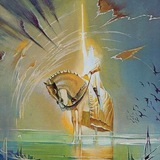
Trying to find meaning in the duality of the titans and gods within a modern understanding leads to certain errors.
First, it must be remembered that the traditional view is one of an eternal reality lacking the modern notion of a linear progression. Therefore the Greeks' theogeny does not tell a story of successive generations each replacing the last, but explains the principles which wax and wane in a cyclical fashion. Chronos/Saturn as King of the Primordial empire does not make the Golden Age defined by titanism but rather one ruled by a titan who mirrors the order established by his father Uranus. For Zeus to later defeat Chronos and establish the rule of the Olympians is the same phenomenon (thus Apollo now rules primordial Hyperborea).
Second is the consequential moral judgement linking all titans to the 'titanism' symbolic of their corrupted state. For Chronos to usurp Uranus only to be usurped himself does not represent a moral cause being progressively realized but the assertion and re-assertion of the same principle of Uranic, Solar order. The titans are then not a damned generation defined by an inherent corruption, but one part of a whole. The relationship between the titans and gods is not unlike that of the so-called Apollonian and Dionysian duality. One is not ultimately preeminent over the other, even if one rules over the other in a particular point of the cycle.
Lastly then, on the other hand, the Olympian symbol is itself not a perfected form. The Olympian hero is as much a hero as that of the titanic or 'Luciferian' (or Promethean) hero. A beggar cannot become a King simply by killing one and wearing his crown; a King is only ordained from above by God. That Chronos is King of the Golden Age is thus no mistake on the part of God and a hint towards the power to be found in the titanic symbol. Zeus' reign in this age too is no mistake. Therefore in this age defined by its defeat of titanism, the path of Olympian heroism represents the renewal of this victory over titanic corruption and acts to actualize the Uranic order that has ordained the Olympians. However, it may be good to remember that the Olympian principle is not self-sustaining and contains a propensity for its own faults, perhaps those that Nietzsche saw in his 'Apollonian' principle.
In the end there are higher principles to be found in the relationships within these supposed dualities. Titan and god are unified under the Uranic order which both express.
First, it must be remembered that the traditional view is one of an eternal reality lacking the modern notion of a linear progression. Therefore the Greeks' theogeny does not tell a story of successive generations each replacing the last, but explains the principles which wax and wane in a cyclical fashion. Chronos/Saturn as King of the Primordial empire does not make the Golden Age defined by titanism but rather one ruled by a titan who mirrors the order established by his father Uranus. For Zeus to later defeat Chronos and establish the rule of the Olympians is the same phenomenon (thus Apollo now rules primordial Hyperborea).
Second is the consequential moral judgement linking all titans to the 'titanism' symbolic of their corrupted state. For Chronos to usurp Uranus only to be usurped himself does not represent a moral cause being progressively realized but the assertion and re-assertion of the same principle of Uranic, Solar order. The titans are then not a damned generation defined by an inherent corruption, but one part of a whole. The relationship between the titans and gods is not unlike that of the so-called Apollonian and Dionysian duality. One is not ultimately preeminent over the other, even if one rules over the other in a particular point of the cycle.
Lastly then, on the other hand, the Olympian symbol is itself not a perfected form. The Olympian hero is as much a hero as that of the titanic or 'Luciferian' (or Promethean) hero. A beggar cannot become a King simply by killing one and wearing his crown; a King is only ordained from above by God. That Chronos is King of the Golden Age is thus no mistake on the part of God and a hint towards the power to be found in the titanic symbol. Zeus' reign in this age too is no mistake. Therefore in this age defined by its defeat of titanism, the path of Olympian heroism represents the renewal of this victory over titanic corruption and acts to actualize the Uranic order that has ordained the Olympians. However, it may be good to remember that the Olympian principle is not self-sustaining and contains a propensity for its own faults, perhaps those that Nietzsche saw in his 'Apollonian' principle.
In the end there are higher principles to be found in the relationships within these supposed dualities. Titan and god are unified under the Uranic order which both express.
🔥4
Forwarded from Sagittarius Granorum (Sagittarius Hyperboreius)
Forwarded from Traditionalism & Metaphysics
Leo X's pet elephant Hanno, 1514/16, after a lost drawing by Raffael
Under his pontificate, Latin Christianity assumed a pagan, Greco-Roman character, which, passing from art into manners, gives to this epoch a strange complexion. Crimes for the moment disappeared, to give place to vices; but to charming vices, vices in good taste, such as those indulged in by Alcibiades and sung by Catullus. - Alexandre Dumas
David Hume, while claiming that Leo was too intelligent to believe in Catholic doctrine, conceded that he was "one of the most illustrious princes that ever sat on the papal throne. Humane, beneficent, generous, affable; the patron of every art, and friend of every virtue".
Martin Luther himself testified:
Indeed, the published opinion of so many great men and the repute of your blameless life are too widely famed and too much reverenced throughout the world to be assailed by any man, of however great name, or by any arts. I am not so foolish to attack one whom everybody praises ...
Under his pontificate, Latin Christianity assumed a pagan, Greco-Roman character, which, passing from art into manners, gives to this epoch a strange complexion. Crimes for the moment disappeared, to give place to vices; but to charming vices, vices in good taste, such as those indulged in by Alcibiades and sung by Catullus. - Alexandre Dumas
David Hume, while claiming that Leo was too intelligent to believe in Catholic doctrine, conceded that he was "one of the most illustrious princes that ever sat on the papal throne. Humane, beneficent, generous, affable; the patron of every art, and friend of every virtue".
Martin Luther himself testified:
Indeed, the published opinion of so many great men and the repute of your blameless life are too widely famed and too much reverenced throughout the world to be assailed by any man, of however great name, or by any arts. I am not so foolish to attack one whom everybody praises ...
Forwarded from Traditionalism & Metaphysics
'Sir,' saith the hermit to Messire Gawain, 'The damsel will say her pleasure. May God defend King Arthur, for his father made me knight. Now am I priest, and in this hermitage ever sithence that I came hither have I served King Fisherman by the will of Our Lord and His commandment, and all they that serve him do well partake of his reward, for the place of his most holy service is a refuge so sweet that unto him that hath been there a year, it seemeth to have been but a month for the holiness of the place and of himself, and for the sweetness of his castle wherein have I oftentimes done service in the chapel where the Holy Graal appeareth. Therefore is it that I and all that serve him are so youthful of seeming.' 'Sir,' saith Messire Gawain, 'By what way may a man go to his castle?' 'Sir,' saith the hermit, 'None may teach you the way, save the will of God lead you therein. And would you fain go thither?' 'Sir,' saith Messire Gawain, 'It is the most wish that I have.' 'Sir,' saith the hermit, 'Now God give you grace and courage to the question that the others to whom the Graal hath appeared would ask not, whereof have many mischances sithence befallen much people.' ~ The High History of the Holy Graal
Forwarded from The Exaltation of Beauty
Le_Chevalier_aux_Fleurs_2560x1600.png
8.8 MB
When Parsifal has overcome Klingsor’s knights and put them to flight, he strays into the Flowermaiden garden. Klingsor calls on the seductive sorceress Kundry to seek young Parsifal out and seduce him. Parsifal then finds himself in a beautiful garden, full of flowers, and surrounded by the beautiful and seductive Flowermaidens. They call him and entwine their bodies around him in their efforts to seduce him, but he resists their temptations and remains chaste.
Rochegrosse shows this event in an unusual mixture of styles, with which he felt he expressed the central idea of the scene, that of Parsifal resisting temptation by being “obsessed with the ideal”. There are elements of symbolism in pictorial elements, but the whole painting is realist, with some Impressionist effects in the garden and landscape.
From eclecticlight.co
Rochegrosse shows this event in an unusual mixture of styles, with which he felt he expressed the central idea of the scene, that of Parsifal resisting temptation by being “obsessed with the ideal”. There are elements of symbolism in pictorial elements, but the whole painting is realist, with some Impressionist effects in the garden and landscape.
From eclecticlight.co
Christianity is too often considered to have caused the death of Rome when in reality it was responsible for doubling its lifespan—and this isn't referring to the Eastern Roman Empire, but the Holy Roman Empire. The ideal of Rome, the one which functioned as a sacred center towards which many iterations of the empire (some simultaneously) oriented and structured themselves, was practically seamlessly adopted by the Goths who invaded the Western Empire and the later Merovingian Franks and then the Carolingians who created the Holy Roman Empire in that sacred image of Rome. It is the very preservation of the essential Romanity which afforded the Middle Ages their greatness, and Christianity was central to this phenomenon. Christianity converted the Germanic tribes into Roman Empires.
👍16👎12❤2🔥1😁1
Forwarded from The Classical Wisdom Tradition
The philosophy I speak of is not the one which takes the citizen out of public life and the gods out of the world we live in, and hands morality over to pleasure, but the philosophy which thinks nothing good unless it is honorable, which is incapable of being enticed astray by the rewards of men or fortune, and the very pricelessness of which lies in the fact that it cannot be bought at any price.
Seneca, Letter 90
Seneca, Letter 90
🔥1
Fixed Centre Art
Photo
There is a misconception that so-called Dionysian art is truer art since its supposed irrationality imparts a 'life-affirming' character to the art which is seen as an inherently good thing. If you refer back to our post on the Titanic/Olympian duality, you might see how it is unwise to focus on only one side of such an illusory division in which both sides are pointing to the same transcendent ideal.
👍4
Forwarded from The Exaltation of Beauty
"All art is in its origin essentially symbolical and ritual, and only through a late degeneration, indeed a very recent degeneration, has it lost its sacred character so as to become at last the purely profane 'recreation' to which it has been reduced among our contemporaries."
~René Guénon
~René Guénon
👍5🔥2
Forwarded from The Apollonian
The happiness of your life depends upon the quality of your thoughts: therefore, guard accordingly, and take care that you entertain no notions unsuitable to virtue and reasonable nature.
Marcus Aurelius
Marcus Aurelius
👍2
Forwarded from The Classical Wisdom Tradition
An Athenian prayer: "Rain, Zeus, please. Rain on the farmland and the fields of the Athenians." That's how to pray, simply and in a spirit of self-reliance; otherwise, one shouldn't pray at all.
Marcus Aurelius, Meditations 5.7
Marcus Aurelius, Meditations 5.7
😁1👌1
Forwarded from Ghost of de Maistre
"The first invention of psychologism must be attributed to Luther instead of to Descartes. The heresiarch threw the fatal seed, which the French philosopher explicated. Luther substituted the psychological method to the ontological one in religion. Descartes applied this innovation to philosophy in particular and through it to all the knowable. The first cut the thread of religious tradition, the second put aside even the scientific tradition."
~ 𝑰𝒏𝒕𝒓𝒐𝒅𝒖𝒄𝒕𝒊𝒐𝒏 𝒕𝒐 𝒕𝒉𝒆 𝑺𝒕𝒖𝒅𝒚 𝒐𝒇 𝑷𝒉𝒊𝒍𝒐𝒔𝒐𝒑𝒉𝒚, 𝒃𝒚 𝑽𝒊𝒏𝒄𝒆𝒏𝒛𝒐 𝑮𝒊𝒐𝒃𝒆𝒓𝒕𝒊
~ 𝑰𝒏𝒕𝒓𝒐𝒅𝒖𝒄𝒕𝒊𝒐𝒏 𝒕𝒐 𝒕𝒉𝒆 𝑺𝒕𝒖𝒅𝒚 𝒐𝒇 𝑷𝒉𝒊𝒍𝒐𝒔𝒐𝒑𝒉𝒚, 𝒃𝒚 𝑽𝒊𝒏𝒄𝒆𝒏𝒛𝒐 𝑮𝒊𝒐𝒃𝒆𝒓𝒕𝒊
Forwarded from The Cinnabar Library (Sagittarius Hyperboreius)
Sailing as a Heroic Symbol - Julius C. Evola.pdf
133.2 KB
Sailing as a Heroic Symbol, written by Julius C. Evola.
Forwarded from Ghost of de Maistre
"Agarttha, it is said, was not in fact always underground, and will not always remain so. According to Ossendowski’s report, a time will come when ‘the peoples of Agharti will come up from their subterranean caverns to the surface of the earth.’" - René Guénon, "King of the World"
👍6