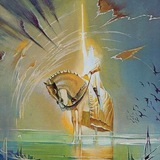
¹ Now hear, O son of Prtha [Arjuna], how by practicing yoga in full consciousness of Me, with mind attached to Me, you can know Me in full, free from doubt.
² I shall now declare unto you in full this knowledge both phenomenal and noumenal, by knowing which there shall remain nothing further to be known.
³ Out of many thousands among men, one may endeavor for perfection, and of those who have achieved perfection, hardly one knows Me in truth.
⁴ Earth, water, fire, air, ether, mind, intelligence and false ego—altogether these eight comprise My separated material energies.
⁵ Besides this inferior nature, O mighty-armed Arjuna, there is a superior energy of Mine, which are all living entities who are struggling with material nature and are sustaining the universe.
⁶ Of all that is material and all that is spiritual in this world, know for certain that I am both its origin and dissolution.
⁷ O conquerer of wealth [Arjuna], there is no Truth superior to Me. Everything rests upon Me, as pearls are strung on a thread.
- Bhagavad Gita Chapter 7
² I shall now declare unto you in full this knowledge both phenomenal and noumenal, by knowing which there shall remain nothing further to be known.
³ Out of many thousands among men, one may endeavor for perfection, and of those who have achieved perfection, hardly one knows Me in truth.
⁴ Earth, water, fire, air, ether, mind, intelligence and false ego—altogether these eight comprise My separated material energies.
⁵ Besides this inferior nature, O mighty-armed Arjuna, there is a superior energy of Mine, which are all living entities who are struggling with material nature and are sustaining the universe.
⁶ Of all that is material and all that is spiritual in this world, know for certain that I am both its origin and dissolution.
⁷ O conquerer of wealth [Arjuna], there is no Truth superior to Me. Everything rests upon Me, as pearls are strung on a thread.
- Bhagavad Gita Chapter 7
👍3🔥1
Forwarded from Diary of an Underground Ronin
“We cannot permit ourselves to be tired. Danger is knocking at the door.”
— Oswald Spengler
— Oswald Spengler
Forwarded from Ghost of de Maistre
"Mind is the highest exercise of our cognitive power by which we are able to know purely intelligible things: that is, realities that cannot be known by the senses directly. It is through mind that one can even come to knowledge of God. When the mind is directed toward God as its object it is called "intellect" and the truth discovered is called wisdom. Directed toward anything less than God, it is called "reason" and the truth discovered is called science."
~ 𝑶𝒏 𝑪𝒉𝒓𝒊𝒔𝒕𝒊𝒂𝒏 𝑫𝒐𝒄𝒕𝒓𝒊𝒏𝒆, 𝒃𝒚 𝑺𝒕. 𝑨𝒖𝒈𝒖𝒔𝒕𝒊𝒏𝒆 𝒐𝒇 𝑯𝒊𝒑𝒑𝒐
~ 𝑶𝒏 𝑪𝒉𝒓𝒊𝒔𝒕𝒊𝒂𝒏 𝑫𝒐𝒄𝒕𝒓𝒊𝒏𝒆, 𝒃𝒚 𝑺𝒕. 𝑨𝒖𝒈𝒖𝒔𝒕𝒊𝒏𝒆 𝒐𝒇 𝑯𝒊𝒑𝒑𝒐
¹ Arjuna said: O Janardana, O Kesava, why do You urge me to engage in this ghastly warfare, if You think that intelligence is better than fruitive work?
² My intelligence is bewildered by Your equivocal instructions. Therefore, please tell me decisively what is most beneficial for me.
³ The Blessed Lord said: O sinless Arjuna, I have already explained that there are two classes of men who realize the Self. Some are inclined to understand Him by empirical, philosophical speculation, and others are inclined to know Him by devotional work.
⁴ Not by merely abstaining from work can one achieve freedom from reaction, nor by renunciation alone can one attain perfection.
⁵ All men are forced to act helplessly according to the impulses born of the modes of material nature; therefore no one can refrain from doing something, not even for a moment.
⁶ One who restrains the senses and organs of action, but whose mind dwells on sense objects, certainly deludes himself and is called a pretender.
⁷ On the other hand, he who controls the senses by the mind and engages his active organs in works of devotion, without attachment, is by far superior.
⁸ Perform your prescribed duty, for action is better than inaction. A man cannot even maintain his physical body without work.
- Bhagavad Gita Chapter 3
² My intelligence is bewildered by Your equivocal instructions. Therefore, please tell me decisively what is most beneficial for me.
³ The Blessed Lord said: O sinless Arjuna, I have already explained that there are two classes of men who realize the Self. Some are inclined to understand Him by empirical, philosophical speculation, and others are inclined to know Him by devotional work.
⁴ Not by merely abstaining from work can one achieve freedom from reaction, nor by renunciation alone can one attain perfection.
⁵ All men are forced to act helplessly according to the impulses born of the modes of material nature; therefore no one can refrain from doing something, not even for a moment.
⁶ One who restrains the senses and organs of action, but whose mind dwells on sense objects, certainly deludes himself and is called a pretender.
⁷ On the other hand, he who controls the senses by the mind and engages his active organs in works of devotion, without attachment, is by far superior.
⁸ Perform your prescribed duty, for action is better than inaction. A man cannot even maintain his physical body without work.
- Bhagavad Gita Chapter 3
[Enter POSEIDON]POSEIDON: Lo! From the depths of salt Aegean floods I, Poseidon, come, where choirs of Nereids trip in the mazes of the graceful dance; for since the day that Phoebus and myself with measurement exact set towers of stone about this land of Troy and ringed it round, never from my heart hath passed away a kindly feeling for my Phrygian town, which now is smouldering and o'erthrown, a prey to Argive prowess. For, from his home beneath Parnassus, Phocian Epeus, aided by the craft of Pallas, framed a horse to bear within its womb an armed host, and sent it within the battlements, fraught with death; whence in days to come men shall tell of 'the wooden horse,' with its hidden load of warriors. Groves forsaken stand and temples of the gods run down with blood, and at the altar's very base, before the god who watched his home, lies Priam dead. ... Farewell, O city prosperous once! farewell, ye ramparts of hewn stone! had not Pallas, daughter of Zeus, decreed thy ruin, thou wert standing firmly still.
[Enter ATHENA]ATHENA: May I address the mighty god whom Heaven reveres and who to my own sire is very nigh in blood, laying aside our former enmity?
POSEIDON: Thou mayst; for o'er the soul the ties of kin exert no feeble spell, great queen Athena.
...
ATHENA: I wish to give my former foes, the Trojans, joy, and on the Achaean host impose a return that they will rue.
POSEIDON: Why leap'st thou thus from mood to mood? Thy love and hate both go too far, on whomsoever centred.
ATHENA: Dost not know the insult done to me and to the shrine I love?
POSEIDON: Surely, in the hour that Aias tore Cassandra thence.
ATHENA: Yea, and the Achaeans did naught, said naught to him.
...
ATHENA: When they have set sail from Ilium for their homes. On them will Zeus also send his rain and fearful hail, and inky tempests from the sky; yea, and he promises to grant me his levin-bolts to hurl on the Achaeans and fire their ships. And do thou, for thy part, make the Aegean strait to roar with mighty billows and whirlpools, and fill Euboea's hollow bay with corpses, that Achaeans may learn henceforth to reverence my temples and regard all other deities.
POSEIDON: So shall it be, for the boon thou cravest needs but few words. I will vex the broad Aegean sea; and the beach of Myconus and the reefs round Delos, Scyros and Lemnos too, and the cliffs of Caphareus shall be strown with many a corpse. Mount thou to Olympus, and taking from thy father's hand his lightning bolts, keep careful watch against the hour when Argos' host lets slip its cables. A fool is he who sacks the towns of men, with shrines and tombs, the dead man's hallowed home, for at the last he makes a desert round himself, and dies.
- Prologue to Trojan Women, Euripides
Forwarded from Gemeinschaft der Eigenen (☠ Lain_OS ᛇ)
YouTube
Meister Eckhart - The Aristocrat
Meister Eckhart's treatise on the God-filled man, or Aristocrat, exploring the restoration of human integrity after the fall of Adam & Eve.
Forwarded from Sagittarius Granorum (Sagittarius Hyperboreius)
Suggestions On Luther and Nietzsche.
Luther and Nietzsche are two personalities not often compared, indeed some would say that they are almost opposites typologically speaking, however in essence and in mythical or symbolic proportion we would instead argue that they are almost identical.
There is something of the Promethean in the character of both, although they express it very differently. Both express, though Luther did it almost entirely differently from Nietzsche, one might say that he emphasized the negative values, a kind of profound and anarchic exhaltation of the human dignity.
In other words, both Nietzsche and Luther represent what you might call humanist prophets. Even though they both seemingly contradict Humanist ethics at first glance, especially Luther due to his heretical theological disposition and evasive religious tendency, both men in reality serve the wider humanistic purpose of "alienating man from heaven with the excuse of conquering the earthly domain."
This is not to condemn either man, however. We are of the firm belief that Luther is probably the only Lutheran that there has ever been, if you will excuse the revisionism, much as we believe that there have only ever been a very select number of Nietzscheans (Ernst Jünger being perhaps the one who best deserves the noscript of "Nietzsche's Disciple"). These men are damned saints, to borrow an expression of the past, and thus they are akin to the very Prometheus referenced in the beginning, on which their characters are so clearly molded, in that they await the coming of Herakles, who shall free them of their bonds, heal their wounds, and enter the mighty hero's service.
Luther and Nietzsche are two personalities not often compared, indeed some would say that they are almost opposites typologically speaking, however in essence and in mythical or symbolic proportion we would instead argue that they are almost identical.
There is something of the Promethean in the character of both, although they express it very differently. Both express, though Luther did it almost entirely differently from Nietzsche, one might say that he emphasized the negative values, a kind of profound and anarchic exhaltation of the human dignity.
In other words, both Nietzsche and Luther represent what you might call humanist prophets. Even though they both seemingly contradict Humanist ethics at first glance, especially Luther due to his heretical theological disposition and evasive religious tendency, both men in reality serve the wider humanistic purpose of "alienating man from heaven with the excuse of conquering the earthly domain."
This is not to condemn either man, however. We are of the firm belief that Luther is probably the only Lutheran that there has ever been, if you will excuse the revisionism, much as we believe that there have only ever been a very select number of Nietzscheans (Ernst Jünger being perhaps the one who best deserves the noscript of "Nietzsche's Disciple"). These men are damned saints, to borrow an expression of the past, and thus they are akin to the very Prometheus referenced in the beginning, on which their characters are so clearly molded, in that they await the coming of Herakles, who shall free them of their bonds, heal their wounds, and enter the mighty hero's service.
Forwarded from Sagittarius Granorum (Sagittarius Hyperboreius)
on-fairy-stories1.pdf
547.7 KB
Forwarded from Sagittarius Granorum (Sagittarius Hyperboreius)
LEAF-BY-NIGGLE.pdf
113.7 KB