Forwarded from Quantus tremor est futurus - Actaeon Journal
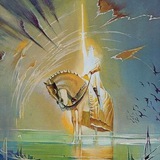
The Minotaur is a figure born of woman and a metal-ribbed bull, much like the mechanical giant Talos. Another related figure is Perdix, who surpasses Daedalus in technical mastery, is pushed off a tower by him and saved by Athena – turned into a partridge, the simplest of ground birds. It is significant that in the technological myth there are extremes of brutality and open spaces, the labyrinth and the void. In this we see that the rational and irrational may be wrapped up in a single form, that the dionysian can give rise to the apollonian, the titanic the olympian. Oftentimes a mythic figure achieves its true form only through the agony of struggle with its opponent – one overwhelms the other and even surpasses its dominion. Zeus becomes the god of time and metaphophosis through his contests, just as the giants are enslaved to the creation of mechanised monsters and automatons. The mechanical world is revealed as the master of the irrational, as seen in Talos, the Minotaur, and the great Briareus Archimedes, who horrified the Romans with his gigantic war machines.
The portal can be a gate to the heavens or the underworld. It appears fantastically at times, or is constructed through the gift of the intellect. In Pasiphaë, who mates with the Cretan Bull, creation and technical force are united in the utmost devastation. An irrational will and a rational intellect form the whole shape of the portal – the will is simply hidden, less known. The Cretan Bull is snow-white, related to the Trick of Mecone and also the ancient practise of covering faces in gypsum as a symbol of the titans; the labyrinth is an underworld of such meetings. Those who renounce their oath to sacrifice will find only the reversal of laws.
The portal can be a gate to the heavens or the underworld. It appears fantastically at times, or is constructed through the gift of the intellect. In Pasiphaë, who mates with the Cretan Bull, creation and technical force are united in the utmost devastation. An irrational will and a rational intellect form the whole shape of the portal – the will is simply hidden, less known. The Cretan Bull is snow-white, related to the Trick of Mecone and also the ancient practise of covering faces in gypsum as a symbol of the titans; the labyrinth is an underworld of such meetings. Those who renounce their oath to sacrifice will find only the reversal of laws.
🔥3
Forwarded from Eternal Dharma
"In the Vedas, Gods are Beings to whom man brings the homage and adoration of his heart. He praises them, glorifies them, invokes them. Gods in turn respond to man's prayers and bestow on him all kinds of blessings, material and spiritual. When invoked, they come to his feasts and demand their share of the offerings. Nourished by him they in turn nourish him, as the Gita tells us.
Here we are taught a great spiritual truth, the truth of interchange between man and Gods. When man invokes Gods, they are born in his soul and raise him up to their own status. Through worship and adoration, man grows into their likeness. But if he withdraws his worship, they also withdraw from his view. It is in this sense that Gods die in atheistic and positivistic epochs. They withdraw more and more into their natural habitat, into 'heaven', or deeper and deeper in the cave of the heart; and man sees less and less of their presence in the working of his mind and heart."
- Sri Ram Swarup, Meditations: Yogas, Gods, Religions
Here we are taught a great spiritual truth, the truth of interchange between man and Gods. When man invokes Gods, they are born in his soul and raise him up to their own status. Through worship and adoration, man grows into their likeness. But if he withdraws his worship, they also withdraw from his view. It is in this sense that Gods die in atheistic and positivistic epochs. They withdraw more and more into their natural habitat, into 'heaven', or deeper and deeper in the cave of the heart; and man sees less and less of their presence in the working of his mind and heart."
- Sri Ram Swarup, Meditations: Yogas, Gods, Religions
🔥4👍1
Forwarded from Der Schattige Wald 🇬🇱
"The human being is preeminently a GOD of the earth, through its commission to be creator, self-maintainer and ever-multiplier of its race. Indeed this divinity is assimilated into the entire visible economy, and a development of the blessing pronounced at the beginning; yet none of our fellow-creatures is made for this purpose, for a deliberate and voluntary decision or a covenant and social contract: just as none is more capable of and more in need of a greater education than the human.
So where does it come from, our shame of that similarity to GOD as of a theft or robbery? Is not this shame a secret blemish of our nature, and at the same time a mute reproach of its majestic, only-wise and highly-praised Creator? —
It is not an innate, universal instinct, as can be seen from the examples of children, savages and the cynical school; rather, an inherited custom, and all customs and habits are meaningful signs and markers instituted for the preservation of documented events and the propagation of conventional beliefs."
~ Johann Georg Hamann
So where does it come from, our shame of that similarity to GOD as of a theft or robbery? Is not this shame a secret blemish of our nature, and at the same time a mute reproach of its majestic, only-wise and highly-praised Creator? —
It is not an innate, universal instinct, as can be seen from the examples of children, savages and the cynical school; rather, an inherited custom, and all customs and habits are meaningful signs and markers instituted for the preservation of documented events and the propagation of conventional beliefs."
~ Johann Georg Hamann
Forwarded from Solitary Individual
[...] Yet so simple
These images, so very holy,
One fears to describe them. But the gods,
Ever kind in all things,
Are rich in virtue and joy.
Which man may imitate.
May a man look up
From the utter hardship of his life
And say: Let me also be
Like these? Yes. As long as kindness lasts,
Pure, within his heart, he may gladly measure himself
Against the divine. Is God unknown?
Is he manifest as the sky? This I tend
To believe. Such is man's measure.
Well deserving, yet poetically
Man dwells on this earth.
[Hölderlin, From In Lovely Blue...]
These images, so very holy,
One fears to describe them. But the gods,
Ever kind in all things,
Are rich in virtue and joy.
Which man may imitate.
May a man look up
From the utter hardship of his life
And say: Let me also be
Like these? Yes. As long as kindness lasts,
Pure, within his heart, he may gladly measure himself
Against the divine. Is God unknown?
Is he manifest as the sky? This I tend
To believe. Such is man's measure.
Well deserving, yet poetically
Man dwells on this earth.
[Hölderlin, From In Lovely Blue...]
👍2
Forwarded from Gornahoor
Thoughts on the Trinity and Logos.
https://www.gornahoor.net/?p=9317
https://www.gornahoor.net/?p=9317
Gornahoor
Christian Gnosis: Meister Eckhart
Eckhart, with the possible exception of Dante, can be regarded from an Indian point of view as the greatest of all Europeans. ~ Ananda Coomaraswamy
🔥1
Forwarded from Der Schattige Wald 🇬🇱
"At all times, people have listened attentively to the dying. Their words seeme mantic, prophetic, almost a transmission, almost an order, like that of the exhausted runner handing over his torch."
~ Ernst Jünger
~ Ernst Jünger
🔥4
Saturn is deposed—by Jove!
Justice has opposed earth his grove.
Sacred boughs' seeped sap hardens;
No fruit will grow in frosted gardens.
Where o'er East to West shone one light,
Days damned now crested by night.
Constant O Sun now crowned,
You shine only on your holy ground.
May your kingdom eternal
Remember its old infernal
Golden King with sparing rod.
The Titan is dead; long live the God!
Justice has opposed earth his grove.
Sacred boughs' seeped sap hardens;
No fruit will grow in frosted gardens.
Where o'er East to West shone one light,
Days damned now crested by night.
Constant O Sun now crowned,
You shine only on your holy ground.
May your kingdom eternal
Remember its old infernal
Golden King with sparing rod.
The Titan is dead; long live the God!
❤1👍1
Halls of the Hyperboreads
Saturn is deposed—by Jove! Justice has opposed earth his grove. Sacred boughs' seeped sap hardens; No fruit will grow in frosted gardens. Where o'er East to West shone one light, Days damned now crested by night. Constant O Sun now crowned, You shine only…
Cole_Thomas_Expulsion_from_the_Garden_of_Eden_1828.jpg
4.9 MB
Expulsion from Eden by Thomas Cole (1828)
Forwarded from wandering spΛrtan
Hesiod was a simple man who was deemed worthy by the Muses.
He was chosen to tell the story of how the Gods came to be, their origin and relation to each other (Theogony).
Even though it is Hesiod's voice that hymns the story, it is the immortal muses that speak through him.
Hesiod never takes credit for his knowledge and continually praises the muses and reminds us that they are the authors of his Theogony.
It is basically the Gods hymning their own story, their perspective.
Chaos is the source and beginning of all.
Not even the Gods themselves know its nature or if there was something before it. Chaos is the Great Unknown and for reasons known only to itself came forward the primeval cosmic forces/entities of existence.
He was chosen to tell the story of how the Gods came to be, their origin and relation to each other (Theogony).
Even though it is Hesiod's voice that hymns the story, it is the immortal muses that speak through him.
Hesiod never takes credit for his knowledge and continually praises the muses and reminds us that they are the authors of his Theogony.
It is basically the Gods hymning their own story, their perspective.
Chaos is the source and beginning of all.
Not even the Gods themselves know its nature or if there was something before it. Chaos is the Great Unknown and for reasons known only to itself came forward the primeval cosmic forces/entities of existence.
🔥4
Forwarded from Āryāvarta ᛟ
Evola and Nietzche wrote about the denial of rationalism/intellectualism/ too, sometimes this gets misconstrued as that we should not use our minds and deny logical reasoning. Logical reasoning is a tool to understand the great but not how we get there. Instead what Evola/Nietzche etc meant was to reject the rationalist materialist movements of the 19th century and early 20th century, (aka marxism, liberalism, freud) the worldviews and scientists that tried to say a man was better simply because of material goods, or because of his own personal comfort.
👍5🔥2
Āryāvarta ᛟ
Evola and Nietzche wrote about the denial of rationalism/intellectualism/ too, sometimes this gets misconstrued as that we should not use our minds and deny logical reasoning. Logical reasoning is a tool to understand the great but not how we get there. Instead…
We reject all efforts to externalize guilt or rationalize away personal responsibility. A modern man looks back in horror to his not-so-ancient ancestors who knew that the reason his army lost was because they had sinned and God had given victory to the holier side. The modern man cannot stand the notion that he is the one at fault and that it is his own inadequacies that cause him suffering. He does not claim ownership of his Life. Traditional man did not need constant encouragement to reassure his ego; he had responsibilities to fulfill and a sacred duty to fulfill them to the best of his ability—not to do 'just enough' to be satisfactory in his own view or even that of other mere men.
👍2
Forwarded from Gnostic Intel
“Like the preclassical Greeks, the ancient Romans were extremely religious, with a kind of animism in which the whole world was experienced as ensouled. Each mountain and lake had its spirit; each tree, each family, home, and hearth was inhabited by an unseen power. All activities were sacralized, ranging from war and harvest to childbirth, prophecy, and the common acts of daily life.”
― The Golden Thread, Joscelyn Godwin
Image: The Visit of a Sick Child to the Temple of Aesculapius by John William Waterhouse
― The Golden Thread, Joscelyn Godwin
Image: The Visit of a Sick Child to the Temple of Aesculapius by John William Waterhouse
❤4