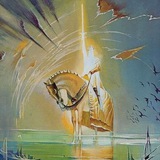
With your heroic blood, do not get caught up in the physical and forget your true nature. "You do not have a soul. You are a soul, you have a body." The essence of our rational mind has its origins in the Divine, yet indeed we know nothing other than what it means to be intimately tied to our moral bodies. What seems like a contradiction is instead a mystery to unravel.
Just as the blood of our heroic ancestors empowers our bodies, the ancient wisdom of our ancestors enlightens our minds. Our senses, cognition, and memories as we know them are all inseparably connected to material flesh, yet, all we actually experience is wholly transcendent and immaterial. Our consciousness is not a product of matter, rather the illusion of the material world is a creation of our minds. Everything we truly know is consciousness; that is our essence. With that knowledge we can begin to know God, in whose image we are made.
All is mental, the universe is mental...
As above, so below; as within, so without...
Just as the blood of our heroic ancestors empowers our bodies, the ancient wisdom of our ancestors enlightens our minds. Our senses, cognition, and memories as we know them are all inseparably connected to material flesh, yet, all we actually experience is wholly transcendent and immaterial. Our consciousness is not a product of matter, rather the illusion of the material world is a creation of our minds. Everything we truly know is consciousness; that is our essence. With that knowledge we can begin to know God, in whose image we are made.
All is mental, the universe is mental...
As above, so below; as within, so without...
Forwarded from The Classical Wisdom Tradition
The universe is a happy God.
Plato, Timaeus 34b
Plato, Timaeus 34b
Halls of the Hyperboreads pinned «The trinitarian model of consciousness conceptualizes consciousness as we know it and live it in Life. Through understanding the nature of our own subjective experiences - perceiving, feeling, thinking, willing - as conscious beings, or as souls, we can begin…»
Meditation is an important part of most spiritual disciplines, whether it be in the form of active prayer, laboring, or silent contemplation. It allows the mind to focus itself on anything it may choose without the body distracting it. The timeless idea of momento mori or "remember death" is a call to contemplate one's mortality. To meditate on this is to carry around that awareness of our inevitable death so we may act more prudently in the short lives we are given. In this manner we can meditate on anything we choose and have it fill our awareness so that it will in turn affect ourselves; we have the power to change ourselves simply by thinking about it.
❤1
For those of you who saw our newer posts on heroic blood and noble souls and decided to subscribe, please check out some older posts on this topic:
On the habits of our noble ancestors https://news.1rj.ru/str/hyperboread/52
On women and sexuality https://news.1rj.ru/str/hyperboread/127
On the solar archetype https://news.1rj.ru/str/hyperboread/200
On beginning down the path https://news.1rj.ru/str/hyperboread/213
On the habits of our noble ancestors https://news.1rj.ru/str/hyperboread/52
On women and sexuality https://news.1rj.ru/str/hyperboread/127
On the solar archetype https://news.1rj.ru/str/hyperboread/200
On beginning down the path https://news.1rj.ru/str/hyperboread/213
Telegram
Halls of the Hyperboreads
On the habits of our noble ancestors
Forwarded from • Hellas • Ελλάδα • Greece
The Delphic Maxims, pt. 6
128. Πλούτῳ ἀπίστει Don't put your trust in wealth
129. Σεαυτὸν αἰδοῦ Respect yourself
130. Μὴ ἄρχε ὑβρίζειν Don't initiate violence
131. Προγόνους στεφάνου Crown your ancestors
132. Θνῆσκε ὑπὲρ πατρίδος Die for your country
133. Τῷ βίῳ μὴ ἄχθου Do not live your life in discontent
134. Ἐπὶ νεκρῷ μὴ γέλα Do not make fun of the dead
135. Ἀτυχοῦντι συνάχθου Share the load of the unfortunate
136. Χαρίζου ἀβλαβῶς Gratify without harming
137. Μὴ ἐπὶ παντὶ λυποῦ Have no grief
138. Ἐξ εὐγενῶν γέννα Beget good from good
139. Ἐπαγγέλλου μηδενί Make promises to none
140. Φθιμένους μὴ ἀδίκει Do not wrong the dead
141. Εὖ πάσχε ὡς θνητός Do as well as your mortal status permits
142.Τύχῃ μὴ πίστευε Do not put your trust in chance
143. Παῖς ὢν κόσμιος ἴσθι As a child be well-behaved
144. Ἡβῶν ἐγκρατής As a youth be self-disciplined
145. Μέσος δίκαιος As a middle-aged person be honest
146. Πρεσβύτης εὔλογος As an old man be sensible
147. Τελευτῶν ἄλυπος At your end be without sorrow.
128. Πλούτῳ ἀπίστει Don't put your trust in wealth
129. Σεαυτὸν αἰδοῦ Respect yourself
130. Μὴ ἄρχε ὑβρίζειν Don't initiate violence
131. Προγόνους στεφάνου Crown your ancestors
132. Θνῆσκε ὑπὲρ πατρίδος Die for your country
133. Τῷ βίῳ μὴ ἄχθου Do not live your life in discontent
134. Ἐπὶ νεκρῷ μὴ γέλα Do not make fun of the dead
135. Ἀτυχοῦντι συνάχθου Share the load of the unfortunate
136. Χαρίζου ἀβλαβῶς Gratify without harming
137. Μὴ ἐπὶ παντὶ λυποῦ Have no grief
138. Ἐξ εὐγενῶν γέννα Beget good from good
139. Ἐπαγγέλλου μηδενί Make promises to none
140. Φθιμένους μὴ ἀδίκει Do not wrong the dead
141. Εὖ πάσχε ὡς θνητός Do as well as your mortal status permits
142.Τύχῃ μὴ πίστευε Do not put your trust in chance
143. Παῖς ὢν κόσμιος ἴσθι As a child be well-behaved
144. Ἡβῶν ἐγκρατής As a youth be self-disciplined
145. Μέσος δίκαιος As a middle-aged person be honest
146. Πρεσβύτης εὔλογος As an old man be sensible
147. Τελευτῶν ἄλυπος At your end be without sorrow.
HYPERBOREA
Herodotus's 5th c. BC account states "There is also a story related in a poem by Aristeas [...] This Aristeas, possessed by Phoibos (Phoebus) [Apollon], visited the Issedones; beyond these (he said) live the one-eyed Arimaspians, beyond whom are the Grypes (Griffins) that guard gold, and beyond these again the Hyperboreans, whose territory reaches to the sea. Except for the Hyperboreans, all these nations (and first the Arimaspians) are always at war with their neighbors; the Issedones were pushed from their lands by the Arimaspoi (Arimaspians), and the Skythians (Scythians) by the Issedones, and the Kimmeroi (Cimmerians), living by the southern sea, were hard pressed by the Skythians and left their country."
The tribes Herodotus mentions represent real tribes; First Cimmerians to Scythians to Issedones, which Herodotus elsewhere puts "east of Scythia and North of the Massagetae," and then the mythic Arimaspians, until finally there is Hyperborea which extends "to the sea." Of very interesting note are the gold-guarding griffins, a staple of Scythian lore, with the fact that much of the famed Scythian gold came from Mongolia.
Pliny the Elder writing in 1st c. AD states "From the extreme north-north-east to the northernmost point at which the sun rises in summer there are the Scythians, and outside of them and beyond the point where north-north-east begins some have placed the Hyperboreans, who are said by a majority of authorities to be in Europe. After that point the first place known is Lytharmis [?], a promontory of Celtica, and the river Carambucis [Northern Dvina?], where the range of the Ripaean Mountains terminates [Volga region?] and with it the rigour of the climate relaxes"
According to Pliny's account, Hyperborea could be found beyond the "first place known" within "Celtica" which has geological features that have been thought to describe Eastern Russia. Since Finnic tribes inhabited that region until the Middle Ages it would connect them to Hyperborea. Pliny also mentions "Those who locate them merely in a region having six months of daylight have recorded that they sow in the morning periods, reap at midday, pluck the fruit from the trees at sunset, and retire into caves for the night." This would place it within the Arctic circle, where the sun acts in this manner.
Herodotus's 5th c. BC account states "There is also a story related in a poem by Aristeas [...] This Aristeas, possessed by Phoibos (Phoebus) [Apollon], visited the Issedones; beyond these (he said) live the one-eyed Arimaspians, beyond whom are the Grypes (Griffins) that guard gold, and beyond these again the Hyperboreans, whose territory reaches to the sea. Except for the Hyperboreans, all these nations (and first the Arimaspians) are always at war with their neighbors; the Issedones were pushed from their lands by the Arimaspoi (Arimaspians), and the Skythians (Scythians) by the Issedones, and the Kimmeroi (Cimmerians), living by the southern sea, were hard pressed by the Skythians and left their country."
The tribes Herodotus mentions represent real tribes; First Cimmerians to Scythians to Issedones, which Herodotus elsewhere puts "east of Scythia and North of the Massagetae," and then the mythic Arimaspians, until finally there is Hyperborea which extends "to the sea." Of very interesting note are the gold-guarding griffins, a staple of Scythian lore, with the fact that much of the famed Scythian gold came from Mongolia.
Pliny the Elder writing in 1st c. AD states "From the extreme north-north-east to the northernmost point at which the sun rises in summer there are the Scythians, and outside of them and beyond the point where north-north-east begins some have placed the Hyperboreans, who are said by a majority of authorities to be in Europe. After that point the first place known is Lytharmis [?], a promontory of Celtica, and the river Carambucis [Northern Dvina?], where the range of the Ripaean Mountains terminates [Volga region?] and with it the rigour of the climate relaxes"
According to Pliny's account, Hyperborea could be found beyond the "first place known" within "Celtica" which has geological features that have been thought to describe Eastern Russia. Since Finnic tribes inhabited that region until the Middle Ages it would connect them to Hyperborea. Pliny also mentions "Those who locate them merely in a region having six months of daylight have recorded that they sow in the morning periods, reap at midday, pluck the fruit from the trees at sunset, and retire into caves for the night." This would place it within the Arctic circle, where the sun acts in this manner.
❤1
Therefore the historical accounts of Hyperborea match the denoscription of the most "hyperborean" ancestral population to modern Eurasians: paleolithic Siberian mammoth-hunters referred to within genetics as Ancient North Eurasians.
Of interesting note on the Hyperboreans themselves are the repeated mentions of their great health, their propensity for song, dance, and other art, as well as being devoted worshipers of Apollo. The diety of song/dance/poetry, truth, and the Sun himself was said to rest there for half the year.
The Hyperboreads, the three sons of Boreas and kings of Hyperborea, were said to be 10 feet tall. See on giants: https://news.1rj.ru/str/hyperboread/281
Of interesting note on the Hyperboreans themselves are the repeated mentions of their great health, their propensity for song, dance, and other art, as well as being devoted worshipers of Apollo. The diety of song/dance/poetry, truth, and the Sun himself was said to rest there for half the year.
The Hyperboreads, the three sons of Boreas and kings of Hyperborea, were said to be 10 feet tall. See on giants: https://news.1rj.ru/str/hyperboread/281
👍2