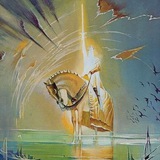
HYPERBOREA
Herodotus's 5th c. BC account states "There is also a story related in a poem by Aristeas [...] This Aristeas, possessed by Phoibos (Phoebus) [Apollon], visited the Issedones; beyond these (he said) live the one-eyed Arimaspians, beyond whom are the Grypes (Griffins) that guard gold, and beyond these again the Hyperboreans, whose territory reaches to the sea. Except for the Hyperboreans, all these nations (and first the Arimaspians) are always at war with their neighbors; the Issedones were pushed from their lands by the Arimaspoi (Arimaspians), and the Skythians (Scythians) by the Issedones, and the Kimmeroi (Cimmerians), living by the southern sea, were hard pressed by the Skythians and left their country."
The tribes Herodotus mentions represent real tribes; First Cimmerians to Scythians to Issedones, which Herodotus elsewhere puts "east of Scythia and North of the Massagetae," and then the mythic Arimaspians, until finally there is Hyperborea which extends "to the sea." Of very interesting note are the gold-guarding griffins, a staple of Scythian lore, with the fact that much of the famed Scythian gold came from Mongolia.
Pliny the Elder writing in 1st c. AD states "From the extreme north-north-east to the northernmost point at which the sun rises in summer there are the Scythians, and outside of them and beyond the point where north-north-east begins some have placed the Hyperboreans, who are said by a majority of authorities to be in Europe. After that point the first place known is Lytharmis [?], a promontory of Celtica, and the river Carambucis [Northern Dvina?], where the range of the Ripaean Mountains terminates [Volga region?] and with it the rigour of the climate relaxes"
According to Pliny's account, Hyperborea could be found beyond the "first place known" within "Celtica" which has geological features that have been thought to describe Eastern Russia. Since Finnic tribes inhabited that region until the Middle Ages it would connect them to Hyperborea. Pliny also mentions "Those who locate them merely in a region having six months of daylight have recorded that they sow in the morning periods, reap at midday, pluck the fruit from the trees at sunset, and retire into caves for the night." This would place it within the Arctic circle, where the sun acts in this manner.
Herodotus's 5th c. BC account states "There is also a story related in a poem by Aristeas [...] This Aristeas, possessed by Phoibos (Phoebus) [Apollon], visited the Issedones; beyond these (he said) live the one-eyed Arimaspians, beyond whom are the Grypes (Griffins) that guard gold, and beyond these again the Hyperboreans, whose territory reaches to the sea. Except for the Hyperboreans, all these nations (and first the Arimaspians) are always at war with their neighbors; the Issedones were pushed from their lands by the Arimaspoi (Arimaspians), and the Skythians (Scythians) by the Issedones, and the Kimmeroi (Cimmerians), living by the southern sea, were hard pressed by the Skythians and left their country."
The tribes Herodotus mentions represent real tribes; First Cimmerians to Scythians to Issedones, which Herodotus elsewhere puts "east of Scythia and North of the Massagetae," and then the mythic Arimaspians, until finally there is Hyperborea which extends "to the sea." Of very interesting note are the gold-guarding griffins, a staple of Scythian lore, with the fact that much of the famed Scythian gold came from Mongolia.
Pliny the Elder writing in 1st c. AD states "From the extreme north-north-east to the northernmost point at which the sun rises in summer there are the Scythians, and outside of them and beyond the point where north-north-east begins some have placed the Hyperboreans, who are said by a majority of authorities to be in Europe. After that point the first place known is Lytharmis [?], a promontory of Celtica, and the river Carambucis [Northern Dvina?], where the range of the Ripaean Mountains terminates [Volga region?] and with it the rigour of the climate relaxes"
According to Pliny's account, Hyperborea could be found beyond the "first place known" within "Celtica" which has geological features that have been thought to describe Eastern Russia. Since Finnic tribes inhabited that region until the Middle Ages it would connect them to Hyperborea. Pliny also mentions "Those who locate them merely in a region having six months of daylight have recorded that they sow in the morning periods, reap at midday, pluck the fruit from the trees at sunset, and retire into caves for the night." This would place it within the Arctic circle, where the sun acts in this manner.
❤1
Therefore the historical accounts of Hyperborea match the denoscription of the most "hyperborean" ancestral population to modern Eurasians: paleolithic Siberian mammoth-hunters referred to within genetics as Ancient North Eurasians.
Of interesting note on the Hyperboreans themselves are the repeated mentions of their great health, their propensity for song, dance, and other art, as well as being devoted worshipers of Apollo. The diety of song/dance/poetry, truth, and the Sun himself was said to rest there for half the year.
The Hyperboreads, the three sons of Boreas and kings of Hyperborea, were said to be 10 feet tall. See on giants: https://news.1rj.ru/str/hyperboread/281
Of interesting note on the Hyperboreans themselves are the repeated mentions of their great health, their propensity for song, dance, and other art, as well as being devoted worshipers of Apollo. The diety of song/dance/poetry, truth, and the Sun himself was said to rest there for half the year.
The Hyperboreads, the three sons of Boreas and kings of Hyperborea, were said to be 10 feet tall. See on giants: https://news.1rj.ru/str/hyperboread/281
👍2
ATLANTIS
Here is the account by Plato, by far the foremost surviving source, on Atlantis in Timaeus with an Egyptian speaking to Plato's relative Solon:
"Many great and wonderful deeds are recorded of your state [Athens] in our [the Egyptian's] histories. But one of them exceeds all the rest in greatness and valour. For these histories tell of a mighty power [Atlantis] which unprovoked made an expedition against the whole of Europe and Asia, and to which your city put an end. This power came forth out of the Atlantic Ocean, for in those days the Atlantic was navigable; and there was an island situated in front of the straits which are by you called the Pillars of Herakles (Heracles) [i.e. the Strait of Gibraltar]; the island was larger than Libya and Asia put together, and was the way to other islands, and from these you might pass to the whole of the opposite continent which surrounded the true ocean; for this sea which is within the Straits of Herakles is only a harbour, having a narrow entrance, but that other is a real sea, and the surrounding land may be most truly called a boundless continent. Now in this island of Atlantis there was a great and wonderful empire which had rule over the whole island and several others, and over parts of the continent, and, furthermore, the men of Atlantis had subjected the parts of Libya [Africa] within the columns of Herakles as far as Aigyptos (Egypt), and of Europe as far as Tyrrhenia [in Italy]. This vast power, gathered into one, endeavoured to subdue at a blow our country and yours and the whole of the region within the straits. [account of Athens defeating Atlanteans in battle] But afterwards there occurred violent earthquakes and floods; and in a single day and night of misfortune all your warlike men in a body sank into the earth, and the island of Atlantis in like manner disappeared in the depths of the sea."
What Plato describes here, with little stretch of the imagination, describes North America. He tells of a large continent, large enough to be called "boundless," that lies across the Atlantic Ocean, which is a "real sea" large enough to make the Mediterranean seem like "only a harbor." The great power that lay there was well under way subduing Mediterranean peoples before a great cataclysm took the world.
Plato, again, speaking as Socrates in Critias:
"Now first of all we must recall the fact that 9000 is the sum of years since the war occurred, as is recorded, between the [Atlantean] dwellers beyond the pillars of Herakles (Heracles) [i.e. the Strait of Gibraltar] and all that dwelt within them [...] Now a large family of distinguished sons sprang from Atlas; but it was the eldest, who, as king, always passed on the scepter to the eldest of his sons, and thus they preserved the sovereignty for many generations; and the wealth they possessed was so immense that the like had never been seen before in any royal house nor will ever easily be seen again; [...] and the island itself furnished most of the requirements of daily life,--metals, to begin with, both the hard kind and the fusible kind, which are extracted by mining, and also that kind which is now known only by name but was more than a name then, there being mines of it in many places of the island,--I mean orikhalkon (mountain-copper), which was the most precious of the metals then known, except gold. It brought forth also in abundance all the timbers that a forest provides for the labors of carpenters; and of animals it produced a sufficiency, both of tame and wild. Moreover, it contained a very large stock of elephants"
Here is the account by Plato, by far the foremost surviving source, on Atlantis in Timaeus with an Egyptian speaking to Plato's relative Solon:
"Many great and wonderful deeds are recorded of your state [Athens] in our [the Egyptian's] histories. But one of them exceeds all the rest in greatness and valour. For these histories tell of a mighty power [Atlantis] which unprovoked made an expedition against the whole of Europe and Asia, and to which your city put an end. This power came forth out of the Atlantic Ocean, for in those days the Atlantic was navigable; and there was an island situated in front of the straits which are by you called the Pillars of Herakles (Heracles) [i.e. the Strait of Gibraltar]; the island was larger than Libya and Asia put together, and was the way to other islands, and from these you might pass to the whole of the opposite continent which surrounded the true ocean; for this sea which is within the Straits of Herakles is only a harbour, having a narrow entrance, but that other is a real sea, and the surrounding land may be most truly called a boundless continent. Now in this island of Atlantis there was a great and wonderful empire which had rule over the whole island and several others, and over parts of the continent, and, furthermore, the men of Atlantis had subjected the parts of Libya [Africa] within the columns of Herakles as far as Aigyptos (Egypt), and of Europe as far as Tyrrhenia [in Italy]. This vast power, gathered into one, endeavoured to subdue at a blow our country and yours and the whole of the region within the straits. [account of Athens defeating Atlanteans in battle] But afterwards there occurred violent earthquakes and floods; and in a single day and night of misfortune all your warlike men in a body sank into the earth, and the island of Atlantis in like manner disappeared in the depths of the sea."
What Plato describes here, with little stretch of the imagination, describes North America. He tells of a large continent, large enough to be called "boundless," that lies across the Atlantic Ocean, which is a "real sea" large enough to make the Mediterranean seem like "only a harbor." The great power that lay there was well under way subduing Mediterranean peoples before a great cataclysm took the world.
Plato, again, speaking as Socrates in Critias:
"Now first of all we must recall the fact that 9000 is the sum of years since the war occurred, as is recorded, between the [Atlantean] dwellers beyond the pillars of Herakles (Heracles) [i.e. the Strait of Gibraltar] and all that dwelt within them [...] Now a large family of distinguished sons sprang from Atlas; but it was the eldest, who, as king, always passed on the scepter to the eldest of his sons, and thus they preserved the sovereignty for many generations; and the wealth they possessed was so immense that the like had never been seen before in any royal house nor will ever easily be seen again; [...] and the island itself furnished most of the requirements of daily life,--metals, to begin with, both the hard kind and the fusible kind, which are extracted by mining, and also that kind which is now known only by name but was more than a name then, there being mines of it in many places of the island,--I mean orikhalkon (mountain-copper), which was the most precious of the metals then known, except gold. It brought forth also in abundance all the timbers that a forest provides for the labors of carpenters; and of animals it produced a sufficiency, both of tame and wild. Moreover, it contained a very large stock of elephants"
Plato thus dates the Atlantean war to ~10,000 BC, which roughly coincides with the Younger Dryas cataclysm that ended the Ice Age and changed geography around the world, especially destroying North America in particular. This connection to North America is strengthened by the mentioning of the precious copper mines like those known to have been operated in Michigan by ancient Europeans, as well as the mentioning of great reserve of timber and elephants, which may refer to the mammoths that went extinct in America roughly 10,000 BC.
Who were the Atlaneans? They were ancient West Eurasians who made the voyage across the Atlantic. The R Y-DNA and X-mtDNA haplogroups both share the same anomalous distribution that includes North American and West Eurasia, providing evidence of a connection between these locations. In some of the European populations that were insulated from the Aryan invasions such as Basques, Guanches, and Berbers, evidence of Aryan phenotypic qualities persist despite their natural defenses against the invasions of genetics typically assigned to the "Aryan" Indo-European dispersal. There are also groups featuring European heritage elsewhere in the Americas.
❤1👍1
Copper_from_Michigan_in_the_Mediterranean_20210407110047.jpg
3.9 MB
Evidence of North American copper used in the ancient Mediterranean
MaoriInfoSupressionOfFacts_20211215114033.jpg
850.4 KB
On pre-Maori inhabitants of New Zealand, another population founded by ancient seafaring West Eurasians
Forwarded from Revolt Against The Modern World
"Men will learn eventually, and if they insist on rejecting the received wisdom of generations past, they do not thereby succeed at invalidating it; they merely condemn themselves to learning it, time and again, by ever grimmer experience."
Why care about myths like Atlantis and Hyperborea? They are living history, of our genetic and cultural ancestors, and they offer us inspiring archetypes. This is my personal feelings on the subject; there has been much said on the specifics of what these myths really describe, I only seek to add to these. As I see it these two myths exemplify the two halves of Europe - genetically, culturally, spiritually.
Hyperborea is of the open and expansive North; a natural landscape of plenty where its peaceful people continually harvested an abundance from its great groves. The Hyperboreans were giant, vigorous, and divinely artistic in inspiration by the Solar diety whom they faithfully worshiped. This peaceful, isolated holy place is an allegory to the primordial hunter-gatherer past. This naturalistic ideal is encapsulated in much the same way as the Garden of Eden.
Atlantis on the other hand represents the high point of human civilization. Their empire was extremely wealthy and technologically advanced. It is said its priests were masters of magic, its armies were unmatched, and its merchants spanned the globe. The kingdom seemed eternal as even the very structure of their magnificent capital city was sculpted by Poseidon himself to be impregnable. As the stories go the priests of Atlantis forsook piety and grew hungry for material power and wealth, and so their civilization was then cast into the sea (from whose Lunar god they sprung) in a great flood. Whether collapse or cataclysm actually came first, one always brings about the other, and so all civilizations will inevitably meet their end in this manner of total catastrophe. In contrast to the idyllic Hyperborea, Atlantis represents the struggle of civilized man to create his own utopia.
Thus Hyperboreans represent those builders of wood in vast natural settings, of innate wisdom and spirituality, and great individual strength and power, whereas Atlanteans represent those monumental builders of stone, of social and learned men, and strength in numbers and in technology.
Hyperborea is of the open and expansive North; a natural landscape of plenty where its peaceful people continually harvested an abundance from its great groves. The Hyperboreans were giant, vigorous, and divinely artistic in inspiration by the Solar diety whom they faithfully worshiped. This peaceful, isolated holy place is an allegory to the primordial hunter-gatherer past. This naturalistic ideal is encapsulated in much the same way as the Garden of Eden.
Atlantis on the other hand represents the high point of human civilization. Their empire was extremely wealthy and technologically advanced. It is said its priests were masters of magic, its armies were unmatched, and its merchants spanned the globe. The kingdom seemed eternal as even the very structure of their magnificent capital city was sculpted by Poseidon himself to be impregnable. As the stories go the priests of Atlantis forsook piety and grew hungry for material power and wealth, and so their civilization was then cast into the sea (from whose Lunar god they sprung) in a great flood. Whether collapse or cataclysm actually came first, one always brings about the other, and so all civilizations will inevitably meet their end in this manner of total catastrophe. In contrast to the idyllic Hyperborea, Atlantis represents the struggle of civilized man to create his own utopia.
Thus Hyperboreans represent those builders of wood in vast natural settings, of innate wisdom and spirituality, and great individual strength and power, whereas Atlanteans represent those monumental builders of stone, of social and learned men, and strength in numbers and in technology.
👍3❤2