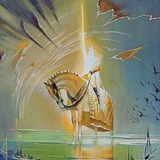
The good king cannot operate on the level of consciousness of his peasantry, who are not capable of understanding royal matters. By transcending the populi he rules in divine right, mirroring heavenly order, which orients the entire society towards to the Transcendent. This is the place of aristocracy; to rule rightly above the lower castes, for their sake, because the lower castes are only capable of higher forms of virtue when they are organized under a virtuous structure.
The religion of kings and heroes is not the religion of the people. The Way for the ascetic cannot be the Way for the people. A movement for the aristocracy is not a movement for the people. Royalty, heroes, and aristocrats of the soul seek higher goals than what can be called strictly religious, political, or social. Those things are downstream of higher forces; their best forms come as expressions of higher values.
Therefore it is not the aristocrat's place to operate only in the world of institutions and ideologies. This is not to say an aristocrat cannot be part of an institution or should never adopt an ideological identity; these things certainly have their practical places. But to navigate institutions and ideologies with the knowledge of what forces are above all of it, to live according to those higher principles even when the lower reality objects, to rightfully rule over those lower ones who DaVinci said 'cannot see at all' even when shown; that is the aristocratic way.
The religion of kings and heroes is not the religion of the people. The Way for the ascetic cannot be the Way for the people. A movement for the aristocracy is not a movement for the people. Royalty, heroes, and aristocrats of the soul seek higher goals than what can be called strictly religious, political, or social. Those things are downstream of higher forces; their best forms come as expressions of higher values.
Therefore it is not the aristocrat's place to operate only in the world of institutions and ideologies. This is not to say an aristocrat cannot be part of an institution or should never adopt an ideological identity; these things certainly have their practical places. But to navigate institutions and ideologies with the knowledge of what forces are above all of it, to live according to those higher principles even when the lower reality objects, to rightfully rule over those lower ones who DaVinci said 'cannot see at all' even when shown; that is the aristocratic way.
Forwarded from Túrin ᛉ
This is something of an equivocation or what some people call the "word-concept" fallacy. To assume the word "nationalism" must always, in all contexts and uses, refer to the liberal nation-state is illogical and not consistent with how more and more are coming to understand it.
If, by nationalism, you mean nineteenth century liberal ideas, then yes, that is "the big gay".
But the traditional meaning of the word nation doesn't mean this, and it predates liberalism.
Latin natio (whence 'nation') comes from nasci which means to be born or begotten. Natio could be perhaps best understood as "a common birth" and refers to a collective people, an ethnicity, a folk; indeed, it would be directly equivalent to old Greek ethnos (ἔθνος) or German volk. Indeed, in the dreaded Bible, natio and ethnos are used in place of each other in respective Latin and Greek editions.
One would make the case that true "nationalism" is what is often called volkism, tribalism, or redundantly, "ethnonationalism", while there is no distinction between what is called "civic nationalism" and nineteenth century liberal nationalism.
Because the traditional nation is an ethnic collection of families and dynasties irrespective of liberal ideologues and their gross misuse of words.
If, by nationalism, you mean nineteenth century liberal ideas, then yes, that is "the big gay".
But the traditional meaning of the word nation doesn't mean this, and it predates liberalism.
Latin natio (whence 'nation') comes from nasci which means to be born or begotten. Natio could be perhaps best understood as "a common birth" and refers to a collective people, an ethnicity, a folk; indeed, it would be directly equivalent to old Greek ethnos (ἔθνος) or German volk. Indeed, in the dreaded Bible, natio and ethnos are used in place of each other in respective Latin and Greek editions.
One would make the case that true "nationalism" is what is often called volkism, tribalism, or redundantly, "ethnonationalism", while there is no distinction between what is called "civic nationalism" and nineteenth century liberal nationalism.
Because the traditional nation is an ethnic collection of families and dynasties irrespective of liberal ideologues and their gross misuse of words.
👍3🔥1
Forwarded from The Classical Wisdom Tradition
Death, I think, is actually nothing but the separation of two things from each other, the soul and the body.
Plato, Gorgias 524b
Plato, Gorgias 524b
👍4
Forwarded from Solitary Individual
Imagine then a fleet or a ship in which there is a captain who is taller and stronger than any of the crew, but he is a little deaf and has a similar infirmity in sight, and his knowledge of navigation is not much better. The sailors are quarreling with one another about the steering––every one is of the opinion that he has a right to steer, though he has never learned the art of navigation and cannot tell who taught him or when he learned, and will further assert that it cannot be taught, and they are ready to cut in pieces any one who says the contrary.
They throng about the captain, begging and praying him to commit the helm to them; and if at any time they do not prevail, but others are preferred to them, they kill the others or throw them overboard, and having first chained up the noble captain’s senses with drink or some narcotic drug, they mutiny and take possession of the ship and make free with the stores; thus, eating and drinking, they proceed on their voyage in such a manner as might be expected of them. Him who is their partisan and cleverly aids them in their plot for getting the ship out of the captain’s hands into their own whether by force or persuasion, they compliment with the name of sailor, pilot, able seaman, and abuse the other sort of man, whom they call a good-for-nothing; but that the true pilot must pay attention to the year and seasons and sky and stars and winds, and whatever else belongs to his art, if he intends to be really qualified for the command of a ship, and that he must and will be the steerer, whether other people like or not––the possibility of this union of authority with the steerer’s art has never seriously entered into their thoughts or been made part of their calling. Now in vessels which are in a state of mutiny and by sailors who are mutineers, how will the true pilot be regarded? Will he not be called by them a prater, a star-gazer, a good-for-nothing?
[from Book VI of Plato’s Republic]
They throng about the captain, begging and praying him to commit the helm to them; and if at any time they do not prevail, but others are preferred to them, they kill the others or throw them overboard, and having first chained up the noble captain’s senses with drink or some narcotic drug, they mutiny and take possession of the ship and make free with the stores; thus, eating and drinking, they proceed on their voyage in such a manner as might be expected of them. Him who is their partisan and cleverly aids them in their plot for getting the ship out of the captain’s hands into their own whether by force or persuasion, they compliment with the name of sailor, pilot, able seaman, and abuse the other sort of man, whom they call a good-for-nothing; but that the true pilot must pay attention to the year and seasons and sky and stars and winds, and whatever else belongs to his art, if he intends to be really qualified for the command of a ship, and that he must and will be the steerer, whether other people like or not––the possibility of this union of authority with the steerer’s art has never seriously entered into their thoughts or been made part of their calling. Now in vessels which are in a state of mutiny and by sailors who are mutineers, how will the true pilot be regarded? Will he not be called by them a prater, a star-gazer, a good-for-nothing?
[from Book VI of Plato’s Republic]
Forwarded from Orphic Inscendence (Naida)
“Many people say: “I do not like the clangor and agitation that are characteristic of kirtan. I prefer to sit quietly in a solitary place and meditate.” As a matter of fact, if in solitude you can obtain communion with God, it is excellent. But watch and note carefully whether your mind is seeking God or wandering away among the perplexities of the world. If you take no notice of the boisterousness of the kirtan, but concentrate on God’s Name; if you do not listen to the various tunes and to the rhythms of the drums and cymbals, but let yourself be wafted away at the final note of the music, you will become aware that a contemplative mood has spontaneously awakened in you.”
- Anandamayi Ma
- Anandamayi Ma
Forwarded from Orthodox Ramblings
And yet he does not meet God himself, but contemplates, not him who is invisible, but rather where he dwells. This means, I presume, that the holiest and highest of the things perceived with the eye of the body or the mind are but the rationale which presupposes all that lies below the Transcendent One. Through them, however, his unimaginable presence is shown, walking the heights of those holy places to which the mind at least can rise. But then he [Moses] breaks free of them, away from what sees and is seen, and he plunges into the truly mysterious darkness of unknowing. Here, renouncing all that the mind may conceive, wrapped entirely in the intangible and the invisible, he belongs completely to him who is beyond everything. Here, being neither oneself nor someone else, one is supremely united to the completely unknown by an inactivity of all knowledge, and knows beyond the mind by knowing nothing.
Dionysius the Areopagite, The Mystical Theology
Dionysius the Areopagite, The Mystical Theology
Forwarded from Ghost of de Maistre
“The Bogdo clapped his hands and one of the secretaries took from a red kerchief a big silver key with which he unlocked the chest with the seals. The Living Buddha slipped his hand into the chest and drew forth a small box of carved ivory, from which he took out and showed to me a large gold ring set with a magnificent ruby carved with the sign of the swastika.
"This ring was always worn on the right hand of the Khans Jenghiz and Kublai," said the Bogdo.”
- Source: "Beasts, Men And Gods" by Ferdynand Antoni Ossendowski, pp. 284 - 285
"This ring was always worn on the right hand of the Khans Jenghiz and Kublai," said the Bogdo.”
- Source: "Beasts, Men And Gods" by Ferdynand Antoni Ossendowski, pp. 284 - 285
"Having explained the spirit that animated the caste system, it is now necessary to discuss the path that is above the castes and is directed at implementing the realization of transcendence—in analogous terms to those of high initiation, yet outside the specific and rigorous structures characterizing it. On the one hand, the pariah is a person without a caste, the one who has 'lapsed' or who has eluded the 'form' by being powerless before it, thus returning to the infernal world. The ascetic, on the other hand, is a being above the caste, one who becomes free from the form by renouncing the illusory center of human individuality; he turns toward the principle from which every 'form' proceeds, not by faithfulness to his own nature and by participation in the hierarchy, but by direct action. Therefore, as great as was the revulsion harbored by every caste toward the pariah in Ancient India, so, by contrast, was the veneration felt by everybody for a person who was above the castes. These beings, according to a Buddhist image, should not be expected to follow a human dharma, just as one who is trying to kindle a fire ultimately does not care what kind of wood is being employed, as long as it is capable of producing fire and light."
- Julius Evola in Revolt Against the Modern World
- Julius Evola in Revolt Against the Modern World
"First of all, Buddhism does not know any 'gods' in the religious sense of the word; the gods are believed to be powers who also need liberation, and thus the 'Awakened One' is acknowledged to be superior to both men and gods. In the Buddhist canon it is written that an ascetic not only becomes free from human bonds, but from divine bonds as well. Secondly, moral norms, in the original forms of Buddhism, are purported to be mere instruments to be employed in the quest for the objective realization of superindividual states. Anything that belongs to the world of 'believing,' of 'faith,' or that is remotely associated with emotional experiences is shunned. The fundamental principle of the method is 'knowledge': to turn the knowledge of the ultimate nonidentity of the Self with anything 'else' (whether it be the monistic All or the world of Brahmā, theistically conceived) into a fire that progressively devours any irrational self-identification with anything that is conditioned. In conformity to the path, the final outcome, besides the negative designation (nirvāņa = 'cessation of restlessness'), is expressed in terms of 'knowledge,' bodhi, which is knowledge in the eminent sense of superrational enlightenment or liberating knowledge, as in 'waking up' from sleep, slumber, or a hallucination. It goes without saying that this is not the equivalent of cessation of power or of anything resembling a dissolution. To dissolve ties is not to become dissolved but to become free. The image of the one who, once freed from all yokes, whether human or divine, is supremely autonomous and thus may go wherever he pleases, is found very frequently in the Buddhist canon together with all kinds of symbols of a virile and warrior type, and also with constant and explicit references not so much to nonbeing but rather to something superior to both being and nonbeing. Buddha, as it is known, belonged to an ancient stock of Aryan warrior nobility and his doctrine (purported to be 'the dharma of the pure ones, inaccessible to an uninstructed, average person') is a very far cry from any mystical escapism. Buddha's doctrine is permeated by a sense of superiority, clarity, and an indomitable spirit, and Buddha himself is called 'the fully Awakened One,' 'the Lord.' "
- Julius Evola, Revolt Against the Modern World
- Julius Evola, Revolt Against the Modern World
Forwarded from Sagittarius Granorum (Sagittarius Hyperboreius)
This channel is anti-populist, non-conformist, harbours contempt for the working and middle classes, it is the enemy of the cults of the flesh, it is anti-capitalist, anti-american in the wider sense of the word, anti-social, and anti-liberal, it hates the economy, scientism, and it denounces sports and 'culture'.
However, and more importantly, it celebrates and values silence, good activity and works, Being, Nature, Science, Victory, Life, Love, Distance, Freedom, Duty, Dignity, mysteries and myths, Culture, and all those things that is and was cherished in the world of Tradition.
However, and more importantly, it celebrates and values silence, good activity and works, Being, Nature, Science, Victory, Life, Love, Distance, Freedom, Duty, Dignity, mysteries and myths, Culture, and all those things that is and was cherished in the world of Tradition.
❤2
Forwarded from Acroaticus Atlas Aryanis
"The possession of Knowledge, unless accompanied by a manifestation and expression in Action, is like the hoarding of precious metals-a vain and foolish thing. Knowledge, like wealth, is intended for Use. The Law of Use is Universal, and he who violates it suffers by reason of his conflict with natural forces."
--The Kybalion.
@esotericatlantean
--The Kybalion.
@esotericatlantean
Forwarded from The Classical Wisdom Tradition
If you aren't practicing, you're just an unpaid academic!