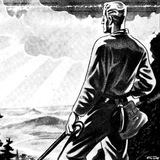
The mountain, as Evola describes it in these essays, is portrayed as the guardian of the initiatory threshold over which anyone who wants to be initiated must cross at least once in a lifetime; otherwise it's better never to have been born, because the meaning of life is found only through realizing oneself. But we realize oneself only by putting ourselves to the test.
The mountain also represents the power of vision and of enlightenment. It presents the struggle against inner ghosts; the victory over fear of solitude, silence, and the void; the capability of the awakening of the divine element within man; the power of transcendence that allows us to
ascend to the top of the self.
Evola reveals the mountain to us through symbols and enigmas. The mountain of high icy peaks, with its clear cut forms carved in the ice ,
shapes the contours of that hyper-Uranian world to which we yearn to return.
He who has conquered the mountain, Evola himself observes, namely, he who has learned to adapt himself to its fundamental meaning, already possesses a key to comprehending the original spirit and the spirit of the Aryan-Roman world in its most severe, pure, and monumental aspects. Such a key is not to be found in ordinary culture and fields of study in the academic world.
Finally, the mountain is a school of inner toughening, with its known victims and obscure conquerors; its highest value consists in not being able to approach it without adequate preparation, but in needing a long apprenticeship.
Like any good teacher, the mountain does not love compromises and is not forgiving toward cowards or those who are inept.
Thus, the ascent becomes asceticism.
The mountain also represents the power of vision and of enlightenment. It presents the struggle against inner ghosts; the victory over fear of solitude, silence, and the void; the capability of the awakening of the divine element within man; the power of transcendence that allows us to
ascend to the top of the self.
Evola reveals the mountain to us through symbols and enigmas. The mountain of high icy peaks, with its clear cut forms carved in the ice ,
shapes the contours of that hyper-Uranian world to which we yearn to return.
He who has conquered the mountain, Evola himself observes, namely, he who has learned to adapt himself to its fundamental meaning, already possesses a key to comprehending the original spirit and the spirit of the Aryan-Roman world in its most severe, pure, and monumental aspects. Such a key is not to be found in ordinary culture and fields of study in the academic world.
Finally, the mountain is a school of inner toughening, with its known victims and obscure conquerors; its highest value consists in not being able to approach it without adequate preparation, but in needing a long apprenticeship.
Like any good teacher, the mountain does not love compromises and is not forgiving toward cowards or those who are inept.
Thus, the ascent becomes asceticism.
🔥9👎1
Julius Evola outlines two categories of spiritual action: The Bow, and the Club.
The Bow:
A weapon of precision, the bow is a tool of orientation, of aims and of goals. It is a method of attack characterized by rectification. Examples may be Mask and Face of Contemporary Spirituality and Eros and the Mysteries of Sex.
The Club:
A weapon of destruction, the club is a tool of brutality, of demolishing and of a 'virile barbarism'. It is a method of strengthening and hardening ourselves whilst weakening and demolishing the modern world. Examples may be Orientations and Recognitions.
These two methods of spiritual action represent a two pronged attack on modernity. An attack from above and from below.
The bow to strike from a distance, the bludgeon, to destroy at close range.
The Bow:
A weapon of precision, the bow is a tool of orientation, of aims and of goals. It is a method of attack characterized by rectification. Examples may be Mask and Face of Contemporary Spirituality and Eros and the Mysteries of Sex.
The Club:
A weapon of destruction, the club is a tool of brutality, of demolishing and of a 'virile barbarism'. It is a method of strengthening and hardening ourselves whilst weakening and demolishing the modern world. Examples may be Orientations and Recognitions.
These two methods of spiritual action represent a two pronged attack on modernity. An attack from above and from below.
The bow to strike from a distance, the bludgeon, to destroy at close range.
❤4👎1
“The proud Black-Shirt motto ‘Me ne frego’ written on the bandages that cover a wound isn’t just an act of stoic philosophy or the summary of a political doctrine.
It’s an education to fighting, and the acceptance of the risks it implies. It’s a new Italian lifestyle.
This is how the Fascist welcomes and loves life, while rejecting and regarding suicide as an act of cowardice; this is how the Fascist understands life as duty, exaltation, conquest.
A life that must be lived highly and fully, both for oneself but especially for others, near and far, present and future.”—Benito Mussolini
It’s an education to fighting, and the acceptance of the risks it implies. It’s a new Italian lifestyle.
This is how the Fascist welcomes and loves life, while rejecting and regarding suicide as an act of cowardice; this is how the Fascist understands life as duty, exaltation, conquest.
A life that must be lived highly and fully, both for oneself but especially for others, near and far, present and future.”—Benito Mussolini
❤14
If the bourgeois generation perceived nature as a kind of idyllic Sunday respite from city life, if for the generation that replaced it it is a place where one can dump the excesses of one's brutal, pervasive, and contagious vulgarity, then for our special man it is a school of the objective and distant, something fundamental in the sense that his existence in it begins to take on a total character.
"When I lifted a certain weight of steel, I was able to believe in my own strength. I sweated and panted, struggling to obtain certain proof of my strength. At such times, the strength was mine, and equally it was the steel's."
Yukio Mishima ‘Sun and Steel’
Yukio Mishima ‘Sun and Steel’
⚡11
This media is not supported in your browser
VIEW IN TELEGRAM
Death approaches, reality approaches.
❤5
"In the Hindu aristocratic and warrior tradition, there are men of impersonal violence…”
Jonathan Bowden.
Jonathan Bowden.
⚡13❤1👍1😁1
There is a Chinese saying: 'The rites are not the legacy of ordinary people,' which corresponds to the famous saying of Appius Claudius: 'Auspicia sunt patrum.' A Latin expression characterized the plebeians as gentum non habent: people who have no rites nor ancestors.
Thus, the supernatural element was the foundation of the idea of a traditional patriciate and of legitimate royalty: what constituted an ancient aristocrat was not merely a biological legacy or a racial selection, but rather a sacred tradition.
Thus, the supernatural element was the foundation of the idea of a traditional patriciate and of legitimate royalty: what constituted an ancient aristocrat was not merely a biological legacy or a racial selection, but rather a sacred tradition.
👏8❤1👍1