⚜Dense medium separation
🔹Principle
DMS is a gravity separation process. In the strictest sense, it implies separation of lower-density particles from higher-density particles at a specific separating density regardless of size, shape, and other secondary influences. In industrial reality, such simplistic gravity separation is seldom so perfectly achievable though, with appropriate design and operational care, DMS is generally able to achieve separation very close to that predicted by theoretical
particle density considerations alone as size and shape play
a less dominant role compared with other gravity techniques. A well-designed DMS operation can therefore be regarded as being size-independent (Bosman,2007). It is generally more efficient in terms of separation sharpness than competing gravity processes like jigging and yet is considered the simplest of all gravity processes (Wills,1985).
DMS machines and plants achieve the separation of different density materials in fluid media, and the terms “floats” and “sinks” are therefore often used to describe the lighter and heavier fractions. In the context of iron ore beneficiation, the separation medium is invariably made up of a suspension of very fine ferrosilicon (FeSi) particles in water that performs as a dense liquid. The lighter particles staying buoyant in the medium (“floats”) are always the undesirable part, while the heavier, denser “sinks” represent the upgraded part of the ore. Iron ore beneficiation is therefore opposite to coal beneficiation where DMS is even more extensively used but where the floats represent the desired outcome. Another notable difference is that while coal DMS can use a cheaper medium made up of ground magnetite particles, the higher separation densities required in iron ore beneficiation (in the order of 3–4 kg/l) necessitate the use of relatively expensive FeSi.
@mineralprocessing
🔹Principle
DMS is a gravity separation process. In the strictest sense, it implies separation of lower-density particles from higher-density particles at a specific separating density regardless of size, shape, and other secondary influences. In industrial reality, such simplistic gravity separation is seldom so perfectly achievable though, with appropriate design and operational care, DMS is generally able to achieve separation very close to that predicted by theoretical
particle density considerations alone as size and shape play
a less dominant role compared with other gravity techniques. A well-designed DMS operation can therefore be regarded as being size-independent (Bosman,2007). It is generally more efficient in terms of separation sharpness than competing gravity processes like jigging and yet is considered the simplest of all gravity processes (Wills,1985).
DMS machines and plants achieve the separation of different density materials in fluid media, and the terms “floats” and “sinks” are therefore often used to describe the lighter and heavier fractions. In the context of iron ore beneficiation, the separation medium is invariably made up of a suspension of very fine ferrosilicon (FeSi) particles in water that performs as a dense liquid. The lighter particles staying buoyant in the medium (“floats”) are always the undesirable part, while the heavier, denser “sinks” represent the upgraded part of the ore. Iron ore beneficiation is therefore opposite to coal beneficiation where DMS is even more extensively used but where the floats represent the desired outcome. Another notable difference is that while coal DMS can use a cheaper medium made up of ground magnetite particles, the higher separation densities required in iron ore beneficiation (in the order of 3–4 kg/l) necessitate the use of relatively expensive FeSi.
@mineralprocessing
🔹DMS in current iron ore use
Two of the biggest DMS installations in iron ore involve the plants of Kumba Iron Ore at their Sishen mine in South Africa and of Rio Tinto at their Mount Tom Price mine in Australia.
🔹🔹Sishen DMS plant
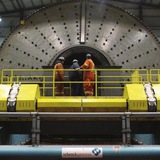
Sishen crush their run of mine (ROM) to a nominal top size of 90 mm before separation into four main size fractions. The two coarsest fractions −90 + 25 mm and −25 + 8 mm are gravity fed to separate WEMCO drum sections (Figure1), while the two finer fractions −8 +5 mm and −5 + 2 mm are fed to the DMS cyclone plant (Figure 2). The −2 mm material is kept out of the DMS circuits for enhanced efficiency and is rather beneficiated by non-DMS classification.
The Sishen drums are WEMCO 4 m × 4 m units with rated capacities of 650 and 450 tph in the coarse drum plant (−90 + 25 mm) and medium drum plant (−25 + 8 mm), respectively. The DMS cyclones are 360 mm with rated capacities of 340 and 190 tph per cluster of three units in the coarse cyclone plant (−8 + 5 mm) and fine cyclone plant (−5 + 2 mm), respectively.
Examples of the sharply defined sinks and floats of both drum and cyclone operations are shown in Figures 3 and 4.
@mineralprocessing
Two of the biggest DMS installations in iron ore involve the plants of Kumba Iron Ore at their Sishen mine in South Africa and of Rio Tinto at their Mount Tom Price mine in Australia.
🔹🔹Sishen DMS plant
Sishen crush their run of mine (ROM) to a nominal top size of 90 mm before separation into four main size fractions. The two coarsest fractions −90 + 25 mm and −25 + 8 mm are gravity fed to separate WEMCO drum sections (Figure1), while the two finer fractions −8 +5 mm and −5 + 2 mm are fed to the DMS cyclone plant (Figure 2). The −2 mm material is kept out of the DMS circuits for enhanced efficiency and is rather beneficiated by non-DMS classification.
The Sishen drums are WEMCO 4 m × 4 m units with rated capacities of 650 and 450 tph in the coarse drum plant (−90 + 25 mm) and medium drum plant (−25 + 8 mm), respectively. The DMS cyclones are 360 mm with rated capacities of 340 and 190 tph per cluster of three units in the coarse cyclone plant (−8 + 5 mm) and fine cyclone plant (−5 + 2 mm), respectively.
Examples of the sharply defined sinks and floats of both drum and cyclone operations are shown in Figures 3 and 4.
@mineralprocessing
🌸🌸🌸🌸🌸
درود
📚 تز ، بعضی از مقالات و کتابهای مربوط به روشهای فعالسازی مکانیکی در فرآوری مواد معدنی
👇👇👇👇👇👇👇👇
درود
📚 تز ، بعضی از مقالات و کتابهای مربوط به روشهای فعالسازی مکانیکی در فرآوری مواد معدنی
👇👇👇👇👇👇👇👇
Mechanical activation of hematite using different grinding methods with special focus on structural changes and reactivity
@mineralprocessing
@mineralprocessing
Mechanochemical synthesis of complex oxides
@mineralprocessing
@mineralprocessing
Ultra-fine grinding and mechanical activation of mine waste rock using a high-speed stirred mill for mineral carbonation
@mineralprocessing
@mineralprocessing
Structural Change of Mechanically Activated Molybdenite and the Effect of Mechanical Activation on Molybdenite
@mineralprocessing
@mineralprocessing
Effect of mechanical activation on thiosulfate leaching of gold from complex sulfide concentrate
@mineralprocessing
@mineralprocessing