Forwarded from mehkum-e-hikmah (josephine kalieda)
pragmatic political action over despotic morality of ressentiment
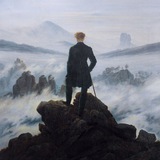
“Et in Arcadia Ego. — I looked down, over waves of hills, to a milky-green lake, through firs and pines austere with age; rocky crags of all shapes about me, the soil gay with flowers and grasses. A herd of cattle moved, stretched, and expanded itself before me; single cows and groups in the distance, in the clearest evening light, hard by the forest of pines; others nearer and darker; all in calm and eventide contentment. My watch pointed to half-past six. The bull of the herd had stepped into the white foaming brook, and went forward slowly, now striving against, now giving way to his tempestuous course; thus, no doubt, he took his sort of fierce pleasure. Two dark brown beings, of Bergamasque origin, tended the herd, the girl dressed almost like a boy. On the left, overhanging cliffs and fields of snow above broad belts of woodland; to the right, two enormous ice-covered peaks, high above me, shimmering in the veil of the sunny haze – all large, silent, and bright. The beauty of the whole was awe-inspiring and induced to a mute worship of the moment and its revelation. Unconsciously, as if nothing could be more natural, you peopled this pure, clear world of light (which had no trace of yearning, of expectancy, of looking forward or backward) with Greek heroes. You felt it all as Poussin and his school felt – at once heroic and idyllic. – So individual humans too have lived, constantly feeling themselves in the world and the world in themselves, and among them one of the greatest humans, the inventor of a heroico-idyllic form of philosophy – Epicurus.”
— Friedrich Nietzsche,
Human, All Too Human (Part II) (§2. 295)
— Friedrich Nietzsche,
Human, All Too Human (Part II) (§2. 295)
My faith in human dignity consists in the belief that man is the greatest scamp on earth. Human dignity must be associated with the idea of a scamp and not with that of an obedient, disciplined and regimented soldier. The scamp is probably the most glorious type of human being, as the soldier is the lowest type, according to this conception. …
I am doing my best to glorify the scamp or vagabond. I hope I shall succeed. For things are not so simple as they sometimes seem. In this present age of threats to democracy and individual liberty, probably only the scamp and the spirit of the scamp alone will save us from becoming lost as serially numbered units in the masses of disciplined, obedient, regimented and uniformed coolies. The scamp will be the last and most formidable enemy of dictatorships. He will be the champion of human dignity and individual freedom, and will be the last to be conquered. All modern civilization depends entirely upon him.
— Lin Yutang, The Importance of Living (chapter 1. §3)
The world, I believe, is far too serious, and being far too serious, is it has need of a wise and merry philosophy. The philosophy of the Chinese art of living can certainly be called the ‘gay science,’ if anything can be called by that phrase used by Nietzsche. After all, only a gay philosophy is profound philosophy; the serious philosophies of the West haven’t even begun to understand what life is. To me personally, the only function of philosophy is to teach us to take life more lightly and gayly than the average businessman does, for no businessman who does not retire at fifty, if he can, is in my eyes a philosopher. This is not merely a casual thought, but is a fundamental point of view with me. The world can be made a more peaceful and more reasonable place to live in only when men have imbued themselves in the light gayety of this spirit. The modern man takes life far too seriously, and because he is too serious, the world is full of troubles. We ought, therefore, to take time to examine the origin of that attitude which will make possible a wholehearted enjoyment of this life and a more reasonable, more peaceful and less hot-headed temperament.
— Lin Yutang, The Importance of Living (chapter 1. §3)
I think that, from a biological standpoint, human life almost reads like a poem. It has its own rhythm and beat, its internal cycles of growth and decay. It begins with innocent childhood, followed by awkward adolescence trying awkwardly to adapt itself to mature society, with its young passions and follies, its ideals and ambitions; then it reaches a manhood of intense activities, profiting from experience and learning more about society and human nature; at middle age, there is a slight easing of tension, a mellowing of character like the ripening of fruit or the mellowing of good wine, and the gradual acquiring of a more tolerant, more cynical and at the same time a kindlier view of life; then in the sunset of our life, the endocrine glands decrease their activity, and if we have a true philosophy of old age and have ordered our life pattern according to it, it is for us the age of peace and security and leisure and contentment; finally, life flickers out and one goes into eternal sleep, never to wake up again. …
No one can say that a life with childhood, manhood and old age is not a beautiful arrangement; the day has its morning, noon and sunset, and the year has its seasons, and it is good that it is so. There is no good or bad in life, except what is good according to its own season. And if we take this biological view of life and try to live according to the seasons, no one but a conceited fool or an impossible idealist can deny that human life can be lived like a poem. Shakespeare has expressed this idea more graphically in his passage about the seven stages of life, and a good many Chinese writers have said about the same thing.
— Lin Yutang, The Importance of Living (chapter 2. §5)
“Counting and Measuring. — The art of seeing many things, of weighing one with another, of reckoning one thing with another and constructing from them a rapid conclusion, a fairly correct sum – that goes to make a great politician or general or merchant. This quality is, in fact, a power of speedy mental calculation. The art of seeing one thing alone, of finding therein the sole motive for action, the guiding principle of all other action, goes to make the hero and also the fanatic. This quality means a dexterity in measuring with one scale.”
— Friedrich Nietzsche,
Human, All Too Human (Part II) (§2. 296)
— Friedrich Nietzsche,
Human, All Too Human (Part II) (§2. 296)
“Not to See too Soon. — As long as we undergo some experience, we must give ourselves up to the experience and shut our eyes – in other words, not become observers of what we are undergoing. For to observe would disturb good digestion of the experience, and instead of wisdom we should gain nothing but dyspepsia.”
— Friedrich Nietzsche,
Human, All Too Human (Part II) (§2. 297)
— Friedrich Nietzsche,
Human, All Too Human (Part II) (§2. 297)
“From the Practice of the Wise. — To become wise we must will to undergo certain experiences, and accordingly leap into their jaws. This, it is true, is very dangerous. Many a ‘sage’ has been eaten up in the process.”
— Friedrich Nietzsche,
Human, All Too Human (Part II) (§2. 298)
— Friedrich Nietzsche,
Human, All Too Human (Part II) (§2. 298)
“Honesty. — It is but a small thing to be a pattern [Muster; model] sort of person with regard to rights and property – for instance (to name trifling points, which of course give a better proof of this sort of pattern nature than great examples), if as a boy one never steals fruit from another's orchard, and as a man never walks on unmown fields. It is but little; you are then still only a ‘law-abiding person,’ with just that degree of morality of which a ‘society,’ a group of human beings, is capable.”
— Friedrich Nietzsche,
Human, All Too Human (Part II) (§2. 303)
— Friedrich Nietzsche,
Human, All Too Human (Part II) (§2. 303)
❤1
“Man! — What is the vanity of the vainest individual as compared with the vanity which the most modest person feels when he thinks of his position in nature and in the world as ‘Man!’”
— Friedrich Nietzsche,
Human, All Too Human (Part II) (§2. 304)
— Friedrich Nietzsche,
Human, All Too Human (Part II) (§2. 304)
❤2
“The Most Necessary Gymnastic. — Through deficiency in self-control in small matters a similar deficiency on great occasions slowly arises. Every day on which we have not at least once denied ourselves some trifle is turned to bad use and a danger to the next day. This gymnastic is indispensable if we wish to maintain the joy of being our own master.”
— Friedrich Nietzsche,
Human, All Too Human (Part II) (§2. 305)
— Friedrich Nietzsche,
Human, All Too Human (Part II) (§2. 305)
❤2
“Fundamental idea of a commercial culture. — Today one can see coming into existence the culture of a society of which commerce is as much the soul as personal contest was with the ancient Greeks and as war, victory and justice were for the Romans. The man engaged in commerce understands how to appraise everything without having made it, and to appraise it according to the needs of the consumer, not according to his own needs; ‘who and how many will consume this?’ is his question of questions. This type of appraisal he then applies instinctively and all the time: he applies it to everything, and thus also to the productions of the arts and sciences, of thinkers, scholars, artists, statesmen, peoples and parties, of the entire age: in regard to everything that is made he inquires after supply and demand in order to determine the value of a thing in his own eyes. This becomes the character of an entire culture, thought through in the minutest and subtlest detail and imprinted in every will and every faculty: it is this of which you men of the coming century will be proud: if the prophets of the commercial class are right to give it into your possession! But I have little faith in these prophets. Credat Judaeus Apella – in the words of Horace.”
— Friedrich Nietzsche,
The Dawn of Day (175)
— Friedrich Nietzsche,
The Dawn of Day (175)
❤1
Dionysian Anarchism
Culture and the state – one should not deceive oneself about this – are antagonists: ‘Culture-State’ [‚Kultur-Staat‘] is merely a modern idea. One lives off the other, one thrives at the expense of the other. All great ages of culture are ages of political decline: what is great culturally has always been unpolitical, even anti-political.
Anarchism as Nietzschean anti-politics
My interpretation of anarchism as a social and (anti-)political philosophy is inspired from this quote of Nietzsche. It does point to some new interpretation of politics, and to a new conception of society, so to speak. And the fundamental antagonism between the state and culture that the quote points out, is a great insight, something that has already influenced many anarchists, such as Rudolf Rocker who expanded upon it in his works like Nationalism and Culture and Anarcho-Syndicalism. A beautiful quote!
Also, direct action is, for us anarchists, a manifestation of a strong will to power, just as the anarchic nature itself is the consequence of an overflowing life: of fullness — of overfullness of existence!
My interpretation of anarchism as a social and (anti-)political philosophy is inspired from this quote of Nietzsche. It does point to some new interpretation of politics, and to a new conception of society, so to speak. And the fundamental antagonism between the state and culture that the quote points out, is a great insight, something that has already influenced many anarchists, such as Rudolf Rocker who expanded upon it in his works like Nationalism and Culture and Anarcho-Syndicalism. A beautiful quote!
Also, direct action is, for us anarchists, a manifestation of a strong will to power, just as the anarchic nature itself is the consequence of an overflowing life: of fullness — of overfullness of existence!
❤1
“As little State as possible. — Political and economic affairs are not worthy of being the enforced concern of society’s most gifted spirits: such a wasteful use of the spirit is at bottom worse than having none at all. They are and remain domains for lesser heads, and others than lesser heads ought not to be in the service of these workshops: better for the machinery to fall to pieces again! But as things now stand, with everybody believing he is obliged to know what is taking place here every day and neglecting his own work in order to be continually participating in it, the whole arrangement has become a great and ludicrous piece of insanity. The price being paid for ‘universal security’ is much too high: and the maddest thing is that what is being effected is the very opposite of universal security, a fact our lovely century is undertaking to demonstrate: as if demonstration were needed! To make society safe against thieves and fireproof and endlessly amenable to every kind of trade and traffic, and to transform the state into a kind of providence in both the good and the bad sense – these are lower, mediocre and in no way indispensable goals which ought not to be pursued by means of the highest instruments which in any way exist – instruments which ought to be saved up for the highest and rarest objectives! Our age may talk about economy but it is in fact a squanderer: it squanders the most precious thing there is, the spirit.”
— Friedrich Nietzsche,
The Dawn of Day (179)
— Friedrich Nietzsche,
The Dawn of Day (179)
❤1
“I heartily accept the motto,—‘That government is best which governs least;’ and I should like to see it acted up to more rapidly and systematically. Carried out, it finally amounts to this, which also I believe—‘That government is best which governs not at all;’ and when men are prepared for it, that will be the kind of government which they will have. Government is at best but an expedient; but most governments are usually, and all governments are sometimes, inexpedient. The objections which have been brought against a standing army, and they are many and weighty, and deserve to prevail, may also at last be brought against a standing government. The standing army is only an arm of the standing government. The government itself, which is only the mode which the people have chosen to execute their will, is equally liable to be abused and perverted before the people can act through it.”
— Henry David Thoreau, Civil Disobedience
— Henry David Thoreau, Civil Disobedience
❤1
The Indian Rationalist
Photo
Constitutionalism is a hopeless ideology...
It is impotent against fascism...
Don't forget that it is Constitutionalism that makes fascism possible.
A bourgeois, representative democracy — i.e., a fake democracy — is what makes fascism possible.
Demagoguery is an essential feature of bourgeois democracy, as is oppression and exploitation, fundamentally.
You can never really completely overcome the threat of fascism within a statist, hierarchical society. Pretty much all countries today prove this, even Germany and Italy which had the most brutal, most horrible fascist regimes in history.
The fight against fascism is also a fight against the state, against all social hierarchies, against caste, against patriarchy, and against Constitutionalism, liberalism, capitalism, etc.
It is impotent against fascism...
Don't forget that it is Constitutionalism that makes fascism possible.
A bourgeois, representative democracy — i.e., a fake democracy — is what makes fascism possible.
Demagoguery is an essential feature of bourgeois democracy, as is oppression and exploitation, fundamentally.
You can never really completely overcome the threat of fascism within a statist, hierarchical society. Pretty much all countries today prove this, even Germany and Italy which had the most brutal, most horrible fascist regimes in history.
The fight against fascism is also a fight against the state, against all social hierarchies, against caste, against patriarchy, and against Constitutionalism, liberalism, capitalism, etc.
❤1👍1