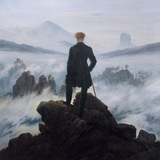
Every hierarchical, authoritarian system is a death machine, rooted in ressentiment and perpetuates itself through it...
A cancer...
All they do ultimately is kill life, both literally and figuratively...
Only those spirits vigorously full of life can bring the death machine to an end, so that life may flourish... so that we all may thrive
Every (wanna-be) authority, every (wanna-be) cop, every fascist manifests this desire for death within them... their will too weak to overcome it, too weak to affirm life... (but there is nothing essentialist about it, one can overcome this condition)
A cancer...
All they do ultimately is kill life, both literally and figuratively...
Only those spirits vigorously full of life can bring the death machine to an end, so that life may flourish... so that we all may thrive
Every (wanna-be) authority, every (wanna-be) cop, every fascist manifests this desire for death within them... their will too weak to overcome it, too weak to affirm life... (but there is nothing essentialist about it, one can overcome this condition)
❤1
There are still harmless self-observers who believe that there are ‘immediate certainties’; for instance, ‘I think,’ or as the superstition of Schopenhauer puts it, ‘I will’; as though cognition here got hold of its object purely and simply as ‘the thing in itself,’ without any falsification taking place either on the part of the subject or the object. I would repeat it, however, a hundred times, that ‘immediate certainty,’ as well as ‘absolute knowledge’ and the ‘thing in itself,’ involve a contradictio in adjecto;* we really ought to free ourselves from the misleading significance of words! The people on their part may think that cognition is knowing all about things, but the philosopher must say to himself: “When I analyze the process that is expressed in the sentence, ‘I think,' I find a whole series of daring assertions, the argumentative proof of which would be difficult, perhaps impossible: for instance, that it is I who think, that there must necessarily be something that thinks, that thinking is an activity and operation on the part of a being who is thought of as a cause, that there is an ‘I’ [ego], and finally, that it is already determined what is to be designated by thinking—that I know what thinking is. For if I had not already decided within myself what it is, by what standard could I determine whether that which is just happening is not perhaps ‘willing’ or ‘feeling’? In short, the assertion ‘I think,’ assumes that I compare my state at the present moment with other states of myself which I know, in order to determine what it is; on account of this retrospective connection with further ‘knowledge,’ it has, at any rate, no immediate certainty for me.”
In place of the ‘immediate certainty’ in which the people may believe in the given case, the philosopher thus finds a series of metaphysical questions presented to him, veritable conscience questions of the intellect, to wit: “Whence did I get the notion of ‘thinking’? Why do I believe in cause and effect? What gives me the right to speak of an ‘ego,’ and even of an ‘ego’ as cause, and finally of an ‘ego’ as cause of thought?” He who ventures to answer these metaphysical questions at once by an appeal to a sort of intuitive perception, like the person who says, “I think, and know that this, at least, is true, actual, and certain”—will encounter a smile and two notes of interrogation in a philosopher nowadays. “Sir,” the philosopher will perhaps give him to understand, “it is improbable that you are not mistaken, but why should it be the truth?”
* Latin: a logical inconsistency between a noun and its modifier
— Friedrich Nietzsche,
Beyond Good and Evil (16)
❤1
With regard to the superstitions of logicians, I shall never tire of emphasizing a small, terse fact, which is unwillingly recognized by these credulous minds—namely, that a thought comes when ‘it’ wishes, and not when ‘I’ wish; so that it is a perversion of the facts of the case to say that the subject ‘I’ is the condition of the predicate ‘think.’ One thinks;* but that this ‘one’ [es] is precisely the famous old ‘ego,’ is, to put it mildly, only a supposition, an assertion, and assuredly not an ‘immediate certainty.’ After all, one has even gone too far with this ‘one thinks’—even the ‘one’ contains an interpretation of the process, and does not belong to the process itself. One infers here according to the usual grammatical formula—“To think is an activity; every activity requires an agency that is active; consequently”... It was pretty much on the same lines that the older atomism sought, besides the operating ‘power,’ the material particle wherein it resides and out of which it operates—the atom. More rigorous minds, however, learnt at last to get along without this ‘earth-residuum’ [Erdenrest], and perhaps some day we shall accustom ourselves, even from the logician's point of view, to get along without the little ‘one’ (to which the worthy old ‘ego’ has refined itself).
* es denkt — another translator (Marion Faber) interprets this as ‘there is thinking’
It is certainly not the least charm of a theory that it is refutable; it is precisely thereby that it attracts the more subtle minds. It seems that the hundred-times-refuted theory of the ‘free will’ owes its persistence to this charm alone; some one is always appearing who feels himself strong enough to refute it.
— Friedrich Nietzsche,
Beyond Good and Evil (17, 18)
❤1
Forwarded from Intellectual cemetery 💀 (Revolutionary Girl)
“Not every love story is written the same way. I don’t need a happy ending. I need our ending. The one that might be messy and imperfect, but exclusively ours.”
❤3🔥2
Intellectual cemetery 💀
Photo
“You're not alone. We are accomplices. If you're a witch, then I'll be your warlock.”
❤1
Dionysian Anarchism
human nature
The guy on the left is that philosopher of cringe — Thomas Hobbes
On the right: Jean-Jacques Rousseau, Herbert Marcuse, Peter Kropotkin
On the right: Jean-Jacques Rousseau, Herbert Marcuse, Peter Kropotkin
❤1
“Every philosophy which believes that the problem of existence is touched on, not to say solved, by a political event is a joke- and pseudo-philosophy. Many states have been founded since the world began; that is an old story. How should a political innovation suffice to turn men once and for all into contented inhabitants of the earth? ...
Here, however, we are experiencing the consequences of the doctrine, lately preached from all the rooftops, that the state is the highest goal of mankind and that a man has no higher duty than to serve the state: in which doctrine I recognize a relapse not into paganism but into stupidity. It may be that a man who sees his highest duty in serving the state really knows no higher duties; but there are men and duties existing beyond this — and one of the duties that seems, at least to me, to be higher than serving the state demands that one destroys stupidity in every form, and therefore in this form too. That is why I am concerned with a species of man whose teleology extends somewhat beyond the welfare of a state, with philosophers, and with these only in relation to a world which is again fairly independent of the welfare of a state, that of culture.”
— Friedrich Nietzsche,
Untimely Meditations (III. §4)
Here, however, we are experiencing the consequences of the doctrine, lately preached from all the rooftops, that the state is the highest goal of mankind and that a man has no higher duty than to serve the state: in which doctrine I recognize a relapse not into paganism but into stupidity. It may be that a man who sees his highest duty in serving the state really knows no higher duties; but there are men and duties existing beyond this — and one of the duties that seems, at least to me, to be higher than serving the state demands that one destroys stupidity in every form, and therefore in this form too. That is why I am concerned with a species of man whose teleology extends somewhat beyond the welfare of a state, with philosophers, and with these only in relation to a world which is again fairly independent of the welfare of a state, that of culture.”
— Friedrich Nietzsche,
Untimely Meditations (III. §4)
❤1
“When [the philosopher] thinks of the haste and hurry now universal, of the increasing velocity of life, of the cessation of all contemplativeness and simplicity, he almost thinks that what he is seeing are the symptoms of a total extermination and uprooting of culture. The waters of religion are ebbing away and leaving behind swamps or stagnant pools; the nations are again drawing away from one another in the most hostile fashion and long to tear one another to pieces. The sciences, pursued without any restraint and in a spirit of the blindest laissez faire, are shattering and dissolving all firmly held belief; the educated classes and states are being swept along by a hugely contemptible money economy. The world has never been more worldly, never poorer in love and goodness. The educated classes are no longer lighthouses or refuges in the midst of this turmoil of secularization; they themselves grow daily more restless, thoughtless and loveless. Everything, contemporary art and science included, serves the coming barbarism. The cultured man has degenerated to the greatest enemy of culture, for he wants lyingly to deny the existence of the universal sickness and thus obstructs the physicians. They become incensed, these poor wretches, whenever one speaks of their weakness and resists their pernicious lying spirit. They would dearly like to make us believe that of all the centuries theirs has borne the prize away, and they shake with artificial merriment. Their way of hypocritically simulating happiness sometimes has something touching about it, because their happiness is something so completely incomprehensible.”
— Friedrich Nietzsche,
Untimely Meditations (III. §4)
— Friedrich Nietzsche,
Untimely Meditations (III. §4)
❤1
Intellectual cemetery 💀
I am an aggressive black hole, always have been, and always will be.
So am I, Süße...
Shall we – shall we merge and shake up the spacetime?
After all, our gravity is irresistible 👉🏼👈🏼
Shall we – shall we merge and shake up the spacetime?
After all, our gravity is irresistible 👉🏼👈🏼
❤1
“If it may be one-sided to emphasize only the weakness of the outlines and the dullness of the colours in the picture of modern life, the other side of the picture is in no way more gratifying but only more disturbing. There are certainly forces there, tremendous forces, but savage, primal and wholly merciless. One gazes upon them with a fearful expectation, as though gazing into the cauldron of a witch's kitchen: at any moment sparks and flashes may herald dreadful apparitions. For a century we have been preparing for absolutely fundamental convulsions; and if there have recently been attempts to oppose this deepest of modern inclinations, to collapse or to explode, with the constitutive power of the so-called nation state, the latter too will for a long time serve only to augment the universal insecurity and atmosphere of menace. That individuals behave as though they knew nothing of all these anxieties does not mislead us: their restlessness reveals how well they know of them; they think with a precipitancy and with an exclusive preoccupation with themselves never before encountered in man, they build and plant for their own day alone...”
— Friedrich Nietzsche,
Untimely Meditations (III. §4)
— Friedrich Nietzsche,
Untimely Meditations (III. §4)
❤1👍1
I'm so overflowing with life that should I have to choose between ending my life once and for all, and having to live this same life — exactly the same way — again and again, for all eternity... I'd choose the latter without hesitation
The eternal recurrence of life ❤️
The eternal recurrence of life ❤️
🔥1
“Nowadays the crudest and most evil forces, the egoism of the money-makers and the military despots, hold sway over almost everything on earth. In the hands of these despots and money-makers, the state certainly makes an attempt to organize everything anew out of itself and to bind and constrain all those mutually hostile forces: that is to say, it wants men to render it the same idolatry they formerly rendered the church. With what success? We have still to learn; we are, in any case, even now still in the ice-filled stream of the Middle Ages; it has thawed and is rushing on with devastating power. Ice-floe piles on ice-floe, all the banks have been inundated and are in danger of collapse. The revolution is absolutely unavoidable, and it will be the atomistic revolution: but what are the smallest indivisible basic constituents of human society?”
— Friedrich Nietzsche,
Untimely Meditations (III. §4)
— Friedrich Nietzsche,
Untimely Meditations (III. §4)
Re-living the entire life — even again and again — is worth it for a single great, beautiful moment
Ressentiment, the death drive, guilt etc — characterizing weakness of will — typically lead to ascetic renunciation and passive nihilism, to inaction in a sense... and that's deplorable enough...
But when they do lead to action — when they become "creative", when they become the driving factors behind movements etc — that is when the slave morality triumphs... and it's all the worse!
They cannot lead to liberation or creation, but only to destruction of everything, to destruction of life, to death and only death... not destruction for the sake of creation, as in active nihilism, but destruction for the sake of destruction...
Fascism is the clearest example of this.
But it's not only explicitly reactionary movements that exemplify this...
Every "liberation" movement which doesn't oppose the State — the greatest death machine — and worse, aims to take control of it and make it "omnipotent"; and, in general, which doesn't aim for and work for effecting the transvaluation of all values... every such movement is also an instance of the foregoing death cults.
But when they do lead to action — when they become "creative", when they become the driving factors behind movements etc — that is when the slave morality triumphs... and it's all the worse!
They cannot lead to liberation or creation, but only to destruction of everything, to destruction of life, to death and only death... not destruction for the sake of creation, as in active nihilism, but destruction for the sake of destruction...
Fascism is the clearest example of this.
But it's not only explicitly reactionary movements that exemplify this...
Every "liberation" movement which doesn't oppose the State — the greatest death machine — and worse, aims to take control of it and make it "omnipotent"; and, in general, which doesn't aim for and work for effecting the transvaluation of all values... every such movement is also an instance of the foregoing death cults.