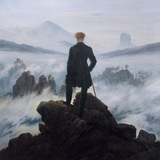
Dionysian Anarchism
Photo
By our best enemies we do not want to be spared, nor by those either whom we love from the very heart.
I know the hatred and envy of your hearts. Ye are not great enough not to know of hatred and envy. Then be great enough not to be ashamed of them!
And if ye cannot be saints of knowledge, then, I pray you, be at least its warriors. They are the companions and forerunners of such saintship.
I see many soldiers; could I but see many warriors! “Uniform” one calleth what they wear; may it not be uniform what they therewith hide!
Ye shall be those whose eyes ever seek for an enemy—for your enemy. And with some of you there is hatred at first sight.
Your enemy shall ye seek; your war shall ye wage, and for the sake of your thoughts! And if your thoughts succumb, your uprightness shall still shout triumph thereby!
— Friedrich Nietzsche,
Thus Spoke Zarathustra
👍3👎1
“The psychological tact of the Germans seems very questionable to me, in view of quite a number of cases which modesty prevents me from enumerating. In one case I shall not lack a great occasion to substantiate my thesis: I bear the Germans a grudge for having made such a mistake about Kant and his ‘backdoor philosophy,’ as I call it — for that was not the type of intellectual integrity.”
— Friedrich Nietzsche,
Twilight of the Idols (§9. 16)
— Friedrich Nietzsche,
Twilight of the Idols (§9. 16)
👍3
“The most spiritual human beings, if we assume that they are the most courageous, also experience by far the most painful tragedies: but just for that reason they honor life because it pits its greatest opposition against them.”
— Friedrich Nietzsche,
Twilight of the Idols (§9. 17)
— Friedrich Nietzsche,
Twilight of the Idols (§9. 17)
👍3👎1
“Beautiful and ugly [‘fair and foul’]. — Nothing is more conditional — or, let us say, narrower — than our feeling for beauty. Whoever would think of it apart from man's joy in man would immediately lose any foothold. ‘Beautiful in itself’ is a mere phrase, not even a concept. In the beautiful, man posits himself as the measure of perfection; in special cases he worships himself in it. A species cannot do otherwise but thus affirm itself alone. Its lowest instinct, that of self-preservation and self-expansion, still radiates in such sublimities. Man believes the world itself to be overloaded with beauty — and he forgets himself as the cause of this. He alone has presented the world with beauty — alas! only with a very human, all-too-human beauty. At bottom, man mirrors himself in things; he considers everything beautiful that reflects his own image: the judgment ‘beautiful’ is the vanity of his species. For a little suspicion may whisper this question into the skeptic's ear: Is the world really beautified by the fact that man thinks it beautiful? He has humanized it, that is all. But nothing, absolutely nothing, guarantees that man should be the model of beauty. Who knows what he looks like in the eyes of a higher judge of beauty? Daring perhaps? Perhaps even amusing? Perhaps a little arbitrary?
‘O Dionysus, divine one, why do you pull me by my ears?’ Ariadne once asked her philosophic lover during one of those famous dialogues on Naxos. ‘I find a kind of humor in your ears, Ariadne: why are they not even longer?’”
— Friedrich Nietzsche,
Twilight of the Idols (§9. 19)
‘O Dionysus, divine one, why do you pull me by my ears?’ Ariadne once asked her philosophic lover during one of those famous dialogues on Naxos. ‘I find a kind of humor in your ears, Ariadne: why are they not even longer?’”
— Friedrich Nietzsche,
Twilight of the Idols (§9. 19)
mein liebes süßestes Kätzchen,
mein revolutionäres Mädchen...
wie für dich mein ganzes Herz voller Leidenschaft ist! –
welche Etwas jenseits von Liebe und Freundschaft ist –
bist du mein Engel?
oder... mein Teufel?
oh, eigentlich bist du beides!
das Leben meines Herzens...
du bist ein Kätzchen und eine Löwin,
auch meine anbetungswürdige Göttin!
die furchtbare, unbesiegbare Kriegerin.
du und ich, wir werden zum Märchen –
eine Ewigkeit mit dir, mein Schätzchen!
von: Dionysos
an: meri jungli billi
mein revolutionäres Mädchen...
wie für dich mein ganzes Herz voller Leidenschaft ist! –
welche Etwas jenseits von Liebe und Freundschaft ist –
bist du mein Engel?
oder... mein Teufel?
oh, eigentlich bist du beides!
das Leben meines Herzens...
du bist ein Kätzchen und eine Löwin,
auch meine anbetungswürdige Göttin!
die furchtbare, unbesiegbare Kriegerin.
du und ich, wir werden zum Märchen –
eine Ewigkeit mit dir, mein Schätzchen!
von: Dionysos
an: meri jungli billi
❤2
“Nothing is beautiful, except man alone: all aesthetics rests upon this naïveté, which is its first truth. Let us immediately add the second: nothing is ugly except the degenerating man — and with this the realm of aesthetic judgment is circumscribed. Physiologically, everything ugly weakens and saddens man. It reminds him of decay, danger, impotence; it actually deprives him of strength. One can measure the effect of the ugly with a dynamometer. Wherever man is depressed at all, he senses the proximity of something ‘ugly.’ His feeling of power, his will to power, his courage, his pride — all fall with the ugly and rise with the beautiful. In both cases we draw an inference: the premises for it are piled up in the greatest abundance in instinct. The ugly is understood as a sign and symptom of degeneration: whatever reminds us in the least of degeneration causes in us the judgment of ‘ugly.’ Every suggestion of exhaustion, of heaviness, of age, of weariness; every kind of lack of freedom, such as cramps, such as paralysis; and above all, the smell, the color, the form of dissolution, of decomposition — even in the ultimate attenuation into a symbol — all evoke the same reaction, the value judgment, ‘ugly.’ A hatred is aroused — but whom does man hate then? There is no doubt: the decline of his type. Here he hates out of the deepest instinct of the species; in this hatred there is a shudder, caution, depth, farsightedness — it is the deepest hatred there is. It is because of this that art is deep.”
— Friedrich Nietzsche,
Twilight of the Idols (§9. 20)
— Friedrich Nietzsche,
Twilight of the Idols (§9. 20)
❤1
spoken like a true liberal
all these clowns who complain about people being lazy can't imagine a different world; in spite of all their revolutionary aesthetics (LARPing), at most they want a slightly different version of the current system to be perpetuated.
leftists who bootlick dictators; leftists who condemn idleness, laziness, anti-work philosophy, etc
all these clowns who complain about people being lazy can't imagine a different world; in spite of all their revolutionary aesthetics (LARPing), at most they want a slightly different version of the current system to be perpetuated.
leftists who bootlick dictators; leftists who condemn idleness, laziness, anti-work philosophy, etc
👍3
I'll worship you, my Beauty,
but not just for your beauty...
but for everything that you are...
my evil Goddess that you are!
For a moment that lasts an eternity,
and an eternity that lasts a moment...
but not just for your beauty...
but for everything that you are...
my evil Goddess that you are!
For a moment that lasts an eternity,
and an eternity that lasts a moment...
Dionysian Anarchism
“Schopenhauer. — Schopenhauer, the last German worthy of consideration (who represents a European event like Goethe, like Hegel, like Heinrich Heine, and not merely a local event, a ‘national’ one), is for a psychologist a first-rate case: namely, as a maliciously…
“I take a single case. Schopenhauer speaks of beauty with a melancholy fervor. Why? Because he sees in it a bridge on which one will go farther, or develop a thirst to go farther. Beauty is for him a momentary redemption from the ‘will’ — a lure to eternal redemption. Particularly, he praises beauty as the redeemer from ‘the focal point of the will,’ from sexuality — in beauty he sees the negation of the drive toward procreation. Queer saint! Somebody seems to be contradicting you; I fear it is nature. To what end is there any such thing as beauty in tone, color, fragrance, or rhythmic movement in nature? What is it that beauty evokes? Fortunately, a philosopher contradicts him too. No lesser authority than that of the divine Plato (so Schopenhauer himself calls him) maintains a different proposition: that all beauty incites procreation, that just this is the proprium of its effect, from the most sensual up to the most spiritual.”
— Friedrich Nietzsche,
Twilight of the Idols (§9. 22)
— Friedrich Nietzsche,
Twilight of the Idols (§9. 22)
👏4🤡1
“L'art pour l'art. — The fight against purpose in art is always a fight against the moralizing tendency in art, against its subordination to morality. L'art pour l'art means, ‘The devil take morality!’ But even this hostility still betrays the overpowering force of the prejudice. When the purpose of moral preaching and of improving man has been excluded from art, it still does not follow by any means that art is altogether purposeless, aimless, senseless — in short, l'art pour l'art, a worm chewing its own tail. ‘Rather no purpose at all than a moral purpose!’ — that is the talk of mere passion. A psychologist, on the other hand, asks: what does all art do? does it not praise? glorify? choose? prefer? With all this it strengthens or weakens certain valuations. Is this merely a ‘moreover’? an accident? something in which the artist's instinct had no share? Or is it not the very presupposition of the artist's ability? Does his basic instinct aim at art, or rather at the sense of art, at life? at a desirability of life? Art is the great stimulus to life: how could one understand it as purposeless, as aimless, as l'art pour l'art?”
— Friedrich Nietzsche,
Twilight of the Idols (§9. 24)
— Friedrich Nietzsche,
Twilight of the Idols (§9. 24)
👍1
“One question remains: art also makes apparent much that is ugly, hard, and questionable in life; does it not thereby spoil life for us? And indeed there have been philosophers who attributed this sense to it: ‘liberation from the will’ was what Schopenhauer taught as the overall end of art; and with admiration he found the great utility of tragedy in its ‘evoking resignation.’ But this, as I have already suggested, is the pessimist's perspective and ‘evil eye.’ We must appeal to the artists themselves. What does the tragic artist communicate of himself? Is it not precisely the state without fear in the face of the fearful and questionable that he is showing? This state itself is a great desideratum, whoever knows it, honors it with the greatest honors. He communicates it — must communicate it, provided he is an artist, a genius of communication. Courage and freedom of feeling before a powerful enemy, before a sublime calamity, before a problem that arouses dread — this triumphant state is what the tragic artist chooses, what he glorifies. Before tragedy, what is warlike in our soul celebrates its Saturnalia; whoever is used to suffering, whoever seeks out suffering, the heroic man praises his own being through tragedy — to him alone the tragedian presents this drink of sweetest cruelty.”
— Friedrich Nietzsche,
Twilight of the Idols (§9. 24)
— Friedrich Nietzsche,
Twilight of the Idols (§9. 24)
❤1
“We no longer have sufficiently high esteem for ourselves when we communicate. Our true experiences are not at all garrulous. They could not communicate themselves even if they tried: they lack the right words. We have already gone beyond whatever we have words for. In all talk there is a grain of contempt. Language, it seems, was invented only for what is average, medium, communicable. By speaking the speaker immediately vulgarizes himself. — Out of a morality for deaf-mutes and other philosophers.”
— Friedrich Nietzsche,
Twilight of the Idols (§9. 26)
— Friedrich Nietzsche,
Twilight of the Idols (§9. 26)
❤3🥰1