Save result of echo command in a variable
This is a very basic question, but I am new to bash noscripting. In the code snippet below, I am trying to extract something from a file and save it to a variable. What I have shown in the first echo command is working correctly. Instead of echoing it, I want to save it to a variable. The stuff below that is not working, I feel like maybe I am missing brackets or have the $ in the wrong place. Thanks in advance for your help! Sorry about the bad formatting, I am posting from my phone.
#!/bin/bash
header_file="../../build.vivado/output/headers/axi_gp_header.vh"
# Extract the 3rd word (reg value) from the line that contains the word "DIAGNOSTICS":
echo $(grep "DIAGNOSTICS" $header_file) | cut -d " " -f 3
# This does not print the same thing as above:
REG_VALUE=$((grep "DIAGNOSTICS" $header_file) | cut -d " " -f 3)
echo $REG_VALUE
https://redd.it/yxtsx7
@r_bash
This is a very basic question, but I am new to bash noscripting. In the code snippet below, I am trying to extract something from a file and save it to a variable. What I have shown in the first echo command is working correctly. Instead of echoing it, I want to save it to a variable. The stuff below that is not working, I feel like maybe I am missing brackets or have the $ in the wrong place. Thanks in advance for your help! Sorry about the bad formatting, I am posting from my phone.
#!/bin/bash
header_file="../../build.vivado/output/headers/axi_gp_header.vh"
# Extract the 3rd word (reg value) from the line that contains the word "DIAGNOSTICS":
echo $(grep "DIAGNOSTICS" $header_file) | cut -d " " -f 3
# This does not print the same thing as above:
REG_VALUE=$((grep "DIAGNOSTICS" $header_file) | cut -d " " -f 3)
echo $REG_VALUE
https://redd.it/yxtsx7
@r_bash
reddit
Save result of echo command in a variable
This is a very basic question, but I am new to bash noscripting. In the code snippet below, I am trying to extract something from a file and save it...
Bash - Renaming text file names based on word count
I am new to bash and have been struggling to figure this problem out. I have been trying to figure out how to go through a directory that contains all text file, sort and rename each text file according to their word count. I am trying to rename them 1.txt 2.txt 3.txt etc. 1.txt being the file with the least amount of words.
i=1
wc -w ./test1/txt | sort -n |
for files in./test1/txt; do
mv "$files" "./test1/$i.txt"
let i++
done;
This would rename the files 1,2,3.txt etc but it wont be in order of word count.
​
Thanks!
https://redd.it/yxw1nc
@r_bash
I am new to bash and have been struggling to figure this problem out. I have been trying to figure out how to go through a directory that contains all text file, sort and rename each text file according to their word count. I am trying to rename them 1.txt 2.txt 3.txt etc. 1.txt being the file with the least amount of words.
i=1
wc -w ./test1/txt | sort -n |
for files in./test1/txt; do
mv "$files" "./test1/$i.txt"
let i++
done;
This would rename the files 1,2,3.txt etc but it wont be in order of word count.
​
Thanks!
https://redd.it/yxw1nc
@r_bash
reddit
Bash - Renaming text file names based on word count
I am new to bash and have been struggling to figure this problem out. I have been trying to figure out how to go through a directory that contains...
There seems to be a ghost in my array.
Here's the noscript:
get_names() { sudo virsh list --all | sed 1,2d | tr -s ' ' | cut -d ' ' -f 3 }
mapfile -t names < <( get_names )
printf '%s\\n' "${names[@\]}"; printf '%s\\n' "${#names[@\]}"
exit
There should be 5 elements in $names, but the noscript says there are 6. I manually the edits to virsh list output and they seem fine. I even rewrote the edits from the original noscript, posted a few days ago. I tested with a simple array, where I fed it the elements, so I know my computer can count ;-)
Any help?
https://redd.it/yxxvuu
@r_bash
Here's the noscript:
get_names() { sudo virsh list --all | sed 1,2d | tr -s ' ' | cut -d ' ' -f 3 }
mapfile -t names < <( get_names )
printf '%s\\n' "${names[@\]}"; printf '%s\\n' "${#names[@\]}"
exit
There should be 5 elements in $names, but the noscript says there are 6. I manually the edits to virsh list output and they seem fine. I even rewrote the edits from the original noscript, posted a few days ago. I tested with a simple array, where I fed it the elements, so I know my computer can count ;-)
Any help?
https://redd.it/yxxvuu
@r_bash
reddit
There seems to be a ghost in my array.
Here's the noscript: get\_names() { sudo virsh list --all | sed 1,2d | tr -s ' ' | cut -d ' ' -f 3 } mapfile -t names < <( get\_names ) printf...
Confused about desktop entry (.desktop) not making executable visible under App Launcher
Hi there,
I have:
added this line to `.bashrc` to append the directory 'Portables' to variable `$PATH`:
​
export PATH=$PATH:/home/abc-pc/Portables
​
applied this code from the terminal:
​
source ~/.bashrc
copied the executable 'xyz' (an AppImage without extension) to 'Portables' with associated `xyz.desktop` and `xyz.png` files placed into `~/.local/share/applications` and `~/.local/share/icons`, respectively.
​
Exec=xyz %f
Icon=xyz
The program runs okay from the terminal by just typing
Question: Why doesn't the program icon show under the Application Launcher? It does, however, when I type in the full path to the program directory inside
Thank you!
https://redd.it/yy2vsg
@r_bash
Hi there,
I have:
added this line to `.bashrc` to append the directory 'Portables' to variable `$PATH`:
​
export PATH=$PATH:/home/abc-pc/Portables
​
applied this code from the terminal:
​
source ~/.bashrc
copied the executable 'xyz' (an AppImage without extension) to 'Portables' with associated `xyz.desktop` and `xyz.png` files placed into `~/.local/share/applications` and `~/.local/share/icons`, respectively.
xyz.desktop contains these lines:​
Exec=xyz %f
Icon=xyz
The program runs okay from the terminal by just typing
$ xyz, not $ ./xyz, which I presume means the system recognises the directory path inserted into `.bashrc`.Question: Why doesn't the program icon show under the Application Launcher? It does, however, when I type in the full path to the program directory inside
xyz.desktop. Although I thought that appending the path to $PATH was enough for the executable to be recognised by simply Exec=xyz (no full path, no file extension).Thank you!
https://redd.it/yy2vsg
@r_bash
reddit
Confused about desktop entry (.desktop) not making executable...
Hi there, I have: * added this line to `.bashrc` to append the directory 'Portables' to variable `$PATH`: export...
Incrementing variable names?
I have a
b=1
select a$b in c d e f
do
$((b++))
done
, but that actually works? Preferably something that uses no more
(If the answer is no, this is not possible with only one
https://redd.it/yy2ryt
@r_bash
I have a
select that I would like to use for assigning values to 4 different variables, a1, a2, a3 and a4. Is there something I could use for this, likeb=1
select a$b in c d e f
do
$((b++))
done
, but that actually works? Preferably something that uses no more
selects than I already have, and not a bunch of nested ifs?(If the answer is no, this is not possible with only one
select and no nested ifs, feel free to let me know.)https://redd.it/yy2ryt
@r_bash
reddit
Incrementing variable names?
I have a `select` that I would like to use for assigning values to 4 different variables, `a1`, `a2`, `a3` and `a4`. Is there something I could...
What color scheme do you use for LS_COLORS?
Are there any specific elements of color scheming that you find particularly useful?
https://redd.it/yy7oyb
@r_bash
Are there any specific elements of color scheming that you find particularly useful?
https://redd.it/yy7oyb
@r_bash
reddit
What color scheme do you use for LS_COLORS?
Are there any specific elements of color scheming that you find particularly useful?
Noob Attempts to write a bash noscript
So, I have been attempting to write a bash noscript, but I don't entirely know what I am doing. I have tried to test out what others have suggested I use/change, but everything in my vm seems to not to see them. I don't know if it changes anything, but the bash noscript is running in vi on a ubuntu console. Anyway, to the actual noscript.
"#"!/bin/bash -x
echo 'Enter the Directory: '
read dd
#This section serves to test if the input is a directory. Following the test, it will resound with a yes or a no.
if -d $dd
then
#If yes, then it will then check if it has a file with the above name. If it does not, it will ask if the person wants it to be created.
echo '$dd is valid directory and it. exists. '
if test -f '$dd'; then
echo '$dd file exists.'
else
read YN
echo '$dd file does not exist. Do you want to create it Y/N? $YN'
#This line below confuses me, but that is because I don't know what is going on.
if [ "$YN" =~ ^(no|No|NO|n|N)$ ] ; then
echo 'File will not be created.'
else
echo 'File will be created.'
touch $dd
fi
fi
else
#It is then suppose to do the same as above, but with a directory instead.
echo '$directory does not exist. Do you want to create it Y/N? $YN'
if [ "$YN" =~ ^(no|No|NO|n|N)$ ] ; then
echo 'Directory will not be created.'
else
echo 'Directory will be created.'
mkdir $dd
fi
fi
The output I am currently getting:
Enter the Directory:
s
$directory does not exist. Do you want to create it Y/N? $YN
Directory will be created.
I don't know what is going wrong. I have tried running it in shellcheck, but the most insight I have gained is "read without -r will mangle backslashes" & "Expressions don't expand in single quotes, use double quotes for that." What am I doing wrong.
https://redd.it/yyeyhc
@r_bash
So, I have been attempting to write a bash noscript, but I don't entirely know what I am doing. I have tried to test out what others have suggested I use/change, but everything in my vm seems to not to see them. I don't know if it changes anything, but the bash noscript is running in vi on a ubuntu console. Anyway, to the actual noscript.
"#"!/bin/bash -x
echo 'Enter the Directory: '
read dd
#This section serves to test if the input is a directory. Following the test, it will resound with a yes or a no.
if -d $dd
then
#If yes, then it will then check if it has a file with the above name. If it does not, it will ask if the person wants it to be created.
echo '$dd is valid directory and it. exists. '
if test -f '$dd'; then
echo '$dd file exists.'
else
read YN
echo '$dd file does not exist. Do you want to create it Y/N? $YN'
#This line below confuses me, but that is because I don't know what is going on.
if [ "$YN" =~ ^(no|No|NO|n|N)$ ] ; then
echo 'File will not be created.'
else
echo 'File will be created.'
touch $dd
fi
fi
else
#It is then suppose to do the same as above, but with a directory instead.
echo '$directory does not exist. Do you want to create it Y/N? $YN'
if [ "$YN" =~ ^(no|No|NO|n|N)$ ] ; then
echo 'Directory will not be created.'
else
echo 'Directory will be created.'
mkdir $dd
fi
fi
The output I am currently getting:
Enter the Directory:
s
$directory does not exist. Do you want to create it Y/N? $YN
Directory will be created.
I don't know what is going wrong. I have tried running it in shellcheck, but the most insight I have gained is "read without -r will mangle backslashes" & "Expressions don't expand in single quotes, use double quotes for that." What am I doing wrong.
https://redd.it/yyeyhc
@r_bash
reddit
Noob Attempts to write a bash noscript
So, I have been attempting to write a bash noscript, but I don't entirely know what I am doing. I have tried to test out what others have suggested...
Get the previous command output buffer
I'm working on a helper noscript that needs to run after every command to analyze its exit status and output logs.
I understand that stdout/stderr buffers are not stored on pseudo terminals. I therefore looked for a way to "save" this output to a temporary file before every command then read it after.
Here's what I added to my
Except when i load a new terminal and enter a command (say
Is what I'm trying to achieve possible? And if so what am I missing here?
Cheers!
https://redd.it/yyjhxo
@r_bash
I'm working on a helper noscript that needs to run after every command to analyze its exit status and output logs.
I understand that stdout/stderr buffers are not stored on pseudo terminals. I therefore looked for a way to "save" this output to a temporary file before every command then read it after.
Here's what I added to my
.bashrc:LAST_OUTPUT_LOG_FILE="~/zero.log"
exec 3>&1 1> >(tee $LAST_OUTPUT_LOG_FILE >&3)
# based on https://superuser.com/a/1111512/1748711
echo "Using $LAST_OUTPUT_LOG_FILE"
precmd () {
LAST_STATUS=$?
LAST_COMMAND=$(fc -ln -1)
echo "Last command: $LAST_COMMAND exited with status $LAST_STATUS"
echo "--------------- LAST COMMAND LOG $LAST_OUTPUT_LOG_FILE ---------------"
cat $LAST_OUTPUT_LOG_FILE
echo "--------------- LAST COMMAND LOG $LAST_OUTPUT_LOG_FILE ---------------"
# run my noscript here with the last command, its status and its output
# reset the log file
echo "" > $LAST_OUTPUT_LOG_FILE
}
export PROMPT_COMMAND=precmd
Except when i load a new terminal and enter a command (say
ls) I get the following error:precmd:echo:3: write error: broken pipe
precmd:3: write error: broken pipe
precmd:echo:4: write error: broken pipe
precmd:4: write error: broken pipe
cat: ~/zero.log: No such file or directory
precmd:echo:6: write error: broken pipe
precmd:6: write error: broken pipe
precmd:10: no such file or directory: ~/zero.log
Is what I'm trying to achieve possible? And if so what am I missing here?
Cheers!
https://redd.it/yyjhxo
@r_bash
reddit
Get the previous command output buffer
I'm working on a helper noscript that needs to run after every command to analyze its exit status and output logs. I understand that stdout/stderr...
If no STDIN read from File
I want a noscript which either writes STDIN to a file or if no STDIN present it reads from that file.
How could I do this? If I use cat to read STDIN, but there is no input it hangs.
Thanks
https://redd.it/yysmhu
@r_bash
I want a noscript which either writes STDIN to a file or if no STDIN present it reads from that file.
How could I do this? If I use cat to read STDIN, but there is no input it hangs.
Thanks
https://redd.it/yysmhu
@r_bash
reddit
If no STDIN read from File
I want a noscript which either writes STDIN to a file or if no STDIN present it reads from that file. How could I do this? If I use cat to read...
How to do a one liner for a CLI login which asks for a access token after login command?
I'm using beta version of a CLI as a tester which keeps asking for logging in with a access token each week when I use it. In bash terminal after I run
Thanks for helping
https://redd.it/yzb4kq
@r_bash
I'm using beta version of a CLI as a tester which keeps asking for logging in with a access token each week when I use it. In bash terminal after I run
noah login it prompts like this Enter access token > . How can I do this in a one liner like noah login > access_token? Thanks for helping
https://redd.it/yzb4kq
@r_bash
reddit
How to do a one liner for a CLI login which asks for a access...
I'm using beta version of a CLI as a tester which keeps asking for logging in with a access token each week when I use it. In bash terminal after...
questions about echo appending
Hello, so my problem with "echo >>" that I do not understand:
I have two files input.txt and output.txt when I loop through the lines of the first file and use "echo >>" to move them to the outputfile I have a blank first line. I understand that echo appends but then I have to question how to get rid of that? Is there no other way than deleting the first line (which seems unnecssary)?
Also if someone could explain why that behaviour is necessary instead of >> just appending beginning in the first line, that would be interesting as well.
Edit: So what my problem was, is that I did not realize that echo with no arguments does echo a blank line, so when I used it to delete the contents of a file I unwillingly inserted a blank line into it. Seems like just "> filename" is a better way to delete the contents of a file
https://redd.it/yzd9dn
@r_bash
Hello, so my problem with "echo >>" that I do not understand:
I have two files input.txt and output.txt when I loop through the lines of the first file and use "echo >>" to move them to the outputfile I have a blank first line. I understand that echo appends but then I have to question how to get rid of that? Is there no other way than deleting the first line (which seems unnecssary)?
Also if someone could explain why that behaviour is necessary instead of >> just appending beginning in the first line, that would be interesting as well.
Edit: So what my problem was, is that I did not realize that echo with no arguments does echo a blank line, so when I used it to delete the contents of a file I unwillingly inserted a blank line into it. Seems like just "> filename" is a better way to delete the contents of a file
https://redd.it/yzd9dn
@r_bash
reddit
questions about echo appending
Hello, so my problem with "echo >>" that I do not understand: I have two files input.txt and output.txt when I loop through the lines of the...
If eval find...
I have archives of archives, at least. I would like a noscript to recursively verify all archives and sub-archives for integrity. What I have works, but I know it's dumb.
Rather than making recursion with a function that calls itself (too confusing, IDK), I've decided to just manually run
declare home="${PWD}"
find . -iname '.zip' -exec sh -c '! [[ -f "${0}.val" ]] && unzip -o -d "${0%.}" "$0" && echo "$0">>$0.val' '{}' \;
find . -iname '.zip' -exec sh -c '! [[ -f "${0}.val" ]] && echo "[ERR] $0"' '{}' \;
#----------
if (
find . -iname '.zip' -exec sh -c '! [ -f "${0}.val" ] && echo "ERR $0">>"${home}log.txt"' '{}' \;
); then
echo " GOOD "
else
echo " FAIL "
fi
So, it finds zip files, and if it doesn't find "zipfile.zip.val", it extracts the contents and creates a dummy file (.val) to denote successful extraction. Then, this second part searches to make sure every .zip has an accompanying dummy file (.val).
The bottom section also just checks for the .val dummy files but instead of echo output, it just logs them and echos whether there were archives with missing .val files or not.
So, it just needs to recursively examine an archive of archives to ensure zip integrity. This is as close as I've gotten. Thanks.
OOPS: I've read that eval may be suggested over my "if (find)" sub shell method. If nothing else, maybe we can answer that!
https://redd.it/yzeqx4
@r_bash
I have archives of archives, at least. I would like a noscript to recursively verify all archives and sub-archives for integrity. What I have works, but I know it's dumb.
Rather than making recursion with a function that calls itself (too confusing, IDK), I've decided to just manually run
find a few times. Ugh. It's still far from what I want.declare home="${PWD}"
find . -iname '.zip' -exec sh -c '! [[ -f "${0}.val" ]] && unzip -o -d "${0%.}" "$0" && echo "$0">>$0.val' '{}' \;
find . -iname '.zip' -exec sh -c '! [[ -f "${0}.val" ]] && echo "[ERR] $0"' '{}' \;
#----------
if (
find . -iname '.zip' -exec sh -c '! [ -f "${0}.val" ] && echo "ERR $0">>"${home}log.txt"' '{}' \;
); then
echo " GOOD "
else
echo " FAIL "
fi
So, it finds zip files, and if it doesn't find "zipfile.zip.val", it extracts the contents and creates a dummy file (.val) to denote successful extraction. Then, this second part searches to make sure every .zip has an accompanying dummy file (.val).
The bottom section also just checks for the .val dummy files but instead of echo output, it just logs them and echos whether there were archives with missing .val files or not.
So, it just needs to recursively examine an archive of archives to ensure zip integrity. This is as close as I've gotten. Thanks.
OOPS: I've read that eval may be suggested over my "if (find)" sub shell method. If nothing else, maybe we can answer that!
https://redd.it/yzeqx4
@r_bash
reddit
If eval find...
I have archives of archives, at least. I would like a noscript to recursively verify all archives and sub-archives for integrity. What I have works,...
longest||coolest Linux pipes you have written
Hello there,it's Saturday and I'm trying to cill reading about awsome pipes. Have you any cool pipe to show off?
https://redd.it/yzfh5k
@r_bash
Hello there,it's Saturday and I'm trying to cill reading about awsome pipes. Have you any cool pipe to show off?
https://redd.it/yzfh5k
@r_bash
reddit
longest||coolest Linux pipes you have written
Hello there,it's Saturday and I'm trying to cill reading about awsome pipes. Have you any cool pipe to show off?
Yet another PS1
pardon my MSYS2 setup, I don't get to decide which system I'm working on
After a metric ton of refinements, I proudly present my personal PS1 with the following features:
Colors (duh!)
Git branch + additions/deletions (Github style)
List of managed jobs
Duration and status of the last command
Left-right design
Written 100% in bash and blazing fast (okay, I may have used sed once...)
Portable (works on Windows)
Easy to configure
Here it is : https://github.com/bdelespierre/dotfiles/blob/master/bash/.bash\_ps1
I am not a bash expert, and I would love to hear your comments on that work.
Thank you for your time and have a great day!
https://redd.it/yzgxax
@r_bash
pardon my MSYS2 setup, I don't get to decide which system I'm working on
After a metric ton of refinements, I proudly present my personal PS1 with the following features:
Colors (duh!)
Git branch + additions/deletions (Github style)
List of managed jobs
Duration and status of the last command
Left-right design
Written 100% in bash and blazing fast (okay, I may have used sed once...)
Portable (works on Windows)
Easy to configure
Here it is : https://github.com/bdelespierre/dotfiles/blob/master/bash/.bash\_ps1
I am not a bash expert, and I would love to hear your comments on that work.
Thank you for your time and have a great day!
https://redd.it/yzgxax
@r_bash
I don't understand this printf behavior
Hello everybody!
I'm new-ish to bash and found this while I was tinkering with `printf`. Let's say that I have the following noscript:
#!/usr/bin/env bash
printf -v test '%-14.*s' 14 '123456789ABCDFGH'
printf "%b\n" \
" ╭─demo─────────╮╮" \
" │ $test " \
" ╰──────────────╯"
the output comes out with 2 extra spaces added
​
[How it comes out with just the text \\"123456789ABCDFGH\\" as the value](https://preview.redd.it/jcnkbyanv01a1.png?width=182&format=png&auto=webp&s=e3fe7ee5985e5db73fa26b0faa36ce1b15da9627)
​
but when I set the `test` variable to `printf -v test '%-14.*s' 14 '│123456789ABCDFGH'` it comes out shifted
​
[How it comes out with \\"│123456789ABCDFGH\\" as the value](https://preview.redd.it/b6xsteddw01a1.png?width=155&format=png&auto=webp&s=8e2cdd2479fceaf8b0096d2da1dced469f1ae681)
​
I've also noticed this happening with nerd-font emojis (which is where I first noticed this happening), so I wonder, is there a reason why this occurs when I add the pipe "│" symbol? And if possible, can I make it always produce the second picture looking result (the shifted one), regardless of having or not the pipe?
https://redd.it/yzugcz
@r_bash
Hello everybody!
I'm new-ish to bash and found this while I was tinkering with `printf`. Let's say that I have the following noscript:
#!/usr/bin/env bash
printf -v test '%-14.*s' 14 '123456789ABCDFGH'
printf "%b\n" \
" ╭─demo─────────╮╮" \
" │ $test " \
" ╰──────────────╯"
the output comes out with 2 extra spaces added
​
[How it comes out with just the text \\"123456789ABCDFGH\\" as the value](https://preview.redd.it/jcnkbyanv01a1.png?width=182&format=png&auto=webp&s=e3fe7ee5985e5db73fa26b0faa36ce1b15da9627)
​
but when I set the `test` variable to `printf -v test '%-14.*s' 14 '│123456789ABCDFGH'` it comes out shifted
​
[How it comes out with \\"│123456789ABCDFGH\\" as the value](https://preview.redd.it/b6xsteddw01a1.png?width=155&format=png&auto=webp&s=8e2cdd2479fceaf8b0096d2da1dced469f1ae681)
​
I've also noticed this happening with nerd-font emojis (which is where I first noticed this happening), so I wonder, is there a reason why this occurs when I add the pipe "│" symbol? And if possible, can I make it always produce the second picture looking result (the shifted one), regardless of having or not the pipe?
https://redd.it/yzugcz
@r_bash
(F18) cis student need help writing an awkward command file for price calculation, professor won't help.
So I am given documents on the file I start with:
Sales for week ending November 20, 2022
"Item Price Mon Tue Wed Thu Fri Sat Sun
----------------‐----------------------------------------------------------------------------------------------------------------------
Cones 3.50 23 12 11 37 55 69 70
Ice Cream Floats 3.50 5 4 13 9 42 16 35
Sodas 2.50 10 20 13 16 22 39 25
Dipped Cones 4.50 13 14 0 22 25 35 55
Banana Splits 7.50 7 17 0 12 12 20 30
Milkshakes 5.00 16 14 15 30 37 38 41
Sundaes 6.00 11 9 12 21 20 43 34"
What I am supposed to do is write an awk command file using vim that when the command line "awk -f salesSummary.awk ProductSales.txt" is entered will output exactly this:
"Item Mon Tue Wed Thu Fri Sat Sun Total
‐----------------------------------------------------------------------------------------------------------------------------------------------------------------------------
Cones $ 80.50 $ 42.00 $ 38.50 $129.50 $192.50 $241.50 $245.00 $ 969.50
Ice Cream Floats $ 17.50 $ 14.00 $ 45.50 $ 31.50 $147.00 $ 56.00 $122.50 $ 434.00
Sodas $ 25.00 $ 50.00 $ 32.50 $ 40.00 $ 55.00 $ 97.50 $ 62.50 $ 362.50
Dipped Cones $ 58.50 $ 63.00 $ 0.00 $ 99.00 $112.50 $157.50 $247.50 $ 738.00
Banana Splits $ 52.50 $127.50 $ 0.00 $ 90.00 $ 90.00 $150.00 $225.00 $ 735.00
Milkshakes $ 80.00 $ 70.00 $ 75.00 $150.00 $185.00 $190.00 $205.00 $ 955.00
Sundaes $ 66.00 $ 54.00 $ 72.00 $126.00 $120.00 $258.00 $204.00 $ 900.00
---------------------------------------------------------------------------------------------------------------------------------------------------------------------------
Sales for week ending November 20, 2022
Total Sales: $5094.00
Top Seller $ 969.50 -- Cones"
What I know so far is that I structure an awk file with this syntax:
BEGIN {
-
-
-
-
}{
-
-
-
-
}
END{
-
-
}
Professor says that code is quite similar to Java but I am still lost :(
How would I go about writing this?
Ps sorry I've never used reddit before apologies for bad format.
https://redd.it/yztzir
@r_bash
So I am given documents on the file I start with:
Sales for week ending November 20, 2022
"Item Price Mon Tue Wed Thu Fri Sat Sun
----------------‐----------------------------------------------------------------------------------------------------------------------
Cones 3.50 23 12 11 37 55 69 70
Ice Cream Floats 3.50 5 4 13 9 42 16 35
Sodas 2.50 10 20 13 16 22 39 25
Dipped Cones 4.50 13 14 0 22 25 35 55
Banana Splits 7.50 7 17 0 12 12 20 30
Milkshakes 5.00 16 14 15 30 37 38 41
Sundaes 6.00 11 9 12 21 20 43 34"
What I am supposed to do is write an awk command file using vim that when the command line "awk -f salesSummary.awk ProductSales.txt" is entered will output exactly this:
"Item Mon Tue Wed Thu Fri Sat Sun Total
‐----------------------------------------------------------------------------------------------------------------------------------------------------------------------------
Cones $ 80.50 $ 42.00 $ 38.50 $129.50 $192.50 $241.50 $245.00 $ 969.50
Ice Cream Floats $ 17.50 $ 14.00 $ 45.50 $ 31.50 $147.00 $ 56.00 $122.50 $ 434.00
Sodas $ 25.00 $ 50.00 $ 32.50 $ 40.00 $ 55.00 $ 97.50 $ 62.50 $ 362.50
Dipped Cones $ 58.50 $ 63.00 $ 0.00 $ 99.00 $112.50 $157.50 $247.50 $ 738.00
Banana Splits $ 52.50 $127.50 $ 0.00 $ 90.00 $ 90.00 $150.00 $225.00 $ 735.00
Milkshakes $ 80.00 $ 70.00 $ 75.00 $150.00 $185.00 $190.00 $205.00 $ 955.00
Sundaes $ 66.00 $ 54.00 $ 72.00 $126.00 $120.00 $258.00 $204.00 $ 900.00
---------------------------------------------------------------------------------------------------------------------------------------------------------------------------
Sales for week ending November 20, 2022
Total Sales: $5094.00
Top Seller $ 969.50 -- Cones"
What I know so far is that I structure an awk file with this syntax:
BEGIN {
-
-
-
-
}{
-
-
-
-
}
END{
-
-
}
Professor says that code is quite similar to Java but I am still lost :(
How would I go about writing this?
Ps sorry I've never used reddit before apologies for bad format.
https://redd.it/yztzir
@r_bash
reddit
(F18) cis student need help writing an awkward command file for...
So I am given documents on the file I start with: Sales for week ending November 20, 2022 "Item Price Mon Tue Wed Thu ...
Trap exit function
I have 2 questions regarding trapping exit.
1. Should the trap command come after the trap function? I assume it should, though it works with it before the trap function.
2. Why doesn't trapping exit cause a loop when the trap function exits?
Sample section of the code I've been using without any issue:
#!/usr/bin/env bash
# Trap noscript terminating errors and exit so we can clean up
trap cleanup 1 2 3 6 15 EXIT
# Tmp logs clean up function
cleanup() {
arg1=$?
# Move tmperrorlog to error log if tmperrorlog is not empty
if [ -s $Tmp_Err_Log_File ] && [ -d $Backup_Directory ]; then
mv "${TmpErrLogFile}" "${ErrLogFile}"
if [[ $? -gt "0" ]]; then
echo "WARN: Failed moving ${TmpErrLogFile} to ${ErrLogFile}" |& tee -a "${ErrLogFile}"
fi
fi
# Delete our tmp directory
if [ -d $Tmp_Dir ]; then
rm -rf "${TmpDir}"
if [[ $? -gt "0" ]]; then
echo "WARN: Failed deleting ${TmpDir}" |& tee -a "${ErrLogFile}"
fi
fi
exit "${arg1}"
}
# other code here
exit
https://redd.it/z026d9
@r_bash
I have 2 questions regarding trapping exit.
1. Should the trap command come after the trap function? I assume it should, though it works with it before the trap function.
2. Why doesn't trapping exit cause a loop when the trap function exits?
Sample section of the code I've been using without any issue:
#!/usr/bin/env bash
# Trap noscript terminating errors and exit so we can clean up
trap cleanup 1 2 3 6 15 EXIT
# Tmp logs clean up function
cleanup() {
arg1=$?
# Move tmperrorlog to error log if tmperrorlog is not empty
if [ -s $Tmp_Err_Log_File ] && [ -d $Backup_Directory ]; then
mv "${TmpErrLogFile}" "${ErrLogFile}"
if [[ $? -gt "0" ]]; then
echo "WARN: Failed moving ${TmpErrLogFile} to ${ErrLogFile}" |& tee -a "${ErrLogFile}"
fi
fi
# Delete our tmp directory
if [ -d $Tmp_Dir ]; then
rm -rf "${TmpDir}"
if [[ $? -gt "0" ]]; then
echo "WARN: Failed deleting ${TmpDir}" |& tee -a "${ErrLogFile}"
fi
fi
exit "${arg1}"
}
# other code here
exit
https://redd.it/z026d9
@r_bash
reddit
Trap exit function
I have 2 questions regarding trapping exit. 1. Should the trap command come after the trap function? I assume it should, though it works with it...
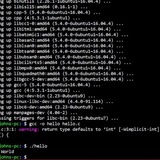
"echo hello > /dev/stdout | echo world" does't make sense
Hello everyone I'm trying to understand this command behaviour, I'm remaking a shell for a school project and bash --posix behaviour looks weird to me.
Why does this command only print "world" ?
My understanding is that bash create the pipe, close it and redirect the first command STDOUT to /dev/stdout so why won't it print "hello" on the terminal ?
https://redd.it/z02289
@r_bash
Hello everyone I'm trying to understand this command behaviour, I'm remaking a shell for a school project and bash --posix behaviour looks weird to me.
Why does this command only print "world" ?
My understanding is that bash create the pipe, close it and redirect the first command STDOUT to /dev/stdout so why won't it print "hello" on the terminal ?
https://redd.it/z02289
@r_bash
reddit
"echo hello > /dev/stdout | echo world" does't make sense
Hello everyone I'm trying to understand this command behaviour, I'm remaking a shell for a school project and bash --posix behaviour looks weird...