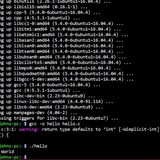
Bashtutor - interactive bash tutorial
I wrote a minimal framework for creating CLI obstacle courses.
Currently there is one "module" which is for Bash itself.
While its a proof of concept, I attempted to make it entertaining and smoothen the edges as much as I could.
The main inspiration was vimtutor and how I would have liked something like this back when I was starting out.
https://github.com/agvxov/bashtutor
I'm hoping it will be useful to someone somewhere.
https://redd.it/1ev6ex5
@r_bash
I wrote a minimal framework for creating CLI obstacle courses.
Currently there is one "module" which is for Bash itself.
While its a proof of concept, I attempted to make it entertaining and smoothen the edges as much as I could.
The main inspiration was vimtutor and how I would have liked something like this back when I was starting out.
https://github.com/agvxov/bashtutor
I'm hoping it will be useful to someone somewhere.
https://redd.it/1ev6ex5
@r_bash
GitHub
GitHub - agvxov/bashtutor: Easily extendable utility to interactively showcase or teach CLIs, command line tasks, workflows and…
Easily extendable utility to interactively showcase or teach CLIs, command line tasks, workflows and Bash itself. - agvxov/bashtutor
I have written some helper noscripts to simplify on-demand GNU/Linux proxy configuration
https://gitlab.com/brlin/linux-proxy-configuration-helper
https://redd.it/1ev7j98
@r_bash
https://gitlab.com/brlin/linux-proxy-configuration-helper
https://redd.it/1ev7j98
@r_bash
GitLab
林博仁 Buo-ren Lin / Linux proxy configuration helper · GitLab
Helper noscripts to assist in configuring proxy settings on a GNU/Linux desktop.
Interpolation and sed!
I hope this helps somebody, like it did for myself, last week.
I love this shit. And I am always happy to share/ read contructive critiscism.
I got tasked with a set of instructions, under immense pressure, the other day.
I needed to edit a 20k line file, and was told it needed batching into many, 100 line files, to avoid deadlocking our DB whilst running the finished article. In total, we were deleting millions of duplicate rows, with specific IDs. I also needed to add a comma, at the end of each newline (so far, no sweat). So I did
I then batched that file, into many smaller ones, running
But, after I had done this, I discovered that I also needed to remove the very last comma in each file. This is so that the syntax is accepted by MySQL. So I did -
Then, here's the interpolation... courtesy of my wise and all-knowing colleague, who just happened to shoot me a message, making sure I was ok. I was stuck on how to run the MySQL statement, using the content in all my files. I was also very nervous, at this point. We ended up writing,
I felt very accomplished, as I always do when I learn something new, and needed a little nudge to get over the line, in the end. But my goodness, it was such a rush! I hope someone finds this useful and/ or interesting. I know I did.
https://redd.it/1evju1s
@r_bash
I hope this helps somebody, like it did for myself, last week.
I love this shit. And I am always happy to share/ read contructive critiscism.
I got tasked with a set of instructions, under immense pressure, the other day.
I needed to edit a 20k line file, and was told it needed batching into many, 100 line files, to avoid deadlocking our DB whilst running the finished article. In total, we were deleting millions of duplicate rows, with specific IDs. I also needed to add a comma, at the end of each newline (so far, no sweat). So I did
for i in x*; do cat "$i" | tr \\n , >> $i.new;I then batched that file, into many smaller ones, running
split -l 100 FILE.txt. The newly created batched files then had naming conventions like, `xaa.new`, `xab.new` etc.But, after I had done this, I discovered that I also needed to remove the very last comma in each file. This is so that the syntax is accepted by MySQL. So I did -
for i in x*; do sed -e '$s/,$//' "$i" > "$i".new.Then, here's the interpolation... courtesy of my wise and all-knowing colleague, who just happened to shoot me a message, making sure I was ok. I was stuck on how to run the MySQL statement, using the content in all my files. I was also very nervous, at this point. We ended up writing,
for i in x*; do mysql databaseName -vvv -e "DELETE from table where table_id in ($(cat $i))" >> /home/userName/incidentNumber/output.sql after we had tested SELECT statements, echo'ing output (without any MySQL) and had it approved by all stakeholders.I felt very accomplished, as I always do when I learn something new, and needed a little nudge to get over the line, in the end. But my goodness, it was such a rush! I hope someone finds this useful and/ or interesting. I know I did.
https://redd.it/1evju1s
@r_bash
mirror one GNU Screen session to another?
I'd like to create two screen sessions, then mirror the activity of one to another. So, if I create
Is this possible using functionality built into screen, or would if be more complicated? I can't find anything about this online, so I'm guessing it's the latter.
https://redd.it/1evp3t5
@r_bash
I'd like to create two screen sessions, then mirror the activity of one to another. So, if I create
session_1 in one Terminal window, and create session_2 in another Terminal window, they'd look the exact same if I ran a certain program in session_1. It'd also be nice if detaching session_1 detached session_2 as well.Is this possible using functionality built into screen, or would if be more complicated? I can't find anything about this online, so I'm guessing it's the latter.
https://redd.it/1evp3t5
@r_bash
Reddit
From the bash community on Reddit
Explore this post and more from the bash community
Trap not taking effect in POSIX noscript
In this noscript I launch vim opening a temp file in the terminal window. If the terminal window is closed with vim running, the temp file should be deleted. Closing the terminal window should also kill vim process.
However, closing the terminal window doesn't remove the file and the vim process lingers when the terminal window is closed. If I remove the
Any ideas? I have
https://redd.it/1evoe9l
@r_bash
In this noscript I launch vim opening a temp file in the terminal window. If the terminal window is closed with vim running, the temp file should be deleted. Closing the terminal window should also kill vim process.
However, closing the terminal window doesn't remove the file and the vim process lingers when the terminal window is closed. If I remove the
trap command, then the vim process will terminate as expected but the temp file will of course remain.Any ideas? I have
exec sh -c because for some reason without it, vim process lingers when its terminal window closes.https://redd.it/1evoe9l
@r_bash
Expanding filenames containing spaces with readlink in a bash noscript
Several programs don't remember the last document(s) they worked with given by command line, e.g. eog ("Eye of GNOME Image Viewer"). So i wrote a general noscript:
- when given command line args: expand them with readlink, call eog, and store expanded names in <last-args-file>.
- when given no command line args at current invocation: load the files specified on command line at last time of invocation, stored in <last-args-file>
This mechanism works quite fine, so far i don't need that it does not allow specifying other parameters to the "wrapped" programs.
The question: see commented code ("DOES NOT WORK") in lastargs.sh. My intent is to clean up files that do not exist anymore since the last invocation. But $(expandargs "$ARGS") returns empty paths when paths contains spaces.
Any idea/hint? Thank you.
btw. eval was used to allow invocations like PRG="QTSCALEFACTOR=1.8 /opt/libreoffice/program/oosplash"
eog:
#!/bin/bash
FILENAME="eog-lastargs.txt"
PRG=/usr/bin/eog
source ~/bin/lastargs.sh
lastargs.sh:
# Specify the folder to check
FOLDER="$HOME/.config/last-args"
if [[ "$1" == "c" || "$1" == "clear" ]]; then
rm -f "$FOLDER/$FILENAME"
exit 0
fi
expandargs() {
expandedargs=""
for arg in "$@"; do
# Resolve the full path using readlink and add it to the
# expandedargs string
fullpath=$(readlink -e "$arg")
if [[ $? == 0 ]]; then
expandedargs+="\"$fullpath\" "
fi
done
# Trim the trailing space and return the full string
echo "${expandedargs% }"
}
# Check if there are no command line arguments
if $# -eq 0 ; then
# Specify the file to store the last command line arguments
FILE="$FOLDER/$FILENAME"
# Check if the specified folder exists
if ! -d "$FOLDER" ; then
# If not, create the folder
mkdir -p "$FOLDER"
fi
# Check if the file with the last command line arguments exists
if -f "$FILE" ; then
# Read the last command line arguments from the file
ARGS=$(cat "$FILE")
# DOES NOT WORK
# - returns empty paths when path contains spaces
#ARGS=$(expandargs "$ARGS")
#echo "$ARGS" > "$FOLDER/$FILENAME"
# Start with the content of the file as command line arguments
eval "$PRG $ARGS" &
else
# Start without command line arguments
eval "$PRG" &
fi
else
ARGS=$(expandargs "$@")
# Write the current command line arguments to the file in the
# specified folder
echo $ARGS > "$FOLDER/$FILENAME"
# Start with the provided command line arguments
eval "$PRG $ARGS" &
fi
https://redd.it/1evv3q2
@r_bash
Several programs don't remember the last document(s) they worked with given by command line, e.g. eog ("Eye of GNOME Image Viewer"). So i wrote a general noscript:
- when given command line args: expand them with readlink, call eog, and store expanded names in <last-args-file>.
- when given no command line args at current invocation: load the files specified on command line at last time of invocation, stored in <last-args-file>
This mechanism works quite fine, so far i don't need that it does not allow specifying other parameters to the "wrapped" programs.
The question: see commented code ("DOES NOT WORK") in lastargs.sh. My intent is to clean up files that do not exist anymore since the last invocation. But $(expandargs "$ARGS") returns empty paths when paths contains spaces.
Any idea/hint? Thank you.
btw. eval was used to allow invocations like PRG="QTSCALEFACTOR=1.8 /opt/libreoffice/program/oosplash"
eog:
#!/bin/bash
FILENAME="eog-lastargs.txt"
PRG=/usr/bin/eog
source ~/bin/lastargs.sh
lastargs.sh:
# Specify the folder to check
FOLDER="$HOME/.config/last-args"
if [[ "$1" == "c" || "$1" == "clear" ]]; then
rm -f "$FOLDER/$FILENAME"
exit 0
fi
expandargs() {
expandedargs=""
for arg in "$@"; do
# Resolve the full path using readlink and add it to the
# expandedargs string
fullpath=$(readlink -e "$arg")
if [[ $? == 0 ]]; then
expandedargs+="\"$fullpath\" "
fi
done
# Trim the trailing space and return the full string
echo "${expandedargs% }"
}
# Check if there are no command line arguments
if $# -eq 0 ; then
# Specify the file to store the last command line arguments
FILE="$FOLDER/$FILENAME"
# Check if the specified folder exists
if ! -d "$FOLDER" ; then
# If not, create the folder
mkdir -p "$FOLDER"
fi
# Check if the file with the last command line arguments exists
if -f "$FILE" ; then
# Read the last command line arguments from the file
ARGS=$(cat "$FILE")
# DOES NOT WORK
# - returns empty paths when path contains spaces
#ARGS=$(expandargs "$ARGS")
#echo "$ARGS" > "$FOLDER/$FILENAME"
# Start with the content of the file as command line arguments
eval "$PRG $ARGS" &
else
# Start without command line arguments
eval "$PRG" &
fi
else
ARGS=$(expandargs "$@")
# Write the current command line arguments to the file in the
# specified folder
echo $ARGS > "$FOLDER/$FILENAME"
# Start with the provided command line arguments
eval "$PRG $ARGS" &
fi
https://redd.it/1evv3q2
@r_bash
Reddit
From the bash community on Reddit
Explore this post and more from the bash community
Could you help me debug this ChatGPT-created noscript that deleted my pdfs?
I asked ChatGPT to create a noscript that changes names of magazines to be consistent with each other (All in the same format), and it deleted all of my files. (Thankfully, I had a backup). Is ChatGPT's fix good? (I asked it to make it not change their directory anymore, not realizing it just outright deleted them). Here is the noscript:
Sorry, I can't seem to format it
# #!/bin/bash
# Function to rename PDF files
rename_pdfs() {
local dir="$1"
local parent_dir="$(basename "$(dirname "$dir")")"
local grandparent_dir="$(basename "$(dirname "$(dirname "$dir")")")"
# List PDF files in alphabetical order
pdf_files=("$dir"/*.pdf)
IFS=$'\\n' sorted_files=($(sort <<<"${pdf_files[*\]}"))
unset IFS
# Rename files with the desired format, ensuring they stay in the same directory
count=1
for file in "${sorted_files[@\]}"; do
if [[ -f "$file" \]\]; then
base_number=$(printf "%02d" "$count")
new_name="${grandparent_dir}_${parent_dir}_${base_number}.pdf"
mv "$file" "$dir/$new_name" # This keeps the file in the same directory
((count++))
fi
done
}
# Export function so it's available in subshells
export -f rename_pdfs
# Find all directories 2 levels deep and rename PDFs
find . -type d -mindepth 2 -maxdepth 2 -exec bash -c 'rename_pdfs "$0"' {} \\;
https://redd.it/1ewcs17
@r_bash
I asked ChatGPT to create a noscript that changes names of magazines to be consistent with each other (All in the same format), and it deleted all of my files. (Thankfully, I had a backup). Is ChatGPT's fix good? (I asked it to make it not change their directory anymore, not realizing it just outright deleted them). Here is the noscript:
Sorry, I can't seem to format it
# #!/bin/bash
# Function to rename PDF files
rename_pdfs() {
local dir="$1"
local parent_dir="$(basename "$(dirname "$dir")")"
local grandparent_dir="$(basename "$(dirname "$(dirname "$dir")")")"
# List PDF files in alphabetical order
pdf_files=("$dir"/*.pdf)
IFS=$'\\n' sorted_files=($(sort <<<"${pdf_files[*\]}"))
unset IFS
# Rename files with the desired format, ensuring they stay in the same directory
count=1
for file in "${sorted_files[@\]}"; do
if [[ -f "$file" \]\]; then
base_number=$(printf "%02d" "$count")
new_name="${grandparent_dir}_${parent_dir}_${base_number}.pdf"
mv "$file" "$dir/$new_name" # This keeps the file in the same directory
((count++))
fi
done
}
# Export function so it's available in subshells
export -f rename_pdfs
# Find all directories 2 levels deep and rename PDFs
find . -type d -mindepth 2 -maxdepth 2 -exec bash -c 'rename_pdfs "$0"' {} \\;
https://redd.it/1ewcs17
@r_bash
Reddit
From the bash community on Reddit
Explore this post and more from the bash community
Had a suit made they asked if I wanted anything embroidered...
https://i.imgur.com/pIx5eXT.jpg
https://redd.it/1ewit33
@r_bash
https://i.imgur.com/pIx5eXT.jpg
https://redd.it/1ewit33
@r_bash
what is a "flag" in bash? and how is it different then other options? what would be a good example to highlight the difference?
so i keep hearing that a flag is a TYPE of option, and that the only difference between a flag and normal options is that a flag is a type of "boolean" option, which when explained to me seems no different then binary
so what is a flag? how is it different then other options?
what would be a good example to show someone in the terminal the difference between flags and other types of options?
thank you
https://redd.it/1ewi7pc
@r_bash
so i keep hearing that a flag is a TYPE of option, and that the only difference between a flag and normal options is that a flag is a type of "boolean" option, which when explained to me seems no different then binary
so what is a flag? how is it different then other options?
what would be a good example to show someone in the terminal the difference between flags and other types of options?
thank you
https://redd.it/1ewi7pc
@r_bash
Reddit
From the bash community on Reddit
Explore this post and more from the bash community
bash completion for pet
I use pet command-line snippet manager (GitHub link)
there are few commands:
Usage:
pet command
Available Commands:
clip Copy the selected commands
configure Edit config file
edit Edit snippet file
exec Run the selected commands
help Help about any command
list Show all snippets
new Create a new snippet
search Search snippets
sync Sync snippets
version Print the version number
Flags:
--config string config file (default is $HOME/.config/pet/config.toml)
--debug debug mode
-h, --help help for pet
Use "pet command --help" for more information about a command.
I write this very simple bash completion:
petcompletions() {
local cur commands
cur="${COMPWORDS[COMPCWORD]}"
commands="clip configure edit exec help list new search sync version"
if [ ${COMP_CWORD} -eq 1 ]; then
COMPREPLY=( $(compgen -W "${commands}" -- ${cur}) )
fi
}
complete -F petcompletions pet
it works,
but I would like to know if it is well written or if it can be improved
very thanks
https://redd.it/1ewqnsb
@r_bash
I use pet command-line snippet manager (GitHub link)
there are few commands:
Usage:
pet command
Available Commands:
clip Copy the selected commands
configure Edit config file
edit Edit snippet file
exec Run the selected commands
help Help about any command
list Show all snippets
new Create a new snippet
search Search snippets
sync Sync snippets
version Print the version number
Flags:
--config string config file (default is $HOME/.config/pet/config.toml)
--debug debug mode
-h, --help help for pet
Use "pet command --help" for more information about a command.
I write this very simple bash completion:
petcompletions() {
local cur commands
cur="${COMPWORDS[COMPCWORD]}"
commands="clip configure edit exec help list new search sync version"
if [ ${COMP_CWORD} -eq 1 ]; then
COMPREPLY=( $(compgen -W "${commands}" -- ${cur}) )
fi
}
complete -F petcompletions pet
it works,
but I would like to know if it is well written or if it can be improved
very thanks
https://redd.it/1ewqnsb
@r_bash
GitHub
GitHub - knqyf263/pet: Simple command-line snippet manager
Simple command-line snippet manager. Contribute to knqyf263/pet development by creating an account on GitHub.
How to uninstall a package installed via curl?
I originally posted this in r/AskProgramming and a fellow redditor suggested I also post my questions here, just in case someone has some additional input on this. Thank you in advance for your help, and pardon the newbie questions.
Hi, everyone 😃 Any input and help is greatly appreciated.
# The Background
I recently installed the package
I installed the package (regrefully so) via
I did this because the project's recommendation was to install via curl:
>The best way (source)
I've uninstalled curl-installed programs before thanks to the devs providing an easy way to do so, via a simple command (like Starship).
# The Problem
I don't know how to reverse engineer the installer noscript for
# Questions
1. Is there a tool I can install to programmatically fetch any binaries and related files installed via
2. If not, could you please explain how to go about manually uninstalling curled binaries and their files?
# My Setup
Operating System: macOS Sonoma 14.6.1
ZSH version: zsh 5.9 (x86_64-apple-darwin23.0)
`which zplug`: `zplug not found`
Files are indeed within my home directory, though.
https://redd.it/1ex1zlf
@r_bash
I originally posted this in r/AskProgramming and a fellow redditor suggested I also post my questions here, just in case someone has some additional input on this. Thank you in advance for your help, and pardon the newbie questions.
Hi, everyone 😃 Any input and help is greatly appreciated.
# The Background
I recently installed the package
zplug from its repo. I don't have a use for it anymore, however. So, I would like to uninstall it.I installed the package (regrefully so) via
curl, rather than using my handy-dandy brew package manager.I did this because the project's recommendation was to install via curl:
>The best way (source)
I've uninstalled curl-installed programs before thanks to the devs providing an easy way to do so, via a simple command (like Starship).
# The Problem
I don't know how to reverse engineer the installer noscript for
zplug to correctly uninstall the package, and any other files it may have created in my system.# Questions
1. Is there a tool I can install to programmatically fetch any binaries and related files installed via
curl , and then uninstall them?2. If not, could you please explain how to go about manually uninstalling curled binaries and their files?
# My Setup
Operating System: macOS Sonoma 14.6.1
ZSH version: zsh 5.9 (x86_64-apple-darwin23.0)
`which zplug`: `zplug not found`
Files are indeed within my home directory, though.
https://redd.it/1ex1zlf
@r_bash
GitHub
GitHub - zplug/zplug: :hibiscus: A next-generation plugin manager for zsh
:hibiscus: A next-generation plugin manager for zsh - zplug/zplug
Linux Bible and error
I have been going through the Linux Bible by Christopher Negus. In it he discusses using aliases. He gives an example to use
alias p='pwd ; ls -CF'
whenever i run that I get
ls -CF:not found
I then enter ls --help and can see both C and F for arguments. I can type ls -CF from terminal and it will show the files formatted and in columns. However, when using it with the alias command it is not working.
Is there an error in the book? I have also ensured that /bin is in $PATH
I also tried to run it as root and I still received the same error.
UPDATE: well i figured out what was going on. I was using putty and was ssh into my machine. I went directly to the machine and entered the command and it was fine. so weird thanks all.
https://redd.it/1ex3j5w
@r_bash
I have been going through the Linux Bible by Christopher Negus. In it he discusses using aliases. He gives an example to use
alias p='pwd ; ls -CF'
whenever i run that I get
ls -CF:not found
I then enter ls --help and can see both C and F for arguments. I can type ls -CF from terminal and it will show the files formatted and in columns. However, when using it with the alias command it is not working.
Is there an error in the book? I have also ensured that /bin is in $PATH
I also tried to run it as root and I still received the same error.
UPDATE: well i figured out what was going on. I was using putty and was ssh into my machine. I went directly to the machine and entered the command and it was fine. so weird thanks all.
https://redd.it/1ex3j5w
@r_bash
Reddit
From the bash community on Reddit
Explore this post and more from the bash community
pong.bash
Was bored so I wrote this bad pong game in bash... https://0x0.st/XJg2.bash
https://redd.it/1ex4bvf
@r_bash
Was bored so I wrote this bad pong game in bash... https://0x0.st/XJg2.bash
https://redd.it/1ex4bvf
@r_bash
For loop, grep, and curly braces
Me again :)
Today, I had to pull this one out of the hat. I found it tough, as I wanted to use the curly braces as a range. Like I've done in the past for simpler queries (E.g -
I must point out as well, we were after logs from a specific time/ date (
I hope this is somewhat useful to those who are, like me, trying to get a firm grasp of bash.
Here is what was ran:-
for i in servers-{1..3}.domain.io; do ssh user@"$i" "zgrep -E '16/Aug/2024:15:4-50-9:0-9{2}' /var/log/nginx/access.log-20240817.gz >> /tmp/outfile"; done
https://redd.it/1exkfum
@r_bash
Me again :)
Today, I had to pull this one out of the hat. I found it tough, as I wanted to use the curly braces as a range. Like I've done in the past for simpler queries (E.g -
{0..9} and at the beginning of this command!). But a colleague of mine pointed out, when using grep, you cannot do this, and instead they are interpreted as repetition operators. I confirmed this, myself, when reading the man page. However, only after stepping away did things click.I must point out as well, we were after logs from a specific time/ date (
15:40-15:59) I hope this is somewhat useful to those who are, like me, trying to get a firm grasp of bash.
Here is what was ran:-
for i in servers-{1..3}.domain.io; do ssh user@"$i" "zgrep -E '16/Aug/2024:15:4-50-9:0-9{2}' /var/log/nginx/access.log-20240817.gz >> /tmp/outfile"; done
https://redd.it/1exkfum
@r_bash
Reddit
From the bash community on Reddit
Explore this post and more from the bash community
what is a "string"
hello, i keep hearing people talking about "strings"?
what is a string? what are people talking about?
thank you
https://redd.it/1exmlum
@r_bash
hello, i keep hearing people talking about "strings"?
what is a string? what are people talking about?
thank you
https://redd.it/1exmlum
@r_bash
Reddit
From the bash community on Reddit
Explore this post and more from the bash community
10 Essential Terminal Commands Every Developer Should Know
https://trevorlasn.com/blog/10-essential-terminal-commands-every-developer-should-know/
https://redd.it/1exvpjr
@r_bash
https://trevorlasn.com/blog/10-essential-terminal-commands-every-developer-should-know/
https://redd.it/1exvpjr
@r_bash
10 Essential Terminal Commands Every Developer Should Know
List of useful Unix terminal commands to boost your productivity. Here are some of my favorites.
Remote launch bash noscript with ssh problem
sshpass -p "pass" scp ~/Documents/Scripts/bash2.sh remoteuser@ip:~/Documents/
sshpass -p "pass" ssh remoteuser@ip bash -s < ~/Documents/bash2.sh
exit
There are no problems with scp, but the second command searches bash2 on my computer, but I need it to search on a remote PC.
https://redd.it/1eydjjp
@r_bash
sshpass -p "pass" scp ~/Documents/Scripts/bash2.sh remoteuser@ip:~/Documents/
sshpass -p "pass" ssh remoteuser@ip bash -s < ~/Documents/bash2.sh
exit
There are no problems with scp, but the second command searches bash2 on my computer, but I need it to search on a remote PC.
https://redd.it/1eydjjp
@r_bash
Reddit
From the bash community on Reddit
Explore this post and more from the bash community
How do i activate a wireless network?
I have a headless raspberry pi. I messed up some wifi settings by adding a new access point, then ssh connection closed. I rebooted the device hoping it would connect to the new AP but it couldnt connect.
I have access to the root filesystem through sd card. And when i check /etc/NetworkManager/private_networks, i see that configuration is correct but i guess its not automatically connecting. It doesnt connect to the old network as well...
How do i activate specific network from root filesystem on my raspberry pi?
https://redd.it/1eyiw8r
@r_bash
I have a headless raspberry pi. I messed up some wifi settings by adding a new access point, then ssh connection closed. I rebooted the device hoping it would connect to the new AP but it couldnt connect.
I have access to the root filesystem through sd card. And when i check /etc/NetworkManager/private_networks, i see that configuration is correct but i guess its not automatically connecting. It doesnt connect to the old network as well...
How do i activate specific network from root filesystem on my raspberry pi?
https://redd.it/1eyiw8r
@r_bash
Reddit
From the bash community on Reddit
Explore this post and more from the bash community
Can someone please explain this cryptic noscript?
I'm not able to follow the awk and apt-* commands. I need every piped command explained. Thank you!
```txt
# source: https://github.com/nodejs/docker-node/blob/main/20/bullseye-slim/Dockerfile
apt-mark auto '.*' > /dev/null \
&& find /usr/local -type f -executable -exec ldd '{}' ';' \
| awk '/=>/ { so = $(NF-1); if (index(so, "/usr/local/") == 1) { next }; gsub("^/(usr/)?", "", so); print so }' \
| sort -u \
| xargs -r dpkg-query --search \
| cut -d: -f1 \
| sort -u \
| xargs -r apt-mark manual \
&& apt-get purge -y --auto-remove -o APT::AutoRemove::RecommendsImportant=false
```
https://redd.it/1eyi703
@r_bash
I'm not able to follow the awk and apt-* commands. I need every piped command explained. Thank you!
```txt
# source: https://github.com/nodejs/docker-node/blob/main/20/bullseye-slim/Dockerfile
apt-mark auto '.*' > /dev/null \
&& find /usr/local -type f -executable -exec ldd '{}' ';' \
| awk '/=>/ { so = $(NF-1); if (index(so, "/usr/local/") == 1) { next }; gsub("^/(usr/)?", "", so); print so }' \
| sort -u \
| xargs -r dpkg-query --search \
| cut -d: -f1 \
| sort -u \
| xargs -r apt-mark manual \
&& apt-get purge -y --auto-remove -o APT::AutoRemove::RecommendsImportant=false
```
https://redd.it/1eyi703
@r_bash
GitHub
docker-node/20/bullseye-slim/Dockerfile at main · nodejs/docker-node
Official Docker Image for Node.js :whale: :turtle: :rocket: - nodejs/docker-node
learning bash
hi i am learning bash (on kali) and i cant figre out what is the error tryid ai but with no luck code:
#!/bin/bash
read -p 'username: ' name
read -sp 'password: ' pass
entered = $1
echo your user name is: $name your password is: $pass inputted number is: $entered
if someone recommend a totrail say to me
https://redd.it/1eyo77n
@r_bash
hi i am learning bash (on kali) and i cant figre out what is the error tryid ai but with no luck code:
#!/bin/bash
read -p 'username: ' name
read -sp 'password: ' pass
entered = $1
echo your user name is: $name your password is: $pass inputted number is: $entered
if someone recommend a totrail say to me
https://redd.it/1eyo77n
@r_bash
Reddit
From the bash community on Reddit
Explore this post and more from the bash community
awk delimiter ‘ OR “
I’m writing a bash noscript that scrapes a site’s HTML for links, but I’m having trouble cleaning up the output.
I’m extracting lines with
The problem is that some sites use single quotes for certain links and double quotes for other links.
Normally I’d just use Python & Beautiful Soup, but I’m trying to get better with Bash. I’ve been stuck on this for a while, so I really appreciate any advice!
https://redd.it/1eyt150
@r_bash
I’m writing a bash noscript that scrapes a site’s HTML for links, but I’m having trouble cleaning up the output.
I’m extracting lines with
:// (e.g. http://), and outputting the section that comes after that.curl -s $url | grep ‘://‘ | awk -F ‘://‘ ‘{print $2}’ | uniqThe problem is that some sites use single quotes for certain links and double quotes for other links.
Normally I’d just use Python & Beautiful Soup, but I’m trying to get better with Bash. I’ve been stuck on this for a while, so I really appreciate any advice!
https://redd.it/1eyt150
@r_bash
Reddit
From the bash community on Reddit
Explore this post and more from the bash community