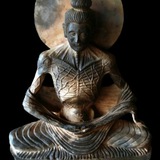
"Realizing that our fundamental human quality is clear and pure allows us to cut through all partial, limiting and self-imprisoning concepts. In the clear space of the fully relaxed mind there is no distinction between your fundamental reality and my fundamental reality. One is not better than the other; one is not worse than the other. Ultimately, there is no good and bad, no pure and impure. The whole point of meditation or prayer or whatever we are trying to do is to discover the fundamental principle of human nature, to go into this deep nature, to touch our mind, the fundamental principle of totality, nonduality. The moment we reach this experience there is no room for heavy concepts, heavy emotions or sentimentality. Just be! At the moment of this experience, there are no concepts labeled by the dualistic mind. At such a time there is no Buddha, no God, no heaven or hell. Just being—the great peace, the great satisfaction."
Lama Yeshe
Lama Yeshe
"We have all had the experience of being so absorbed in something that we remain oblivious to things that would ordinarily distract or disturb us. Similarly, if we contemplate deeply and continuously enough upon the formless clarity of our own mind, it is possible to stop perceiving the forms, sounds, smells, and so forth that come to us through the doors of our senses. As these sensory experiences and our gross conceptual thoughts subside, the gateway to superstition closes and we become aware of an upsurge of ecstatic, blissful energy from within. This tremendous surge of bliss happens spontaneously; we do not have to fabricate it in any way. And the more we experience this deep internal state of bliss, the more profound our absorption into it will become. This opens the way for us to experience expansive, liberated, and all-encompassing states of consciousness that are presently unknown to us."
Lama Yeshe
Lama Yeshe
"The clear, pure, and blissful state of mind that we have been describing exists within each one of us right now. Yet the fact that we have this fundamentally pure nature does not mean that we are already enlightened. Until we rid ourselves of hatred, greed, jealousy, and all the other symptoms of the false ego shrouding our mind, we are certainly not enlightened. There is no such thing as a buddha with delusions. But beneath the gross levels at which these delusions function there is something more subtle, more basic to our nature. And it is this essential aspect of our human consciousness that has the potential of becoming fully awakened and everlastingly blissful."
Lama Yeshe
Lama Yeshe
"According to Buddhist psychology, whether an object brings satisfaction or not depends upon a decision made beforehand by your consciousness. Even before you see a particular thing, your mind has already decided, “This will make me happy.” Then when you actually contact it with your eyesight you think, “Oh, this is very nice!” The same is true for a negative reaction. If your consciousness has already decided that you do not like a certain person, then when you actually meet him you will see nothing but an unpleasant person. In other words, all the seemingly real good things that we like and bad things that we dislike are, in fact, creations of our own mind."
Lama Yeshe
Lama Yeshe
"This subject of practice with a consort is open to great misinterpretation, especially by people who have made only superficial contact with Buddhist tantra. Many Westerners, for instance, because they have seen Tibetan paintings and statues showing deities in embrace, have the mistaken notion that Tibetan Buddhism is mainly concerned with sexual contact between men and women. As was pointed out earlier, what this art is actually representing is the experience of total unity—of method and wisdom, bliss and emptiness—characteristic of the fully enlightened state. But now with the mention of the completion stage practices there is a further opportunity for confusion to arise. Therefore it should be emphasized that until we have gained mastery over our subtle body and have “embraced” the blissful kundalini energy dormant within, we are not at all qualified to embrace an external consort.
There are vast differences between tantric embrace and ordinary sexual contact. How different these two are becomes clear when we remember that at the time of the completion stage the practitioner has dissolved the energy winds into his or her central channel, thereby experiencing the same mental and physical absorptions occurring at the time of death. Unless these death-like experiences have been entered into with full consciousness and control, it is a farce to talk about tantric embrace. Moreover, while in ordinary sex it is the man who enters the woman’s body, in true tantric embrace it is the woman’s energy that penetrates the man!"
Lama Yeshe
There are vast differences between tantric embrace and ordinary sexual contact. How different these two are becomes clear when we remember that at the time of the completion stage the practitioner has dissolved the energy winds into his or her central channel, thereby experiencing the same mental and physical absorptions occurring at the time of death. Unless these death-like experiences have been entered into with full consciousness and control, it is a farce to talk about tantric embrace. Moreover, while in ordinary sex it is the man who enters the woman’s body, in true tantric embrace it is the woman’s energy that penetrates the man!"
Lama Yeshe
Forwarded from Gemeinschaft der Eigenen (Maitreya Gyaltso)
"Extend yourself greatly, immeasurably; leap beyond every body, surpass Kronos, become Aion, and you can apprehend theos. Having supposed that for you there is nothing that is not possible, regard yourself as deathless, capable of apprehending everything: every craft, all learning, the nature of every living being. Become elevated above every elevation, deeper than every depth. Gather within yourself awareness of every creation; of Fire and Water; the Dry and the Moist; and jointly be at all places on land, at sea, in the heavens. Be not yet born; in the womb; young; old; having died; what is beyond death.
And if you apprehend all that together - durations, places, occurrences, quality, quantity - you will be capable of apprehending theos."
Corpus Hermeticum, XI
And if you apprehend all that together - durations, places, occurrences, quality, quantity - you will be capable of apprehending theos."
Corpus Hermeticum, XI
At this time you have received a precious human life qualified with eight freedoms and ten fortunes, a precious human body that is like a dream. Receiving a precious human body is rare; it happens just once.
This perfect human rebirth is highly meaningful. With it you can achieve the happiness of this life and whatever else you wish for. If you wish to again attain a human rebirth, you can. In addition, if you wish to have a body endowed with the eight favorable qualities, you can create its causes during your present precious human life.
Lama Zopa Rinpoche
This perfect human rebirth is highly meaningful. With it you can achieve the happiness of this life and whatever else you wish for. If you wish to again attain a human rebirth, you can. In addition, if you wish to have a body endowed with the eight favorable qualities, you can create its causes during your present precious human life.
Lama Zopa Rinpoche
Forwarded from Gemeinschaft der Eigenen (Maitreya)
"The Absolute void is Bhairava who is beyond the senses and the mind, beyond all the categories of these instruments. From the point of view of the human mind, He is most void. from the point of view of Reality, He is most full, for He is the source of all manifestation."
Vijñāna Bhairava Tantra
Vijñāna Bhairava Tantra
"All forms of suffering are like a child's death in a dream.
Holding illusory appearances to be true makes you weary.
Therefore, when you meet with disagreeable circumstances,
See them as illusory.
This is the practice of bodhisattvas."
Togme Zangpo, The Thirty-seven Practices of Bodhisattvas
Holding illusory appearances to be true makes you weary.
Therefore, when you meet with disagreeable circumstances,
See them as illusory.
This is the practice of bodhisattvas."
Togme Zangpo, The Thirty-seven Practices of Bodhisattvas
Forwarded from Meditations of a Yogin
“Those who worship to achieve a certain reward receive a reward that is (however) as prone to decay as a kingdom found in a dream. However, those who act righteously without hoping for reward attain nirvana and are freed from reincarnation.”
- The Mahanirvana Tantra
- The Mahanirvana Tantra
"The ultimate guru, the dharmakaya, the transcendental wisdom of non-dual bliss and emptiness, is eternal. It is the primordial savior (liberator), the originator (source) without beginning or end, that pervades all existence."
Lama Zopa Rinpoche
Lama Zopa Rinpoche
"The moment anger arises, your mind believes in a creator. You think that someone else is creating your problem. "The problem I'm experiencing came from that person." That is similar to believing in an external creator. You hold two contradictory attitudes-you talk about and believe karma and the philosophy of Buddhism, but when you encounter a difficulty in your daily life, you think that there is an external being who created it! Instead of practicing that there is no creator, you practice that there is a creator because the problem came from somebody else. "That person created my problem." In daily life, you become just like practitioners of other religions; you practice that there is a creator. Even though you do not use the word "God," you believe that there is a creator, somebody else who created your problem. With this as the basis, anger arises.
But the minute that you think that you are the creator, that your mind is the creator, that whatever you are experiencing comes from karma you yourself have created, you know that there is nothing external to blame, so there is no basis for anger to arise. The wish to retaliate and harm someone else is based on the belief that the other person is harming you, that you are an innocent victim who has nothing to do with the problem."
Lama Zopa Rinpoche
But the minute that you think that you are the creator, that your mind is the creator, that whatever you are experiencing comes from karma you yourself have created, you know that there is nothing external to blame, so there is no basis for anger to arise. The wish to retaliate and harm someone else is based on the belief that the other person is harming you, that you are an innocent victim who has nothing to do with the problem."
Lama Zopa Rinpoche
"Even though we might say that we’re following a spiritual path or leading a meditator’s life, we’re not serious. It doesn’t matter if we sit in meditation, go to church on Sundays, visit the temple regularly or do any other kind of customary religious activity; that doesn’t mean anything. The actions that we need to do are those that actually lead us to everlasting, peaceful happiness, the truly joyful state, not those that simply bring up and down transitory pleasure. Actions that bounce us up and down are not true Dharma, not true meditation, not true religion—here I can make a definitive statement. Check up: we might think we’re doing something spiritual but is our polluted mind simply dreaming?"
Lama Yeshe
Lama Yeshe
Forwarded from Meditations of a Yogin
“I understood that, in general, all things related to samsara and nirvana are interdependent. Also, I perceived that the alaya [the fundamental consciousness] is neutral.
Samsara is the result of a wrong point of view. Nirvana is realized through perfect awareness. I perceived that the essence of both resided in the luminous and empty consciousness.”
- Milarepa
Samsara is the result of a wrong point of view. Nirvana is realized through perfect awareness. I perceived that the essence of both resided in the luminous and empty consciousness.”
- Milarepa
"Taking another example of how mind is so important is the example of when we dream. While we are dreaming, the sensory consciousnesses are shut down and the seventh consciousness which is the "self' begins to receive perceptual information from the storehouse consciousness and this input is so vivid that we believe it is really happening to us even though we may be dreaming that we are doing something fantastic such as flying.
Throughout a dream we have one part of our mind which is an awareness, a self or I, which is perceiving what is going on and there must also be another part of our mind which is creating the dream. Sometimes these two functions of mind are quite distinct so we actually don't know how the dream will tum out and at other times these two functions bleed together and we either know what is going to happen in the dream or have an ability to change the "noscript" or outcome of the dream.
The Mind-only view is that when we are awake, the outside sensory information is so vivid that we believe that it is real and how we are interpreting what is happening to us is based on what is stored in our store-house eighth consciousness."
Clark Johnson
Throughout a dream we have one part of our mind which is an awareness, a self or I, which is perceiving what is going on and there must also be another part of our mind which is creating the dream. Sometimes these two functions of mind are quite distinct so we actually don't know how the dream will tum out and at other times these two functions bleed together and we either know what is going to happen in the dream or have an ability to change the "noscript" or outcome of the dream.
The Mind-only view is that when we are awake, the outside sensory information is so vivid that we believe that it is real and how we are interpreting what is happening to us is based on what is stored in our store-house eighth consciousness."
Clark Johnson
"The basis of the view is egolessness which is called in the sutras "the view of what will be destroyed." This view explains the aggregates (Skt. skandha) which continually change, are accumulated, and are destroyed. All of the aggregates are impermanent, undergo change, and are eventually destroyed. What is new eventually decays, becomes old, and finally ends. We are not a single entity but rather a coming together of the five aggregates (form, feeling, perception, mental formations, and consciousness).
These various components will change and eventually come to an end. The components are also not single. For example, a form (such as the body) does not consist of one single unit but is made up of components that are continually changing and being destroyed. The view of the self also is called "the view of that which will be destroyed" because it is a view founded upon the aggregates coming together and then dispersing.
Even though elements come together and make up an entity composed of many different things, we think of them as a single entity. For example, our body is composed of many parts and yet we consider ourselves to be a single individual. We see ourselves as "one being", as an "I" or a "self" who took birth, has grown older and will die. But, in fact, the self is a composite of changing aggregates that come together, undergo change, and will finally end. As babies we had a small body and the thoughts of a baby. As a grown-up we have another body and the thoughts of an adult. As long as we are not aware of the changes that take place from childhood through adolescence to old age, we think of ourselves as a single individual.
If we examine this closely, however, we discover that there is no place where the self exists and that the view of a self is nothing but a delusion. This is the delusion based on ignorance that must be eliminated."
Khenchen Thrangu Rinpoche
These various components will change and eventually come to an end. The components are also not single. For example, a form (such as the body) does not consist of one single unit but is made up of components that are continually changing and being destroyed. The view of the self also is called "the view of that which will be destroyed" because it is a view founded upon the aggregates coming together and then dispersing.
Even though elements come together and make up an entity composed of many different things, we think of them as a single entity. For example, our body is composed of many parts and yet we consider ourselves to be a single individual. We see ourselves as "one being", as an "I" or a "self" who took birth, has grown older and will die. But, in fact, the self is a composite of changing aggregates that come together, undergo change, and will finally end. As babies we had a small body and the thoughts of a baby. As a grown-up we have another body and the thoughts of an adult. As long as we are not aware of the changes that take place from childhood through adolescence to old age, we think of ourselves as a single individual.
If we examine this closely, however, we discover that there is no place where the self exists and that the view of a self is nothing but a delusion. This is the delusion based on ignorance that must be eliminated."
Khenchen Thrangu Rinpoche
"We experience illness, problems, misery, and suffering in life but where do all of these difficulties and obstacles come from? They come from attachment to the self. As long as we mistakenly perceive the world, we think that pain and misery come from outside ourselves. By failing to understand the source of suffering, we think others bring pain and affliction upon us. We do not realize that attachment to the self is the source of all our suffering."
Khenchen Thrangu Rinpoche
Khenchen Thrangu Rinpoche
"First, if something doesn't exist, then it doesn't exist, but whatever does exist is composite and not a single, indivisible entity. All things are made up of various ingredients and these ingredients form existing things. Therefore, all phenomena that exist are composed of various ingredients and as a result are impermanent. Living beings die, objects wear out and disintegrate. At this coarse or obvious level of impermanence, everything changes over time, and this is obvious and can be understood by everyone. The subtle level of impermanence is the main concern here; it is the momentary impermanence of every instant.
When looking at momentary impermanence on a gross level, we can see that a person changes from childhood to adulthood. One may think that there is continuity in the change that takes place. One may wonder when this change takes place and conclude that every year, everybody is different. However, a change doesn't automatically take place at a certain point each year. One may conclude that every month, everybody is different, but the change doesn't automatically take place at a certain point in each month either. One may conclude that every day or every hour, everybody changes. We follow this reasoning down to every single instant in which a change takes place, so there is impermanence in every instant.
This is the subtle level of impermanence. It is easy to see changes that take place over the years, but, in fact, changes are taking place in every instant."
Khenchen Thrangu Rinpoche
When looking at momentary impermanence on a gross level, we can see that a person changes from childhood to adulthood. One may think that there is continuity in the change that takes place. One may wonder when this change takes place and conclude that every year, everybody is different. However, a change doesn't automatically take place at a certain point each year. One may conclude that every month, everybody is different, but the change doesn't automatically take place at a certain point in each month either. One may conclude that every day or every hour, everybody changes. We follow this reasoning down to every single instant in which a change takes place, so there is impermanence in every instant.
This is the subtle level of impermanence. It is easy to see changes that take place over the years, but, in fact, changes are taking place in every instant."
Khenchen Thrangu Rinpoche