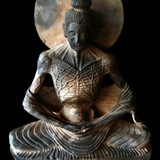
"Hārītī is invoked today for the health of children and for an easy birth. In India she was originally a demon who fed on small children. Legend says that grieving villagers appealed to the Buddha to deliver them from her, and so the Buddha hid one of her ten thousand children from her. Mad with grief, Hārītī searched frantically for the missing child and then, unable to find it, went to the Buddha for help, believing him omniscient.
"Here you are," said the Buddha, "grief-stricken because one of your ten thousand children is missing. How do you think the villagers, who have only two or three, feel when they lose one?"
Hārītī then awoke to the extent of her wrongdoing and became a deity that protected children."
Akira Sadakata
"Here you are," said the Buddha, "grief-stricken because one of your ten thousand children is missing. How do you think the villagers, who have only two or three, feel when they lose one?"
Hārītī then awoke to the extent of her wrongdoing and became a deity that protected children."
Akira Sadakata
"The teacher embodies the essence of all Buddhas throughout the three times.
He is the union of the Three Jewels: his body is the Sangha, his speech the Dharma, his mind the Buddha.
He is the union of the Three Roots: his body is the teacher, his speech the yidam, his mind the dakini.
He is the union of the three kayas: his body is the nirmamakaya, his speech the sambhogakaya, his mind the dharmakaya.
He is the embodiment of all the Buddhas of the past, source of all the Buddhas of the future and the representative of all the Buddhas of the present.
Since he takes as his disciples degenerate beings like us, whom none of the thousand Buddhas of the Good Kalpa could help, his compassion and bounty exceed that of all Buddhas."
Patrul Rinpoche
He is the union of the Three Jewels: his body is the Sangha, his speech the Dharma, his mind the Buddha.
He is the union of the Three Roots: his body is the teacher, his speech the yidam, his mind the dakini.
He is the union of the three kayas: his body is the nirmamakaya, his speech the sambhogakaya, his mind the dharmakaya.
He is the embodiment of all the Buddhas of the past, source of all the Buddhas of the future and the representative of all the Buddhas of the present.
Since he takes as his disciples degenerate beings like us, whom none of the thousand Buddhas of the Good Kalpa could help, his compassion and bounty exceed that of all Buddhas."
Patrul Rinpoche
Forwarded from Egbert Moray-Falls
This media is not supported in your browser
VIEW IN TELEGRAM
Happy 88th birthday to the light of compassion in this Sahaloka, this world of enduring many sufferings.
Hail to the Guru!
Hail to the Guru!
Forwarded from Meditations of a Yogin
In the gap between thoughts, non-conceptual wisdom shines continuously.
~ Milarepa
~ Milarepa
"In the Shaivite tradition, the god's companions (kaulas) are described as a troupe of freakish, adventurous delinquent and wild young people, who prowl in the night, shouting in the storm, singing, dancing and ceaselessly playing outrageous tricks on sages and gods. They are called Ganas, the 'vagabonds', corresponding to the Cretan Korybantes and the Celtic Korrigans (fairies' sons). Like the Sileni and Satyrs, some of them have goat's or bird's feet. The Ganas mock the rules of ethics and social order. They personify the joy of living, courage and imagination, which are all youthful values. They live in harmony with nature and oppose the destructive ambition of the city and the deceitful moralism which both hides and expresses it. These delinquents of heaven are always there to restore true values and to assist the 'god-mad' who are persecuted and mocked by the powerful."
Alain Daniélou
Alain Daniélou
Lord Śīva said:
Those lowest of the Beings who insult Śākta, Bhaīrava, along with Devgaņas drink their blood.
Gaņa of Bhaīrava and Bhaīravī always destroys these sinners. Bahūraktapāyī Gaņa always drinks their blood.
Those who kill Śaktas, verbally abuses Śāktas, or insult Śāktas, O Dévésī, Śīvavallabhā pierces their head.
There is no Upāsaka superior to Śākta in three worlds.
Muņdamālā Tantra 3.41-44
Those lowest of the Beings who insult Śākta, Bhaīrava, along with Devgaņas drink their blood.
Gaņa of Bhaīrava and Bhaīravī always destroys these sinners. Bahūraktapāyī Gaņa always drinks their blood.
Those who kill Śaktas, verbally abuses Śāktas, or insult Śāktas, O Dévésī, Śīvavallabhā pierces their head.
There is no Upāsaka superior to Śākta in three worlds.
Muņdamālā Tantra 3.41-44
Forwarded from Meditations of a Yogin
"The dakinis are the most important element of the enlightened feminine in Tibetan Buddhism.. They are the luminous, subtle, spiritual energy, the key, the gatekeeper, the guardian of the unconditioned state. If we are not willing to invite the dakini into our life then we cannot enter into the subtle states of mind. Sometimes the dakinis appear as messengers, sometimes as guides and sometimes as protectors.. Dakinis have a quality of playfulness, expressing emptiness and pulling the rug out from under you."
- Lama Tsultrim Allione
- Lama Tsultrim Allione
Forwarded from 𝖳𝖱𝖨𝖪𝖠 𝖲𝖧𝖠𝖨𝖵𝖨𝖲𝖬
Here's an excerpt from an article by Sthaneshwar-ji at Sutra Journal,
" Tantra in the Western imagination stands for exotic and orgasmic rituals coming from India and Tibet that blend sex and meditation. Tantric practice is often compared with pagan animistic rituals that include blood and sex, and the supernatural powers described in Tantric texts are often compared with magic. This does not mean that Tantra has always been painted positively in its homeland. For most native Indians, Tantra stands for scary witchcraft and ghoulish Aghoris that capture the imagination when one thinks of a ‘Tantrik’. With the 20th century guru movements and the vacuum resulting from a lack of traditional awareness, the ‘exotic’ side of Tantra appears to be in transit, doubling back to India in changed form.
"Historically, Tantra has remained elastic in adopting practices that cannot be blended together to make one single practice or belief. The contemporary categorization of Tantra subsumes this intrinsic diversity, with its practices contradictory to each other, and philosophies supporting different goals. As Tantra becomes grossly simplified, the market that consumes Tantra is little concerned with the problems inherent to blending Hindu and Buddhist Tantras, left-hand and right-hand Tantras, and various disciplines (Acharas). Once again, this homogenization is doubling back ..."
http://www.sutrajournal.com/tantra-and-the-west-sthaneshwar-timalsina
And another ...
http://www.sutrajournal.com/mantra-by-sthaneshwar-timalsina
" Tantra in the Western imagination stands for exotic and orgasmic rituals coming from India and Tibet that blend sex and meditation. Tantric practice is often compared with pagan animistic rituals that include blood and sex, and the supernatural powers described in Tantric texts are often compared with magic. This does not mean that Tantra has always been painted positively in its homeland. For most native Indians, Tantra stands for scary witchcraft and ghoulish Aghoris that capture the imagination when one thinks of a ‘Tantrik’. With the 20th century guru movements and the vacuum resulting from a lack of traditional awareness, the ‘exotic’ side of Tantra appears to be in transit, doubling back to India in changed form.
"Historically, Tantra has remained elastic in adopting practices that cannot be blended together to make one single practice or belief. The contemporary categorization of Tantra subsumes this intrinsic diversity, with its practices contradictory to each other, and philosophies supporting different goals. As Tantra becomes grossly simplified, the market that consumes Tantra is little concerned with the problems inherent to blending Hindu and Buddhist Tantras, left-hand and right-hand Tantras, and various disciplines (Acharas). Once again, this homogenization is doubling back ..."
http://www.sutrajournal.com/tantra-and-the-west-sthaneshwar-timalsina
And another ...
http://www.sutrajournal.com/mantra-by-sthaneshwar-timalsina
Sutrajournal
Tantra and the West
Tantra in the Western imagination stands for exotic and orgasmic rituals coming from India and Tibet that blend sex and meditation.
Tantric practice is often compared with pagan animistic rituals that include blood and sex, and the supernatural powers described…
Tantric practice is often compared with pagan animistic rituals that include blood and sex, and the supernatural powers described…
Regarding the practice of Mantra & Tantra without the guidance of a Guru:
"Pustake likhitā vidyā yena sundari yapyate
Sidhir na jāyate tasya kalpakoti-ṣaṭair api.
O Beauteous one! He who does Japa of a Vidyā [Mantra] learnt from a book can never attain Siddhi even if he persists for countless millions of years."
Ṣaṭkarmadīpikā
"Pustake likhitā vidyā yena sundari yapyate
Sidhir na jāyate tasya kalpakoti-ṣaṭair api.
O Beauteous one! He who does Japa of a Vidyā [Mantra] learnt from a book can never attain Siddhi even if he persists for countless millions of years."
Ṣaṭkarmadīpikā
"O Kuleśvari!
For a Kaulika non-drink is a drink, not to be eaten is worth eating, and that which should not be resorted to is worth resorting.
O Kuleśvari!
For a Kaulika there is neither injunction nor rejection, neither merit or demerit, neither heaven nor hell.
Such a Yogī lives in a way that the men of the world may laugh, feel disgust, revile and seeing bypass him from a distance leaving him alone. He would go about in different guises, at times like one worthy, at time like one fallen, and at times like a ghost or a demon."
Kulārṇava Tantra
For a Kaulika non-drink is a drink, not to be eaten is worth eating, and that which should not be resorted to is worth resorting.
O Kuleśvari!
For a Kaulika there is neither injunction nor rejection, neither merit or demerit, neither heaven nor hell.
Such a Yogī lives in a way that the men of the world may laugh, feel disgust, revile and seeing bypass him from a distance leaving him alone. He would go about in different guises, at times like one worthy, at time like one fallen, and at times like a ghost or a demon."
Kulārṇava Tantra
"What need is there for many words here?
Do everything to make your guru happy;
abandon everything he is displeased with;
apply yourself to that, examine that!
This was said by Vajradhara himself:
“Spiritual attainments follow the guru.”
Aware of this, use everything there is,
and make your guru absolutely happy."
Gurupañcāśikā
Do everything to make your guru happy;
abandon everything he is displeased with;
apply yourself to that, examine that!
This was said by Vajradhara himself:
“Spiritual attainments follow the guru.”
Aware of this, use everything there is,
and make your guru absolutely happy."
Gurupañcāśikā
"If you take someone as your spiritual teacher and then relinquish your reliance on him, you will be harmed by illnesses and evil spirits in this life, and in future lives you will have to experience the immeasurable sufferings of the lower rebirths.
If you rely on nonvirtuous friends and bad companions, your excellent qualities will also diminish, your faults will increase, and misfortune will befall you. Therefore it was taught that this should be avoided in every way."
Je Tsongkhapa
If you rely on nonvirtuous friends and bad companions, your excellent qualities will also diminish, your faults will increase, and misfortune will befall you. Therefore it was taught that this should be avoided in every way."
Je Tsongkhapa
"nāgēndrahārāya trilōcanāya
bhasmāṅgarāgāya
mahēśvarāya
nityāya śuddhāya digambarāya
tasmai nakārāya namaḥ śivāya"
"To the one wearing a garland of the chief of serpents, to the three-eyed one
To the one with the beauty of ashes on his body, to the great lord
To the eternal, to the immaculate, to the one clothed in space
To him, to the one with the letter "na", to Shiva, salutations!"
Śiva-pañcākṣara-stotra
bhasmāṅgarāgāya
mahēśvarāya
nityāya śuddhāya digambarāya
tasmai nakārāya namaḥ śivāya"
"To the one wearing a garland of the chief of serpents, to the three-eyed one
To the one with the beauty of ashes on his body, to the great lord
To the eternal, to the immaculate, to the one clothed in space
To him, to the one with the letter "na", to Shiva, salutations!"
Śiva-pañcākṣara-stotra
Forwarded from Vajrarastra
Nepalese woman making offerings to the spirits that inhabited a recently felled tree.
Forwarded from Meditations of a Yogin
The Five Goddesses or Pancha Yogini of Vajrayana - Vajrayogini, Ugratara Vajrayogini/Khadgayogini, Vajravarahi, Akashayogini, Nairatma/Nilyogini .
Courtesy : Rabindra Munankarmi
Courtesy : Rabindra Munankarmi
Forwarded from Deleted channel 2
DakShinamoorthy Stótram by adi shankaracharya a laudatory hymn for this form of Siva.
ॐ मौनव्याख्या प्रकटितपरब्रह्मतत्वंयुवानं वर्शिष्ठान्तेवसदृषिगणैरावृतं ब्रह्मनिष्ठैः | आचार्येन्द्रं करकलित चिन्मुद्रमानन्दमूर्तिं स्वात्मरामं मुदितवदनं दक्षिणामूर्तिमीडे ‖
oṃ maunavyākhyā prakaṭita parabrahmatatvaṃ yuvānaṃ varśiṣṭhānte vasad ṛṣigaṇair āvṛtaṃ brahmaniṣṭhaiḥ | ācāryendraṃ karakalita cinmudram ānandamūrtiṃ svātmarāmaṃ muditavadanaṃ dakṣiṇāmūrtimīḍe ‖
I salute Śrī Dakṣiṇāmūrti, the Young Guru, who teaches the knowledge of Brahman through silence, who is surrounded by disciples, who are themselves ṛṣis and scholars in the Vedas. (I worship Śrī Dakṣiṇāmūrti), who is the teacher of teachers, whose hand is held in the sign of knowledge (cin-mudrā), whose nature is fullness, who reveals in himself, and who is ever silent.
ॐ मौनव्याख्या प्रकटितपरब्रह्मतत्वंयुवानं वर्शिष्ठान्तेवसदृषिगणैरावृतं ब्रह्मनिष्ठैः | आचार्येन्द्रं करकलित चिन्मुद्रमानन्दमूर्तिं स्वात्मरामं मुदितवदनं दक्षिणामूर्तिमीडे ‖
oṃ maunavyākhyā prakaṭita parabrahmatatvaṃ yuvānaṃ varśiṣṭhānte vasad ṛṣigaṇair āvṛtaṃ brahmaniṣṭhaiḥ | ācāryendraṃ karakalita cinmudram ānandamūrtiṃ svātmarāmaṃ muditavadanaṃ dakṣiṇāmūrtimīḍe ‖
I salute Śrī Dakṣiṇāmūrti, the Young Guru, who teaches the knowledge of Brahman through silence, who is surrounded by disciples, who are themselves ṛṣis and scholars in the Vedas. (I worship Śrī Dakṣiṇāmūrti), who is the teacher of teachers, whose hand is held in the sign of knowledge (cin-mudrā), whose nature is fullness, who reveals in himself, and who is ever silent.
Forwarded from Deleted channel
Pure consciousness has no physical or visible body. Tripura is identical to pure consciousness. Infinite power is Her essential nature. She is perfect and without limitation and witnesses the whole universe.
~ Tripura Rahasya
~ Tripura Rahasya
Forwarded from Egbert Moray-Falls
This media is not supported in your browser
VIEW IN TELEGRAM
chomdendé dezhin shekpa drachompa yangdakpar dzokpé sangye gönpo öpaktumepa la chaktsal lo
Bhagavān, tathāgata, arhat, complete and perfect buddha, protector Amitābha, to you I pay homage!
chö do kyab su chi o
To you I make offerings! In you I take refuge!
Bhagavān, tathāgata, arhat, complete and perfect buddha, protector Amitābha, to you I pay homage!
chö do kyab su chi o
To you I make offerings! In you I take refuge!