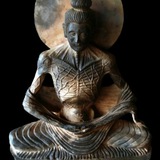
Forwarded from Meditations of a Yogin
“Adverse conditions are spiritual friends
Devils and demons are emanations of the victorious ones
Illness is the broom for evil and obscurations
Suffering is the dance of what is”
- Jamgon Kongtrul Lodro Thaye
Devils and demons are emanations of the victorious ones
Illness is the broom for evil and obscurations
Suffering is the dance of what is”
- Jamgon Kongtrul Lodro Thaye
Forwarded from 𝖳𝖱𝖨𝖪𝖠 𝖲𝖧𝖠𝖨𝖵𝖨𝖲𝖬
In some traditions, pure luminosity is worshiped as a last phase englobing these states of consciousness as its creative vibrancy.
Fortifying this gnostic ritual with the expansive joy of caste-free sexual union and the consumption of wine, flesh, and the impurities of the body, the initiate penetrates through the inhibition of external values and the rebirth-generating bondage of self-awareness that this inhibition entails, thereby attaining the conviction that his individualized consciousness is but the spontaneous play of these universal powers.
No longer enslaved by the appearance of subjection to the not-self in consciousness, he achieves liberation within the very flow of extroverted cognit.
Fortifying this gnostic ritual with the expansive joy of caste-free sexual union and the consumption of wine, flesh, and the impurities of the body, the initiate penetrates through the inhibition of external values and the rebirth-generating bondage of self-awareness that this inhibition entails, thereby attaining the conviction that his individualized consciousness is but the spontaneous play of these universal powers.
No longer enslaved by the appearance of subjection to the not-self in consciousness, he achieves liberation within the very flow of extroverted cognit.
"Shakti is the creator of the universe,
The universe is Her form;
Shakti is the foundation of the world,
She is the true form of the body.
Shakti is the form of all things,
Of all that lives and moves in the world.
There is no jewel rarer than Shakti,
No condition is superior to that of Shakti."
Shaktisangama Tantra
The universe is Her form;
Shakti is the foundation of the world,
She is the true form of the body.
Shakti is the form of all things,
Of all that lives and moves in the world.
There is no jewel rarer than Shakti,
No condition is superior to that of Shakti."
Shaktisangama Tantra
Forwarded from Wu Journal
Emptiness, the ultimate nature of Dharmakaya, the Ultimate Body, is not a simple nothingness. It possesses intrinsically the faculty of knowing the nature of all phenomena. This faculty is the luminous or cognitive aspect of the Dharmakaya, whose expression is spontaneous. The Dharmakaya is not the product of causes and conditions; it is the original nature of mind.
—Kyabje Dilgo Khyentse Rinpoche
—Kyabje Dilgo Khyentse Rinpoche
Forwarded from Meditations of a Yogin
Everywhere Is A Pure Land
“When you experience that phenomena are unreal,
you will then be free from the concept of self and other, right and wrong, and free from the afflictions of greed, hatred, worry and pride. You will not need to search for peace and purity, and you will not need to detest evil afflictions and impurity.
Although you live in the world of phenomenal reality, to you, any environment is a Buddha’s Pure Land. To an unenlightened person, you are but an ordinary person. To you, all ordinary people are identical with Buddha.
You will feel that your own self-nature is the same as that of all Buddhas, and the self-nature of Buddhas is universal throughout time and space. You will spontaneously apply your wisdom and wealth, giving to all sentient beings everywhere, throughout all time and space.”
~ Master Sheng Yen
“When you experience that phenomena are unreal,
you will then be free from the concept of self and other, right and wrong, and free from the afflictions of greed, hatred, worry and pride. You will not need to search for peace and purity, and you will not need to detest evil afflictions and impurity.
Although you live in the world of phenomenal reality, to you, any environment is a Buddha’s Pure Land. To an unenlightened person, you are but an ordinary person. To you, all ordinary people are identical with Buddha.
You will feel that your own self-nature is the same as that of all Buddhas, and the self-nature of Buddhas is universal throughout time and space. You will spontaneously apply your wisdom and wealth, giving to all sentient beings everywhere, throughout all time and space.”
~ Master Sheng Yen
Forwarded from Borān Kammaṭṭhāna and Tai Esotericism
Teaching by Venerable Luang Phor Uttama(หลวงพ่ออุตตมะ ဦးဥတ်တမ)
We have to believe in the law of kamma. According to the Abhidhamma, even though one may have engaged in many meritous acts in this life, if one is frightened at the time of death, i.e. one's mind is overwhelmed with disturbing emotions and fleeting thoughts, one will inevitably recollect the negative deeds that oneself has done in this life.
If you follow this thought process at the time of death, you will not have a fortunate rebirth, and will inevitably take birth in the womb of a non-virtuous person. Therefore, when one is about to die, one should recite arahang, arahang continuously and let the mind focus on the mantra.
Let the mind only dwell in goodness. Alternatively, others could invite the Venerable Sangha to do chanting for the one who is about to pass.
We have to believe in the law of kamma. According to the Abhidhamma, even though one may have engaged in many meritous acts in this life, if one is frightened at the time of death, i.e. one's mind is overwhelmed with disturbing emotions and fleeting thoughts, one will inevitably recollect the negative deeds that oneself has done in this life.
If you follow this thought process at the time of death, you will not have a fortunate rebirth, and will inevitably take birth in the womb of a non-virtuous person. Therefore, when one is about to die, one should recite arahang, arahang continuously and let the mind focus on the mantra.
Let the mind only dwell in goodness. Alternatively, others could invite the Venerable Sangha to do chanting for the one who is about to pass.
👍1
Forwarded from Egbert Moray-Falls
"The tradition of Nath, the tradition of Aghori, actually it is not Hinduism, it is actually ancient tantric practice. It is the [same] origin of the Tibetan Vajrayana.
"As you know, the Tibetan Vajrayana became a little bit diluted, or watered down, in some sense because of the background of Tibetan culture, Tibetan language, Tibetan tradition. Things were a little bit different, but the root is all the same as what we see with the ancient tantric practices. The same as the Aghori tradition..."
Dilgo Khyentse Yangsi Rinpoche
https://fb.watch/pdtJ8YJcEz/
"As you know, the Tibetan Vajrayana became a little bit diluted, or watered down, in some sense because of the background of Tibetan culture, Tibetan language, Tibetan tradition. Things were a little bit different, but the root is all the same as what we see with the ancient tantric practices. The same as the Aghori tradition..."
Dilgo Khyentse Yangsi Rinpoche
https://fb.watch/pdtJ8YJcEz/
❤4
Forwarded from Meditations of a Yogin
“I myself have practiced without distraction
You too should follow this example.”
- Padampa Sangye
You too should follow this example.”
- Padampa Sangye
🔥6
"It is worth noting here that to be "sectarian" in the sense of exclusively dedicating yourself to the study and practice of one particular school is not necessarily a negative thing. Most Tibetan lamas train in this way. This is positive sectarianism. Negative sectarianism is to follow one tradition exclusively, while looking down on other traditions."
H.H Dalai Lama
H.H Dalai Lama
🙏13
Forwarded from 𝖳𝖱𝖨𝖪𝖠 𝖲𝖧𝖠𝖨𝖵𝖨𝖲𝖬
This media is not supported in your browser
VIEW IN TELEGRAM
Who is Batuka Bhairva
🔥1
"In short, attaining and bringing to completion all the bodhisattva deeds, and, likewise, attaining and bringing to completion the perfections, levels, forbearances, concentrations, superknowledges, retentions of teachings heard, dedications, aspirational prayers, confidence to speak, and all the qualities of a buddha are contingent upon the guru. The guru is the root from which they arise. The guru is the source and creator from which they are produced. The guru increases them. They depend upon the guru. The guru is their cause."
Bodhisattvapiṭaka
Bodhisattvapiṭaka
🙏8
Forwarded from Wu Journal
Who is Vajrayogini? The texts refer to her reverentially as a “blessed one” (bhagavati), as a “deity” (devata) or “goddess” (devi). She is divine in the sense that she embodies enlightenment; and as she is worshiped at the center of a mandala of other enlightened beings, the supreme focus of devotion, she has the status of a buddha. In the opening verse to the Vajravarahi Sadhana., the author salutes her as a vajradevi, that is, as a Vajrayana or tantric Buddhist (vajra) goddess, and in the final verse prays that all beings may become enlightened like her, that is, that they may attain “the state of the glorious vajra goddess” (snvajradevipadavt).
—Elizabeth English
—Elizabeth English
👍3❤2⚡1
"The wise should not befriend
Those who are without faith or who are stingy,
Those who lie, or who speak divisively;
They should not accompany sinful persons.
Even those who do not sin Create the doubt that they might be doing so
If they rely on those who do sin,
Thereby increasing that which is unpleasant.
The person who relies on the unreliable
Will have faults as a result,
Just as unsmeared arrows are tainted
When arrows smeared with poison are placed in the same quiver."
Those who are without faith or who are stingy,
Those who lie, or who speak divisively;
They should not accompany sinful persons.
Even those who do not sin Create the doubt that they might be doing so
If they rely on those who do sin,
Thereby increasing that which is unpleasant.
The person who relies on the unreliable
Will have faults as a result,
Just as unsmeared arrows are tainted
When arrows smeared with poison are placed in the same quiver."
🔥3🙏1
"The worst person, though keeping good company, does not become better than middling. The best, when keeping company with the worst, readily becomes part of the worst."
Geshe Drom-don-ba
Geshe Drom-don-ba