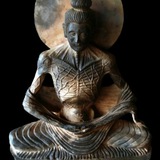
“It is because the myriad phenomena are merely a reflection of the mind. When something exists in the mind, then it exists. When something does not exist in the mind, then it does not exist. If one is able to grasp one's mind, then one is able to grasp all myriad phenomena; one can make everything external to the mind exist, if he wants it; if he doesn’t want it, the things disappear immediately.”
Master Sheng Yen
Master Sheng Yen
🙏5❤1
“Vajra is a Sanskrit word which defies translation because of its numerous connotations, but essentially vajra is an indestructible substance, usually represented by diamond.
Vajra refers to the vajra mind, the vajra nature, and the vajra prajñā. The vajra prajñā is the vajra nature which in turn is the vajra prajñā. Vajra is identical with the self-nature, the essential life force of all living beings, because both are indestructible and adamantine.
Furthermore, the eternally dwelling mind all beings have in common is the same as the vajra nature, since it too cannot be destroyed. Prajñā, as the highest form of wisdom living beings can attain, is real mark prajñā, eternally indestructible. It is therefore referred to as vajra prajñā.
Ānanda thought the false-thinking mind was the real mind. The Buddha told Ānanda, “That is not your mind. What is it? It is just the empty false appearance of dust objects before you. Those appearances manifest from your false thinking and delude your true nature. From beginningless kalpas until now you have always taken that for your mind. To do so is like thinking a thief is your son, and it makes you lose the knowledge of your eternal source. That source is the eternally indestructible precious nature, the enlightened bright mind. For that reason you appear and disappear endlessly in the six paths of the turning wheel.”
The third mind is the true suchness mind which is real mark prajñā. The true suchness mind is so great there is nothing beyond it, and so small there is nothing within it. One will find nothing smaller or larger than true suchness. The true suchness mind is the vajra mind, the real nature of every one of us.”
Hsuan Hua
Vajra refers to the vajra mind, the vajra nature, and the vajra prajñā. The vajra prajñā is the vajra nature which in turn is the vajra prajñā. Vajra is identical with the self-nature, the essential life force of all living beings, because both are indestructible and adamantine.
Furthermore, the eternally dwelling mind all beings have in common is the same as the vajra nature, since it too cannot be destroyed. Prajñā, as the highest form of wisdom living beings can attain, is real mark prajñā, eternally indestructible. It is therefore referred to as vajra prajñā.
Ānanda thought the false-thinking mind was the real mind. The Buddha told Ānanda, “That is not your mind. What is it? It is just the empty false appearance of dust objects before you. Those appearances manifest from your false thinking and delude your true nature. From beginningless kalpas until now you have always taken that for your mind. To do so is like thinking a thief is your son, and it makes you lose the knowledge of your eternal source. That source is the eternally indestructible precious nature, the enlightened bright mind. For that reason you appear and disappear endlessly in the six paths of the turning wheel.”
The third mind is the true suchness mind which is real mark prajñā. The true suchness mind is so great there is nothing beyond it, and so small there is nothing within it. One will find nothing smaller or larger than true suchness. The true suchness mind is the vajra mind, the real nature of every one of us.”
Hsuan Hua
❤7
“With your present physical form you can prevent yourself from ever going to the lower realms again. Moreover, if you want to achieve the physical rebirth of a Brahma, an Indra, and so forth, you can achieve it through your present one. If you want to go to pure realms such as Abhirati, Sukhavati, or Tushita, you can do so by means of this present physical rebirth. And this is not all, for you can even achieve the states of liberation or omniscience through this present rebirth—unless you don’t practice.
Most important of all, through this physical rebirth you are able to achieve the state of Vajradhara [the unification of the illusory body and great bliss] within one short lifetime in this degenerate age; otherwise it would take three countless great eons to achieve. Thus, this rebirth is worth more than one thousand billion precious jewels.”
Pabongkhapa Déchen Nyingpo
Most important of all, through this physical rebirth you are able to achieve the state of Vajradhara [the unification of the illusory body and great bliss] within one short lifetime in this degenerate age; otherwise it would take three countless great eons to achieve. Thus, this rebirth is worth more than one thousand billion precious jewels.”
Pabongkhapa Déchen Nyingpo
🙏10👍1
“In short, as long as you are not free of samsara for good, you have not transcended the nature of suffering. You therefore must definitely become liberated from it; and you must do so with your present rebirth.
We normally say, “We cannot do anything in this rebirth,” and make prayers for our next rebirth. But it is possible to do it in this rebirth. We have gained the optimum human rebirth, and this is the most advantageous physical form to have for the practice of Dharma. We are free from adverse conditions—we have met with the Buddha’s teachings, and so forth. We have all the right conditions, and so if we cannot achieve liberation now, when shall we ever achieve it?
Thus you should feel, “Now I definitely must liberate myself from samsara, come what may. And liberation is achieved only by means of the precious three high trainings. I will therefore train myself in these three and gain my liberation from this great ocean of suffering.” This is setting your motivation at the level of the lamrim shared with the medium scope.”
Pabongkhapa Déchen Nyingpo
We normally say, “We cannot do anything in this rebirth,” and make prayers for our next rebirth. But it is possible to do it in this rebirth. We have gained the optimum human rebirth, and this is the most advantageous physical form to have for the practice of Dharma. We are free from adverse conditions—we have met with the Buddha’s teachings, and so forth. We have all the right conditions, and so if we cannot achieve liberation now, when shall we ever achieve it?
Thus you should feel, “Now I definitely must liberate myself from samsara, come what may. And liberation is achieved only by means of the precious three high trainings. I will therefore train myself in these three and gain my liberation from this great ocean of suffering.” This is setting your motivation at the level of the lamrim shared with the medium scope.”
Pabongkhapa Déchen Nyingpo
🙏5❤1
Forwarded from Theravada Buddhism - ථේරවාද බෞද්ධ
The most important questions you can ask yourself are, “Who am I?”, and “What am I really looking for?”
Most people are born, and then they live, and die, and they never once are aware of their breath, going in and out of their body. They are not aware of their body, their feelings, their thoughts, in the moment. That’s how far away they live from themselves.
People rarely seek to find themselves. They rarely seek to understand their mind. They mostly seek to learn about external things. People know more about external things, rather than their own mind.
People know more about the sun, the moon, planets, oceans, politicians, about their neighbours, relatives, celebrities, scientists, actors, actresses, sportsmen, and so on. But they do not know about their own thoughts and feelings. They are not aware they are breathing, within this moment. People will gossip about these things, but they do not like to talk about what really matters.
They try to learn about economics, science, archeology, history, politics, entertainment, and so on, but they are not interested in learning about their own mind. They are not interested in the very thing that helps them to interpret the external world. They are not interested in finding out about what puts their experiences together, which is the mind itself. Because it is the mind that is the root of what we can experience.
In the Kalakarama sutta, The Buddha says, this is like, going to see a magician perform tricks, and really enjoying the tricks he is showing, but not trying to find out how he is performing those tricks, in the first place. In this sutta, the Buddha compares the mind, to a very skilled magician, who is so good at tricking his audience, that they don't even know he's the one performing the tricks.
People try to find out about things that are far away, but fail to see what is right in front of them, what is right within them. So, don’t you think we should discover ourselves first? Don’t you think we should try to understand what’s right within us, first, before we try to understand about the external world?
If we want to find the reality, or the truth, shouldn't we first know about what puts that reality together? Which is our mind?
"Cittena nīyati loko, cittena parikassati"
"Cittassa ekadhammassa sabbe va vasam-anvagū."
Samyutta Nikaya - 1.1.62 (Cittasuttaṁ) - The mind
The Buddha’s Vipassana technique is fully about understanding ourselves. Once we understand ourselves, we can then understand our entire world, and then end your problems.
Dhammapada Verse 65:
Thirty youths were enjoying themselves with a prostitute in a forest, when the prostitute stole their valuable ornaments, jewellery, and ran away. While searching for her they came across the Buddha and asked him if they had seen a woman. The Buddha asked them whether it was better to search for a woman or to search for themselves. They sat down and listened to the Dhamma and instantly attained Sotapanna (first stage of enlightenment). All of them joined the Order of the Buddha and followed him to the Jetavana monastery.
Because when you search for yourself instead, when you ask 'who am I', and start looking inwards, instead of outwards, via the practice of Satipatthana, the Sakkaya-ditthi (view of a stable, and continuous 'me', that exists now, existed in the past, and will exist in future, from moment to moment, fades away), because you start to see, how that 'me' was put together by your mind. When you see the process of how 'you', and your experience of the external world, were put together by the process of the mind,, you realize that this is all just an illusion, just like a magic trick. But, now that you see that it's just a trick, just an illusion, the mind, the greatest magician, can no longer trick you. This will lead you to the realization that there is no actual self, and that it's just another illusion that your mind creates. Realizing this is the way to Sotapanna.
Most people are born, and then they live, and die, and they never once are aware of their breath, going in and out of their body. They are not aware of their body, their feelings, their thoughts, in the moment. That’s how far away they live from themselves.
People rarely seek to find themselves. They rarely seek to understand their mind. They mostly seek to learn about external things. People know more about external things, rather than their own mind.
People know more about the sun, the moon, planets, oceans, politicians, about their neighbours, relatives, celebrities, scientists, actors, actresses, sportsmen, and so on. But they do not know about their own thoughts and feelings. They are not aware they are breathing, within this moment. People will gossip about these things, but they do not like to talk about what really matters.
They try to learn about economics, science, archeology, history, politics, entertainment, and so on, but they are not interested in learning about their own mind. They are not interested in the very thing that helps them to interpret the external world. They are not interested in finding out about what puts their experiences together, which is the mind itself. Because it is the mind that is the root of what we can experience.
In the Kalakarama sutta, The Buddha says, this is like, going to see a magician perform tricks, and really enjoying the tricks he is showing, but not trying to find out how he is performing those tricks, in the first place. In this sutta, the Buddha compares the mind, to a very skilled magician, who is so good at tricking his audience, that they don't even know he's the one performing the tricks.
People try to find out about things that are far away, but fail to see what is right in front of them, what is right within them. So, don’t you think we should discover ourselves first? Don’t you think we should try to understand what’s right within us, first, before we try to understand about the external world?
If we want to find the reality, or the truth, shouldn't we first know about what puts that reality together? Which is our mind?
"Cittena nīyati loko, cittena parikassati"
The world is led on by the mind, by the mind it is swept away
"Cittassa ekadhammassa sabbe va vasam-anvagū."
They all follow the authority of that one thing: the mind.
Samyutta Nikaya - 1.1.62 (Cittasuttaṁ) - The mind
The Buddha’s Vipassana technique is fully about understanding ourselves. Once we understand ourselves, we can then understand our entire world, and then end your problems.
Dhammapada Verse 65:
Thirty youths were enjoying themselves with a prostitute in a forest, when the prostitute stole their valuable ornaments, jewellery, and ran away. While searching for her they came across the Buddha and asked him if they had seen a woman. The Buddha asked them whether it was better to search for a woman or to search for themselves. They sat down and listened to the Dhamma and instantly attained Sotapanna (first stage of enlightenment). All of them joined the Order of the Buddha and followed him to the Jetavana monastery.
Because when you search for yourself instead, when you ask 'who am I', and start looking inwards, instead of outwards, via the practice of Satipatthana, the Sakkaya-ditthi (view of a stable, and continuous 'me', that exists now, existed in the past, and will exist in future, from moment to moment, fades away), because you start to see, how that 'me' was put together by your mind. When you see the process of how 'you', and your experience of the external world, were put together by the process of the mind,, you realize that this is all just an illusion, just like a magic trick. But, now that you see that it's just a trick, just an illusion, the mind, the greatest magician, can no longer trick you. This will lead you to the realization that there is no actual self, and that it's just another illusion that your mind creates. Realizing this is the way to Sotapanna.
🙏4
Forwarded from Borān Kammaṭṭhāna and Tai Esotericism
The Website is Up and Running, You may make donations to keep the website running at https://www.paypal.me/GavinSymahanou.
Here is the link to the website: https://www.esoterictheravada.com
Here is the link to the website: https://www.esoterictheravada.com
PayPal.Me
Betalen Gavin Symahanou met PayPal.Me
Ga naar paypal.me/GavinSymahanou en voer het bedrag in. En met PayPal weet je zeker dat het gemakkelijk en veiliger is. Heb je geen PayPal-rekening? Geen probleem.
“When you attend other teachings—initiations for example—you may think you will receive the power to subdue evil spirits by reciting the mantra, and so forth; or you may think you will subdue sicknesses or spirits, achieve wealth, acquire power, etc. Others, no matter how many teachings they have received, treat Dharma as if it were, for example, capital to start a business; they then go to places like Mongolia to peddle the Dharma. Such people accumulate enormous, grave sins through the Dharma. The Buddha, our Teacher, discussed the means to achieve liberation and omniscience. To exploit such teachings for worldly ends is equal to forcing a king off his throne and making him sweep the floor.”
Pabongkhapa Déchen Nyingpo
Pabongkhapa Déchen Nyingpo
🙏5👍1
“The experience commonly called 'entering Nirvana' is, in fact, an intuitive realization of that Self-nature which is the true Nature of all things. The Absolute, or Reality, is regarded as having for sentient beings two aspects. The only aspect perceptible to the unenlightened is the one in which individual phenomena have a separate though purely transitory existence within the limits of space-time.
The other aspect is spaceless and timeless; moreover all opposites, all distinctions and 'entities' of every kind, are here seen to be One. Yet neither is this second aspect, alone, the highest fruit of Enlightenment, as many contemplatives suppose; it is only when both aspects are perceived and reconciled that the beholder may be regarded as truly Enlightened.
Yet, from that moment, he ceases to be the beholder, for he is conscious of no division between beholding and beheld. This leads to further paradoxes, unless the use of words is abandoned altogether. It is incorrect to employ such mystical terminology as 'I dwell in the Absolute', 'The Absolute dwells in me', or 'I am penetrated by the Absolute, etc.; for, when space is transcended, the concepts of whole and part are no longer valid; the part is the whole — I am the Absolute, except that I am no longer I. What I behold then is my real Self, which is the true nature of all things; seer and seen are one and the same, yet there is no seeing, just as the eye cannot behold itself.”
John Blofeld
The other aspect is spaceless and timeless; moreover all opposites, all distinctions and 'entities' of every kind, are here seen to be One. Yet neither is this second aspect, alone, the highest fruit of Enlightenment, as many contemplatives suppose; it is only when both aspects are perceived and reconciled that the beholder may be regarded as truly Enlightened.
Yet, from that moment, he ceases to be the beholder, for he is conscious of no division between beholding and beheld. This leads to further paradoxes, unless the use of words is abandoned altogether. It is incorrect to employ such mystical terminology as 'I dwell in the Absolute', 'The Absolute dwells in me', or 'I am penetrated by the Absolute, etc.; for, when space is transcended, the concepts of whole and part are no longer valid; the part is the whole — I am the Absolute, except that I am no longer I. What I behold then is my real Self, which is the true nature of all things; seer and seen are one and the same, yet there is no seeing, just as the eye cannot behold itself.”
John Blofeld
🔥3👍1
“The Master said to me: All the Buddhas and all sentient beings are nothing but the One Mind, beside which nothing exists. This Mind, which is without beginning, is unborn and indestructible. It is not green nor yellow, and has neither form nor appearance.
It does not belong to the categories of things which exist or do not exist, nor can it be thought of in terms of new or old. It is neither long nor short, big nor small, for it transcends all limits, measures, names, traces and comparisons. It is that which you seek before you — begin to reason about it and you at once fall into error.
It is like the boundless void which cannot be fathomed or measured. The One Mind alone is the Buddha, and there is no distinction between the Buddha and sentient things, but that sentient beings are attached to forms and so seek externally for Buddhahood.”
Huángbò Xīyùn
It does not belong to the categories of things which exist or do not exist, nor can it be thought of in terms of new or old. It is neither long nor short, big nor small, for it transcends all limits, measures, names, traces and comparisons. It is that which you seek before you — begin to reason about it and you at once fall into error.
It is like the boundless void which cannot be fathomed or measured. The One Mind alone is the Buddha, and there is no distinction between the Buddha and sentient things, but that sentient beings are attached to forms and so seek externally for Buddhahood.”
Huángbò Xīyùn
❤6👍1
“The substance of the Absolute is inwardly like wood or stone, in that it is motionless, and outwardly like the void, in that it is without bounds or obstructions. It is neither subjective nor objective, has no specific location, is formless, and cannot vanish. Those who hasten towards it dare not enter, fearing to hurtle down through the void with nothing to cling to or to stay their fall. So they look to the brink and retreat.
This refers to all those who seek such a goal through cognition. Thus, those who seek the goal through cognition are like the fur (many), while those who obtain intuitive knowledge of the Way are like the horns (few).”
Huángbò Xīyùn
This refers to all those who seek such a goal through cognition. Thus, those who seek the goal through cognition are like the fur (many), while those who obtain intuitive knowledge of the Way are like the horns (few).”
Huángbò Xīyùn
🙏4
Forwarded from MAHASIDDHAS, MAHAMUDRA & DZOGCHEN 👹
“in the universal womb that is boundless space
all forms of matter and energy occur
as flux of the four elements,
but all are empty forms, absent in reality:
all phenomena, arising in pure mind, are like that.
just as dream is a part of sleep,
unreal in its arising,
so all and everything is pure mind,
never separated from it,
and without substance or attribute.
experience is neither mind nor anything but mind;
it is a vivid display of emptiness, like magical illusion,
in the very moment inconceivable and unutterable.
all experience arising in the mind,
at its inception, know it as emptiness!”
― Longchenpa
all forms of matter and energy occur
as flux of the four elements,
but all are empty forms, absent in reality:
all phenomena, arising in pure mind, are like that.
just as dream is a part of sleep,
unreal in its arising,
so all and everything is pure mind,
never separated from it,
and without substance or attribute.
experience is neither mind nor anything but mind;
it is a vivid display of emptiness, like magical illusion,
in the very moment inconceivable and unutterable.
all experience arising in the mind,
at its inception, know it as emptiness!”
― Longchenpa
Forwarded from MahaYog - Yoga 🔱 and Buddhism ☸️
An important aspect of our practice is our confidence in the law of karma: we are well aware that there is a cause-and-effect relationship between our actions and experiences. With this conviction, we have a basis for decision-making: we can distinguish which actions are beneficial and which are harmful.
Kalu Rinpoche
Kalu Rinpoche
🙏6❤1
“If an ordinary man, when he is about to die, could only see the five elements of consciousness as void; the four physical elements as not constituting an I; the real Mind as formless and neither coming nor going; his nature as something neither commencing at his birth nor perishing at his death, but as whole and motionless in its very depths; his Mind and environmental objects as one – if he could really accomplish this, he would receive Enlightenment in a flash.
He would no longer be entangled by the Triple World; he would be a World-Transcendor. He would be without even the faintest tendency towards rebirth. If he should behold the glorious sight of all the Buddhas coming to welcome him, surrounded by every kind of gorgeous manifestation, he would feel no desire to approach them.
If he should behold all sorts of horrific forms surrounding him, he would experience no terror. He would just be himself oblivious of conceptual thought and one with the Absolute. He would have attained the state of unconditioned being. This, then, is the fundamental principle.”
Huángbò Xīyùn
He would no longer be entangled by the Triple World; he would be a World-Transcendor. He would be without even the faintest tendency towards rebirth. If he should behold the glorious sight of all the Buddhas coming to welcome him, surrounded by every kind of gorgeous manifestation, he would feel no desire to approach them.
If he should behold all sorts of horrific forms surrounding him, he would experience no terror. He would just be himself oblivious of conceptual thought and one with the Absolute. He would have attained the state of unconditioned being. This, then, is the fundamental principle.”
Huángbò Xīyùn
❤9👍1🙏1
“Mind is the Buddha, while the cessation of conceptual thought is the Way. Once you stop arousing concepts and thinking in terms of existence and non-existence, long and short, other and self, active and passive, and suchlike, you will find that your Mind is intrinsically the Buddha, that the Buddha is intrinsically Mind, and that Mind resembles a void. Therefore is it written that 'the true Dharmakaya resembles a void'. Seek for naught besides this... Only come to know the nature of your own Mind, in which there is no self and no other, and you will in fact be a Buddha!”
Huángbò Xīyùn
Huángbò Xīyùn
❤7
“Since Mind knows no divisions into separate entities, phenomena must be equally undifferentiated. Since Mind is above all activities, so must it be with phenomena. Every phenomenon that exists is a creation of thought; therefore I need but empty my mind to discover that all of them are void.
It is the same with all sense-objects, to whichever of the myriads of categories they belong. The entire void stretching out in all directions is of one substance with Mind; and, since Mind is fundamentally undifferentiated, so must it be with everything else.
Different entities appear to you only because your perceptions differ — just as the colours of the precious delicacies eaten by the Devas are said to differ in accordance with the individual merits of the Devas eating them!”
Huángbò Xīyùn
It is the same with all sense-objects, to whichever of the myriads of categories they belong. The entire void stretching out in all directions is of one substance with Mind; and, since Mind is fundamentally undifferentiated, so must it be with everything else.
Different entities appear to you only because your perceptions differ — just as the colours of the precious delicacies eaten by the Devas are said to differ in accordance with the individual merits of the Devas eating them!”
Huángbò Xīyùn
❤4
Forwarded from Meditations of a Yogin
Acinta - The Avaricious Hermit
"Mahamudra is imageless, objectless.
Within it all phenomenon become
Knowledge and pure awareness.
Within it the ten thousand delusive thoughts
Are empty. All reality
Is Mahamudra."
Long ago in Dhanirupa, there lived a man so poor that he was never certain of his next meal. But his fantasy life was very rich indeed. In fact, all his thoughts were centered on one unobtainable goal, - to be rich. So tormented was he by his obsession, that he couldn't bear to have others interfere with dreaming. To this end, he moved away from civilization and went to live alone with his fantasies in a little hut he built in the forest.
One day, the Yogin Kambala chanced upon his hermits retreat. As they were sharing a frugal meal, Acinta poured his heart out to his visitor.
"Well, I see you've managed to escape from men and their chattering said Kabala. But tell me this, has your thinking improved since you've been here?"
"Unfortunately no," the hermit confessed with a sigh. "I'm still possessed by the desire for riches. But I do know this, if I could just get rid of this one thought my mind would be perfectly empty, for it's all I think about. Do you know of any way I could free myself from this foolishness?"
"As a matter of fact, I do," replied the yogin. "If you will promise to practice what I teach you, I'll give you instruction."
The hermit vowed to practice faithfully, and the guru gave him the Samvara initiation. Then he sang him this song of instruction:
"Desire is like the child
Of a barren woman,
To free your mind of it,
Visualize your body as the heavens,
And each of your thoughts
As the stars of the sky.
In time, the God of wealth will himself appear,
and all your desires will be fulfilled."
In the solitude of the forest, the hermit meditated according to his guru's instruction. When the glittering radiance of the stars filled this mind, there was no room left for thoughts of gold. His obsession vanished, as did the stars themselves, into the boundless expanse of the heavens, and he became thought free.
He sought out his guru to tell him that his mind had become empty, and Kambala sang him another song:
"What is the nature of the sky?
Can you make something of it?
How can you desire it?
How can you think about it at all?"
When the hermit realized the deep meaning within this verse, he achieved, "Mahamudra-siddhi" and became known as the guru Acintapa, "The Thought-Free Guru".
For three hundred years he selflessly taught his countless disciples how to realize the ultimate nature of being. And when the time came, they all accompanied him as rose bodily into the Paradise of the Dakinis.
~
From: "Buddhist Masters of Enchantment. The Lives and Legends of the Mahasiddhas."
Translated by Keith Dowman
Illustrated by Robert Beer
Image: Acinta - painting by Robert Beer
"Mahamudra is imageless, objectless.
Within it all phenomenon become
Knowledge and pure awareness.
Within it the ten thousand delusive thoughts
Are empty. All reality
Is Mahamudra."
Long ago in Dhanirupa, there lived a man so poor that he was never certain of his next meal. But his fantasy life was very rich indeed. In fact, all his thoughts were centered on one unobtainable goal, - to be rich. So tormented was he by his obsession, that he couldn't bear to have others interfere with dreaming. To this end, he moved away from civilization and went to live alone with his fantasies in a little hut he built in the forest.
One day, the Yogin Kambala chanced upon his hermits retreat. As they were sharing a frugal meal, Acinta poured his heart out to his visitor.
"Well, I see you've managed to escape from men and their chattering said Kabala. But tell me this, has your thinking improved since you've been here?"
"Unfortunately no," the hermit confessed with a sigh. "I'm still possessed by the desire for riches. But I do know this, if I could just get rid of this one thought my mind would be perfectly empty, for it's all I think about. Do you know of any way I could free myself from this foolishness?"
"As a matter of fact, I do," replied the yogin. "If you will promise to practice what I teach you, I'll give you instruction."
The hermit vowed to practice faithfully, and the guru gave him the Samvara initiation. Then he sang him this song of instruction:
"Desire is like the child
Of a barren woman,
To free your mind of it,
Visualize your body as the heavens,
And each of your thoughts
As the stars of the sky.
In time, the God of wealth will himself appear,
and all your desires will be fulfilled."
In the solitude of the forest, the hermit meditated according to his guru's instruction. When the glittering radiance of the stars filled this mind, there was no room left for thoughts of gold. His obsession vanished, as did the stars themselves, into the boundless expanse of the heavens, and he became thought free.
He sought out his guru to tell him that his mind had become empty, and Kambala sang him another song:
"What is the nature of the sky?
Can you make something of it?
How can you desire it?
How can you think about it at all?"
When the hermit realized the deep meaning within this verse, he achieved, "Mahamudra-siddhi" and became known as the guru Acintapa, "The Thought-Free Guru".
For three hundred years he selflessly taught his countless disciples how to realize the ultimate nature of being. And when the time came, they all accompanied him as rose bodily into the Paradise of the Dakinis.
~
From: "Buddhist Masters of Enchantment. The Lives and Legends of the Mahasiddhas."
Translated by Keith Dowman
Illustrated by Robert Beer
Image: Acinta - painting by Robert Beer
👍2
“When all the Buddhas manifest themselves in the world, they proclaim nothing but the One Mind. Thus, Gautama Buddha silently transmitted to Mahakasyapa the doctrine that the One Mind, which is the substance of all things, is co-extensive with the Void and fills the entire world of phenomena. This is called the Law of All the Buddhas. Discuss it as you may, how can you even hope to approach the truth through words? Nor can it be perceived either subjectively or objectively. So full understanding can come to you only through an inexpressible mystery.
The approach to it is called the Gateway of the Stillness beyond all Activity — If you wish to understand, know that a sudden comprehension comes when the mind has been purged of all the clutter of conceptual and discriminatory thought-activity.
Those who seek the truth by means of intellect and learning only get further and further away from it. Not till your thoughts cease all their branching here and there, not till you abandon all thoughts of seeking for something, not till your mind is motionless as wood or stone, will you be on the right road to the Gate.”
Huángbò Xīyùn
The approach to it is called the Gateway of the Stillness beyond all Activity — If you wish to understand, know that a sudden comprehension comes when the mind has been purged of all the clutter of conceptual and discriminatory thought-activity.
Those who seek the truth by means of intellect and learning only get further and further away from it. Not till your thoughts cease all their branching here and there, not till you abandon all thoughts of seeking for something, not till your mind is motionless as wood or stone, will you be on the right road to the Gate.”
Huángbò Xīyùn
“Error has no substance; it is entirely the product of your own thinking. If you know that Mind is the Buddha and that Mind is fundamentally without error, whenever thoughts arise, you will be fully convinced that they are responsible for errors. If you could prevent all conceptual movements of thought and still your thinking-processes, naturally there would be no error left in you. Therefore is it said: 'When thoughts arise, then do all things arise. When thoughts vanish, then do all things vanish.'”
Huángbò Xīyùn
Huángbò Xīyùn
🔥4⚡1
“Were you now to practise keeping your minds motionless at all times, whether walking, standing, sitting or lying;
concentrating entirely upon the goal of no thought-creation, no duality, no reliance on others and no attachments; just allowing all things to take their course the whole day long, as though you were too ill to bother; unknown to the world; innocent of any urge to be known or unknown to others; with your minds like blocks of stone that mend no holes — then all the Dharmas would penetrate your understanding through and through.
In a little while you would find yourselves firmly unattached. Thus, for the first time in your lives, you would discover your reactions to phenomena decreasing and, ultimately, you would pass beyond the Triple World; and people would say that a Buddha had appeared in the world. Pure and passionless knowledge implies putting an end to the ceaseless flow of thoughts and images, for in that way you stop creating the karma that leads to rebirth — whether as gods or men or as sufferers in hell.
Once every sort of mental process has ceased, not a particle of karma is formed. Then, even in this life, your minds and bodies become those of a being completely liberated. Supposing that this does not result in freeing you immediately from further rebirths, at the very least you will be assured of rebirth in accordance with your own wishes.
The sutra declares: 'Bodhisattvas are re-embodied into whatsoever forms they desire'. But were they suddenly to lose the power of keeping their minds free from conceptual thought, attachment to form would drag them back into the phenomenal world, and each of those forms would create for them a demon's karma!”
Huángbò Xīyùn
concentrating entirely upon the goal of no thought-creation, no duality, no reliance on others and no attachments; just allowing all things to take their course the whole day long, as though you were too ill to bother; unknown to the world; innocent of any urge to be known or unknown to others; with your minds like blocks of stone that mend no holes — then all the Dharmas would penetrate your understanding through and through.
In a little while you would find yourselves firmly unattached. Thus, for the first time in your lives, you would discover your reactions to phenomena decreasing and, ultimately, you would pass beyond the Triple World; and people would say that a Buddha had appeared in the world. Pure and passionless knowledge implies putting an end to the ceaseless flow of thoughts and images, for in that way you stop creating the karma that leads to rebirth — whether as gods or men or as sufferers in hell.
Once every sort of mental process has ceased, not a particle of karma is formed. Then, even in this life, your minds and bodies become those of a being completely liberated. Supposing that this does not result in freeing you immediately from further rebirths, at the very least you will be assured of rebirth in accordance with your own wishes.
The sutra declares: 'Bodhisattvas are re-embodied into whatsoever forms they desire'. But were they suddenly to lose the power of keeping their minds free from conceptual thought, attachment to form would drag them back into the phenomenal world, and each of those forms would create for them a demon's karma!”
Huángbò Xīyùn