Forwarded from Sri Kinaram Aghora Sampradaya
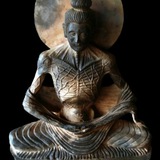
The Madman Heruka from Tsang 1452-1507, was an author and a master of the Kagyu school of Tantrik Buddhism. Born in Tsang Tibet, he is best known as a biographer and compiler of the Life of Milarepa and The Collections of Songs of Milarepa. Tsangnyön Heruka was a Nyönpa "religious madman". He was ordained as a monk as a child, but at the age of 21 he renounced his vows and trained under various tantrik yogis from different schools. After Heruka left the monastery, he became a wandering yogi for the rest of his life, never staying in one place permanently. He was known to keep his hair long, carry a khatvanga and drink from a kapala (skull bowl). When local villagers saw his body covered in human ashes and blood with his hair adorned by human fingers and toes, they gave him the name 'Nyönpa' (madman). He later used the name Trantung Gyelpo "King of the Blood-drinkers" which he received from the deity Hevajra in a vision, "blood drinker" being the Tibetan name for the deity Heruka. These eccentric ways were influenced by an Indian sect of yogis called Kapalikas "skull-bearers", who practiced austerities as well as dressing in loincloths and human ashes and carrying symbols of the dakinis such as bone ornaments and skulls. Many monks questioned his behavior and way of dress but Tsangnyön Heruka Trantung Gyelpo was known to strongly defend his unconventional practice through rigorous argument and accurate quotations from noscriptures. One day He appeared on a market place naked with brown sugar in one hand and feces in the other eating from both. Another day he was seen eating the brains of someone who had died of smallpox. It's said from this time on he was completely free from all misunderstandings and the dualities of samsara and nirvana became one and the same to him.
⚡2❤2🤔1
“What is the benefit of peacefully abiding, allowing the mind to remain still, in a natural state which is motionless? Until you are able to develop quiescence, you will not be able to control or suppress deluded mental afflictions. They will continue to arise and control the mind. The only way to get a handle on that and put an end to it is to accomplish quiescence. Once that is accomplished, all other spiritual qualities will arise from that basis, such as super knowledge, clairvoyance, the ability to see into the minds of others, to recall the past, and so forth.
These are mundane qualities that arise on the path but are developed only after the mind can abide peacefully. Qualities such as heightened awareness and clairvoyance must be developed, because it is through them that one is able to understand and realize the fundamental nature of the mind.
As it says in the Bodhicharyavatara, one of the most important mahayana texts, "Having developed enthusiasm in this way, I should place my mind in concentration; for one whose mind is distracted dwells between the fangs of mental afflictions."
An individual who has been able to accomplish quiescence will no longer be overpowered by attachment to ordinary activities and contact with worldly people. The mind automatically turns from attachment and attraction to cyclic existence, because quiescence is the experience of mental contentment and bliss which is far more sublime than ordinary attractions that arise from confused perception.
When the mind is at peace, it can then be directed to concentrate undistractedly for indefinite periods of time. Quiescence destroys delusion because mental afflictions do not arise when one is experiencing the equipoise of single-pointed concentration. People who have achieved quiescence naturally experience compassion as they view the predicament in which other living beings are ensnared. Pure compassion arises as they begin to clearly perceive the nature of emptiness in all aspects of reality.
These are only a few of many qualities as taught by the Buddha which are the direct result of accomplishing quiescence. Quiescence is the preparation and basis for the main practice which is the cultivation of the primordial wisdom of insight. These two meditations are complimentary.
The success that one has in developing insight is dependent on the success that one has with developing quiescence. If you are able to develop quiescence only to a certain degree, then your experience of insight will be limited. However, if you are able to fully accomplish quiescence, then you will be able to fully perfect insight as well. If that is the case, then that is as good as saying perfect enlightenment will be realized.”
Gyatrul Rinpoche
These are mundane qualities that arise on the path but are developed only after the mind can abide peacefully. Qualities such as heightened awareness and clairvoyance must be developed, because it is through them that one is able to understand and realize the fundamental nature of the mind.
As it says in the Bodhicharyavatara, one of the most important mahayana texts, "Having developed enthusiasm in this way, I should place my mind in concentration; for one whose mind is distracted dwells between the fangs of mental afflictions."
An individual who has been able to accomplish quiescence will no longer be overpowered by attachment to ordinary activities and contact with worldly people. The mind automatically turns from attachment and attraction to cyclic existence, because quiescence is the experience of mental contentment and bliss which is far more sublime than ordinary attractions that arise from confused perception.
When the mind is at peace, it can then be directed to concentrate undistractedly for indefinite periods of time. Quiescence destroys delusion because mental afflictions do not arise when one is experiencing the equipoise of single-pointed concentration. People who have achieved quiescence naturally experience compassion as they view the predicament in which other living beings are ensnared. Pure compassion arises as they begin to clearly perceive the nature of emptiness in all aspects of reality.
These are only a few of many qualities as taught by the Buddha which are the direct result of accomplishing quiescence. Quiescence is the preparation and basis for the main practice which is the cultivation of the primordial wisdom of insight. These two meditations are complimentary.
The success that one has in developing insight is dependent on the success that one has with developing quiescence. If you are able to develop quiescence only to a certain degree, then your experience of insight will be limited. However, if you are able to fully accomplish quiescence, then you will be able to fully perfect insight as well. If that is the case, then that is as good as saying perfect enlightenment will be realized.”
Gyatrul Rinpoche
👍3❤1
Forwarded from Meditations of a Yogin
Illusion-Like Thoughts
“All of our different activities are projections of the mind, created by our thoughts. If you follow these deluded thoughts, there will be no end to your mind being upset by delusion, just as when the wind blows over the surface of a lake, the crystal clarity of the water is masked by ripples.”
~ HH Dilgo Khentsye Rinpoche
Zurchungpa's Testament, pg 267 – on Wisdom – Snow Lion Publications
“All of our different activities are projections of the mind, created by our thoughts. If you follow these deluded thoughts, there will be no end to your mind being upset by delusion, just as when the wind blows over the surface of a lake, the crystal clarity of the water is masked by ripples.”
~ HH Dilgo Khentsye Rinpoche
Zurchungpa's Testament, pg 267 – on Wisdom – Snow Lion Publications
👍3
“One can impute emptiness logically when an independent reality of the self or of other phenomena is sought and not found. One also experiences it directly through meditation when the mind abides without ideas of existence or non-existence or both or neither. Meditators experience emptiness as a kind of fullness.
Emptiness allows for the unimpeded radiance of intrinsic awareness. In the experiential sense, then, it is not only a lack of something, but also a quality of knowing, or pristine cognition, a luminous quality that is the actual nature of the mind that can be experienced once the veils of concepts and emotions have been cleared away.
This experience is often referred to as clear light or radiance and also as "compassion." It is not something other than emptiness, for without emptiness it could not occur. It is the radiance-awareness that is the primordially pure basis of all manifestation and perception, the buddha nature.
This very nature of mind was always already there and is never corrupted or damaged, but only covered up by confusion. As such, it is the basis of spiritual practice, and also the goal or result. Buddha is not found anywhere outside of the intrinsic state of one's own mind. In the traditional breakdown, then, of ground, path, and fruition, the ground is one's own true nature, the fruition is the discovery of that, and the path is whatever it takes to make the discovery.
Kongtrul describes the identity of ground (basis) and fruition when he says:
The basis of purification is the eternal, noncomposite realm of reality that fully permeates all beings as the buddha nature.”
Sarah Harding
Emptiness allows for the unimpeded radiance of intrinsic awareness. In the experiential sense, then, it is not only a lack of something, but also a quality of knowing, or pristine cognition, a luminous quality that is the actual nature of the mind that can be experienced once the veils of concepts and emotions have been cleared away.
This experience is often referred to as clear light or radiance and also as "compassion." It is not something other than emptiness, for without emptiness it could not occur. It is the radiance-awareness that is the primordially pure basis of all manifestation and perception, the buddha nature.
This very nature of mind was always already there and is never corrupted or damaged, but only covered up by confusion. As such, it is the basis of spiritual practice, and also the goal or result. Buddha is not found anywhere outside of the intrinsic state of one's own mind. In the traditional breakdown, then, of ground, path, and fruition, the ground is one's own true nature, the fruition is the discovery of that, and the path is whatever it takes to make the discovery.
Kongtrul describes the identity of ground (basis) and fruition when he says:
The basis of purification is the eternal, noncomposite realm of reality that fully permeates all beings as the buddha nature.”
Sarah Harding
Forwarded from Meditations of a Yogin
"Empty, luminous, and infinite in potential, mind can be understood as having five basic qualities: emptiness, mobility, clarity, continuity, and stability. Each of these corresponds respectively to the five principal elements of space, air, fire, water, and earth.
We have already described mind as not being a tangible thing: it is indeterminate, omnipresent, and immaterial; it is emptiness, with the nature of space.
Thoughts and mental states constantly arise in the mind; this movement and fluctuation is the air element’s nature.
Furthermore, mind is clear; it can know, and that clear lucidity is the fire element’s nature.
And mind is continuous; its experiences are an uninterrupted flow of thoughts and perceptions. This continuity is the water element’s nature.
Finally, mind is the ground, or basis, from which arise all knowable things in samsara as well as nirvana, and this quality is the earth element’s nature."
From: "Luminous Mind: The Way of the Buddha"
~ Kyabje Kalu Rinpoche
We have already described mind as not being a tangible thing: it is indeterminate, omnipresent, and immaterial; it is emptiness, with the nature of space.
Thoughts and mental states constantly arise in the mind; this movement and fluctuation is the air element’s nature.
Furthermore, mind is clear; it can know, and that clear lucidity is the fire element’s nature.
And mind is continuous; its experiences are an uninterrupted flow of thoughts and perceptions. This continuity is the water element’s nature.
Finally, mind is the ground, or basis, from which arise all knowable things in samsara as well as nirvana, and this quality is the earth element’s nature."
From: "Luminous Mind: The Way of the Buddha"
~ Kyabje Kalu Rinpoche
👍7❤5🙏2
Forwarded from MahaYog - Yoga 🔱 and Buddhism ☸️
Just as cattle pulling carts manage to grasp only a tuft of grass, so also people who are caught up in desires have many hard things to endure and few pleasant things to enjoy.
Shantideva
Shantideva
Forwarded from No Beginning
In fact, essential reality (dharmata) transcends all conceptual fabrications, & the Buddha taught this to his disciples very clearly.
In this way the Buddha taught the path that dissolves all conceptual fabrications and thereby leads to the peace that is free from samsara's suffering.
Suffering comes from taking things to be real—from taking friends & enemies to be real, from taking birth and death to be real, from taking clean & dirty to be real, & from taking happiness & pain in general to be real.
The Buddha taught that the true nature of reality actually transcends all these concepts...& he also taught us how to realize this.
Since putting the Buddha's teachings into practice leads to the complete transcendence of suffering & the perfect awakening of the omniscient enlightened mind, then these teachings are the greatest words ever spoken, and the Buddha himself is the supreme of all who speak.
For these reasons, the Buddha is worthy of our respect & our prostration.
—Khenchen Tsultrim Gyamtso
In this way the Buddha taught the path that dissolves all conceptual fabrications and thereby leads to the peace that is free from samsara's suffering.
Suffering comes from taking things to be real—from taking friends & enemies to be real, from taking birth and death to be real, from taking clean & dirty to be real, & from taking happiness & pain in general to be real.
The Buddha taught that the true nature of reality actually transcends all these concepts...& he also taught us how to realize this.
Since putting the Buddha's teachings into practice leads to the complete transcendence of suffering & the perfect awakening of the omniscient enlightened mind, then these teachings are the greatest words ever spoken, and the Buddha himself is the supreme of all who speak.
For these reasons, the Buddha is worthy of our respect & our prostration.
—Khenchen Tsultrim Gyamtso
❤8
Forwarded from MahaYog - Yoga 🔱 and Buddhism ☸️
We should try to get used to the fact that everything we see, do and think is an interpretation created by our mind. This in itself is an important milestone on the path to practicing non-duality. And “getting used to it” in this case means reminding ourselves of it over and over again.
Dzongsar Jamyang Kyentse Rinpoche
Dzongsar Jamyang Kyentse Rinpoche
❤12🙏3
Forwarded from Sri Kinaram Aghora Sampradaya
"The Tantrik devotee is very much committed to a human guru, with whom he has personally come into contact in the transactional world. The guidance that he gets from the master is by no means imaginary, it is concrete and practical. While the guru is an individual, he also symbolizes the theme of personal transmission of the secret of realization in a succession of masters. This succession is known as Sampradaya which is defined in the Tantrik texts as whispering into the ears of the prepared disciple the highest truth so as to awaken him spiritually."
- The Tantra of Sri-Chakra
- The Tantra of Sri-Chakra
👍8❤2
Forwarded from Shakti Rising
“The word kula refers to the family or grouping of the yoginīs and of the 'Mothers'. It is also taken to mean the corporeal body, the body of power, the cosmic body, the totality of things so that by entering into a 'family', a kula, the worshipper enters into the totality of cosmic powers, the kula. He himself, in his own body, is the embodiment of the 'Mothers' and of the whole of reality. By being initiated into a 'Mother' he also enters into one or other level of his own body and becomes master of the powers identified with it. By piercing all the circles of his body he is master of the totality and attains the central deity which is identified with the true self of the worshipper, his 'blissful inner consciousness' of whom the eighth 'Mothers' are the projections.”
John R. Depuche
John R. Depuche
👍3
“Many people have this fantasy of somehow coming across some yogi or lama sitting on a mountain-top who looks up and says, “Ah, I’ve been waiting for you. What took you so long?” People think that if they could only find the perfect master who’s just right for them, all their problems would be solved. Sometimes I say to people, “Look, even if you meet your master, that’s when your problems begin!” In fact, even if the Buddha himself was sitting in front of us right now, what could he do to our untamed and uncontrolled minds? The only thing he could do is tell us to practice.”
Jetsunma Tenzin Palmo
Jetsunma Tenzin Palmo
❤11👍3
Forwarded from Borān Kammaṭṭhāna and Tai Esotericism
Sarvaṃ ca yujyate tasya śūnyatā yasya yujyate |
Sarvaṃ na yujyate tasya śūnyaṃ yasya na yujyate ||
All is possible when emptiness is possible.
Nothing is possible when emptiness is impossible.
-Chapter 24, verse 14, of the Mūlamadhyamakakārikā (Nāgārjuna).
Sarvaṃ na yujyate tasya śūnyaṃ yasya na yujyate ||
All is possible when emptiness is possible.
Nothing is possible when emptiness is impossible.
-Chapter 24, verse 14, of the Mūlamadhyamakakārikā (Nāgārjuna).
🔥6👍3❤1
“In Buddhism, purification is a science based on understanding the psychomechanics of karma, or action-the law of cause and effect-and entails the application of what are called the four opponent powers. Sometimes referred to as "confession," Buddhist purification is very different from the Christian conception of the term, although parallels certainly exist. Every action, whether physical, verbal, or mental, leaves an imprint on consciousness, like a seed planted in a field. When the conditions are right, this imprint ripens into an experience. Positive imprints, or "good" karma, result in happiness; negative imprints, or "bad" karma, bring suffering. Every action has four aspects that determine whether the action is complete or incomplete: motivation, object, performance, and completion.
To be complete, the action of killing, for instance, would require the motivation, or intention, to kill; a sentient being as the object to be killed; performance of the action, either directly or indirectly, that is, doing it oneself or ordering someone else to do it; and completion of the action, with the other sentient being dying before the killer. If an action is complete in all four aspects, it becomes what is called a throwing karma, an action that can determine your state of rebirth by throwing you into one of the six samsaric realms. If one or more of the four branches is missing, the action becomes a completing karma, determining the quality of the experiences you will have in this and future lives.
A completing karma brings three types of result: the result similar to the cause in experience, the result similar to the cause in habit, and the environmental result. Thus, a complete negative karma has four suffering results. For killing, these four could be rebirth in a hell, a short life plagued with illness, a tendency to kill other beings, and rebirth in a very dangerous place. Although all this applies equally to positive as well as negative actions, in the context of purification we focus on the latter. The four opponent powers work — and are all necessary — because each one counters one of the four negative karmic results.
The first power-taking refuge and generating bodhichitta-is called the power of the object, or the power of dependence, and purifies the environmental result. It is called the power of dependence because our recovery depends upon the object that hurt us. For example, to get up after you have fallen over and hurt yourself, you depend upon the same ground that hurt you. Similarly, almost all the negative karma we create has as its object either holy objects or sentient beings. In order to purify it we take refuge in holy objects and generate bodhichitta for the sake of all sentient beings. The second power is the power of release, which counteracts the result similar to the cause in experience. The third power is the power of the remedy, which is the antidote to the throwing karma that cat.ises us to be reborn in the three lower realms. Finally, the fourth power is that of indestructible determination, by which we overcome our lifetime-to-lifetime tendency to habitually create negativities again and again.
Thus, in neutralizing the four results of negative karma, the four opponent powers purify them completely, preventing us from ever having to experience their suffering results. This kind of explicit logic lies behind all Buddhist practice. The third power embraces many different kinds of remedy, from making prostrations to building stupas to reciting the hundred-syllable Vajrasattva mantra to meditating on emptiness. Ideally, several of these are practiced simultaneously.”
Nicholas Ribush
To be complete, the action of killing, for instance, would require the motivation, or intention, to kill; a sentient being as the object to be killed; performance of the action, either directly or indirectly, that is, doing it oneself or ordering someone else to do it; and completion of the action, with the other sentient being dying before the killer. If an action is complete in all four aspects, it becomes what is called a throwing karma, an action that can determine your state of rebirth by throwing you into one of the six samsaric realms. If one or more of the four branches is missing, the action becomes a completing karma, determining the quality of the experiences you will have in this and future lives.
A completing karma brings three types of result: the result similar to the cause in experience, the result similar to the cause in habit, and the environmental result. Thus, a complete negative karma has four suffering results. For killing, these four could be rebirth in a hell, a short life plagued with illness, a tendency to kill other beings, and rebirth in a very dangerous place. Although all this applies equally to positive as well as negative actions, in the context of purification we focus on the latter. The four opponent powers work — and are all necessary — because each one counters one of the four negative karmic results.
The first power-taking refuge and generating bodhichitta-is called the power of the object, or the power of dependence, and purifies the environmental result. It is called the power of dependence because our recovery depends upon the object that hurt us. For example, to get up after you have fallen over and hurt yourself, you depend upon the same ground that hurt you. Similarly, almost all the negative karma we create has as its object either holy objects or sentient beings. In order to purify it we take refuge in holy objects and generate bodhichitta for the sake of all sentient beings. The second power is the power of release, which counteracts the result similar to the cause in experience. The third power is the power of the remedy, which is the antidote to the throwing karma that cat.ises us to be reborn in the three lower realms. Finally, the fourth power is that of indestructible determination, by which we overcome our lifetime-to-lifetime tendency to habitually create negativities again and again.
Thus, in neutralizing the four results of negative karma, the four opponent powers purify them completely, preventing us from ever having to experience their suffering results. This kind of explicit logic lies behind all Buddhist practice. The third power embraces many different kinds of remedy, from making prostrations to building stupas to reciting the hundred-syllable Vajrasattva mantra to meditating on emptiness. Ideally, several of these are practiced simultaneously.”
Nicholas Ribush
❤8👍2🔥2
Forwarded from 𝗕𝘂𝗱𝗱𝗵𝗶𝘀𝘁 𝗛𝗶𝘀𝘁𝗼𝗿𝘆 & 𝗔𝗿𝗰𝗵𝗲𝗼𝗹𝗼𝗴𝘆
Nibbānaṃ paramaṃ sukhaṃ.
"Nibbāna is the highest happiness."
The Buddha describes the excellence of Nibbāna, it’s better than anything else, better than anything you can imagine. So that’s where we’re headed as we practice.
- Ajahn Ṭhānissaro
"Nibbāna is the highest happiness."
The Buddha describes the excellence of Nibbāna, it’s better than anything else, better than anything you can imagine. So that’s where we’re headed as we practice.
- Ajahn Ṭhānissaro
🙏6🔥3
Forwarded from Chintanam
Even creating a small bad deed will result in terrible fear and disasters in future lives, like having ingested poison.
Even creating a little merit will bring great happiness in future lives and accomplish vast objectives, like grains that ripen to perfection.
From: The Collection of Indicative Verses
Even creating a little merit will bring great happiness in future lives and accomplish vast objectives, like grains that ripen to perfection.
From: The Collection of Indicative Verses
❤17🔥4
"Four sublime states of mind have been taught by the Buddha:
Love, or loving kindness (mettā)
Compassion (karuṇā)
Sympathetic Joy (muditā)
Equanimity (upekkhā).
In Pali, the language of the Buddhist noscriptures, these four are known as Brahma-vihāra, a term which may be rendered as excellent, lofty, or sublime states of mind; or alternatively, as Brahma-like, god-like, or divine abodes.
These four attitudes are said to be excellent or sublime because they are the right or ideal way of conduct towards living beings (sattesu sammā paṭipatti). They provide, in fact, the answer to all situations arising from social contact. They are the great removers of tension, the great peace-makers in social conflict, and the great healers of wounds suffered in the struggle of existence. They level social barriers, build harmonious communities, awaken slumbering magnanimity long forgotten, revive joy and hope long abandoned, and promote human brotherhood against the forces of egotism.
The Brahma-vihāras are incompatible with a hating state of mind, and in that they are akin to Brahmā, the divine but transient ruler of the higher heavens in the traditional Buddhist picture of the universe. In contrast to many other conceptions of deities, East and West, who by their own devotees are said to show anger, wrath, jealousy, and “righteous indignation,” Brahmā is free from hate; and one who assiduously develops these four sublime states, by conduct and meditation, is said to become an equal of Brahmā (brahma-samo).
If they become the dominant influence in one’s mind, one will be reborn in congenial worlds, the realms of Brahmā. Therefore these states of mind are called god-like, Brahma-like."
Nyanaponika Thera
Love, or loving kindness (mettā)
Compassion (karuṇā)
Sympathetic Joy (muditā)
Equanimity (upekkhā).
In Pali, the language of the Buddhist noscriptures, these four are known as Brahma-vihāra, a term which may be rendered as excellent, lofty, or sublime states of mind; or alternatively, as Brahma-like, god-like, or divine abodes.
These four attitudes are said to be excellent or sublime because they are the right or ideal way of conduct towards living beings (sattesu sammā paṭipatti). They provide, in fact, the answer to all situations arising from social contact. They are the great removers of tension, the great peace-makers in social conflict, and the great healers of wounds suffered in the struggle of existence. They level social barriers, build harmonious communities, awaken slumbering magnanimity long forgotten, revive joy and hope long abandoned, and promote human brotherhood against the forces of egotism.
The Brahma-vihāras are incompatible with a hating state of mind, and in that they are akin to Brahmā, the divine but transient ruler of the higher heavens in the traditional Buddhist picture of the universe. In contrast to many other conceptions of deities, East and West, who by their own devotees are said to show anger, wrath, jealousy, and “righteous indignation,” Brahmā is free from hate; and one who assiduously develops these four sublime states, by conduct and meditation, is said to become an equal of Brahmā (brahma-samo).
If they become the dominant influence in one’s mind, one will be reborn in congenial worlds, the realms of Brahmā. Therefore these states of mind are called god-like, Brahma-like."
Nyanaponika Thera
"The world suffers. But most people have their eyes and ears closed. They do not see the unbroken stream of tears flowing through life; they do not hear the cry of distress continually pervading the world. Their own little grief or joy bars their sight, deafens their ears. Bound by selfishness, their hearts turn stiff and narrow. Being stiff and narrow, how should they be able to strive for any higher goal, to realize that only release from selfish craving will effect their own freedom from suffering?
It is compassion that removes the heavy bar, opens the door to freedom, makes the narrow heart as wide as the world. Compassion takes away from the heart the inert weight, the paralyzing heaviness; it gives wings to those who cling to the lowlands of self.
Through compassion the fact of suffering remains vividly present to our mind, even at times when we personally are free from it. It gives us the rich experience of suffering, thus strengthening us to meet it prepared when it does befall us.
Compassion reconciles us to our own destiny by showing us the lives of others, often much harder than ours.
Behold the endless caravan of beings, men and beasts, burdened with sorrow and pain! The burden of every one of them, we also have carried in bygone times during the unfathomable sequence of repeated births. Behold this, and open your heart to compassion!
And this misery may well be our own destiny again! One who is without compassion now will one day cry for it. If sympathy with others is lacking, it will have to be acquired through one’s own long and painful experience. This is the great law of life. Knowing this, keep guard over yourself!
Beings, sunk in ignorance, lost in delusion, hasten from one state of suffering to another, not knowing the real cause, not knowing the escape from it. This insight into the general law of suffering is the real foundation of our compassion, not any isolated fact of suffering.
Hence our compassion will also include those who at the moment may be happy, but act with an evil and deluded mind. In their present deeds we shall foresee their future state of distress, and compassion will arise."
Nyanaponika Thera
It is compassion that removes the heavy bar, opens the door to freedom, makes the narrow heart as wide as the world. Compassion takes away from the heart the inert weight, the paralyzing heaviness; it gives wings to those who cling to the lowlands of self.
Through compassion the fact of suffering remains vividly present to our mind, even at times when we personally are free from it. It gives us the rich experience of suffering, thus strengthening us to meet it prepared when it does befall us.
Compassion reconciles us to our own destiny by showing us the lives of others, often much harder than ours.
Behold the endless caravan of beings, men and beasts, burdened with sorrow and pain! The burden of every one of them, we also have carried in bygone times during the unfathomable sequence of repeated births. Behold this, and open your heart to compassion!
And this misery may well be our own destiny again! One who is without compassion now will one day cry for it. If sympathy with others is lacking, it will have to be acquired through one’s own long and painful experience. This is the great law of life. Knowing this, keep guard over yourself!
Beings, sunk in ignorance, lost in delusion, hasten from one state of suffering to another, not knowing the real cause, not knowing the escape from it. This insight into the general law of suffering is the real foundation of our compassion, not any isolated fact of suffering.
Hence our compassion will also include those who at the moment may be happy, but act with an evil and deluded mind. In their present deeds we shall foresee their future state of distress, and compassion will arise."
Nyanaponika Thera
🔥4❤2🙏2
"Isolated virtues, if unsupported by other qualities which give them either the needed firmness or pliancy, often deteriorate into their own characteristic defects. For instance, loving kindness, without energy and insight, may easily degenerate into a mere sentimental goodness of weak and unreliable nature. Moreover, such isolated virtues may often carry us in a direction contrary to our original aims and contrary to the welfare of others, too. It is the firm and balanced character of a person that knits isolated virtues into an organic and harmonious whole, within which the single qualities exhibit their best manifestations and avoid the pitfalls of their respective weaknesses. And this is the very function of equanimity, the way it contributes to an ideal relationship between all four sublime states.
Equanimity is a perfect, unshakable balance of mind, rooted in insight. But in its perfection and unshakable nature equanimity is not dull, heartless, and frigid. Its perfection is not due to an emotional “emptiness,” but to a “fullness” of understanding, to its being complete in itself. Its unshakable nature is not the immovability of a dead, cold stone, but the manifestation of the highest strength.
In what way, now, is equanimity perfect and unshakable? Whatever causes stagnation is here destroyed, what dams up is removed, what obstructs is destroyed. Vanished are the whirls of emotion and the meanderings of intellect. Unhindered goes the calm and majestic stream of consciousness, pure and radiant.
Watchful mindfulness (sati) has harmonized the warmth of faith (saddhā) with the penetrative keenness of wisdom (paññā); it has balanced strength of will (viriya) with calmness of mind (samādhi); and these five inner faculties (indriya) have grown into inner forces (bala) that cannot be lost again. They cannot be lost because they do not lose themselves any more in the labyrinths of the world (saṃsāra), in the endless diffuseness of life (papañca). These inner forces emanate from the mind and act upon the world, but being guarded by mindfulness, they nowhere bind themselves, and they return unchanged.
Love, compassion and sympathetic joy continue to emanate from the mind and act upon the world, but being guarded by equanimity, they cling nowhere, and return unweakened and unsullied."
Nyanaponika Thera
Equanimity is a perfect, unshakable balance of mind, rooted in insight. But in its perfection and unshakable nature equanimity is not dull, heartless, and frigid. Its perfection is not due to an emotional “emptiness,” but to a “fullness” of understanding, to its being complete in itself. Its unshakable nature is not the immovability of a dead, cold stone, but the manifestation of the highest strength.
In what way, now, is equanimity perfect and unshakable? Whatever causes stagnation is here destroyed, what dams up is removed, what obstructs is destroyed. Vanished are the whirls of emotion and the meanderings of intellect. Unhindered goes the calm and majestic stream of consciousness, pure and radiant.
Watchful mindfulness (sati) has harmonized the warmth of faith (saddhā) with the penetrative keenness of wisdom (paññā); it has balanced strength of will (viriya) with calmness of mind (samādhi); and these five inner faculties (indriya) have grown into inner forces (bala) that cannot be lost again. They cannot be lost because they do not lose themselves any more in the labyrinths of the world (saṃsāra), in the endless diffuseness of life (papañca). These inner forces emanate from the mind and act upon the world, but being guarded by mindfulness, they nowhere bind themselves, and they return unchanged.
Love, compassion and sympathetic joy continue to emanate from the mind and act upon the world, but being guarded by equanimity, they cling nowhere, and return unweakened and unsullied."
Nyanaponika Thera
🙏6
“For one who clings, motion exists; but for one who clings not, there is no motion. Where no motion is, there is stillness. Where stillness is, there is no craving. Where no craving is, there is neither coming nor going. Where no coming nor going is, there is neither arising nor passing away. Where neither arising nor passing away is, there is neither this world nor a world beyond, nor a state between. This, indeed, is the end of suffering.”
Udāna 8:4, Nibbāna Suttaṁ
Udāna 8:4, Nibbāna Suttaṁ
🙏7
Forwarded from MahaYog - Yoga 🔱 and Buddhism ☸️
Even a crow feels like Garuda in front of a dead snake. If your spirit is weak, even minor troubles can break you.
Shantideva
Shantideva
❤14