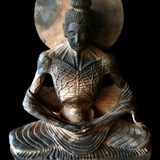
"O Buda ensinou que tudo quanto surge desaparece de acordo com as causas e as condições. Se, numa determinada situação, prevalecerem as causas e as condições para que aconteça o pior, então o pior acontecerá; se prevalecem as causas e as condições para que aconteça o melhor resultado possível, então surgirá o melhor desfecho.
Os budistas defendem que, se uma chávena de chá tiver um sabor salgado, mesmo que seja o mais desagradável possível, não é uma evidência de um universo essencialmente maligno. É simplesmente o resultado de alguém que se enganou no recipiente, pegando no do sal, em vez do açúcar."
~ Ajahn Jayasãro
Os budistas defendem que, se uma chávena de chá tiver um sabor salgado, mesmo que seja o mais desagradável possível, não é uma evidência de um universo essencialmente maligno. É simplesmente o resultado de alguém que se enganou no recipiente, pegando no do sal, em vez do açúcar."
~ Ajahn Jayasãro
Worlds on worlds are rolling ever
From creation to decay,
Like the bubbles on a river
Sparkling, bursting, borne away.
—Percy Bysshe Shelley
From creation to decay,
Like the bubbles on a river
Sparkling, bursting, borne away.
—Percy Bysshe Shelley
"The Buddha asked a Shramana, "How long is the human life span?" He replied, "A few days." The Buddha said, "You have not yet understood the Way."
He asked another Shramana, "How long is the human life span?" The reply was, "The space of a meal." The Buddha said, "You have not yet understood the Way."
He asked another Shramana, "How long is the human life span?" He replied, "The length of a single breath." The Buddha said, "Excellent. You have understood the Way."
He asked another Shramana, "How long is the human life span?" The reply was, "The space of a meal." The Buddha said, "You have not yet understood the Way."
He asked another Shramana, "How long is the human life span?" He replied, "The length of a single breath." The Buddha said, "Excellent. You have understood the Way."
Mahasiddhas: The Punk Buddhists
Tantric Buddhism can be traced back to groups of wandering yogis called Mahasiddhas (great adepts). According to Reynolds (2007), the mahasiddhas date to the medieval period in the Northern Indian Subcontinent (3–13 cen. CE), and used methods that were radically different than those used in Buddhist monasteries including living in forests and caves and practiced meditation in charnel grounds similar to those practiced by Shaiva Kapalika ascetics. These yogic circles came together in tantric feasts (ganachakra) often in sacred sites (pitha) and places (ksetra) which included dancing, singing, sex rites and the ingestion of taboo substances like alcohol, urine, meat, etc. At least two of the Mahasiddhas given in the Buddhist literature are actually names for Shaiva Nath saints (Gorakshanath and Matsyendranath) who practiced Hatha Yoga.
According to Schumann, a movement called Sahaja-Siddhi developed in the 8th century in Bengal. It was dominated by long-haired, wandering Mahasiddhas who openly challenged and ridiculed the Buddhist establishment. The Mahasiddhas pursued siddhis, magical powers such as flight and extrasensory perception as well as liberation and enlightenment.
Tantric Buddhism can be traced back to groups of wandering yogis called Mahasiddhas (great adepts). According to Reynolds (2007), the mahasiddhas date to the medieval period in the Northern Indian Subcontinent (3–13 cen. CE), and used methods that were radically different than those used in Buddhist monasteries including living in forests and caves and practiced meditation in charnel grounds similar to those practiced by Shaiva Kapalika ascetics. These yogic circles came together in tantric feasts (ganachakra) often in sacred sites (pitha) and places (ksetra) which included dancing, singing, sex rites and the ingestion of taboo substances like alcohol, urine, meat, etc. At least two of the Mahasiddhas given in the Buddhist literature are actually names for Shaiva Nath saints (Gorakshanath and Matsyendranath) who practiced Hatha Yoga.
According to Schumann, a movement called Sahaja-Siddhi developed in the 8th century in Bengal. It was dominated by long-haired, wandering Mahasiddhas who openly challenged and ridiculed the Buddhist establishment. The Mahasiddhas pursued siddhis, magical powers such as flight and extrasensory perception as well as liberation and enlightenment.
“Believe nothing, no matter where you read it, or who said it, no matter if I have said it, unless it agrees with your own reason and your own common sense.”
― Siddhartha Guatama
― Siddhartha Guatama
“The more stupid one is, the closer one is to reality. The more stupid one is, the clearer one is. Stupidity is brief and artless, while intelligence squirms and hides itself. Intelligence is unprincipled, but stupidity is honest and straightforward.”
― Fyodor Dostoyevsky,
― Fyodor Dostoyevsky,
“It takes the whole of life to learn how to live, and--what will perhaps make you wonder more--it takes the whole of life to learn how to die.”
― Seneca
― Seneca
“Just look at us. Everything is backwards, everything is upside down. Doctors destroy health, lawyers destroy justice, psychiatrists destroy minds, scientists destroy truth, major media destroys information, religions destroy spirituality and governments destroy freedom.”
― Michael Ellner
― Michael Ellner
“Beings are the owners of their actions, the heirs of their actions; they spring from their actions, are bound to their actions, and are supported by their actions. Whatever deeds they do, good or bad, of those they shall be heirs.”
― Bhikkhu Bodhi
― Bhikkhu Bodhi
“What I hate is ignorance, smallness of imagination, the eye that sees no farther than its own lashes. All things are possible.. Who you are is limited only by who you think you are.”
― Egyptian book of the dead
― Egyptian book of the dead
“Modern man, in pursuit of his aim to dominate the world, has become its slave”
― Nikolai Berdyaev, The Meaning of History
― Nikolai Berdyaev, The Meaning of History
“I will be sick, I will grow old, I will die, I will be separated from those I love, my relations and so forth. In such manner, the fully ripened effect of my actions will come to me and to no one else, and I am therefore not above depending on what I did in former lives.”
To think like this again and again is the antidote to such things as arrogance. Make every effort not to become arrogant by meditating on this antidote.
~ Kangyur Rinpoche
To think like this again and again is the antidote to such things as arrogance. Make every effort not to become arrogant by meditating on this antidote.
~ Kangyur Rinpoche
"To get back up when you fail, to celebrate behaving like a human – however imperfectly – and fully embrace the pursuit that you've embarked on." Marcus Aurelius
How to prepare for difficulty like a Stoic: - Practice Negative Visualization: What’s the worst that could happen? - Practice Misfortune: Ask yourself “Is this what I so feared?” - Practice Amor Fati: Don’t just accept your circumstances, learn to love them.