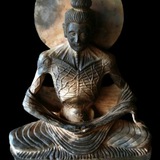
“God, having created the universe, then created the divisions, the worlds, and various gods and goddesses, whom he appointed to certain parts of the universe. He then took a mysterious transparent substance, out of which he created human souls. He appointed the souls to the astral region, which is just above the physical region.
He then assigned the souls to create life on Earth. He handed over some of his creative substance to the souls and commanded them to contribute to his creation. The souls then used the substance to create the various animals and forms of physical life. Soon after, however, the souls began to overstep their boundaries; they succumbed to pride and desired to be equal to the highest gods.
God was displeased and called upon Hermes to create physical bodies that would imprison the souls as a punishment for them. Hermes created human bodies on earth, and God then told the souls of their punishment. God decreed that suffering would await them in the physical world, but he promised them that, if their actions on Earth were worthy of their divine origin, their condition would improve and they would eventually return to the heavenly world. If it did not improve, he would condemn them to repeated reincarnation upon Earth.”
He then assigned the souls to create life on Earth. He handed over some of his creative substance to the souls and commanded them to contribute to his creation. The souls then used the substance to create the various animals and forms of physical life. Soon after, however, the souls began to overstep their boundaries; they succumbed to pride and desired to be equal to the highest gods.
God was displeased and called upon Hermes to create physical bodies that would imprison the souls as a punishment for them. Hermes created human bodies on earth, and God then told the souls of their punishment. God decreed that suffering would await them in the physical world, but he promised them that, if their actions on Earth were worthy of their divine origin, their condition would improve and they would eventually return to the heavenly world. If it did not improve, he would condemn them to repeated reincarnation upon Earth.”
"In the General Discourses did you not hear that all the souls whirled about in all the cosmos - portioned out, as it were - come from the one soul of the all? Many are the changes of these souls, then, some toward a happier lot, others the opposite. The snake-like change into water creatures; the watery change into things of dry land; the dry-land souls change into winged things; the aerial into humans; and human beings, changing into demons, possess the beginning of immortality, and so then they enter the troop of gods, which is really two troops, one wandering, the other fixed. [8] And this is soul most perfect glory. But if a soul that has entered into humans remains vicious, it neither tastes immortality nor shares in the good but turns back and rushes down the road toward the snakes, and this is the sentence pronounced against a vicious soul."
Forwarded from Krishna Consciousness
"Dharma is the basis and origin of all Natural Law, of the most instinctive and healthy way of living, and serves as the very ordering foundation of nature herself. At one time in the not-to-distant past, most of humanity understood and attempted to live in accordance with Dharma. Consequently, people prospered, were healthier, happier, more satisfied, and lived in greater spiritual and material abundance than we do today. Dharma sustained meaningful civilization, and prompted people to pursue peace, discernment, nobility, excellence, wisdom, goodness, and truth in all that they did and in all that they aspire for. Up until 2000 years ago, the concept of Dharma, or Natural Law, was held universally to be the highest achievable standard of both civilized human behavior and of a healthy and balanced ordering of societal dynamics."
Sri Dharma Pravartaka Acharya
The Dharma Manifesto
Introduction
#SanatanaDharma
#KrishnaConsciousness
Sri Dharma Pravartaka Acharya
The Dharma Manifesto
Introduction
#SanatanaDharma
#KrishnaConsciousness
Forwarded from Deleted Account
What Is Brahmacharya?
1. It is only within recent years, practically the last forty, that the scientific attention has been brought to bear upon the subject of the nature and evolution of the sexual impulse in man. Psychologists and clinical students have made careful investigations into the phenomena of normal` and abnormal sexual life among the civilized populations of the present day.
2. The close connection of the subject of sex with religion, both in social evolution and individual psychology, renders the study of chastity an extremely important chapter in the past and future sociology of the race.
3. The gratification of every worldly desire is sinful. Man was created for a life of spiritual communion with God. Moral goodness consists in renouncing all sensuous pleasures, in separating from the world, in living solely after the spirit, in imitating the perfection and purity of God. Sensuality is inconsistent with wisdom and holiness. The great business of life is to avoid impurity.
4. Man has degraded himself to a great degree by becoming a puppet of passion. He has become an imitative machine. He has lost his power of discrimination. He has sunk into the most abject form of slavery. What a sad state! What a lamentable plight indeed! If he wishes to regain his lost divine state and Brahmic glory, his whole being must be completely transmuted by entertaining sublime divine thoughts and practice of regular meditation. Transmutation of sex-desire is a very potent, efficacious and satisfactory way to realize eternal Bliss.
5. Brahmacharya is the vow of celibacy in thought, word and deed, by which one attains Self-realisation or reaches Brahman. It means control of not only the reproductive Indriya but also control of all senses in thought, word and deed. The door to Nirvana or perfection is complete Brahmacharya. Complete celibacy is the master-key to open the realms of elysian Bliss. The avenue to the abode of Supreme Peace begins from Brahmacharya or purity.
6. “Rasad raktam tato mamsam mamsanmedhah prajayate; Medasosthi tato majja majjayah sukrasambhavah—from food comes juice or chyle, from chyle blood, from blood flesh, from flesh fat, from fat bones, from bones marrow and lastly from marrow semen.” Semen is the quintessence of food or blood. One drop of semen is manufactured out of 40 drops of blood according to the medical science. According to Ayurveda it is elaborated out of 80 drops of blood. Just as sugar is all-pervading in the sugar-cane, butter in milk, so also semen is pervading the whole body. Just as the butter-milk is thin after butter is removed, so also semen is thinned by its wastage. The more the wastage of semen the more is the weakness. In Yoga Sastras it is said: “Maranam bindupatanat jivanam bindu-rakshanat—falling of semen brings death; preservation of semen gives life.” Semen is the real vitality in man. It is the hidden treasure for man. It imparts Brahma-Tejas to the face and strength to the intellect.
7. If the spermatic secretion in men is continuous, it must either be expelled or reabsorbed. As a result of the most patient and persevering scientific investigations, whenever the seminal secretions are conserved and thereby reabsorbed into the system, it goes towards enriching the blood and strengthening the brain. Dr. Dio Louis taught that the conservation of this element is essential to the strength of body, vigour of mind and keenness of intellect. Another writer Dr. E.P. Miller writes: “All waste of spermatic secretions, whether voluntary or involuntary, is a direct waste of life-force. It is almost universally conceded that the choicest element of the blood enters into the composition of the spermatic secretion. If these conclusions are correct then it follows that a chaste life is essential to man’s well-being.”
1. It is only within recent years, practically the last forty, that the scientific attention has been brought to bear upon the subject of the nature and evolution of the sexual impulse in man. Psychologists and clinical students have made careful investigations into the phenomena of normal` and abnormal sexual life among the civilized populations of the present day.
2. The close connection of the subject of sex with religion, both in social evolution and individual psychology, renders the study of chastity an extremely important chapter in the past and future sociology of the race.
3. The gratification of every worldly desire is sinful. Man was created for a life of spiritual communion with God. Moral goodness consists in renouncing all sensuous pleasures, in separating from the world, in living solely after the spirit, in imitating the perfection and purity of God. Sensuality is inconsistent with wisdom and holiness. The great business of life is to avoid impurity.
4. Man has degraded himself to a great degree by becoming a puppet of passion. He has become an imitative machine. He has lost his power of discrimination. He has sunk into the most abject form of slavery. What a sad state! What a lamentable plight indeed! If he wishes to regain his lost divine state and Brahmic glory, his whole being must be completely transmuted by entertaining sublime divine thoughts and practice of regular meditation. Transmutation of sex-desire is a very potent, efficacious and satisfactory way to realize eternal Bliss.
5. Brahmacharya is the vow of celibacy in thought, word and deed, by which one attains Self-realisation or reaches Brahman. It means control of not only the reproductive Indriya but also control of all senses in thought, word and deed. The door to Nirvana or perfection is complete Brahmacharya. Complete celibacy is the master-key to open the realms of elysian Bliss. The avenue to the abode of Supreme Peace begins from Brahmacharya or purity.
6. “Rasad raktam tato mamsam mamsanmedhah prajayate; Medasosthi tato majja majjayah sukrasambhavah—from food comes juice or chyle, from chyle blood, from blood flesh, from flesh fat, from fat bones, from bones marrow and lastly from marrow semen.” Semen is the quintessence of food or blood. One drop of semen is manufactured out of 40 drops of blood according to the medical science. According to Ayurveda it is elaborated out of 80 drops of blood. Just as sugar is all-pervading in the sugar-cane, butter in milk, so also semen is pervading the whole body. Just as the butter-milk is thin after butter is removed, so also semen is thinned by its wastage. The more the wastage of semen the more is the weakness. In Yoga Sastras it is said: “Maranam bindupatanat jivanam bindu-rakshanat—falling of semen brings death; preservation of semen gives life.” Semen is the real vitality in man. It is the hidden treasure for man. It imparts Brahma-Tejas to the face and strength to the intellect.
7. If the spermatic secretion in men is continuous, it must either be expelled or reabsorbed. As a result of the most patient and persevering scientific investigations, whenever the seminal secretions are conserved and thereby reabsorbed into the system, it goes towards enriching the blood and strengthening the brain. Dr. Dio Louis taught that the conservation of this element is essential to the strength of body, vigour of mind and keenness of intellect. Another writer Dr. E.P. Miller writes: “All waste of spermatic secretions, whether voluntary or involuntary, is a direct waste of life-force. It is almost universally conceded that the choicest element of the blood enters into the composition of the spermatic secretion. If these conclusions are correct then it follows that a chaste life is essential to man’s well-being.”
Forwarded from Krishna Consciousness
"As the philosophy of Krishna Consciousness is non-sectarian, any man — Hindu or Christian — will advance in his faith by chanting the Holy Name of God and hearing the Bhagavad-gita."
Srila Prabhupada
Sri Isopanisad Appendix 2
#KrishnaConsciousness
Srila Prabhupada
Sri Isopanisad Appendix 2
#KrishnaConsciousness
Our beliefs determine our thoughts and attitudes about life, which in turn direct our actions. By our actions, we create our destiny. Beliefs about sacred matters--God, soul and cosmos--are essential to one's approach to life. Hindus believe many diverse things, but there are a few bedrock concepts on which most Hindus concur. The following nine beliefs, though not exhaustive, offer a simple summary of Hindu spirituality.
1. Hindus believe in a one, all-pervasive Supreme Being who is both immanent and transcendent, both Creator and Unmanifest Reality.
2. Hindus believe in the divinity of the four Vedas, the world's most ancient noscripture, and venerate the Agamas as equally revealed. These primordial hymns are God's word and the bedrock of Sanatana Dharma, the eternal religion.
3. Hindus believe that the universe undergoes endless cycles of creation, preservation and dissolution.
4. Hindus believe in karma, the law of cause and effect by which each individual creates his own destiny by his thoughts, words and deeds.
5. Hindus believe that the soul reincarnates, evolving through many births until all karmas have been resolved, and moksha, liberation from the cycle of rebirth, is attained. Not a single soul will be deprived of this destiny.
6. Hindus believe that divine beings exist in unseen worlds and that temple worship, rituals, sacraments and personal devotionals create a communion with these devas and Gods.
7. Hindus believe that an enlightened master, or satguru, is essential to know the Transcendent Absolute, as are personal discipline, good conduct, purification, pilgrimage, self-inquiry, meditation and surrender in God.
8. Hindus believe that all life is sacred, to be loved and revered, and therefore practice ahimsa, noninjury, in thought, word and deed.
9. Hindus believe that no religion teaches the only way to salvation above all others, but that all genuine paths are facets of God's Light, deserving tolerance and understanding.
Hinduism, the world's oldest religion, has no beginning--it precedes recorded history. It has no human founder. It is a mystical religion, leading the devotee to personally experience the Truth within, finally reaching the pinnacle of consciousness where man and God are one. Hinduism has four main denominations--Saivism, Shaktism, Vaishnavism and Smartism.
1. Hindus believe in a one, all-pervasive Supreme Being who is both immanent and transcendent, both Creator and Unmanifest Reality.
2. Hindus believe in the divinity of the four Vedas, the world's most ancient noscripture, and venerate the Agamas as equally revealed. These primordial hymns are God's word and the bedrock of Sanatana Dharma, the eternal religion.
3. Hindus believe that the universe undergoes endless cycles of creation, preservation and dissolution.
4. Hindus believe in karma, the law of cause and effect by which each individual creates his own destiny by his thoughts, words and deeds.
5. Hindus believe that the soul reincarnates, evolving through many births until all karmas have been resolved, and moksha, liberation from the cycle of rebirth, is attained. Not a single soul will be deprived of this destiny.
6. Hindus believe that divine beings exist in unseen worlds and that temple worship, rituals, sacraments and personal devotionals create a communion with these devas and Gods.
7. Hindus believe that an enlightened master, or satguru, is essential to know the Transcendent Absolute, as are personal discipline, good conduct, purification, pilgrimage, self-inquiry, meditation and surrender in God.
8. Hindus believe that all life is sacred, to be loved and revered, and therefore practice ahimsa, noninjury, in thought, word and deed.
9. Hindus believe that no religion teaches the only way to salvation above all others, but that all genuine paths are facets of God's Light, deserving tolerance and understanding.
Hinduism, the world's oldest religion, has no beginning--it precedes recorded history. It has no human founder. It is a mystical religion, leading the devotee to personally experience the Truth within, finally reaching the pinnacle of consciousness where man and God are one. Hinduism has four main denominations--Saivism, Shaktism, Vaishnavism and Smartism.