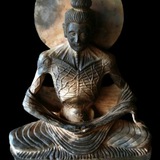
I resolve to become a Buddha,
Equal in attainment to you, O holy king of the Dharma,
To save living beings from birth-and-death,
And to lead them all to emancipation.
I vow that, when I have become a Buddha,
I shall carry out this promise everywhere;
And to all fear-ridden beings
Shall I give great peace"
- The Larger Sutra on Amida Buddha
Equal in attainment to you, O holy king of the Dharma,
To save living beings from birth-and-death,
And to lead them all to emancipation.
I vow that, when I have become a Buddha,
I shall carry out this promise everywhere;
And to all fear-ridden beings
Shall I give great peace"
- The Larger Sutra on Amida Buddha
O nono livro sobre os mistérios trata sobre o Daemon pessoal, então me deixe esclarecer alguns pontos básicos.
Iamblichius julga que o Daemon pessoal não é distribuido conforme o horóscopo específico que é relacionado ao nascimento em uma região específica nos céus, pois isso iria fazer do Daemon similar aos homens de natureza correspondente.
Ao invés disso, o Daemon tem sua sua natureza derivada da totalidade do Cosmos, as almas são manifestas em vidas específicas pelo demiurgo e como a alma descende através dos planetas, ela adquire certas roupagens astrais no momento em que ela vai para o seu destino específico.
A alma, antes que ela seja lançada nesta vida, escolhe o modelo de sua vivência por selecionar o Daemon que se torna o dirigente da vida específica, além de guiar e comunicar a esta nova vida os princípios básicos.
O Daemon executa a tarefa até o tempo em que a alma que ele está auxiliando possa fazer um contato teúrgico com o deus regente a qual o Daemon responde, e neste ponto o deus toma a tarefa de gerenciar a posição dessa vida.
A determinação da conexão com o deus particular é feita através do Daemon revelando o modo correto de culto/adoração e através de como o Daemon é chamado/convocado. Desta forma o Daemon é conhecido pelo deus a qual este é um intermediário.
Iamblichius julga que o Daemon pessoal não é distribuido conforme o horóscopo específico que é relacionado ao nascimento em uma região específica nos céus, pois isso iria fazer do Daemon similar aos homens de natureza correspondente.
Ao invés disso, o Daemon tem sua sua natureza derivada da totalidade do Cosmos, as almas são manifestas em vidas específicas pelo demiurgo e como a alma descende através dos planetas, ela adquire certas roupagens astrais no momento em que ela vai para o seu destino específico.
A alma, antes que ela seja lançada nesta vida, escolhe o modelo de sua vivência por selecionar o Daemon que se torna o dirigente da vida específica, além de guiar e comunicar a esta nova vida os princípios básicos.
O Daemon executa a tarefa até o tempo em que a alma que ele está auxiliando possa fazer um contato teúrgico com o deus regente a qual o Daemon responde, e neste ponto o deus toma a tarefa de gerenciar a posição dessa vida.
A determinação da conexão com o deus particular é feita através do Daemon revelando o modo correto de culto/adoração e através de como o Daemon é chamado/convocado. Desta forma o Daemon é conhecido pelo deus a qual este é um intermediário.
The Bodhisattva-mahasattva sees both the evil elephant and the evil friend as one and not two. Why so? Because both destroy one’s own self. The Bodhisattva never fears the evil elephant, but fears the evil friend. Why? The evil elephant only harms the body, not the mind. The evil friend destroys both.
Mahaparanirvana Sutra
Mahaparanirvana Sutra
Then Vidagdha, the son of Śakala, asked him, ‘How many gods are there, Yājñavalkya?’ Yājñavalkya decided the number asked for by Śākalya through this Nivid that is just going to be mentioned. ‘As many gods as are indicated in the Nivid of the eulogistic hymn on the Viśvadevas.’ The Nivid is a group of verses giving the number of the gods, which are recited in the eulogistic hymn on the Viśvadevas. ‘There are as many gods as are mentioned in that Nivid.’ Which is that Nivid? The words of that Nivid are quoted: ‘Three hundred and three gods, and again three thousand and three gods. So many gods are there.’ ‘Very well,’ said Śākalya
‘Which is the one god?’ ‘The vital force (Hiraṇyagarbha); it is Brahman, which is called Tyat (that).’
"One's own immediate consciousness is this very reality!
Abiding in this reality, which is uncontrived and naturally radiant, how can one say that one does not understand the nature of mind?"
- The Tibetan Book of the Dead
Abiding in this reality, which is uncontrived and naturally radiant, how can one say that one does not understand the nature of mind?"
- The Tibetan Book of the Dead
Because souls are spiritual, their original home is the spiritual kingdom. Almost all souls dwell there. These are called eternally liberated souls. Only a tiny minority of souls inhabit this material world. These are called fallen, or conditioned, souls.
Souls are small samples of God. Hence they possess a minute quantity of that freedom which God possesses in full. Although they are eternal, full of knowledge and bliss, and although their dharma, or essential nature, is to serve God, they may still, in the exercise of that freedom, willfully turn away from divine service. Thereupon these souls fall into the inhospitable realm of the external, material energy.
Because souls are constitutionally servants, even the rebellious souls remain under God’s control, but that control is now exercised indirectly and unfavorably through the agency of material nature. Souls do not have the freedom not to be controlled by God, but they do choose freely how they wish to be controlled. Those who will not voluntarily be controlled by the Lord are controlled involuntarily by material nature. For this reason, spiritual souls become incarcerated within matter. Under the superintendence of the Lord, there is a confluence of the marginal and the external energies, and the creation arises.
Souls are small samples of God. Hence they possess a minute quantity of that freedom which God possesses in full. Although they are eternal, full of knowledge and bliss, and although their dharma, or essential nature, is to serve God, they may still, in the exercise of that freedom, willfully turn away from divine service. Thereupon these souls fall into the inhospitable realm of the external, material energy.
Because souls are constitutionally servants, even the rebellious souls remain under God’s control, but that control is now exercised indirectly and unfavorably through the agency of material nature. Souls do not have the freedom not to be controlled by God, but they do choose freely how they wish to be controlled. Those who will not voluntarily be controlled by the Lord are controlled involuntarily by material nature. For this reason, spiritual souls become incarcerated within matter. Under the superintendence of the Lord, there is a confluence of the marginal and the external energies, and the creation arises.
Even in the conditioned state, the soul always remains a spiritual being. Like a dreamer who projects his identity onto an illusory dream-self, the conditioned soul acquires a false self of matter. Although the self is by nature eternal, full of knowledge and full of bliss, this nature becomes covered by illusion. Identifying with the material body, the soul is plunged into the nightmare of history, trapped in the revolutions of repeated birth and death (mrityu-samsara). This false identification by the embodied souls with their psychophysical coverings is the cause of all their suffering.
The quest by conditioned souls for happiness in this world inevitably fails. The eternal souls naturally seek eternal happiness, yet they seek it where all happiness is temporary. The fulfillment of the most common and basic desire, that of self-preservation, has not once met with success. Indeed, the deluded souls do not know that matters are just the opposite of the way they seem. Gratification of the senses is in fact the generator of suffering, not happiness. This is because each act of sense gratification intensifies the soul’s false identification with the body. Consequently, when the body undergoes disease, senescence, and death, the materially absorbed living beings experience all these as happening to themselves. Death is an illusion they have imposed upon themselves owing to their desire to enjoy in this world. So enjoying, their agony continues unabated. A mind brimming with unfulfilled yearnings propels them, at the time of death, into new material bodies, to begin yet another round.
This (Soul) is Eternal, for it remembers what was experienced in the past. But it may be asked: how if Soul is eternal, they do speak of its being “born” and “dead”?
We reply that birth is because of the Soul’s bondage with body, and
death is, because of its severance therefrom.
Hence the nature of the Soul is Eternal.
Soul is distinct for each distinct body.
We reply that birth is because of the Soul’s bondage with body, and
death is, because of its severance therefrom.
Hence the nature of the Soul is Eternal.
Soul is distinct for each distinct body.
Forwarded from ESTOICISMO
257.
"Ou os deuses existem ou eles não existem. Se eles não existem, por que rezar? Se existem, por que não rezar por algo diferente do que coisas acontecerem ou não? Reze para não sentir medo. Ou desejo, ou tristeza. Se os deuses podem fazer algo, eles podem fazer isso por nós."
— Marco Aurélio
"Ou os deuses existem ou eles não existem. Se eles não existem, por que rezar? Se existem, por que não rezar por algo diferente do que coisas acontecerem ou não? Reze para não sentir medo. Ou desejo, ou tristeza. Se os deuses podem fazer algo, eles podem fazer isso por nós."
— Marco Aurélio
Either the gods have power or they don’t. If they don’t, why pray? If they do, then why not pray for something else instead of for things to happen or not to happen? Pray not to feel fear. Or desire, or grief. If the gods can do anything, they can surely do that for us.—But those are things the gods left up to me.
Then isn’t it better to do what’s up to you—like a free man—than to be passively controlled by what isn’t, like a slave or beggar? And what makes you think the gods don’t care about what’s up to us?
Start praying like this and you’ll see. Not “some way to sleep with her”—but a way to stop wanting to. Not “some way to get rid of him”—but a way to stop trying. Not “some way to save my child”—but a way to lose your fear. Redirect your prayers like that, and watch what happens.
Then isn’t it better to do what’s up to you—like a free man—than to be passively controlled by what isn’t, like a slave or beggar? And what makes you think the gods don’t care about what’s up to us?
Start praying like this and you’ll see. Not “some way to sleep with her”—but a way to stop wanting to. Not “some way to get rid of him”—but a way to stop trying. Not “some way to save my child”—but a way to lose your fear. Redirect your prayers like that, and watch what happens.
Forwarded from The Classical Wisdom Tradition
A basic prayer form with variations in detail arises from its function. At the beginning, underlined by the request 'Hear!', comes the name of the deity. Great importance is attached to finding the right name, especially appropriate epithets; as much as possible, epithets are heaped one upon another - a feature which probably also derives from Indo-European tradition - and the god is also offered the choice: 'With whatever name it pleases you to be called'. An attempt is also made to define the sphere of the god spatially by naming his favored dwelling place or several possible places from which he is to come. This is followed by a justification for calling on the god, in which earlier proofs of friendship are invoked by way of precedent: if ever the god has come to the aid of the suppliant, or if the suppliant has performed works pleasing to the god, has burned sacrifices and built temples, then this should now hold good. Often the assurance 'for you are able' is slipped in. Once contact has been established, the entreaty is made succinctly and clearly and is usually accompanied by the promise for the future, the vow; piety is supposed to guarantee constancy. Philosophically refined religious sensibility later took exception to the self-interested directness of the euchai; one should, it was recommended, pray simply for the Good and leave the decision to the god.
Walter Burkert, Greek Religion, II.3
Walter Burkert, Greek Religion, II.3
"It is impossible to properly understand an entity consisting of infinite properties without the method of modal denoscription consisting of all viewpoints, since it will otherwise lead to a situation of seizing mere sprouts (i.e., a superficial, inadequate cognition), on the maxim of the blind (men) and the elephant."
- Syadavada Manjari of Acharya Mallisena (Jain text)
- Syadavada Manjari of Acharya Mallisena (Jain text)