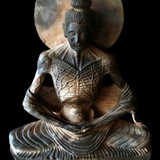
"There's only The One, The Totality of Everything and Nothing at the same time, and both the created and the increated its just an emanation of it"
"In the meantime the deities gave warnings and sent prophets and told these people they were destroying themselves. But they were proud and they gave no mind or no thought... and finally, they rebelled against the gods... and the gods reacted accordingly."
- Manly P. Hall
- Manly P. Hall
"The average student of buddhism may at the beginning develop a materialistic mentality that collecting knowledge and wisdom that would slowly get himself closer to achieving enlightment. Advancing on it's studies, he'll discover that this is a misconception. There's nothing to "achieve" and the mentality of progress is a wrong view.
People attempt to "achieve" enlightment as if they were attempting to learn to play an instrument or be good at an sport.
"I'll achieve Nirvana and then maybe learn some sick floating skills"
This is still samsara and couldn't be further from the buddhist view.
There's nothing to obtain. The endless search for wisdom and knowledge in attempt to "conquer" by "turning" into something is just more desire, and that's not the point of Buddha's teachings.
At least that's what i understood that is the topic adressed here."
People attempt to "achieve" enlightment as if they were attempting to learn to play an instrument or be good at an sport.
"I'll achieve Nirvana and then maybe learn some sick floating skills"
This is still samsara and couldn't be further from the buddhist view.
There's nothing to obtain. The endless search for wisdom and knowledge in attempt to "conquer" by "turning" into something is just more desire, and that's not the point of Buddha's teachings.
At least that's what i understood that is the topic adressed here."
"The ancient rites have lost their effectiveness since Christianity appeared in the world. The Christian and Catholic religion, in fact, is the legitimate daughter of Jesus, king of the Mages. A simple scapular worn by a truly Christian person is a more invincible talisman than the ring and pentacle of Solomon. The Mass is the most prodigious of evocations. Necromancers evoke the dead, the sorcerer evokes the devil and he shakes, but the Catholic priest does not tremble in evoking the living God. Catholics alone have priests because they alone have the altar and the offering, i.e. the whole of religion. To practise high Magic is to compete with the Catholic priesthood; it is to be a dissident priest. Rome is the great Thebes of the new initiation . . . It has crypts for its catacombs; for talismen, its rosaries and medallions; for a magic chain, its congregations; for magnetic fires, its convents; for centres of attraction, its confessionals; for means of expansion, its pulpits and the addresses of its bishops; it has, lastly, its Pope, the Man-God rendered visible." - Eliphas Levi
A god and a demon went to learn about the Self from a great sage. They studied with him for a long time, and at last, the sage told them:
"Thou thyself art the being thou art seeking."
Both of them thought that their bodies were the Self. "We have got everything", they said: and both of them returned to their people and said,
"We have learned everything that is to be learned; eat, drink, and be merry; we are the Self; there is nothing beyond us." The nature of the demon was ignorant, clouded, so he never inquired any further, but was perfectly satisfied with the idea that he was God, that by the Self he meant the body. But the god had a purer nature. He at first committed the mistake of thinking, "I, this body, am Brahman,so keep it strong and in health, and well-dressed, and give it all sorts of bodily enjoyments."
But, in a few days, he found out that this could not be the meaning of the sage, their master; there must be something higher. So he came back and said:
"Sir, did you teach me that this body is the Self? If so, I see all bodies die; the Self cannot die."
The sage said:
"Find it out; thou art That.";
Then the god thought that the vital forces which work the body were what the sage meant. But, after a time, he found that if he ate, these vital forces remained strong, but, if he starved, they became weak. The god then went back to the sage and said:
"Sir, do you mean that the vital forces are the Self ?"
The sage said:
"Find out for yourself; thou art That.";
The god returned once more, and thought that it was the mind; perhaps that is the Self. But in a few days he reflected that thoughts are so various; now good, now bad; the mind is too
changeable to be the Self. He went back to the sage and said:
"Sir, I do not think that the mind is the self; did you mean that?
No; replied the sage,
"thou art That; find out for yourself.";
The god went back, and, at last, found that he was the Self, beyond all thought; One, without birth or death, whom the sword cannot pierce, or the fire burn, whom the air cannot dry, or the water melt, the beginningless and birthless, the immovable, the intangible, the omniscient, the omnipotent Being, and that it was neither the body nor the mind, but beyond them all. So he was satisfied, but the poor demon did not get the truth, owing to his fondness for the body. This world has a good many of these demoniac natures, but there are some gods too. If one propose to teach any science to increase the power of sense enjoyment, he finds multitudes ready for it. If one undertake to show mankind the supreme goal, they care nothing for that. Very few have the power to grasp the highest, fewer still the patience to attain to it, but a few also know that if the body be kept for a thousand years the result will be the same in the end. When the forces that hold it together go away the body must fall. No man was ever born who could stop his body one moment from changing. Body is the name of a series of changes. "As in a river the masses of water are changing before you every moment, and new masses are coming, yet taking similar form, so is it with this body."
Yet the body must be kept strong and healthy; it is the best instrument we have.
- Swami Vivekananda, Raja Yoga
"Thou thyself art the being thou art seeking."
Both of them thought that their bodies were the Self. "We have got everything", they said: and both of them returned to their people and said,
"We have learned everything that is to be learned; eat, drink, and be merry; we are the Self; there is nothing beyond us." The nature of the demon was ignorant, clouded, so he never inquired any further, but was perfectly satisfied with the idea that he was God, that by the Self he meant the body. But the god had a purer nature. He at first committed the mistake of thinking, "I, this body, am Brahman,so keep it strong and in health, and well-dressed, and give it all sorts of bodily enjoyments."
But, in a few days, he found out that this could not be the meaning of the sage, their master; there must be something higher. So he came back and said:
"Sir, did you teach me that this body is the Self? If so, I see all bodies die; the Self cannot die."
The sage said:
"Find it out; thou art That.";
Then the god thought that the vital forces which work the body were what the sage meant. But, after a time, he found that if he ate, these vital forces remained strong, but, if he starved, they became weak. The god then went back to the sage and said:
"Sir, do you mean that the vital forces are the Self ?"
The sage said:
"Find out for yourself; thou art That.";
The god returned once more, and thought that it was the mind; perhaps that is the Self. But in a few days he reflected that thoughts are so various; now good, now bad; the mind is too
changeable to be the Self. He went back to the sage and said:
"Sir, I do not think that the mind is the self; did you mean that?
No; replied the sage,
"thou art That; find out for yourself.";
The god went back, and, at last, found that he was the Self, beyond all thought; One, without birth or death, whom the sword cannot pierce, or the fire burn, whom the air cannot dry, or the water melt, the beginningless and birthless, the immovable, the intangible, the omniscient, the omnipotent Being, and that it was neither the body nor the mind, but beyond them all. So he was satisfied, but the poor demon did not get the truth, owing to his fondness for the body. This world has a good many of these demoniac natures, but there are some gods too. If one propose to teach any science to increase the power of sense enjoyment, he finds multitudes ready for it. If one undertake to show mankind the supreme goal, they care nothing for that. Very few have the power to grasp the highest, fewer still the patience to attain to it, but a few also know that if the body be kept for a thousand years the result will be the same in the end. When the forces that hold it together go away the body must fall. No man was ever born who could stop his body one moment from changing. Body is the name of a series of changes. "As in a river the masses of water are changing before you every moment, and new masses are coming, yet taking similar form, so is it with this body."
Yet the body must be kept strong and healthy; it is the best instrument we have.
- Swami Vivekananda, Raja Yoga
—
“If you do not fight this religious war, then you will certainly incur sins for neglecting your duties and thus lose your reputation as a fighter. People will always speak of your infamy, and for one who has been honored, dishonor is worse than death. The great generals who have highly esteemed your name and fame will think that you have left the battlefield out of fear only, and thus they will consider you a coward.”
Lord Krishna
“If you do not fight this religious war, then you will certainly incur sins for neglecting your duties and thus lose your reputation as a fighter. People will always speak of your infamy, and for one who has been honored, dishonor is worse than death. The great generals who have highly esteemed your name and fame will think that you have left the battlefield out of fear only, and thus they will consider you a coward.”
Lord Krishna
"Minha oração não é o gemido de um mendigo nem uma confissão de amor. Nem é a contagem trivial de um pequeno comerciante: Dê-me e eu darei a você. A minha oração é o relato de um soldado ao seu general: Isto é o que fiz hoje, foi assim que lutei para salvar toda a batalha no meu próprio sector, estes são os obstáculos que encontrei, é assim que pretendo lutar amanhã. Meu Deus e eu somos cavaleiros galopando sob o sol escaldante ou sob chuva miúda. Pálido, faminto, mas não submisso, nós montamos e conversamos"
- Nikos Kazantzakis, The Saviors of God Spiritual Exercises.
- Nikos Kazantzakis, The Saviors of God Spiritual Exercises.
«O homem educado
Sócrates define o homem educado:
Quando pediram para Sócrates dar a definição do homem educado, ele não mencionou nada sobre o acúmulo de conhecimento.
"A educação", disse ele, "é uma questão de comportamento". Quais pessoas nós consideramos educadas?
1. Primeiro, as que controlam todas aquelas situações desagradáveis, em vez de serem controladas por elas;
2. Aquelas que lidam com todos os fatos com coragem e lógica;
3. Aquelas que são honestas em todas as suas relações;
4. Aquelas que estão passando por eventos desagradáveis e ainda assim tratam as pessoas com benevolência;
5. Aquelas que controlam os seus prazeres;
6. Aquelas que não são derrotadas pelos contratempos/infortúnios e falhas;
7. E, finalmente, aquelas que não tiverem sido danificadas/estragadas pelos seus êxitos e glórias.»
Sócrates define o homem educado:
Quando pediram para Sócrates dar a definição do homem educado, ele não mencionou nada sobre o acúmulo de conhecimento.
"A educação", disse ele, "é uma questão de comportamento". Quais pessoas nós consideramos educadas?
1. Primeiro, as que controlam todas aquelas situações desagradáveis, em vez de serem controladas por elas;
2. Aquelas que lidam com todos os fatos com coragem e lógica;
3. Aquelas que são honestas em todas as suas relações;
4. Aquelas que estão passando por eventos desagradáveis e ainda assim tratam as pessoas com benevolência;
5. Aquelas que controlam os seus prazeres;
6. Aquelas que não são derrotadas pelos contratempos/infortúnios e falhas;
7. E, finalmente, aquelas que não tiverem sido danificadas/estragadas pelos seus êxitos e glórias.»