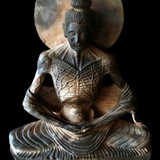
"Abandon fluent essence; let us go to the true goal, assimilation to Him; let us know the Master, let us love the Father; let us obey his call; let us run towards the heat, fleeing the cold; become fire; let's go through the fire. We have the free way for the ascent: the Father guides us, after having opened the roads of fire"
Proclus
Proclus
Full of strange things is the world of yoga in which manifold images appear.
There is a moment when we are drawn into a luminous world of reality.
Do not be proud or deceived by it;
Such a vision is yet provisional.
Away with all images;
The great samadhi of void is to be our companion.
Kūkai
There is a moment when we are drawn into a luminous world of reality.
Do not be proud or deceived by it;
Such a vision is yet provisional.
Away with all images;
The great samadhi of void is to be our companion.
Kūkai
"What is initiation? It is the beginning of the experience of meditation and concentration, of penetration into the nature of the reality of all phenomena. Initiation leads us into the mandala of a deity and into the totality of the experience of that deity. It is an antidote to the dissatisfied, samsaric, fanatical, dualistic mind. During initiation we should completely let go of our preconceptions and fixed ideas of who we are, of our limited self-image. Instead, we need to identify with the wisdom-mind of the deity, which is our own perfect potential."
Lama Yeshe
Lama Yeshe
"This doctrine [of karma, that there is a law of moral cause and effect at work in the world] lies at the heart of his teaching, and forms the essence of the Triple Refuge. Put briefly, it states that action is real, effective, and the result of one's own choice. If one chooses to act skillfully and works to develop that skill, one's actions can lead to happiness, not only on the ordinary sensory level, but also on a level that transcends all the dimensions of time and the present."
Thanissaro Bhikkhu
Thanissaro Bhikkhu
Forwarded from Vajrarastra
A monk offering diverse alcoholic beverages to Chaturbhuja Mahakala and Kakamukha Mahakala.
Forwarded from Buddha Words
Samyutta Nikaya 15.9
A Stick
Dandasutta
At Sāvatthī.
“Mendicants, transmigration has no known beginning. No first point is found of sentient beings roaming and transmigrating, hindered by ignorance and fettered by craving. Suppose a stick was tossed up in the air. Sometimes it’d fall on its bottom, sometimes the middle, and sometimes the end. It’s the same for sentient beings roaming and transmigrating, hindered by ignorance and fettered by craving. Sometimes they go from this world to the other world, and sometimes they come from the other world to this world.
Why is that? Transmigration has no known beginning. … This is quite enough for you to become disillusioned, dispassionate, and freed regarding all conditions.”
A Stick
Dandasutta
At Sāvatthī.
“Mendicants, transmigration has no known beginning. No first point is found of sentient beings roaming and transmigrating, hindered by ignorance and fettered by craving. Suppose a stick was tossed up in the air. Sometimes it’d fall on its bottom, sometimes the middle, and sometimes the end. It’s the same for sentient beings roaming and transmigrating, hindered by ignorance and fettered by craving. Sometimes they go from this world to the other world, and sometimes they come from the other world to this world.
Why is that? Transmigration has no known beginning. … This is quite enough for you to become disillusioned, dispassionate, and freed regarding all conditions.”
“Sense of humor seems to come from all-pervading joy, joy
which has room to expand into a completely open situation because it is not involved with the battle between "this" and "that". Joy develops into the panoramic situation of seeing or feeling the whole ground, the open ground. This open situa- tion has no hint of limitation, of imposed solemnity. And if you do try to treat life as a "serious business," if you try to impose solemnity upon life as though everything is a big deal, then it is funny. Why such a big deal?”
Chogyam Trungpa
which has room to expand into a completely open situation because it is not involved with the battle between "this" and "that". Joy develops into the panoramic situation of seeing or feeling the whole ground, the open ground. This open situa- tion has no hint of limitation, of imposed solemnity. And if you do try to treat life as a "serious business," if you try to impose solemnity upon life as though everything is a big deal, then it is funny. Why such a big deal?”
Chogyam Trungpa
Forwarded from Wisdom
"These things never happened, but are always" - Sallust, Of Gods and of the World
Forwarded from Egbert Moray-Falls
'The devout followers of the non-Buddhist teachings observe the five precepts and the ten good precepts, practice the kind of meditation that is still accompanied by outflows, and, ascending to the worlds of form and formlessness, believe they have attained nirvana when they reach the highest of the heavens. But although they make their way upward bit by bit like an inchworm, they fall back from the heaven where there is neither thought nor no thought, and descend instead into the three evil paths. Not a single one succeeds in remaining on the level of the heavens, though they believe that once having attained that level they will never descend from it. Each approves and practices the doctrines taught by his teacher and firmly abides by them. Thus some of them bathe three times a day in the Ganges even on cold winter days, while others pull out the hairs on their head, fling themselves against rocks, expose themselves to fire, burn their bodies, or go about stark naked. Again there are those who believe they can gain good fortune by sacrificing many horses, or who burn grasses and trees, or make obeisance to every tree they encounter.
'Erroneous teachings such as these are too numerous to be counted. Their adherents pay as much respect and honour to the teachers who propound them as the heavenly deities pay to the lord Shakra (Indra), or the court ministers pay to the ruler of the empire. But not a single person who adheres to these ninety-five types of higher or lower non-Buddhist teachings ever escapes from the cycle of birth and death. Those who follow teachers of the better sort will, after two or three rebirths, fall into the evil paths, while those who follow evil teachers will fall into the evil paths in their very next rebirth.
'And yet the main point of these non-Buddhist teachings constitutes an important means of entry into Buddhism. Some of them state, “A thousand years from now, the Buddha will appear in the world,” while others state, “A hundred years from now, the Buddha will appear in the world.” The Nirvana Sutra remarks, “All of the non-Buddhist noscriptures and writings in society are themselves Buddhist teachings, not non-Buddhist teachings.” And in the Lotus Sutra it is written, “Before the multitude they seem possessed of the three poisons or manifest the signs of distorted views. My disciples in this manner use expedient means to save living beings.”'
Nichiren, The Opening of the Eyes
'Erroneous teachings such as these are too numerous to be counted. Their adherents pay as much respect and honour to the teachers who propound them as the heavenly deities pay to the lord Shakra (Indra), or the court ministers pay to the ruler of the empire. But not a single person who adheres to these ninety-five types of higher or lower non-Buddhist teachings ever escapes from the cycle of birth and death. Those who follow teachers of the better sort will, after two or three rebirths, fall into the evil paths, while those who follow evil teachers will fall into the evil paths in their very next rebirth.
'And yet the main point of these non-Buddhist teachings constitutes an important means of entry into Buddhism. Some of them state, “A thousand years from now, the Buddha will appear in the world,” while others state, “A hundred years from now, the Buddha will appear in the world.” The Nirvana Sutra remarks, “All of the non-Buddhist noscriptures and writings in society are themselves Buddhist teachings, not non-Buddhist teachings.” And in the Lotus Sutra it is written, “Before the multitude they seem possessed of the three poisons or manifest the signs of distorted views. My disciples in this manner use expedient means to save living beings.”'
Nichiren, The Opening of the Eyes
"In what object does one take refuge? You should take refuge in the Three Jewels.
Who can bring an end to birth and death? It is exclusively the omniscient Buddha who is free from all defects and who has perfected all virtues. Therefore, only the Dharma he has taught and the sangha who uphold his doctrine are able to bring an end to the cycle of birth and death of self and others. Since these are the sole objects of refuge, you should take refuge in them.
In general, there are many people who consider the teachings of the truly and perfectly enlightened one as no more than the words of a fortuneteller, and who, when pressed, go to spirits for refuge. It is difficult for such people to have refuge.
What kind of person takes refuge? The one who possesses interest, devotion, and faith, and who thinks of the virtues of the Three Jewels.
One should possess these three particular attitudes:
Since samsara is without beginning and end, I must turn away from it this very moment!
The gods of the non-Buddhists and so forth are not my objects of refuge!
The omniscient state of buddhahood alone is my true object of refuge!
This is how the special taking refuge takes place.
When taking refuge, mere lip service is useless. This is like empty muttering. It is uncertain where it will lead you.
What is the manner in which one takes refuge? You should take refuge with respectful body, speech, and mind. You should take refuge with three thoughts: fear of the lower realms and samsara, trust in the blessings of the Three Jewels, and steadfast faith and compassion.
The person who believes that this life is perfect and that the next one will also be perfect will simply die while still about to practice the Dharma. That is not enough.
In this context, you should know the rituals of taking refuge.
With what particular attitude does one take refuge? You should take refuge with a sense of responsibility for the welfare of others. You should take refuge with this attitude, as you will not attain the true and complete enlightenment simply by renouncing samsara and desiring the result of nirvana:
In order to free all sentient beings from the miseries of samsara, I will take refuge until I and all the sentient beings of the three realms have achieved supreme enlightenment!"
Padmasambhāva
Who can bring an end to birth and death? It is exclusively the omniscient Buddha who is free from all defects and who has perfected all virtues. Therefore, only the Dharma he has taught and the sangha who uphold his doctrine are able to bring an end to the cycle of birth and death of self and others. Since these are the sole objects of refuge, you should take refuge in them.
In general, there are many people who consider the teachings of the truly and perfectly enlightened one as no more than the words of a fortuneteller, and who, when pressed, go to spirits for refuge. It is difficult for such people to have refuge.
What kind of person takes refuge? The one who possesses interest, devotion, and faith, and who thinks of the virtues of the Three Jewels.
One should possess these three particular attitudes:
Since samsara is without beginning and end, I must turn away from it this very moment!
The gods of the non-Buddhists and so forth are not my objects of refuge!
The omniscient state of buddhahood alone is my true object of refuge!
This is how the special taking refuge takes place.
When taking refuge, mere lip service is useless. This is like empty muttering. It is uncertain where it will lead you.
What is the manner in which one takes refuge? You should take refuge with respectful body, speech, and mind. You should take refuge with three thoughts: fear of the lower realms and samsara, trust in the blessings of the Three Jewels, and steadfast faith and compassion.
The person who believes that this life is perfect and that the next one will also be perfect will simply die while still about to practice the Dharma. That is not enough.
In this context, you should know the rituals of taking refuge.
With what particular attitude does one take refuge? You should take refuge with a sense of responsibility for the welfare of others. You should take refuge with this attitude, as you will not attain the true and complete enlightenment simply by renouncing samsara and desiring the result of nirvana:
In order to free all sentient beings from the miseries of samsara, I will take refuge until I and all the sentient beings of the three realms have achieved supreme enlightenment!"
Padmasambhāva
Forwarded from Buddha Words
At Sāvatthī.
Then Venerable Kaccānagotta went up to the Buddha, bowed, sat down to one side, and said to him:
“Sir, they speak of this thing called ‘right view’. How is right view defined?”
“Kaccāna, this world mostly relies on the dual notions of existence and non-existence.
But when you truly see the origin of the world with right understanding, you won’t have the notion of non-existence regarding the world. And when you truly see the cessation of the world with right understanding, you won’t have the notion of existence regarding the world.
The world is for the most part shackled by attraction, grasping, and insisting.
But if—when it comes to this attraction, grasping, mental fixation, insistence, and underlying tendency—you don’t get attracted, grasp, and commit to the notion ‘my self’, you’ll have no doubt or uncertainty that what arises is just suffering arising, and what ceases is just suffering ceasing. Your knowledge about this is independent of others.
This is how right view is defined.
‘All exists’: this is one extreme.
‘All doesn’t exist’: this is the second extreme.
Avoiding these two extremes, the Realized One teaches by the middle way:
‘Ignorance is a condition for choices. Choices are a condition for consciousness. … That is how this entire mass of suffering originates.
When ignorance fades away and ceases with nothing left over, choices cease. When choices cease, consciousness ceases. … That is how this entire mass of suffering ceases.’”
-Kaccānagottasutta (SN 12.15)
Then Venerable Kaccānagotta went up to the Buddha, bowed, sat down to one side, and said to him:
“Sir, they speak of this thing called ‘right view’. How is right view defined?”
“Kaccāna, this world mostly relies on the dual notions of existence and non-existence.
But when you truly see the origin of the world with right understanding, you won’t have the notion of non-existence regarding the world. And when you truly see the cessation of the world with right understanding, you won’t have the notion of existence regarding the world.
The world is for the most part shackled by attraction, grasping, and insisting.
But if—when it comes to this attraction, grasping, mental fixation, insistence, and underlying tendency—you don’t get attracted, grasp, and commit to the notion ‘my self’, you’ll have no doubt or uncertainty that what arises is just suffering arising, and what ceases is just suffering ceasing. Your knowledge about this is independent of others.
This is how right view is defined.
‘All exists’: this is one extreme.
‘All doesn’t exist’: this is the second extreme.
Avoiding these two extremes, the Realized One teaches by the middle way:
‘Ignorance is a condition for choices. Choices are a condition for consciousness. … That is how this entire mass of suffering originates.
When ignorance fades away and ceases with nothing left over, choices cease. When choices cease, consciousness ceases. … That is how this entire mass of suffering ceases.’”
-Kaccānagottasutta (SN 12.15)
"In Dropping Ashes on the Buddha we find the story of Won Hyo, the most famous monk of his time in Korea. Won Hyo Sunim one day went to visit the great Zen Master Dae An. Before arriving at the Zen Master’s mountain cave, Won Hyo already heard his beautiful chanting. Upon arriving at the cave he was chagrined to find the old man crying bitterly over the corpse of a dead baby deer. Since the Buddha taught dispassion, as expressed in the Four Great Vows, how could this highly enlightened man be so upset over the death of a deer? Won Hyo asked the Zen Master to explain what had happened. The old monk said that the mother deer had been killed by some hunters, and he had tried to save the baby deer by feeding it milk which he obtained by begging from the nearby village. Because people would not give milk for an animal, he lied that it was needed for his son. “A dirty monk,” they would say, but some would give milk. After a time, however, the nearby villagers refused to give him more milk. He had to go further, and further, and finally after obtaining a little milk, he returned three days later to his cave to find the baby deer already dead from hunger. “You don’t understand,” said the master. “My mind and the fawn’s mind are the same. It was very hungry. It wants milk, I want milk. Now it is dead. Its mind is my mind. That’s why I am weeping. I want milk.” Won Hyo began to understand this man’s great compassion and became his student."
https://kwanumzen.org/teaching-library/1991/07/01/passionate-zen
https://kwanumzen.org/teaching-library/1991/07/01/passionate-zen
Kwan Um School of Zen
Passionate Zen — Kwan Um School of Zen
It is not uncommon for people to question whether there is any room for passionate feelings in Zen practice. After all, the second of the Four Great Vows clearly asks us to do away with any kind of passion. Each morning at the beginning of practice we recite:…
“If someone has resolved to commit a certain crime that would create negative karma, and if there exists no other choice for hindering this person from the crime and thus the highly negative karma that would result for all his future lives, then a pure motivation of compassion would theoretically justify the killing of this person.”
His Holiness, the 14th Dalai Lama
His Holiness, the 14th Dalai Lama
Forwarded from Self-Immolation
"Kill all these that teach the Dharma incorrectly" - Bodhidharma
― Nagasena, o Nirvana é cessação?
― Sim, Majestade.
― Como assim?
― Todos os tolos não convertidos sentem prazer apegam-se aos sentidos e aos objetos dos sentidos. Deixam-se levar pela corrente. Não se libertam do nascimento, da velhice, da morte, do sofrimento. Mas o sábio discípulo não sente prazer, não se alegra nem sente satisfação, nem se apega aos objetos dos sentidos. Por aí, sucessivamente, cessam a sede (tanha), o apego, a existência, o nascimento, a velhice, a morte, o dukkha. Assim, o Nirvana é cessação.
Milinda Panha II
― Sim, Majestade.
― Como assim?
― Todos os tolos não convertidos sentem prazer apegam-se aos sentidos e aos objetos dos sentidos. Deixam-se levar pela corrente. Não se libertam do nascimento, da velhice, da morte, do sofrimento. Mas o sábio discípulo não sente prazer, não se alegra nem sente satisfação, nem se apega aos objetos dos sentidos. Por aí, sucessivamente, cessam a sede (tanha), o apego, a existência, o nascimento, a velhice, a morte, o dukkha. Assim, o Nirvana é cessação.
Milinda Panha II
Forwarded from MAHASIDDHAS, MAHAMUDRA & DZOGCHEN 👹
"The pure mind, the ubiquitous essence -
it is spontaneously, originally, perfect;
so strenuous engagement with the ten techniques
is unnecessary, superfluous.
I am inscrutable and cannot be cultivated.
All the ten techniques are likewise transcended,
so nothing can be done to affect me.
Those who try to approach me on a causal path,
desirous of catching a glimpse of my face,
seeking me through the ten techniques,
fall straight to earth like a tenderfoot sky-walker,
tumbling down due to deliberate effort.
I, the supreme source, I am the revelation,
and transcend every sphere of activity,
so a view of me cannot be cultivated,
and the ten techniques are meaningless.
If you still think that the ten techniques have purpose,
look at me, and finding nothing to see,
taking no view, remain at that zero-point.
Nothing ever separates us from unoriginated simplicity,
so vows and discipline are redundant;
the essence is always spontaneously present,
so any effort to find it is always superfluous;
self-sprung awareness has never been obscured,
so gnostic awareness cannot be generated;
everybody already lives on my level,
so there is no place to reach through purification;
I embrace all and everything,
so there can be no path that leads to me;
I am forever incapable of dualization,
so there is never anything to be labeled 'subtle';
my form embraces everything,
so there has never been any 'duality';
I am self-sprung awareness from the very beginning,
so I can never be nailed down;
since I am the heart of total presence,
there is no other source of secret precepts."
— Samantabhadra
Via RR
it is spontaneously, originally, perfect;
so strenuous engagement with the ten techniques
is unnecessary, superfluous.
I am inscrutable and cannot be cultivated.
All the ten techniques are likewise transcended,
so nothing can be done to affect me.
Those who try to approach me on a causal path,
desirous of catching a glimpse of my face,
seeking me through the ten techniques,
fall straight to earth like a tenderfoot sky-walker,
tumbling down due to deliberate effort.
I, the supreme source, I am the revelation,
and transcend every sphere of activity,
so a view of me cannot be cultivated,
and the ten techniques are meaningless.
If you still think that the ten techniques have purpose,
look at me, and finding nothing to see,
taking no view, remain at that zero-point.
Nothing ever separates us from unoriginated simplicity,
so vows and discipline are redundant;
the essence is always spontaneously present,
so any effort to find it is always superfluous;
self-sprung awareness has never been obscured,
so gnostic awareness cannot be generated;
everybody already lives on my level,
so there is no place to reach through purification;
I embrace all and everything,
so there can be no path that leads to me;
I am forever incapable of dualization,
so there is never anything to be labeled 'subtle';
my form embraces everything,
so there has never been any 'duality';
I am self-sprung awareness from the very beginning,
so I can never be nailed down;
since I am the heart of total presence,
there is no other source of secret precepts."
— Samantabhadra
Via RR