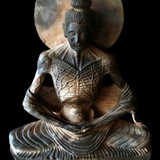
"O, Alas! Alas! Fortunate Child of Buddha Nature, Do not be oppressed by the forces of ignorance and delusion! But rise up now with resolve and courage!
Entranced by ignorance, from beginningless time until now,
You have had [more than] enough time to sleep. So do not slumber any longer, but strive after virtue with body, speech and mind!
Are you oblivious to the sufferings of birth, old age, sickness and death? There is no guarantee that you will survive, even past this very day!
The time has come [for you] to develop perseverance in [your] practice."
The Tibetan book of the dead
Entranced by ignorance, from beginningless time until now,
You have had [more than] enough time to sleep. So do not slumber any longer, but strive after virtue with body, speech and mind!
Are you oblivious to the sufferings of birth, old age, sickness and death? There is no guarantee that you will survive, even past this very day!
The time has come [for you] to develop perseverance in [your] practice."
The Tibetan book of the dead
"Impermanent indeed are all formations; their nature consists of arising and disappearing; having arisen, they cease; their calming is happiness."
Mahāparinirvāṇa Sūtra
Mahāparinirvāṇa Sūtra
"Understanding the true nature of appearances does not impede good conduct; rather, it informs good conduct. Such knowledge makes conduct more subtle and beneficial. It is just like when you stand in front of a mirror and the reflection of your face appears within it. Knowing all the while that the reflection is not real, you can still use that reflection to remove stains from your face and make yourself look beautiful."
Khenpo Tsultrim Gyamtso
Khenpo Tsultrim Gyamtso
"The Devas and Asuras, Angels and Titans, powers of Light and powers of Darkness in Rigveda, although distinct and opposite in operation, are in essence consubstantial, their distinction being a matter not of essence but of orientation, revolution or transformation. In this case, the Titan is potentially an Angel, the Angel still by nature a Titan; the Darkness in actu is Light, the Light in potentia Darkness; whence the designations Asura and Deva may be applied to one and the same Person according to the mode of operation, as in Rigveda 1.163.3, "Trita art thou (Agni) by interior operation".
Ananda Coomaraswamy
Ananda Coomaraswamy
"Não tente chegar a lugar nenhum na prática. O próprio desejo de ser livre ou de ser iluminado será o desejo que impede sua liberdade. Você pode tentar o quanto quiser, praticar ardentemente noite e dia, mas se ainda tiver o desejo de alcançar algo, você nunca encontrará a paz. A energia desse desejo causará dúvida e inquietação. Não importa quanto tempo ou quão duro você pratique, a sabedoria não surgirá do desejo.
Simplesmente deixe ir. Observe a mente e o corpo com atenção, mas não tente alcançar nada, caso contrário, quando você começar a praticar a meditação e seu coração começar a se acalmar, você imediatamente pensará: "Ah, já estou perto do primeiro estágio da iluminação? Quanto mais eu tenho que ir?" Nesse instante, você perderá tudo. É melhor apenas observar como a prática se desenvolve naturalmente."
Ajahn Chah
Simplesmente deixe ir. Observe a mente e o corpo com atenção, mas não tente alcançar nada, caso contrário, quando você começar a praticar a meditação e seu coração começar a se acalmar, você imediatamente pensará: "Ah, já estou perto do primeiro estágio da iluminação? Quanto mais eu tenho que ir?" Nesse instante, você perderá tudo. É melhor apenas observar como a prática se desenvolve naturalmente."
Ajahn Chah
“Where is the source of human grief, lamentation, pain and agony? Is it not to be found in the fact that people are generally desirous. They cling obstinately to lives of wealth and honor, comfort and pleasure, excitement and self indulgence, ignorant of the fact that the desire for these very things is the source of human suffering.
From its beginning, the world has been filled with a succession of calamities, over and above the unavoidable facts of illness, old age and death. But if one carefully considers all the facts, one must be convinced that at the basis of all suffering lies the principle of craving desire. If avarice can be removed, human suffering will come to an end.
Ignorance is manifested in greed that fills the human mind. It comes from the fact that people are unaware of the true reason for the succession of things. From ignorance and greed there spring impure desires for things that are, in fact, unobtainable, but for which people restlessly and blindly search.
Because of ignorance and greed, people imagine discriminations where, in reality, there are no discriminations. Inherently, there is no discrimination of right and wrong in human behavior; but people, because of ignorance, imagine such distinctions and judge them as right or wrong.
Because of their ignorance, all people are always thinking wrong thoughts and always losing the right viewpoint and, clinging to their egos, they take wrong actions. As a result, they become attached to a delusive existence.
Making their deeds the field for their egos, using the working of discrimination of the mind as seed, beclouding the mind by ignorance, fertilizing it with the rain of craving desires, irrigating it by the willfulness of egotism, they add the conception of evil, and carry this incarnation of delusion about with them.”
From its beginning, the world has been filled with a succession of calamities, over and above the unavoidable facts of illness, old age and death. But if one carefully considers all the facts, one must be convinced that at the basis of all suffering lies the principle of craving desire. If avarice can be removed, human suffering will come to an end.
Ignorance is manifested in greed that fills the human mind. It comes from the fact that people are unaware of the true reason for the succession of things. From ignorance and greed there spring impure desires for things that are, in fact, unobtainable, but for which people restlessly and blindly search.
Because of ignorance and greed, people imagine discriminations where, in reality, there are no discriminations. Inherently, there is no discrimination of right and wrong in human behavior; but people, because of ignorance, imagine such distinctions and judge them as right or wrong.
Because of their ignorance, all people are always thinking wrong thoughts and always losing the right viewpoint and, clinging to their egos, they take wrong actions. As a result, they become attached to a delusive existence.
Making their deeds the field for their egos, using the working of discrimination of the mind as seed, beclouding the mind by ignorance, fertilizing it with the rain of craving desires, irrigating it by the willfulness of egotism, they add the conception of evil, and carry this incarnation of delusion about with them.”
Forwarded from Buddha Words
How to react if someone is angry with you?
One time Brahmin Akkosaka got angry at Buddha, because a man from his clan had become a Bhikkhu. Akkosaka was yelling and insulting the Buddha.
Buddha: “What do you think, Akkosaka? Do your friends, relatives, and guests sometimes come to visit you?”
Akkosaka: "Sometimes they do, Master Gotama.”
Buddha: "Do you then serve them with a variety of food and drinks?”
Akkosaka: "Sometimes I do.”
Buddha: “But if they don’t accept it, who do those food and drinks belong to?”
Akkosaka: “In that case Master Gotama, they still belong to me.”
Buddha: “In the same way, Akkosaka, when you abuse, harass, and attack me, who does not abuse, harass, and attack, I don’t accept your insults. They still belong to you, Akkosaka, they still belong to you!"
- SN 7.2 Akkosaka Sutta #anger #Buddha
One time Brahmin Akkosaka got angry at Buddha, because a man from his clan had become a Bhikkhu. Akkosaka was yelling and insulting the Buddha.
Buddha: “What do you think, Akkosaka? Do your friends, relatives, and guests sometimes come to visit you?”
Akkosaka: "Sometimes they do, Master Gotama.”
Buddha: "Do you then serve them with a variety of food and drinks?”
Akkosaka: "Sometimes I do.”
Buddha: “But if they don’t accept it, who do those food and drinks belong to?”
Akkosaka: “In that case Master Gotama, they still belong to me.”
Buddha: “In the same way, Akkosaka, when you abuse, harass, and attack me, who does not abuse, harass, and attack, I don’t accept your insults. They still belong to you, Akkosaka, they still belong to you!"
- SN 7.2 Akkosaka Sutta #anger #Buddha
“Since everything in this world is brought about by causes and conditions, there can be no fundamental distinctions among things. The apparent distinctions exist because of people’s absurd and discriminating thoughts.
In the sky there is no distinction of east and west; people create the distinctions out of their own minds and then believe them to be true.
Mathematical numbers from one to infinity are each complete numbers, and each in itself carries no distinction of quantity; but people make the discrimination for their own convenience, so as to be able to indicate varying amounts.
Inherently there are no distinctions between the process of life and the process of destruction; people make a discrimination and call one birth and the other death. In action there is no discrimination between right and wrong, but people make a distinction for their own convenience.
Buddha keeps away from these discriminations and looks upon the world as upon a passing cloud. To Buddha every definitive thing is illusion; He knows that whatever the mind grasps and throws away is insubstantial; thus He transcends the pitfalls of images and discriminative thought.”
In the sky there is no distinction of east and west; people create the distinctions out of their own minds and then believe them to be true.
Mathematical numbers from one to infinity are each complete numbers, and each in itself carries no distinction of quantity; but people make the discrimination for their own convenience, so as to be able to indicate varying amounts.
Inherently there are no distinctions between the process of life and the process of destruction; people make a discrimination and call one birth and the other death. In action there is no discrimination between right and wrong, but people make a distinction for their own convenience.
Buddha keeps away from these discriminations and looks upon the world as upon a passing cloud. To Buddha every definitive thing is illusion; He knows that whatever the mind grasps and throws away is insubstantial; thus He transcends the pitfalls of images and discriminative thought.”
“Both delusion and Enlightenment originate within the mind, and every existence or phenomenon arises from the functions of the mind, just as different things appear from the sleeve of a magician.
The activities of the mind have no limit, they form the surroundings of life. An impure mind surrounds itself with impure things and a pure mind surrounds itself with pure things; hence, surroundings have no more limits than the activities of the mind.
But the mind that creates its surroundings is never free from memories, fears or laments, not only in the past but in the present and the future, because they have arisen from ignorance and greed.
It is from ignorance and greed that the world of delusion is born, and all the vast complexity of coordinating causes and conditions exists within the mind and nowhere else.
Both life and death arise from the mind and exist within the mind. Hence, when the mind that concerns itself with life and death passes on, the world of life and death passes with it.
An unenlightened life rises from a mind that is bewildered by its own world of delusion. If we learn that there is no world of delusion outside the mind, the bewildered mind becomes clear; and because we cease to create impure surroundings, we attain Enlightenment.
In this way the world of life and death is created by the mind, is in bondage to the mind, is ruled by the mind; the mind is the master of every situation. The world of suffering is brought about by the deluded mortal mind.”
The activities of the mind have no limit, they form the surroundings of life. An impure mind surrounds itself with impure things and a pure mind surrounds itself with pure things; hence, surroundings have no more limits than the activities of the mind.
But the mind that creates its surroundings is never free from memories, fears or laments, not only in the past but in the present and the future, because they have arisen from ignorance and greed.
It is from ignorance and greed that the world of delusion is born, and all the vast complexity of coordinating causes and conditions exists within the mind and nowhere else.
Both life and death arise from the mind and exist within the mind. Hence, when the mind that concerns itself with life and death passes on, the world of life and death passes with it.
An unenlightened life rises from a mind that is bewildered by its own world of delusion. If we learn that there is no world of delusion outside the mind, the bewildered mind becomes clear; and because we cease to create impure surroundings, we attain Enlightenment.
In this way the world of life and death is created by the mind, is in bondage to the mind, is ruled by the mind; the mind is the master of every situation. The world of suffering is brought about by the deluded mortal mind.”
“The important thing in following the path to Enlightenment is to avoid being caught and entangled in any extreme, that is, always to follow the Middle Way.
Knowing that things neither exist nor do not exist, remembering the dream-like nature of everything, one should avoid being caught by pride of personality or praise for good deeds; or caught and entangled by anything else.
If a person is to avoid being caught in the current of his desires, he must learn at the very beginning not to grasp at things lest he should become accustomed to them and attached to them. He must not become attached to existence nor to non-existence, to anything inside or outside, neither to good things nor to bad things, neither to right nor to wrong.
If he becomes attached to things, just at that moment, all at once, the life of delusion begins. The one who follows the Noble Path to Enlightenment will not maintain regrets, neither will he cherish anticipations, but, with an equitable and peaceful mind, will meet what comes.”
Knowing that things neither exist nor do not exist, remembering the dream-like nature of everything, one should avoid being caught by pride of personality or praise for good deeds; or caught and entangled by anything else.
If a person is to avoid being caught in the current of his desires, he must learn at the very beginning not to grasp at things lest he should become accustomed to them and attached to them. He must not become attached to existence nor to non-existence, to anything inside or outside, neither to good things nor to bad things, neither to right nor to wrong.
If he becomes attached to things, just at that moment, all at once, the life of delusion begins. The one who follows the Noble Path to Enlightenment will not maintain regrets, neither will he cherish anticipations, but, with an equitable and peaceful mind, will meet what comes.”
Repa Karma Norbu Rinpoche
Repa Karma Norbu Rinpoche (ras pakarma nor bu rin po che) was an outstanding master and yogic practitioner who is known for his yogic powers and who was responsible for transmitting teachings after the Cultural Revolution. He was the Master of many practitioners of these days in Tibet as Repa Chatral Tsultrim Tharchin (rbya bral ras pa tshul khrims mthar phyin) around Nangchen and the Derge area.
As he practiced tummo (gtum mo) and perfected the practice of inner heat he wore only thin cotton cloth and became known as repa (ras pa) and even as second Milarepa (mi la ras pa gnyis pa) or White Accomplished One or Drubchen Karpo (sgrub chen dkar po) whereas his student Tsultrim Tharchin is also known as Third Milarepa (mi la ras pa gsum pa).
Repa Karma Norbu Rinpoche (ras pakarma nor bu rin po che) was an outstanding master and yogic practitioner who is known for his yogic powers and who was responsible for transmitting teachings after the Cultural Revolution. He was the Master of many practitioners of these days in Tibet as Repa Chatral Tsultrim Tharchin (rbya bral ras pa tshul khrims mthar phyin) around Nangchen and the Derge area.
As he practiced tummo (gtum mo) and perfected the practice of inner heat he wore only thin cotton cloth and became known as repa (ras pa) and even as second Milarepa (mi la ras pa gnyis pa) or White Accomplished One or Drubchen Karpo (sgrub chen dkar po) whereas his student Tsultrim Tharchin is also known as Third Milarepa (mi la ras pa gsum pa).
Karma Norbu was a great Mahasiddha, meaning “great accomplished one” or Drupchen (sgrub chen) in Tibetan) who was traditionally trained in and accomplished the Karma Kagyu path - including the 6 Yogas of Naropa. He accomplished this full path before the Cultural Revolution. After the Chinese occupation, those who knew him could not find Karma Norbu, as he had established himself in a cave at a nearby mountain.
In 1980 the Chinese government started allowing people to engage in a little bit of Dharma practice and the government also began to release many Rinpoches from prison. Many monasteries started a rebuilding process. Every Rinpoche in Tibet also began looking for great Masters that had survived the revolution. Sure enough, someone found Karma Norbu.
At that time Karma Norbu was living in a cave surrounded by a rock edifice -- this is where many disciples came to receive teachings, instructions directly from him. The journey to Karma Norbu's cave (from Gargon) took about 6 days and had to be done on horseback. Many practitioners, monks went there to receive ordination and teachings from him.
In 1980 the Chinese government started allowing people to engage in a little bit of Dharma practice and the government also began to release many Rinpoches from prison. Many monasteries started a rebuilding process. Every Rinpoche in Tibet also began looking for great Masters that had survived the revolution. Sure enough, someone found Karma Norbu.
At that time Karma Norbu was living in a cave surrounded by a rock edifice -- this is where many disciples came to receive teachings, instructions directly from him. The journey to Karma Norbu's cave (from Gargon) took about 6 days and had to be done on horseback. Many practitioners, monks went there to receive ordination and teachings from him.
Forwarded from Egbert Moray-Falls
Here the Dalai Lama is enthroned in a Bön monastery, wearing the crown and holding the sceptre of a Bön master.
There can be much tension between Bön and the other Buddhist schools of Tibet as Bönpo, while following the teachings of Buddha in much the same way as the others, represents the pre-Buddhist traditions of Tibet (although whether or not the continuity is unbroken cannot be reliably ascertained).
The Dalai Lama is a proponent of the Rimé (lit. unbaised, non-sectarian) movement which promotes mutual respect and recognition between sects. I think this is absolutely essential, as sectarian conflict would only serve to weaken Tibetan Buddhism as a whole, which has been in a venerable position since Mao's cultural revolution, and thereby, the light of Dharma would wane and the Kali Yuga would grow darker yet.
To my mind Rimé is a perfect example of creating unity while tolerating diversity and is a lesson for the rest of the world today.
https://www.youtube.com/watch?v=YNr8b12Ow4A
There can be much tension between Bön and the other Buddhist schools of Tibet as Bönpo, while following the teachings of Buddha in much the same way as the others, represents the pre-Buddhist traditions of Tibet (although whether or not the continuity is unbroken cannot be reliably ascertained).
The Dalai Lama is a proponent of the Rimé (lit. unbaised, non-sectarian) movement which promotes mutual respect and recognition between sects. I think this is absolutely essential, as sectarian conflict would only serve to weaken Tibetan Buddhism as a whole, which has been in a venerable position since Mao's cultural revolution, and thereby, the light of Dharma would wane and the Kali Yuga would grow darker yet.
To my mind Rimé is a perfect example of creating unity while tolerating diversity and is a lesson for the rest of the world today.
https://www.youtube.com/watch?v=YNr8b12Ow4A
Forwarded from Egbert Moray-Falls
Egbert Moray-Falls
Here the Dalai Lama is enthroned in a Bön monastery, wearing the crown and holding the sceptre of a Bön master. There can be much tension between Bön and the other Buddhist schools of Tibet as Bönpo, while following the teachings of Buddha in much the same…
Forwarded from Vajrarastra
YouTube
Ultimate Reality in Buddhism | HE Dagyab Rinpoche
Love our content? Support us on Patreon: https://www.patreon.com/studybuddhism
What is conventional reality? What is ultimate reality? In this short video, HE Dagyab Rinpoche talks about emptiness, the ultimate nature of all phenomena.
___
Explore Buddhism…
What is conventional reality? What is ultimate reality? In this short video, HE Dagyab Rinpoche talks about emptiness, the ultimate nature of all phenomena.
___
Explore Buddhism…