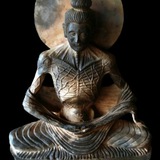
Repa Karma Norbu Rinpoche
Repa Karma Norbu Rinpoche (ras pakarma nor bu rin po che) was an outstanding master and yogic practitioner who is known for his yogic powers and who was responsible for transmitting teachings after the Cultural Revolution. He was the Master of many practitioners of these days in Tibet as Repa Chatral Tsultrim Tharchin (rbya bral ras pa tshul khrims mthar phyin) around Nangchen and the Derge area.
As he practiced tummo (gtum mo) and perfected the practice of inner heat he wore only thin cotton cloth and became known as repa (ras pa) and even as second Milarepa (mi la ras pa gnyis pa) or White Accomplished One or Drubchen Karpo (sgrub chen dkar po) whereas his student Tsultrim Tharchin is also known as Third Milarepa (mi la ras pa gsum pa).
Repa Karma Norbu Rinpoche (ras pakarma nor bu rin po che) was an outstanding master and yogic practitioner who is known for his yogic powers and who was responsible for transmitting teachings after the Cultural Revolution. He was the Master of many practitioners of these days in Tibet as Repa Chatral Tsultrim Tharchin (rbya bral ras pa tshul khrims mthar phyin) around Nangchen and the Derge area.
As he practiced tummo (gtum mo) and perfected the practice of inner heat he wore only thin cotton cloth and became known as repa (ras pa) and even as second Milarepa (mi la ras pa gnyis pa) or White Accomplished One or Drubchen Karpo (sgrub chen dkar po) whereas his student Tsultrim Tharchin is also known as Third Milarepa (mi la ras pa gsum pa).
Karma Norbu was a great Mahasiddha, meaning “great accomplished one” or Drupchen (sgrub chen) in Tibetan) who was traditionally trained in and accomplished the Karma Kagyu path - including the 6 Yogas of Naropa. He accomplished this full path before the Cultural Revolution. After the Chinese occupation, those who knew him could not find Karma Norbu, as he had established himself in a cave at a nearby mountain.
In 1980 the Chinese government started allowing people to engage in a little bit of Dharma practice and the government also began to release many Rinpoches from prison. Many monasteries started a rebuilding process. Every Rinpoche in Tibet also began looking for great Masters that had survived the revolution. Sure enough, someone found Karma Norbu.
At that time Karma Norbu was living in a cave surrounded by a rock edifice -- this is where many disciples came to receive teachings, instructions directly from him. The journey to Karma Norbu's cave (from Gargon) took about 6 days and had to be done on horseback. Many practitioners, monks went there to receive ordination and teachings from him.
In 1980 the Chinese government started allowing people to engage in a little bit of Dharma practice and the government also began to release many Rinpoches from prison. Many monasteries started a rebuilding process. Every Rinpoche in Tibet also began looking for great Masters that had survived the revolution. Sure enough, someone found Karma Norbu.
At that time Karma Norbu was living in a cave surrounded by a rock edifice -- this is where many disciples came to receive teachings, instructions directly from him. The journey to Karma Norbu's cave (from Gargon) took about 6 days and had to be done on horseback. Many practitioners, monks went there to receive ordination and teachings from him.
Forwarded from Egbert Moray-Falls
Here the Dalai Lama is enthroned in a Bön monastery, wearing the crown and holding the sceptre of a Bön master.
There can be much tension between Bön and the other Buddhist schools of Tibet as Bönpo, while following the teachings of Buddha in much the same way as the others, represents the pre-Buddhist traditions of Tibet (although whether or not the continuity is unbroken cannot be reliably ascertained).
The Dalai Lama is a proponent of the Rimé (lit. unbaised, non-sectarian) movement which promotes mutual respect and recognition between sects. I think this is absolutely essential, as sectarian conflict would only serve to weaken Tibetan Buddhism as a whole, which has been in a venerable position since Mao's cultural revolution, and thereby, the light of Dharma would wane and the Kali Yuga would grow darker yet.
To my mind Rimé is a perfect example of creating unity while tolerating diversity and is a lesson for the rest of the world today.
https://www.youtube.com/watch?v=YNr8b12Ow4A
There can be much tension between Bön and the other Buddhist schools of Tibet as Bönpo, while following the teachings of Buddha in much the same way as the others, represents the pre-Buddhist traditions of Tibet (although whether or not the continuity is unbroken cannot be reliably ascertained).
The Dalai Lama is a proponent of the Rimé (lit. unbaised, non-sectarian) movement which promotes mutual respect and recognition between sects. I think this is absolutely essential, as sectarian conflict would only serve to weaken Tibetan Buddhism as a whole, which has been in a venerable position since Mao's cultural revolution, and thereby, the light of Dharma would wane and the Kali Yuga would grow darker yet.
To my mind Rimé is a perfect example of creating unity while tolerating diversity and is a lesson for the rest of the world today.
https://www.youtube.com/watch?v=YNr8b12Ow4A
Forwarded from Egbert Moray-Falls
Egbert Moray-Falls
Here the Dalai Lama is enthroned in a Bön monastery, wearing the crown and holding the sceptre of a Bön master. There can be much tension between Bön and the other Buddhist schools of Tibet as Bönpo, while following the teachings of Buddha in much the same…
Forwarded from Vajrarastra
YouTube
Ultimate Reality in Buddhism | HE Dagyab Rinpoche
Love our content? Support us on Patreon: https://www.patreon.com/studybuddhism
What is conventional reality? What is ultimate reality? In this short video, HE Dagyab Rinpoche talks about emptiness, the ultimate nature of all phenomena.
___
Explore Buddhism…
What is conventional reality? What is ultimate reality? In this short video, HE Dagyab Rinpoche talks about emptiness, the ultimate nature of all phenomena.
___
Explore Buddhism…
Forwarded from Gemeinschaft der Eigenen (Kyyhylly)
Insights into Vedanta-Tattvabodha.pdf
1.6 MB
"When a man who practices one version of the Way of Buddha vilifies another because it differs from his own sect, he cannot avoid the sin of slandering the Law."
Mujū Dōkyō
Mujū Dōkyō
Forwarded from Egbert Moray-Falls
"All experiences of rainbow lights are the natural manifestations of your mind. All the peaceful and wrathful forms are the natural forms of your mind. All sounds are your own sounds. All lights are your own lights. Have no doubt about that. If you do feel doubt, you will be thrown into samsara. Having resolved this to be self-display, if you rest wide awake in luminous emptiness, then simply in that you will attain the three kayas and become enlightened. Even if you are cast into samsara, you won’t go there.
***
"From this moment, it is very important to be without any hope and fear, clinging and fixation, toward the objects of your six sense faculties as well as toward fascination, happiness, and sorrow. From now on, if you attain stability, you will be able to assume your natural state in the bardo and become enlightened. Therefore, the most vital point is to sustain your practice undistractedly from this very moment."
Padmasambhava, The Dakini Teachings
***
"From this moment, it is very important to be without any hope and fear, clinging and fixation, toward the objects of your six sense faculties as well as toward fascination, happiness, and sorrow. From now on, if you attain stability, you will be able to assume your natural state in the bardo and become enlightened. Therefore, the most vital point is to sustain your practice undistractedly from this very moment."
Padmasambhava, The Dakini Teachings
"Oh! I don’t know the Mantra, the Yantra, or the Eulogies. I don’t even know how to invoke You, how to meditate on You, and even the speech behind Your eulogies. I don’t know the postures [in which to say eulogies], and I don’t know how to wail. [But] O Mother! I know that following You absolves the biggest distresses.
The offerings — which were due to the lack of knowledge of methodology, by the lack of resources, by indolence, or due to the lack of strength for submission — fallen [by me] on Your dual-feet, forgive all those mistakes, O Mother! O Shiva, Who absolves everyone! Because a son can become bad or ignorant about his duties as an offspring, but the Mother always remains a Mother.
O Mother! There are many sons of Yours on this earth and they are gentle. Amidst them, I am Your son, who is extremely libidinous. I have the feelings of possession, and I have no compassion within me. But I am Yours, O Shiva! A son can become bad or ignorant about his duties as an offspring, but the Mother always remains a Mother.
O Mother! O Mother of the world! Your feet has not been engaged upon [by me] and, even more so, Your feet has not been submitted with offerings by me. Even then, You shower immaculate benevolence on me. Because a son can become bad or ignorant about his duties as an offspring, but the Mother always remains a Mother.
At an age of more than eighty-five years, by me, who lacks the prowess to perform various rituals, the Devas have been left along. O Mother of Lambodar (Parvati)! Now, in this situation, if Your benevolence does not happens on me, then, I, the unsupported one, will take whose refuge?
O Aparna! A dog-eater (Chandala) becomes a talkative person with honey-like sweet words coming out from the tongue; and a poor man roams fearlessly for long time in golden riches, when the chants of Your name fall [seat] inside the ear of anyone. O Mother! Then, in that case, who can know the achievements due to continuous chants of Your name based on the appropriate rules?
Kapali, Who has ashes from the burnt corpses on body, Who has the directions as clothes (cloth-less), Who has thick tress-locks, Who has a garland of king of snake in neck, Who is known as Pashupati, and Who is the ruler of ghosts, attains the position of poison-destroyer and Lord of the world. O Bhavani! This is just a result of addition of You as His consort.
I don’t have the desire to attain Moksha, neither I have the desire to attain luxuries and resplendence in the world. I don’t have expectations of sciences, and O the Moon-faced Goddess! I don’t even desire for luxuries and comfort. O Mother! Thus, I beg You, that whenever I am born, give me the chanting of these names to me — Mridani, Rudrani, Shiv, Bhavani.
O Shyama! You are not revered by me, using methods or various prenoscriptions. I didn’t do anything beyond the rough-thinking and speech. But even then, if You keep me, the destitute and orphan, in benevolence, then it suits You; since You indeed are beyond everything, O Mother!
O Durga, Who is the abode of ocean of mercy! When I remember You in troublesome situations, don’t think it is stupidity. It is because when a child is hungry, the child only remembers the Mother.
O Mother of the world! You are full of benevolence for me; [but] what is the surprise in this? [Because] Even when a son is full of faults, the Mother does not ignores or disowns the child.
O Mahadevi! There is no fallen one like me, and there is indeed no absolver of sins like You. Knowing this, You do what You think as appropriate."
Bhavani Stuti by Srila Adi Shankaracharya
The offerings — which were due to the lack of knowledge of methodology, by the lack of resources, by indolence, or due to the lack of strength for submission — fallen [by me] on Your dual-feet, forgive all those mistakes, O Mother! O Shiva, Who absolves everyone! Because a son can become bad or ignorant about his duties as an offspring, but the Mother always remains a Mother.
O Mother! There are many sons of Yours on this earth and they are gentle. Amidst them, I am Your son, who is extremely libidinous. I have the feelings of possession, and I have no compassion within me. But I am Yours, O Shiva! A son can become bad or ignorant about his duties as an offspring, but the Mother always remains a Mother.
O Mother! O Mother of the world! Your feet has not been engaged upon [by me] and, even more so, Your feet has not been submitted with offerings by me. Even then, You shower immaculate benevolence on me. Because a son can become bad or ignorant about his duties as an offspring, but the Mother always remains a Mother.
At an age of more than eighty-five years, by me, who lacks the prowess to perform various rituals, the Devas have been left along. O Mother of Lambodar (Parvati)! Now, in this situation, if Your benevolence does not happens on me, then, I, the unsupported one, will take whose refuge?
O Aparna! A dog-eater (Chandala) becomes a talkative person with honey-like sweet words coming out from the tongue; and a poor man roams fearlessly for long time in golden riches, when the chants of Your name fall [seat] inside the ear of anyone. O Mother! Then, in that case, who can know the achievements due to continuous chants of Your name based on the appropriate rules?
Kapali, Who has ashes from the burnt corpses on body, Who has the directions as clothes (cloth-less), Who has thick tress-locks, Who has a garland of king of snake in neck, Who is known as Pashupati, and Who is the ruler of ghosts, attains the position of poison-destroyer and Lord of the world. O Bhavani! This is just a result of addition of You as His consort.
I don’t have the desire to attain Moksha, neither I have the desire to attain luxuries and resplendence in the world. I don’t have expectations of sciences, and O the Moon-faced Goddess! I don’t even desire for luxuries and comfort. O Mother! Thus, I beg You, that whenever I am born, give me the chanting of these names to me — Mridani, Rudrani, Shiv, Bhavani.
O Shyama! You are not revered by me, using methods or various prenoscriptions. I didn’t do anything beyond the rough-thinking and speech. But even then, if You keep me, the destitute and orphan, in benevolence, then it suits You; since You indeed are beyond everything, O Mother!
O Durga, Who is the abode of ocean of mercy! When I remember You in troublesome situations, don’t think it is stupidity. It is because when a child is hungry, the child only remembers the Mother.
O Mother of the world! You are full of benevolence for me; [but] what is the surprise in this? [Because] Even when a son is full of faults, the Mother does not ignores or disowns the child.
O Mahadevi! There is no fallen one like me, and there is indeed no absolver of sins like You. Knowing this, You do what You think as appropriate."
Bhavani Stuti by Srila Adi Shankaracharya
Certa feita, Sakyamuni Buda se encontrava na cidade de Kausambi. Nela vivia um homem que o odiava e, levado por este ressentimento, induziu, com subornos, uns malvados a que circulassem malévolos boatos a seu respeito. Em tais circunstancias, foi muito difícil a seus discípulos mendigar suficiente alimento nesta cidade onde havia muito abuso.
Ananda disse a Sakyamuni: “Seria melhor não ficarmos nesta cidade; há outras e melhores cidades para onde podemos ir; saiamos daqui.” O Abençoado replicou: “Suponhamos que a outra cidade seja como esta; que faremos então?” - “Então iremos para outra” disse Ananda.
O Abençoado retrucou: “Não, Ananda, assim, nunca conseguiremos nosso intento.
É melhor que permaneçamos aqui e suportemos pacientemente o abuso, até que se termine, e então iremos para outro lugar.
“Há lucro e perda, difamação e honra, louvor e abuso, sofrimento e prazer neste mundo; o Abençoado não é controlado pelas coisa externas; elas desaparecem tão rapidamente como surgem.”
Ananda disse a Sakyamuni: “Seria melhor não ficarmos nesta cidade; há outras e melhores cidades para onde podemos ir; saiamos daqui.” O Abençoado replicou: “Suponhamos que a outra cidade seja como esta; que faremos então?” - “Então iremos para outra” disse Ananda.
O Abençoado retrucou: “Não, Ananda, assim, nunca conseguiremos nosso intento.
É melhor que permaneçamos aqui e suportemos pacientemente o abuso, até que se termine, e então iremos para outro lugar.
“Há lucro e perda, difamação e honra, louvor e abuso, sofrimento e prazer neste mundo; o Abençoado não é controlado pelas coisa externas; elas desaparecem tão rapidamente como surgem.”
Dévī said:-- My devotee, in Supreme Devotion; he does not think himself separate from Me but rather thinks himself "that I am the Bhagavatī."
He considers all the Jīvas as Myself and loves Me as he loves himself. He does not make any difference between the Jīvas and myself as he finds the same Caitanya (Consciousness) everywhere and mainfested in all.
He does not quarrel with anybody as he has abandoned all ideas about separateness; he bows down, and worships the Cāndālas and all the Jīvas.
He who becomes filled with devotion to Me whenever he sees My place, My devotees, and hears the Sāstras, describing My deeds, and whenever he meditates on My Mantras, he becomes filled with the highest love and his hairs stand on their ends out of love to Me and tears of love flow incessantly from both his eyes; he recites My name and My deeds in a voice, choked with feelings of love for Me.
Dévī Mahābhāgavatam [Volume 07, Chapter 37, On Bhaktī Yoga]
He considers all the Jīvas as Myself and loves Me as he loves himself. He does not make any difference between the Jīvas and myself as he finds the same Caitanya (Consciousness) everywhere and mainfested in all.
He does not quarrel with anybody as he has abandoned all ideas about separateness; he bows down, and worships the Cāndālas and all the Jīvas.
He who becomes filled with devotion to Me whenever he sees My place, My devotees, and hears the Sāstras, describing My deeds, and whenever he meditates on My Mantras, he becomes filled with the highest love and his hairs stand on their ends out of love to Me and tears of love flow incessantly from both his eyes; he recites My name and My deeds in a voice, choked with feelings of love for Me.
Dévī Mahābhāgavatam [Volume 07, Chapter 37, On Bhaktī Yoga]
Lord Śīva said :-- Those lowest of the Beings who insult Śākta, Bhaīrava, along with Devgaņas drink their blood.
Gaņa of Bhaīrava and Bhaīravī always destroys these sinners. Bahūraktapāyī Gaņa always drinks their blood.
Those who kill Śaktas, verbally abuses Śāktas, or insult Śāktas, O Dévésī, Śīvavallabhā pierces their head.
There is no Upāsaka superior to Śākta in three worlds.
Muņdamālā Tantra 3.41-44
Gaņa of Bhaīrava and Bhaīravī always destroys these sinners. Bahūraktapāyī Gaņa always drinks their blood.
Those who kill Śaktas, verbally abuses Śāktas, or insult Śāktas, O Dévésī, Śīvavallabhā pierces their head.
There is no Upāsaka superior to Śākta in three worlds.
Muņdamālā Tantra 3.41-44
"I came alone into this world and am departing alone to the next world. If there were no compassion toward me from the Other-power, my past, present, and future would not exist. To protect and to guide me, there are countless powers. For example—my parents, my society, my nation, the air, earth, sun, etc.—all these powers of compassion are called Oya-sama. I cannot live in this world without Oya-sama. Oya-sama and I are in Oneness. Oya-sama is the infinite light and life that is called Amida Buddha."
Rev. Hozen Seki
Rev. Hozen Seki
"Concerning "teachings," the noscriptures of the Bhagavān accurately teach that which is to be thoroughly known, that which is to be eliminated, that which is to be manifested, and that which is to be cultivated by deities and humans who wish to attain the ambrosial state [of a nonabiding nirvarna]."
Avalokitavrata
Avalokitavrata
"Bodhisattvas should produce all paths-whatever is a path of a sravaka, a pratyekabuddha, or a buddha-and should know all paths. They should also perform the deeds of these paths and bring all of them to completion."
The Eighteen-Thousand-Verse Perfection of Wisdom Sutra
The Eighteen-Thousand-Verse Perfection of Wisdom Sutra
"Thus, it is contradictory to propound that you should not train in the noscriptural collections of the Hinayana because you are a Mahayana practitioner.
There are shared and unshared paths to enter the Mahayana. Since the shared are those things that come from the noscriptural collections of the Hinayana, how could they be something to set aside?
Therefore, Mahayana followers must practice all those things taught in the Hinayana noscriptural collections, with only a few exceptions, such as diligently seeking a blissful peace for oneself alone. This is the reason for extensively teaching all three vehicles in the very vast noscriptural collections of the bodhisattvas."
Je Tsongkhapa
There are shared and unshared paths to enter the Mahayana. Since the shared are those things that come from the noscriptural collections of the Hinayana, how could they be something to set aside?
Therefore, Mahayana followers must practice all those things taught in the Hinayana noscriptural collections, with only a few exceptions, such as diligently seeking a blissful peace for oneself alone. This is the reason for extensively teaching all three vehicles in the very vast noscriptural collections of the bodhisattvas."
Je Tsongkhapa