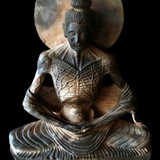
Certa feita, Sakyamuni Buda se encontrava na cidade de Kausambi. Nela vivia um homem que o odiava e, levado por este ressentimento, induziu, com subornos, uns malvados a que circulassem malévolos boatos a seu respeito. Em tais circunstancias, foi muito difícil a seus discípulos mendigar suficiente alimento nesta cidade onde havia muito abuso.
Ananda disse a Sakyamuni: “Seria melhor não ficarmos nesta cidade; há outras e melhores cidades para onde podemos ir; saiamos daqui.” O Abençoado replicou: “Suponhamos que a outra cidade seja como esta; que faremos então?” - “Então iremos para outra” disse Ananda.
O Abençoado retrucou: “Não, Ananda, assim, nunca conseguiremos nosso intento.
É melhor que permaneçamos aqui e suportemos pacientemente o abuso, até que se termine, e então iremos para outro lugar.
“Há lucro e perda, difamação e honra, louvor e abuso, sofrimento e prazer neste mundo; o Abençoado não é controlado pelas coisa externas; elas desaparecem tão rapidamente como surgem.”
Ananda disse a Sakyamuni: “Seria melhor não ficarmos nesta cidade; há outras e melhores cidades para onde podemos ir; saiamos daqui.” O Abençoado replicou: “Suponhamos que a outra cidade seja como esta; que faremos então?” - “Então iremos para outra” disse Ananda.
O Abençoado retrucou: “Não, Ananda, assim, nunca conseguiremos nosso intento.
É melhor que permaneçamos aqui e suportemos pacientemente o abuso, até que se termine, e então iremos para outro lugar.
“Há lucro e perda, difamação e honra, louvor e abuso, sofrimento e prazer neste mundo; o Abençoado não é controlado pelas coisa externas; elas desaparecem tão rapidamente como surgem.”
Dévī said:-- My devotee, in Supreme Devotion; he does not think himself separate from Me but rather thinks himself "that I am the Bhagavatī."
He considers all the Jīvas as Myself and loves Me as he loves himself. He does not make any difference between the Jīvas and myself as he finds the same Caitanya (Consciousness) everywhere and mainfested in all.
He does not quarrel with anybody as he has abandoned all ideas about separateness; he bows down, and worships the Cāndālas and all the Jīvas.
He who becomes filled with devotion to Me whenever he sees My place, My devotees, and hears the Sāstras, describing My deeds, and whenever he meditates on My Mantras, he becomes filled with the highest love and his hairs stand on their ends out of love to Me and tears of love flow incessantly from both his eyes; he recites My name and My deeds in a voice, choked with feelings of love for Me.
Dévī Mahābhāgavatam [Volume 07, Chapter 37, On Bhaktī Yoga]
He considers all the Jīvas as Myself and loves Me as he loves himself. He does not make any difference between the Jīvas and myself as he finds the same Caitanya (Consciousness) everywhere and mainfested in all.
He does not quarrel with anybody as he has abandoned all ideas about separateness; he bows down, and worships the Cāndālas and all the Jīvas.
He who becomes filled with devotion to Me whenever he sees My place, My devotees, and hears the Sāstras, describing My deeds, and whenever he meditates on My Mantras, he becomes filled with the highest love and his hairs stand on their ends out of love to Me and tears of love flow incessantly from both his eyes; he recites My name and My deeds in a voice, choked with feelings of love for Me.
Dévī Mahābhāgavatam [Volume 07, Chapter 37, On Bhaktī Yoga]
Lord Śīva said :-- Those lowest of the Beings who insult Śākta, Bhaīrava, along with Devgaņas drink their blood.
Gaņa of Bhaīrava and Bhaīravī always destroys these sinners. Bahūraktapāyī Gaņa always drinks their blood.
Those who kill Śaktas, verbally abuses Śāktas, or insult Śāktas, O Dévésī, Śīvavallabhā pierces their head.
There is no Upāsaka superior to Śākta in three worlds.
Muņdamālā Tantra 3.41-44
Gaņa of Bhaīrava and Bhaīravī always destroys these sinners. Bahūraktapāyī Gaņa always drinks their blood.
Those who kill Śaktas, verbally abuses Śāktas, or insult Śāktas, O Dévésī, Śīvavallabhā pierces their head.
There is no Upāsaka superior to Śākta in three worlds.
Muņdamālā Tantra 3.41-44
"I came alone into this world and am departing alone to the next world. If there were no compassion toward me from the Other-power, my past, present, and future would not exist. To protect and to guide me, there are countless powers. For example—my parents, my society, my nation, the air, earth, sun, etc.—all these powers of compassion are called Oya-sama. I cannot live in this world without Oya-sama. Oya-sama and I are in Oneness. Oya-sama is the infinite light and life that is called Amida Buddha."
Rev. Hozen Seki
Rev. Hozen Seki
"Concerning "teachings," the noscriptures of the Bhagavān accurately teach that which is to be thoroughly known, that which is to be eliminated, that which is to be manifested, and that which is to be cultivated by deities and humans who wish to attain the ambrosial state [of a nonabiding nirvarna]."
Avalokitavrata
Avalokitavrata
"Bodhisattvas should produce all paths-whatever is a path of a sravaka, a pratyekabuddha, or a buddha-and should know all paths. They should also perform the deeds of these paths and bring all of them to completion."
The Eighteen-Thousand-Verse Perfection of Wisdom Sutra
The Eighteen-Thousand-Verse Perfection of Wisdom Sutra
"Thus, it is contradictory to propound that you should not train in the noscriptural collections of the Hinayana because you are a Mahayana practitioner.
There are shared and unshared paths to enter the Mahayana. Since the shared are those things that come from the noscriptural collections of the Hinayana, how could they be something to set aside?
Therefore, Mahayana followers must practice all those things taught in the Hinayana noscriptural collections, with only a few exceptions, such as diligently seeking a blissful peace for oneself alone. This is the reason for extensively teaching all three vehicles in the very vast noscriptural collections of the bodhisattvas."
Je Tsongkhapa
There are shared and unshared paths to enter the Mahayana. Since the shared are those things that come from the noscriptural collections of the Hinayana, how could they be something to set aside?
Therefore, Mahayana followers must practice all those things taught in the Hinayana noscriptural collections, with only a few exceptions, such as diligently seeking a blissful peace for oneself alone. This is the reason for extensively teaching all three vehicles in the very vast noscriptural collections of the bodhisattvas."
Je Tsongkhapa
"Mañjusri, the karmic obstruction of abandoning the excellent teaching is subtle. Mañjusri, whoever distinguishes some of the words spoken by the Tathāgata as good and some as bad abandons the teaching. One who abandons the teaching, by having abandoned it, deprecates the Tathāgata and speaks badly of the community. If you say, "This is reasonable; this is unreasonable," you abandon the teaching. If you say, "This was set forth for the sake of bodhisattvas; this was set forth for the sake of srāvakas," you abandon the teaching. If you say, "This was set forth for the sake of pratyekabuddhas," you abandon the teaching. If you say, "This is not a training of bodhisattvas," you abandon the teaching."
Sarva-vaidalya-samgraha-sutra
Sarva-vaidalya-samgraha-sutra
"There are those who conclude that any classic text should be considered only an explanatory teaching, therefore lacking the key points for practice. They hold that there are separate personal instructions that teach the core meanings that are the heart of practice. They then imagine that there are two separate forms of the excellent teaching — a teaching that is explained to you and a teaching that you practice.
Know that this attitude precludes the development of great respect for the stainless sutras and tantras as well as the flawless treatises that comment on their intent. Know also that you accumulate the karmic obstruction of abandoning the teaching when you see those classic texts as objects of contempt and say, "Those are merely for promoting one's superficial knowledge and eliminating others' misconceptions; they do not teach the deep meaning."
Therefore, for those who desire liberation, the supreme and authentic instructions are indeed the classic texts. However, due to your limited intelligence and so forth, you may be unable to recognize those texts as the supreme instructions through depending on them alone. Thus, you must seek out personal instructions, thinking, "I will seek certain knowledge of those texts based on the per-sonal instructions of an excellent being." But do not think, "The texts are without substance, since they merely promote a superficial knowledge and eliminate others' misconceptions; yet the personal instructions, since they reveal the deep meaning, are supreme."
Je Tsongkhapa
Know that this attitude precludes the development of great respect for the stainless sutras and tantras as well as the flawless treatises that comment on their intent. Know also that you accumulate the karmic obstruction of abandoning the teaching when you see those classic texts as objects of contempt and say, "Those are merely for promoting one's superficial knowledge and eliminating others' misconceptions; they do not teach the deep meaning."
Therefore, for those who desire liberation, the supreme and authentic instructions are indeed the classic texts. However, due to your limited intelligence and so forth, you may be unable to recognize those texts as the supreme instructions through depending on them alone. Thus, you must seek out personal instructions, thinking, "I will seek certain knowledge of those texts based on the per-sonal instructions of an excellent being." But do not think, "The texts are without substance, since they merely promote a superficial knowledge and eliminate others' misconceptions; yet the personal instructions, since they reveal the deep meaning, are supreme."
Je Tsongkhapa
"The excellent teaching of the Teacher [Buddha] is twofold: Those teachings having a nature of noscripture and those having a nature of realization."
Vasubandhu
Vasubandhu
"Further, what you meditate on with the wisdom arisen from meditation is just that which you know with the wisdom that has arisen from study and reflection. You do not meditate on something else. This is similar to how you show a horse a racetrack, and then race it there."
Kamalasila
Kamalasila
"There are those with misunderstanding who hold that some teachings are methods for becoming a buddha and some teachings are obstacles to becoming a buddha.They then differentiate the words of the Buddha into good and bad, reasonable and unreasonable, and great and small vehicles. Finally, they hold that some teachings are to be cast aside, saying, "A bodhisattva should train in this and should not train in that." Thus, they abandon the teachings."
Je Tsongkhapa
Je Tsongkhapa
Forwarded from Egbert Moray-Falls
"To be praised by fools—that is the greatest shame."
— Nichiren
Above: Nichiren in exile on Sado Island.
— Nichiren
Above: Nichiren in exile on Sado Island.
I find funny the Western mystification usually done by middle aged and "good vibes" people about Buddhism, and especially about Tantrism in general.
It is a very "colorful" Buddhism, where there is no danger at all, reigning only a kind of illusory "good vibes", which historically is not so. The Tantric practices that gave rise to the various lineages of Tibetan Buddhism were as transgressive as the Aghor practices recorded in India centuries ago — which is, meat-eating, bathing in crematory ashes, etc. — and even in the "non-Tantric" Buddhism, you will find a lot that would make the average Western left-handed practitioner's hair stand on end.
Buddhism is not and never has been a place where the so-called "safe space" reigns, giving us a sense of illusory peace and security. Buddhism transcends moral illusions and goes beyond modern false security.
It is a very "colorful" Buddhism, where there is no danger at all, reigning only a kind of illusory "good vibes", which historically is not so. The Tantric practices that gave rise to the various lineages of Tibetan Buddhism were as transgressive as the Aghor practices recorded in India centuries ago — which is, meat-eating, bathing in crematory ashes, etc. — and even in the "non-Tantric" Buddhism, you will find a lot that would make the average Western left-handed practitioner's hair stand on end.
Buddhism is not and never has been a place where the so-called "safe space" reigns, giving us a sense of illusory peace and security. Buddhism transcends moral illusions and goes beyond modern false security.
"Listen to the teachings with one-pointed faith and respect.
Do not censure or deride the speaker;
Honor your instructors —
Develop the idea that they are like a buddha."
The Kṣitigarbha Bodhisattva Pūrvapraṇidhāna Sūtra
Do not censure or deride the speaker;
Honor your instructors —
Develop the idea that they are like a buddha."
The Kṣitigarbha Bodhisattva Pūrvapraṇidhāna Sūtra
Forwarded from 𝖳𝖱𝖨𝖪𝖠 𝖲𝖧𝖠𝖨𝖵𝖨𝖲𝖬
Śūnyata (शून्यत, “void”).— If you can concentrate on your body as void (śūnyata) or space and transcend all thoughts, even for a moment, your mind will be liberated and will take on the form of that void. It is important to note that you do not have to concentrate for hours and hours in order to experience this state. Even if you focus the mind for just a moment, it is enough to give you the experience of a heightened state of awareness.
( Vijñānabhairava verse 46)
( Vijñānabhairava verse 46)
Forwarded from 𝖳𝖱𝖨𝖪𝖠 𝖲𝖧𝖠𝖨𝖵𝖨𝖲𝖬
Jai Mahākāla. Āchāryaji will be giving a talk on consciousness at 8:00 AM PDT today on Zoom.
You may join using the following link:
https://us06web.zoom.us/j/86895536905?pwd=Zi9UQmlOdisyK0FUVkVmVHV0NW5Rdz09
You may join using the following link:
https://us06web.zoom.us/j/86895536905?pwd=Zi9UQmlOdisyK0FUVkVmVHV0NW5Rdz09
"Beyond reckoning in space or time; without direction or locality; impossible to represent; ultimately indescribable; Blissful with the experience of that which is inmost; a field of awareness free of mental constructs: that state of overflowing fullness is Bhairavī, the essence of Bhairava. It is that essence which is ultimately real & fundamental; it is that which ought to be known & experienced; it is that which is inherently pure, and it is that which pervades everything."
Vijñāna-bhairava-tantra
Vijñāna-bhairava-tantra
Some people are ill, their bodies tormented;
For many years there is not even temporary relief.
Afflicted with illness for a very long time,
They seek a doctor, in search of a cure.
Searching about again and again,
They at last find a physician with skill and knowledge.
Treating the patients with compassion,
The doctor gives medicine, saying, "Here, take this."
This medicine is plentiful, good, and valuable.
It will cure the illness, but the patients do not take it.
This is not a shortcoming of the doctor, nor the fault of the medicine;
It is just the fault of those who are ill.
Likewise, after you have left the householder's life for the sake of these teachings
And have come to know the powers, meditative stabilizations, and faculties,
How can you attain nirvana without making effort
At meditation, an effort at what is right?
Samādhirāja Sūtra
For many years there is not even temporary relief.
Afflicted with illness for a very long time,
They seek a doctor, in search of a cure.
Searching about again and again,
They at last find a physician with skill and knowledge.
Treating the patients with compassion,
The doctor gives medicine, saying, "Here, take this."
This medicine is plentiful, good, and valuable.
It will cure the illness, but the patients do not take it.
This is not a shortcoming of the doctor, nor the fault of the medicine;
It is just the fault of those who are ill.
Likewise, after you have left the householder's life for the sake of these teachings
And have come to know the powers, meditative stabilizations, and faculties,
How can you attain nirvana without making effort
At meditation, an effort at what is right?
Samādhirāja Sūtra
All sentient beings are emanations of mahamudra,
The essence of those emanations is the forever non-arising dharmadhatu,
Also all characteristics of dualistic appearances,
Happiness, suffering and so on,
are the play of mahamudra, the original dharmata.
Virupa's Treasury of Doha's
The essence of those emanations is the forever non-arising dharmadhatu,
Also all characteristics of dualistic appearances,
Happiness, suffering and so on,
are the play of mahamudra, the original dharmata.
Virupa's Treasury of Doha's
"Therefore, all appearances are the dharmakaya,
All beings are buddhas,
All composite actions are the primordial dharmadhatu,
All nominal phenomena are like a rabbit’s horns."
Sarahapāda
All beings are buddhas,
All composite actions are the primordial dharmadhatu,
All nominal phenomena are like a rabbit’s horns."
Sarahapāda