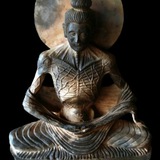
"We have explained that, to benefit beings, fully awakened beings, such as the buddhas, spontaneously assume, in a non-intentional way, various forms on the level of pure manifestation normally inaccessible to ordinary human beings. They are called the Body of Enjoyment [Sambhogakaya]. These forms can be diversified: male, female, peaceful, wrathful, and in several aspects. These deities come directly from the compassionate activity of the buddhas. If the deities have a feminine appearance, they are called goddesses.
From a relative point of view, however, some deities are considered the result of a human ascending to the divine. There are men or women who have embarked on the dharma path, rid themselves of all imperfections of the ordinary state, and have seen the qualities of the awakened state bloom within themselves. They have reached a divine state and become "gods" or "goddesses.""
Bokar Rinpoche
From a relative point of view, however, some deities are considered the result of a human ascending to the divine. There are men or women who have embarked on the dharma path, rid themselves of all imperfections of the ordinary state, and have seen the qualities of the awakened state bloom within themselves. They have reached a divine state and become "gods" or "goddesses.""
Bokar Rinpoche
"Thus philosophy, a thing of the highest utility, flourished in antiquity among the barbarians, shedding its light over the nations. And afterwards it came to Greece. First in its ranks were the prophets of the Egyptians; and the Chaldeans among the Assyrians; and the Druids among the Gauls; and the Sramanas among the Bactrians ("Σαρμαναίοι Βάκτρων"); and the philosophers of the Celts; and the Magi of the Persians, who foretold the Saviour's birth, and came into the land of Judaea guided by a star. The Indian gymnosophists are also in the number, and the other barbarian philosophers. And of these there are two classes, some of them called Sramanas ("Σαρμάναι"), and others Brahmins ("Βραχμάναι")."
Clement of Alexandria, Stromata
Clement of Alexandria, Stromata
“The Buddha, the great Yogi (mahāyogī), sits on a lotus, [head] bent, listening, and wearing mendicant’s rags. [He possesses] beautiful lotus eyes, has a lotus-shaped mark, and is fixed with a jewel. [He is] established in the world, positioned in Samādhi, his hands [making the] wish-granting and protection [mudrās]. Deva holds a rudrākṣa and a lotus. Thus, [the Mantrin] should worship and meditate upon Buddha, [who] grants the fruits of mokṣa to women”.
Netra Tantra, 13.29-36
Netra Tantra, 13.29-36
About “tantra practitioners” who employ sex as “the ultimate means” in their “tantra”:
“Those who have not been initiated (adikshita), who deny mudras and mantras, who have not done japa and puja, should not use Kula-tattvas (here panchamakara, i.e. meat, wine, fish, roasted grains, sex). Using them like this will lead the sadhaka to the hell”.
“There are a lot of people who, relying on their opinion, reject the tradition of spiritual transmission and, following false teachings, engage merely in imitation and distortion of Kula-dharma.”
“Thus, if merely by consuming wine one could achieve siddhis, then all unworthy people, who enjoy in heavy drinking, should have achieved siddhis. If merely by consuming meat one could attain spiritual purity, then all meat-eaters should have reached sainthood. If mere sexual pleasure with one’s partner could bring to Liberation, then all living beings should have reached it through the attachment to their partners”.
Kulavali-tantra, ch. 8
“Those who have not been initiated (adikshita), who deny mudras and mantras, who have not done japa and puja, should not use Kula-tattvas (here panchamakara, i.e. meat, wine, fish, roasted grains, sex). Using them like this will lead the sadhaka to the hell”.
“There are a lot of people who, relying on their opinion, reject the tradition of spiritual transmission and, following false teachings, engage merely in imitation and distortion of Kula-dharma.”
“Thus, if merely by consuming wine one could achieve siddhis, then all unworthy people, who enjoy in heavy drinking, should have achieved siddhis. If merely by consuming meat one could attain spiritual purity, then all meat-eaters should have reached sainthood. If mere sexual pleasure with one’s partner could bring to Liberation, then all living beings should have reached it through the attachment to their partners”.
Kulavali-tantra, ch. 8
"If selflessness is demonstrated, the immature grasp to the explanation thinking there is no self. The intelligent on the other hand think "The [self] exists conventionally, there is no doubt."
Nirvana Sūtra
Nirvana Sūtra
Forwarded from Meditations of a Yogin
Glory to Heruka Chakrasamvara, beloved of Vajrayogini! You are smeared in ashes and your four faces reveal the enlightened nature of all beings in all directions. Though your limbs are the very links of the dependency of all things, each hand of yours is equipped with those powers that destroy ignorance! O Heruka, you are ever in union with Vajrayogini, and so you as the wheel of supreme bliss liberate all beings from dualities while still appearing as the one and the many!
"Karma ou Ação não pode destruir a ignorância visto que não é oposto a ela. Só o Conhecimento ou Jñāna destrói a ignorância como a densa escuridão é destruída pela luz.
Por meio da ação alguém satisfaz seus desejos. Portanto a ação está em harmonia com a ignorância e não pode, portanto, destruí-la diretamente."
Adi Sankarancharya
Por meio da ação alguém satisfaz seus desejos. Portanto a ação está em harmonia com a ignorância e não pode, portanto, destruí-la diretamente."
Adi Sankarancharya
"Thereupon, magically influenced by the Buddha, the venerable Sariputra had this thought: "If the buddha-field is pure only to the extent that the mind of the bodhisattva is pure, then, when Sakyamuni Buddha was engaged in the career of the bodhisattva, his mind must have been impure. Otherwise, how could this buddha-field appear to be so impure?"
The Buddha, knowing telepathically the thought of venerable Sariputra, said to him, "What do you think, Sariputra? Is it because the sun and moon are impure that those
blind from birth do not see them?"
Sariputra replied, "No, Lord. It is not so. The fault lies with those blind from birth, and not with the sun and moon."
The Buddha declared, "In the same way, Sariputra, the fact that some living beings do not behold the splendid display of virtues of the buddha-field of the Tathagata is due to their own ignorance. It is not the fault of the Tathagata. Sariputra, the buddhafield of the Tathagata is pure, but you do not see it."
Vimalakirti Sutra
The Buddha, knowing telepathically the thought of venerable Sariputra, said to him, "What do you think, Sariputra? Is it because the sun and moon are impure that those
blind from birth do not see them?"
Sariputra replied, "No, Lord. It is not so. The fault lies with those blind from birth, and not with the sun and moon."
The Buddha declared, "In the same way, Sariputra, the fact that some living beings do not behold the splendid display of virtues of the buddha-field of the Tathagata is due to their own ignorance. It is not the fault of the Tathagata. Sariputra, the buddhafield of the Tathagata is pure, but you do not see it."
Vimalakirti Sutra
"Termas are texts uttered by Padmasambhava in the 8th century in Tibet, then hidden to be discovered later by predestined "terma discoverers," in an epoch that would need them. These termas may take the form of materially written texts, hidden in rocks, walls, or other places, or directly given to the discoverer by a deity. They also can be revealed in the mind. In that case, they are called gongters, as was the case of the Tara terma received by Chogyur Lingpa."
Bokar Rinpoche
Bokar Rinpoche
"It is true that from the standpoint of ultimate reality, the deity and our mind are one; but we also must understand that from this ultimate point of view, there is neither suffering nor fear. In reality, that which appears now as suffering, fear, and danger is nothing else but a manifestation of our mind. Just as our mind, during a dream, can create appearances that cause us to suffer, threaten us, or make us afraid.
However, as long as we have not realized ultimate reality, we are exposed to suffering and fear that we conceive as real. It is in this relative context that the deity, who also appears to us momentarily as outside ourselves, brings us help when we pray to her.
This prayer, in a relative sense, is necessary as long as we remain in the relative level. The ultimate prayer is to dwell in ultimate truth, the nature of mind, beyond any duality, where the mind, appearances, and deities are revealed to be of a single essence.
Until we attain this level, while we perceive suffering and fear as real, we also call upon a ,deity that we perceive as existing outside of us. However, she really brings help and protection.
It is necessary to differentiate between the realization of nonduality and the present state in which all our experience is lived in a constant subject/object duality."
Bokar Rinpoche
However, as long as we have not realized ultimate reality, we are exposed to suffering and fear that we conceive as real. It is in this relative context that the deity, who also appears to us momentarily as outside ourselves, brings us help when we pray to her.
This prayer, in a relative sense, is necessary as long as we remain in the relative level. The ultimate prayer is to dwell in ultimate truth, the nature of mind, beyond any duality, where the mind, appearances, and deities are revealed to be of a single essence.
Until we attain this level, while we perceive suffering and fear as real, we also call upon a ,deity that we perceive as existing outside of us. However, she really brings help and protection.
It is necessary to differentiate between the realization of nonduality and the present state in which all our experience is lived in a constant subject/object duality."
Bokar Rinpoche
"Individual karmas are varied and of different kinds. Some karmas may not be modified. In this case, if we carry the karma for such a painful event to occur, it will occur. If, on the contrary, we do not have the karma for such a happy circumstance to manifest, it will not manifest. The prayer will hardly be able to modify things.
When we say that the law of karma is infallible, it means that a cause will necessarily produce its effect if nothing prevents it from happening. But if new elements come into play, a change is possible. Sincere devotion and prayer, as well as regret of past negative acts, are factors that can modify karma. There are profound means related to genuinely awakened beings or deities like Tara. That is why these means allow purification to change karma. Besides putting into work such factors, karma effectively produces its effects in an infallible way.
The seed of a weed will grow in an infallible way, unless we pull out the young sprout."
Bokar Rinpoche
When we say that the law of karma is infallible, it means that a cause will necessarily produce its effect if nothing prevents it from happening. But if new elements come into play, a change is possible. Sincere devotion and prayer, as well as regret of past negative acts, are factors that can modify karma. There are profound means related to genuinely awakened beings or deities like Tara. That is why these means allow purification to change karma. Besides putting into work such factors, karma effectively produces its effects in an infallible way.
The seed of a weed will grow in an infallible way, unless we pull out the young sprout."
Bokar Rinpoche
Forwarded from Egbert Moray-Falls
Media is too big
VIEW IN TELEGRAM
Vaishnavas at Krishna temple offering Guru Puja to the Dalai Lama, and performing Abhisheka (ritual bathing) of his feet.
"There is, monks, an unborn—unbecome—unmade—unfabricated. If there were not that unborn—unbecome—unmade—unfabricated, there would not be the case that escape from the born—become—made—fabricated would be discerned. But precisely because there is an unborn—unbecome—unmade—unfabricated, escape from the born—become—made—fabricated is discerned."
Nibbāna Sutta
Nibbāna Sutta
"I have heard that on one occasion the Blessed One was staying near Sāvatthī at Jeta’s Grove, Anāthapiṇḍika’s monastery. And on that occasion a certain monk was sitting not far from the Blessed One, his legs crossed, his body held erect, enduring fierce pains, sharp & severe, that were the result of old kamma—mindful, alert, without suffering. The Blessed One saw him sitting not far away, his legs crossed, his body held erect, enduring fierce pains, sharp & severe, that were the result of old kamma—mindful, alert, and not struck down by them.
Then, on realizing the significance of that, the Blessed One on that occasion exclaimed:
For the monk who has left
all kamma behind,
shaking off the dust of the past,
steady, unpossessive,
Such:
There’s no point in telling
anyone else."
Kamma Sutta
Then, on realizing the significance of that, the Blessed One on that occasion exclaimed:
For the monk who has left
all kamma behind,
shaking off the dust of the past,
steady, unpossessive,
Such:
There’s no point in telling
anyone else."
Kamma Sutta
"Whose mind, standing like rock,
doesn’t shake,
dispassionate for things that spark passion,
unprovoked by things that spark provocation:
When one’s mind is developed like this,
from where can there come to him suffering & stress?"
Juñha Sutta
doesn’t shake,
dispassionate for things that spark passion,
unprovoked by things that spark provocation:
When one’s mind is developed like this,
from where can there come to him suffering & stress?"
Juñha Sutta
"The transformation of consciousness is imagination. What is imagined by it does not exist. Therefore everything is representation-only."
Vasubhandu
Vasubhandu
"By just meditating on the bits we like and avoiding the bits we don’t—like the sufferings of the three lower realms, impermanence and death, and the suffering nature of samsara and life—by not thinking about or meditating on what we feel to be unpleasant, not putting these teachings into practice, and focusing only on the parts that sound good, we can’t really achieve any realizations."
Lama Zopa Rinpoche
Lama Zopa Rinpoche
"Guru devotion, seeing the guru as a buddha, is called “the root of the path” because just as the trunk, branches, leaves and fruit grow from the stable root of a tree, all the realizations of the graduated path to enlightenment grow from stable devotion to the guru. If there is no root, nothing can grow. If we have the stable root of guru devotion, all realizations come quickly."
Lama Zopa Rinpoche
Lama Zopa Rinpoche