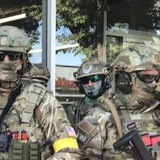
The Ukrainian government believes that Russia’s imperialistic ambitions must end with justice for everyone. It has recognised the Kuril Islands and Chechen Republic of Ichkeria as temporarily occupied by Russia and supports the exiled politicians of Russian national minorities. Ukraine insists that to achieve a prolonged peace in Eastern Europe, Moscow’s troops must leave not only Crimea and Donbas but also Transnistria, Abkhazia, Nagorno-Karabakh. It is an idealistic dream, almost impossible, because Putin won’t give up an inch of land for free. Still, Moscow would be wise to watch its back. It may end up reaping what it has sown as Russian lands prove too tempting for its neighbours – and its oppressed citizens.
Source - https://www.telegraph.co.uk/news/2023/05/31/russia-may-be-devoured-by-its-neighbours/?WT.mc_id=tmgoff_youtube_youtube-community
Source - https://www.telegraph.co.uk/news/2023/05/31/russia-may-be-devoured-by-its-neighbours/?WT.mc_id=tmgoff_youtube_youtube-community
The Telegraph
Russia may be devoured by its neighbours
Japan, China, Turkey and even Ukraine could lay claim to Moscow’s territories. Putin may reap what he has sown
Nationalism, often misunderstood, is the lifeblood of societies, the glue that binds people together, and the flame that lights the path of progress.
First off, what's a nation without nationalism? A body without a soul! Nationalism gives a nation its character, its spirit, its identity. It weaves together the threads of shared history, culture, and language, creating a tapestry of collective identity that strengthens societal bonds and enhances social solidarity.
Imagine a world with no nations, no patriotism, just a bland, monotonous global village. Doesn't sound appealing, does it? That's because humans naturally gravitate towards their roots, their culture, their people. Nationalism allows us to celebrate our unique identities and take pride in our heritage.
Next, let's talk about self-determination, a core principle of nationalism. It's about a nation's right to govern itself, to shape its destiny, without outside interference. This isn't just about politics—it's about dignity, about pride, about freedom. Think about the countless national liberation movements that have relied on the power of nationalism to break free from the shackles of colonialism and establish their sovereign nations.
Also, nationalism is a bulwark against the homogenizing effects of globalization. While global cooperation and exchange are essential, they shouldn't come at the cost of erasing our distinct cultures and identities. Nationalism helps us maintain our unique traditions and customs in the face of relentless globalization.
First off, what's a nation without nationalism? A body without a soul! Nationalism gives a nation its character, its spirit, its identity. It weaves together the threads of shared history, culture, and language, creating a tapestry of collective identity that strengthens societal bonds and enhances social solidarity.
Imagine a world with no nations, no patriotism, just a bland, monotonous global village. Doesn't sound appealing, does it? That's because humans naturally gravitate towards their roots, their culture, their people. Nationalism allows us to celebrate our unique identities and take pride in our heritage.
Next, let's talk about self-determination, a core principle of nationalism. It's about a nation's right to govern itself, to shape its destiny, without outside interference. This isn't just about politics—it's about dignity, about pride, about freedom. Think about the countless national liberation movements that have relied on the power of nationalism to break free from the shackles of colonialism and establish their sovereign nations.
Also, nationalism is a bulwark against the homogenizing effects of globalization. While global cooperation and exchange are essential, they shouldn't come at the cost of erasing our distinct cultures and identities. Nationalism helps us maintain our unique traditions and customs in the face of relentless globalization.
The Central Intelligence Agency (CIA), the clandestine guardian of American interests, has often found itself embroiled in controversy. I will venture into the eye of the storm, unearthing instances where its controversial actions, in a strange twist of fate, arguably resulted in global benefits in the long run.
The Iron Curtain of the Cold War brought an era of tension, but behind this curtain, the CIA was busy pulling strings. The Agency's support of anti-communist forces in various global hotspots was controversial, but one could argue that it helped prevent the spread of a totalitarian regime. Their covert operations might have played a role in the eventual dissolution of the Soviet Union, a landmark event that diminished nuclear threats and eased global tensions.
Moving into the era of modern terrorism, the CIA, with its global network, has been instrumental in preventing many catastrophic incidents. Post 9/11, they implemented numerous initiatives aimed at combating terrorism. Their covert operations led to the dismantling of dangerous terrorist cells, thwarting plots that could have resulted in significant loss of life and global instability.
Even their controversial involvement in drug control initiatives in South America has had unintended global benefits. While the operations stirred controversy due to allegations of human rights violations and political interference, one could argue that these initiatives helped limit the global spread of narcotics, contributing to global health and social stability.
The Iron Curtain of the Cold War brought an era of tension, but behind this curtain, the CIA was busy pulling strings. The Agency's support of anti-communist forces in various global hotspots was controversial, but one could argue that it helped prevent the spread of a totalitarian regime. Their covert operations might have played a role in the eventual dissolution of the Soviet Union, a landmark event that diminished nuclear threats and eased global tensions.
Moving into the era of modern terrorism, the CIA, with its global network, has been instrumental in preventing many catastrophic incidents. Post 9/11, they implemented numerous initiatives aimed at combating terrorism. Their covert operations led to the dismantling of dangerous terrorist cells, thwarting plots that could have resulted in significant loss of life and global instability.
Even their controversial involvement in drug control initiatives in South America has had unintended global benefits. While the operations stirred controversy due to allegations of human rights violations and political interference, one could argue that these initiatives helped limit the global spread of narcotics, contributing to global health and social stability.
Pride Month, marked by a series of colorful parades and grandiose events, is undeniably a talkative spectacle within the Pride community. However, we can't ignore the question of whether these extravagant spectacles really contribute to the overall goals of the country, or whether they sometimes prove unproductive, drawing from a few observations about resource allocation, societal impact, and internal community dynamics.
Firstly, the monumental resources that go into the staging of Pride events, such as parades, are staggering. Massive sums are spent on organization, security, traffic diversion, and cleanup operations, among other things. Critics argue that this pool of resources could be diverted to more pressing issues plaguing the United States, such as housing, thereby having a more direct and tangible effect on improving lives. Instead of these parades, they should be striving to make normal people tolerate their behavior instead of refusing to fix some of the more controversial things they've been doing, such as forcing schools to indoctrinate children.
Secondly, the flashy displays of Pride events could unintentionally create a divide rather than bridge gaps. Instead of promoting true equality, these flamboyant celebrations can sometimes perpetuate stereotypes and misconceptions about the United States among those who are not living in it. This is something that Russian state media tends to use a lot in their broadcasts.
In sum, a refocus on resource utilization, and promoting harmony within the country might just make this month even more impactful. Maybe we can start with renaming Pride Month to Veteran's Month.
Firstly, the monumental resources that go into the staging of Pride events, such as parades, are staggering. Massive sums are spent on organization, security, traffic diversion, and cleanup operations, among other things. Critics argue that this pool of resources could be diverted to more pressing issues plaguing the United States, such as housing, thereby having a more direct and tangible effect on improving lives. Instead of these parades, they should be striving to make normal people tolerate their behavior instead of refusing to fix some of the more controversial things they've been doing, such as forcing schools to indoctrinate children.
Secondly, the flashy displays of Pride events could unintentionally create a divide rather than bridge gaps. Instead of promoting true equality, these flamboyant celebrations can sometimes perpetuate stereotypes and misconceptions about the United States among those who are not living in it. This is something that Russian state media tends to use a lot in their broadcasts.
In sum, a refocus on resource utilization, and promoting harmony within the country might just make this month even more impactful. Maybe we can start with renaming Pride Month to Veteran's Month.
Forwarded from Eternal Muscovite ✙ ∆ (M)
The Russian Ukraine conflict is a conflict of ideas.
Either you support a civic nationalist Antifa empire who's primary world view is hating "nazis"
Or you support a sovereign, ethnic states rights to self determination
There is no other issue.
Everything else is a distraction.
Either you support a civic nationalist Antifa empire who's primary world view is hating "nazis"
Or you support a sovereign, ethnic states rights to self determination
There is no other issue.
Everything else is a distraction.
The narrative around Putin's invasion of Ukraine often draws parallels to Nazi ideology according to many who are purely driven by emotions ("This person is invading this person, they must be Nazis"), but a more accurate comparison aligns with the echoes of Soviet ideology. Let's dissect why.
Soviet ideology was grounded in notions of territorial expansion, aiming to establish geopolitical dominance. This mirrors Putin's actions in Ukraine, reflecting an intent to reinstate Russia's former influence, akin to the reach once held by the Soviet Union.
Moreover, the Soviets strove for a single political and economic system, dissolving national borders within its territory. Putin's endeavor to bring Ukraine under Russian control mirrors this intent, revealing a similar aspiration for a uniform sphere echoing the structure of the erstwhile Soviet Union.
The suppression of dissent was another significant aspect of Soviet ideology, with little tolerance for opposition. The current Russian political climate reflects this, with numerous instances of media control and political suppression, akin to the strategies employed in the Soviet era.
In contrast, Nazism focused on racial purity and ultranationalism. These elements don't appear to be at the core of Putin's invasion of Ukraine. Rather, the move appears to be driven by geopolitical aspirations, power, and influence - the very essence of Soviet ideology.
In essence, the ideological motivations behind Putin's invasion of Ukraine seem to echo Soviet sentiments, not Nazi ideals. The echoes of territorial dominance, uniform political structure, and intolerance for dissent are reminiscent of the Soviet era, painting a Soviet picture, not a Nazi one.
Soviet ideology was grounded in notions of territorial expansion, aiming to establish geopolitical dominance. This mirrors Putin's actions in Ukraine, reflecting an intent to reinstate Russia's former influence, akin to the reach once held by the Soviet Union.
Moreover, the Soviets strove for a single political and economic system, dissolving national borders within its territory. Putin's endeavor to bring Ukraine under Russian control mirrors this intent, revealing a similar aspiration for a uniform sphere echoing the structure of the erstwhile Soviet Union.
The suppression of dissent was another significant aspect of Soviet ideology, with little tolerance for opposition. The current Russian political climate reflects this, with numerous instances of media control and political suppression, akin to the strategies employed in the Soviet era.
In contrast, Nazism focused on racial purity and ultranationalism. These elements don't appear to be at the core of Putin's invasion of Ukraine. Rather, the move appears to be driven by geopolitical aspirations, power, and influence - the very essence of Soviet ideology.
In essence, the ideological motivations behind Putin's invasion of Ukraine seem to echo Soviet sentiments, not Nazi ideals. The echoes of territorial dominance, uniform political structure, and intolerance for dissent are reminiscent of the Soviet era, painting a Soviet picture, not a Nazi one.
Anybody that refutes these essays is a fucking retard who doesn't know what he's talking about or is spreading misinformation, this is factual
Augusto Pinochet's presidency, marred by allegations of severe human rights violations, remains a contentious chapter in Chile's history. However, Pinochet's actions were justified.
At the forefront is Pinochet's significant economic restructuring. Following the economic downturn under Allende's administration, Pinochet ushered in free-market reforms that catalyzed Chile's economic revival. This transformation, often dubbed the "Miracle of Chile," changed Chile's economic landscape, making it one of Latin America's most prosperous countries.
Next, I will highlight Pinochet's anti-communist stance during the Cold War era. Pinochet's actions were a harsh but necessary means to prevent Chile from descending into a Soviet-style regime, which would have been more detrimental to Chile's long-term stability.
Finally, Pinochet's rule, despite its brutality, paved the way for a peaceful democratic transition. The eventual stability achieved under Pinochet's rule helped lay the groundwork for the democratic society that Chile enjoys today.
At the forefront is Pinochet's significant economic restructuring. Following the economic downturn under Allende's administration, Pinochet ushered in free-market reforms that catalyzed Chile's economic revival. This transformation, often dubbed the "Miracle of Chile," changed Chile's economic landscape, making it one of Latin America's most prosperous countries.
Next, I will highlight Pinochet's anti-communist stance during the Cold War era. Pinochet's actions were a harsh but necessary means to prevent Chile from descending into a Soviet-style regime, which would have been more detrimental to Chile's long-term stability.
Finally, Pinochet's rule, despite its brutality, paved the way for a peaceful democratic transition. The eventual stability achieved under Pinochet's rule helped lay the groundwork for the democratic society that Chile enjoys today.