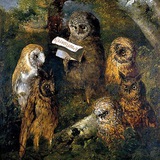
I'm baaaaaack~~
I wrote this after witnessing some extreme stupidity. Expect more soon.
-Hrafna
I wrote this after witnessing some extreme stupidity. Expect more soon.
-Hrafna
Forwarded from 🪻 Wheat & Sky 🌿
To everyone who voted no, too bad! Please enjoy my newest article and let me know what you think. Thank you so much to everyone who has subscribed to my Substack!
👍2❤1
Forwarded from ᛉ Sagnamaðr Stark ᛉ
In the Eddas, while the moon is male (Máni) and the sun is female (Sól), Night (Nótt) is female and Day (Dagr) is male. This could explain the discrepancy with other Indo-European religions with a sun god and moon goddess, ex. Helios and Selene, and Sol Invictus and Luna.
Painting by Giovanni Caselli. ⴲ
Painting by Giovanni Caselli. ⴲ
❤4
Forwarded from Þórr siðr
Úlfs bága verr ægis
ítrbáls hati málu;
sett eru bǫrð fyr bratta
brún Míms vinar rúnu.
Orms váða kann eiðu
allvaldr gǫfugr halda;
menstríðir, njót móður
mellu dólgs til elli.
Háttatal 3, Snorri Sturluson
Translation:
“The hater of the precious pyre of the sea defends the wife of the wolf’s enemy; prows are placed before the steep edge of the confidant of Mímir’s friend. The glorious mighty ruler can hold the mother of the serpent’s harmer; necklace-destroyer, enjoy the mother of the giantess’ enemy until old age.”
Kenning translations:
hati ítrbáls ægis — “The hater of the precious pyre of the sea”
• Óðinn, depicted as a generous man; one who “hates gold”, i.e. does battle for battle’s sake, and gives gold freely to his men. Gold is referred to in terms of fire of the sea in this passage, and in other poems.
málu bága úlfs — “the wife of the wolf’s enemy”
• Jörð, here described as mála, which is a female acquaintance or friend, which is indicative of their consort-relationship. This relationship is typically depicted in skaldic poetry as both landnám and konutak (land-taking and woman-taking). Óðinn, depicted as Fenrir’s enemy, usually denoting his orientation towards violence and battle.
rúnu vinar Míms — “confidant of Mímir’s friend”
• Jörð, here described as a rúna, or a person who knows someone’s secrets; an intimate friend, usually denoting a wife or a sexual partner. Óðinn, depicted as Mímir’s friend, usually denoting his wisdom.
eiðu váða orms — “the mother of the serpent’s harmer”
• Jörð, depicted as Þórr’s mother. Þórr, depicted as a váða, a sudden or extreme danger to Jörmungandr, the great serpent. Denoting his tendency towards extreme violence.
móður dólgs mellu — “mother of the giantess’s enemy”
• Jörð, again depicted as as Þórr’s mother. Þórr, depicted as the enemy of mellu, meaning a noose or trigger, denoting the negative element of giantesses as harmful beings.
menstríðir — “necklace-destroyer”
• A generous man; a lord. As above, one who hates gold, and excels in battle.
ítrbáls hati málu;
sett eru bǫrð fyr bratta
brún Míms vinar rúnu.
Orms váða kann eiðu
allvaldr gǫfugr halda;
menstríðir, njót móður
mellu dólgs til elli.
Háttatal 3, Snorri Sturluson
Translation:
“The hater of the precious pyre of the sea defends the wife of the wolf’s enemy; prows are placed before the steep edge of the confidant of Mímir’s friend. The glorious mighty ruler can hold the mother of the serpent’s harmer; necklace-destroyer, enjoy the mother of the giantess’ enemy until old age.”
Kenning translations:
hati ítrbáls ægis — “The hater of the precious pyre of the sea”
• Óðinn, depicted as a generous man; one who “hates gold”, i.e. does battle for battle’s sake, and gives gold freely to his men. Gold is referred to in terms of fire of the sea in this passage, and in other poems.
málu bága úlfs — “the wife of the wolf’s enemy”
• Jörð, here described as mála, which is a female acquaintance or friend, which is indicative of their consort-relationship. This relationship is typically depicted in skaldic poetry as both landnám and konutak (land-taking and woman-taking). Óðinn, depicted as Fenrir’s enemy, usually denoting his orientation towards violence and battle.
rúnu vinar Míms — “confidant of Mímir’s friend”
• Jörð, here described as a rúna, or a person who knows someone’s secrets; an intimate friend, usually denoting a wife or a sexual partner. Óðinn, depicted as Mímir’s friend, usually denoting his wisdom.
eiðu váða orms — “the mother of the serpent’s harmer”
• Jörð, depicted as Þórr’s mother. Þórr, depicted as a váða, a sudden or extreme danger to Jörmungandr, the great serpent. Denoting his tendency towards extreme violence.
móður dólgs mellu — “mother of the giantess’s enemy”
• Jörð, again depicted as as Þórr’s mother. Þórr, depicted as the enemy of mellu, meaning a noose or trigger, denoting the negative element of giantesses as harmful beings.
menstríðir — “necklace-destroyer”
• A generous man; a lord. As above, one who hates gold, and excels in battle.
❤2
An Old English word I just learned that I like a lot is ān-genga (pronounced AHN-YENGA-ga), which means “a solitary walker, a lone wanderer.
Very (W)Odinic when you compare that with some of his ON attestations:
Vegtamr (wanderer, waytame)
Farmagnuðr (journey empowerer)
Váfuðr (wanderer)
And of course —
Gangleri (wayweary)
Woden is the thirst for knowledge, the One who roves all over and yearns for wisdom in all the hidden and secret places in the Universe.
- Huwila 🦉
Very (W)Odinic when you compare that with some of his ON attestations:
Vegtamr (wanderer, waytame)
Farmagnuðr (journey empowerer)
Váfuðr (wanderer)
And of course —
Gangleri (wayweary)
Woden is the thirst for knowledge, the One who roves all over and yearns for wisdom in all the hidden and secret places in the Universe.
- Huwila 🦉
❤4
There is seriously nothing better than a new haircut at the changing of the seasons. This is my personal ritual and I have done so for quite a long time (prior, even, to my heathen reversion!). It helps me to feel refreshed, marks a delineation of the seasons (where I, living in the North, might not otherwise see them), and helps me to let go of anything I shouldn't hold onto. The last point is maybe a bit ✨woo✨, but I do strongly believe in the metaphysical properties of hair. Maybe I will write something in the near future to explain what I mean...
-H 🌸🐦⬛
-H 🌸🐦⬛
❤8💯1
Forwarded from Æhtemen
Eostre is seen as a dawn goddess, but this is likely the dawning of spring, the coming new year of greenery and regeneration. We can attribute the daily dawn to Dellingr. ‘Delling’s door’ which appears in the Hávamál and Hervarar’s saga seems to be a kenning for the rising sun. But this shouldn’t be a surprise as Dellingr is the father of Day.
Delling’s name has a shared root with the OE deall which meant proud or bright and is also cognate with the ‘dallr’ in Heimdallr. This is remembered in the English place name Dalbury Lees which was once recorded as Dellingeberie and believed to be named after Dellingr.
Delling’s name has a shared root with the OE deall which meant proud or bright and is also cognate with the ‘dallr’ in Heimdallr. This is remembered in the English place name Dalbury Lees which was once recorded as Dellingeberie and believed to be named after Dellingr.
❤3
Forwarded from ᚸ Order of the Sacred Mannerbunde ᚸ
Art: "Wodenist Altar Cloth" by C.N.J. Cornwell, 2022.
❤7
Forwarded from Wudubearu 🌲
It is imperative that we as Heathens make an argument against AI.
My friend Þorr Siðr makes a great point.
“The Gods are artisans. They shaped and prepared this realm for us, which required struggle and a great deal of violence to do. That was not an easy thing for them to do; what they made for us, was not easy to make. It took time and effort to do so. So, when someone uses this generative art and all its imperfections and imitation of reality, they don’t respect that struggle for creation that the Gods underwent at the beginning. In fact, it mocks their work, and that is why we must reject AI art.”
My friend Þorr Siðr makes a great point.
“The Gods are artisans. They shaped and prepared this realm for us, which required struggle and a great deal of violence to do. That was not an easy thing for them to do; what they made for us, was not easy to make. It took time and effort to do so. So, when someone uses this generative art and all its imperfections and imitation of reality, they don’t respect that struggle for creation that the Gods underwent at the beginning. In fact, it mocks their work, and that is why we must reject AI art.”
💯7❤2⚡1👎1🥰1
Forwarded from 🪻 Wheat & Sky 🌿
Each runestone is roughly the diameter of a quarter, made from natural clay, hand carved with an elder futhark rune, and hand painted with watercolour before being sealed with a semi gloss finishing. The stones are durable and withstand being dropped, even onto hard surfaces. I make the occasional one-off set, but would love to start making custom sets in the near future. Please contact me if you are interested in something like this! 🥰🌻🌾🌼
❤5
All three of us are deeply against AI. I refuse to accept AI generated content as art. It's not. Art comes from human beings, end of.
Hrafna 🌸
Hrafna 🌸
⚡15💩1