Paleo calculator update:
https://justpaste.it/5fi54
Just trying to minimize the amount of simulated samples
Enjoy
https://justpaste.it/5fi54
Just trying to minimize the amount of simulated samples
Enjoy
👍15
Genetic distance to the Magdalenian cluster (~17,000 - 14,000 ybp)
The Magdalenians were a distinct cluster of hunter-gatherers who inhabited Europe during the later Upper Paleolithic.
The majority of their ancestry was connected to the Fournol Gravettians, who were a western subgroup of the broader Gravettian culture. The Fournol differed from most other Gravettian groups in that they were largely genetically connected to earlier Western European Aurignacians like GoyetQ116-1. The rest of the Magdalenian cluster’s ancestry was derived from Epigravettians (early WHGs).
Regarding Y-DNA, they show types of C, typical of Paleolithic Europeans, and types of I2, typical of Epigravettians. All samples were found to belong to types of mtDNA U.
Later Epigravettian migrants would largely replace the Magdalenians in most of Europe, although they did pick up some admixture from them (~15-20% for WHGs and ~45-55% for Iberian HGs).
The Magdalenians were a distinct cluster of hunter-gatherers who inhabited Europe during the later Upper Paleolithic.
The majority of their ancestry was connected to the Fournol Gravettians, who were a western subgroup of the broader Gravettian culture. The Fournol differed from most other Gravettian groups in that they were largely genetically connected to earlier Western European Aurignacians like GoyetQ116-1. The rest of the Magdalenian cluster’s ancestry was derived from Epigravettians (early WHGs).
Regarding Y-DNA, they show types of C, typical of Paleolithic Europeans, and types of I2, typical of Epigravettians. All samples were found to belong to types of mtDNA U.
Later Epigravettian migrants would largely replace the Magdalenians in most of Europe, although they did pick up some admixture from them (~15-20% for WHGs and ~45-55% for Iberian HGs).
👍18❤4
Coordinates:
Magdalenian_GoyetQ2,0.078538,0.039606,0.065242,0.126617,0.084016,0.017012,-0.00047,0.008769,0.082832,0.015308,-0.011042,-0.021581,0.011001,-0.013212,0.039902,0.028772,-0.005085,-0.003801,-0.009804,0.042645,0.0564,0.00507,-0.029826,-0.108329,0.010538
Magdalenian_GoyetQ2,0.078538,0.039606,0.065242,0.126617,0.084016,0.017012,-0.00047,0.008769,0.082832,0.015308,-0.011042,-0.021581,0.011001,-0.013212,0.039902,0.028772,-0.005085,-0.003801,-0.009804,0.042645,0.0564,0.00507,-0.029826,-0.108329,0.010538
Haplogroups frequencies of Paleolithic and Mesolithic Europeans
Source:
https://www.nature.com/articles/s41586-023-05726-0
Source:
https://www.nature.com/articles/s41586-023-05726-0
👍16❤4
Forwarded from TheBeakerLady
Not specifically Indo-European related but an interesting topic.
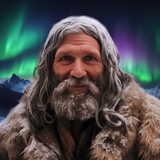
Kostenki 14 is a site in Western Russia where a man of the Aurignacian culture was found. He belonged to y haplogroup C1b and mtdna U2. Members of his genetic group may be the source of the West Eurasian ancestry of the ANE (an ancestor of the steppe peoples).
This artistic reconstruction was based on the skull and facial outline drawn by Orobassas, an artist, who came up with the idea to do a reconstruction of this individual.
The clothing featured on the reconstruction comes from Ice Age Art, from Instagram, who gave advice on clothing and allowed me to use images of his ice age clothing reconstructions.
Kostenki 14 is a site in Western Russia where a man of the Aurignacian culture was found. He belonged to y haplogroup C1b and mtdna U2. Members of his genetic group may be the source of the West Eurasian ancestry of the ANE (an ancestor of the steppe peoples).
This artistic reconstruction was based on the skull and facial outline drawn by Orobassas, an artist, who came up with the idea to do a reconstruction of this individual.
The clothing featured on the reconstruction comes from Ice Age Art, from Instagram, who gave advice on clothing and allowed me to use images of his ice age clothing reconstructions.
❤17👍9👎2
Genetic distance to Mesolithic Western European Hunter-Gatherers (WHG)
The WHG, or Oberkassel cluster, inhabited Western and Central Europe during the Mesolithic.
The bulk of their ancestry was derived from the Epigravettians, who lived in Italy and the Balkans during the Late Paleolithic. The rest of their ancestry was derived from the Paleolithic European Magdalenian cluster, whom the WHGs replaced between 14,000 - 11,000 ybp.
The WHG were important genetic contributors to many other Mesolithic European groups, including Iron Gates HG (~80-85%), Baltic HG (~75-85%), Scandinavian HG (~55-70%), Ukraine Mesolithic (~50%), and Eastern HG (~30-35%).
WHGs overwhelmingly belonged to Y-DNA I2, with a small minority of R1b. Regarding mtDNA, they were mainly U5, with a small amount of U4, H, and K.
The WHG, or Oberkassel cluster, inhabited Western and Central Europe during the Mesolithic.
The bulk of their ancestry was derived from the Epigravettians, who lived in Italy and the Balkans during the Late Paleolithic. The rest of their ancestry was derived from the Paleolithic European Magdalenian cluster, whom the WHGs replaced between 14,000 - 11,000 ybp.
The WHG were important genetic contributors to many other Mesolithic European groups, including Iron Gates HG (~80-85%), Baltic HG (~75-85%), Scandinavian HG (~55-70%), Ukraine Mesolithic (~50%), and Eastern HG (~30-35%).
WHGs overwhelmingly belonged to Y-DNA I2, with a small minority of R1b. Regarding mtDNA, they were mainly U5, with a small amount of U4, H, and K.
❤27
Coordinates (average of Ranchot88, Rochedane, BDB001, and Falkenstein):
WHG,0.1192295,0.1096772,0.186109,0.1929128,0.1568755,0.057591,0.0179195,0.0359408,0.0859512,0.0172665,-0.016604,-0.0155112,0.0206638,-0.0010668,0.0544578,0.056516,-0.011148,0.011877,-0.0089248,0.048961,0.1049712,0.0144675,-0.0499152,-0.1683672,0.0181422
WHG,0.1192295,0.1096772,0.186109,0.1929128,0.1568755,0.057591,0.0179195,0.0359408,0.0859512,0.0172665,-0.016604,-0.0155112,0.0206638,-0.0010668,0.0544578,0.056516,-0.011148,0.011877,-0.0089248,0.048961,0.1049712,0.0144675,-0.0499152,-0.1683672,0.0181422
❤11
Genetic distance to Dagger Period samples from Denmark and Sweden (2300-1750 BC) 🇩🇰🇸🇪🗡️
Y-DNA: Majority R1b and I1, minority R1a and I2a
Coordinates:
https://justpaste.it/ci7zv
Y-DNA: Majority R1b and I1, minority R1a and I2a
Coordinates:
https://justpaste.it/ci7zv
❤17👍6
For reference, the ”I1” Mesolithic Swede is actually pre-I1, I-Z2699
👍14❤5
Maps showing shared drift between Kostenki14 and modern populations
K14 is dated to roughly 37000 ybp and is associated with the Aurignacian culture of Upper Paleolithic Europe. He belonged to Y-DNA C1b.
A group similar to him contributed ancestry to Vestonice cluster Gravettians, Ancient North Siberians/Ancient North Eurasians, and Epigravettians.
K14 is dated to roughly 37000 ybp and is associated with the Aurignacian culture of Upper Paleolithic Europe. He belonged to Y-DNA C1b.
A group similar to him contributed ancestry to Vestonice cluster Gravettians, Ancient North Siberians/Ancient North Eurasians, and Epigravettians.
❤22👍1
Genetic breakdowns of Ancient North Siberians and Ancient North Eurasians ❄️🦣
❤32👍13👎1
1. Geographical spread of Y-haplogroups R and Q
2. mtDNA U
Source:
https://www.nature.com/articles/nature12736
2. mtDNA U
Source:
https://www.nature.com/articles/nature12736
❤20👍3