Forwarded from Stonelide
Genetic Breakdown of the Dnieper–Donets Culture.
The Dnieper–Donets culture is often viewed as a broader cultural context that encompasses the Mariupol culture, also known as Mariupol-type cultures.
This culture, primarily located in the steppe and forest-steppe regions north of the Black Sea, is characterized by complex burial practices and social organization.
The Dnieper–Donets people exhibited diverse ancestry, with notable connections to both Western and Eastern hunter-gatherers, along with minor Caucasus hunter gatherer-related ancestry.
❤28👍6
Forwarded from TheBeakerLady
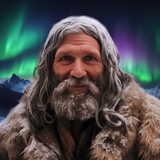
Artistic Reconstruction of a male of the Bronze Age Fatyanovo culture. They were the result of an early eastward migration of the Corded Ware after admixing with the Globular Amphora culture (from which their pottery shows influences). They are the earliest group to have y haplogroup R1a-Z93 which is common in modern Indo-Iranian speakers.
They lived in the forests of western Russia and had an economy of pastoralism however it was not as mobile as the Yamnaya. Weapons included the classic CWC stone axe but later also ones made of metal. Bears seemed to hold importance to them as some axes had the shape of a bear head carved into it along with ornaments made of bear claws and teeth. They later would develop the Abashevo culture which is the ancestor of the Sintashta and the Srubnaya.
They lived in the forests of western Russia and had an economy of pastoralism however it was not as mobile as the Yamnaya. Weapons included the classic CWC stone axe but later also ones made of metal. Bears seemed to hold importance to them as some axes had the shape of a bear head carved into it along with ornaments made of bear claws and teeth. They later would develop the Abashevo culture which is the ancestor of the Sintashta and the Srubnaya.
👍22❤10👎1😁1
Periodic qpAdm breakdowns of the Medieval Gaels of Kilteasheen, located in present-day Roscommon, Ireland 🇮🇪
👍27❤7
Forwarded from Stonelide
Genetic Breakdown of Evensås Man (NEO260)
~66% WHG
~34% EHG
The individual was directly dated to 4232–3982 cal BCE and 3963–3781 cal BCE (rescorr), placing him in the Early Neolithic. However, no indications of a Neolithic diet were observed in the isotope values.
He belonged to Y-Haplogroup I-Z26435 (I2a2a2a1~) and mt-Haplogroup R1b1.
Discovered in 1930 at Evensås, Skaftö 85, Bohuslän, Sweden. He was an adult male estimated to be 20–30 years old at the time of death.
❤18👍5