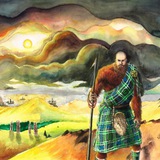
Failinis, a greyhound of great fame who never missed its prey, was invulnerable in battle, and could turn water into wine.
Even to this day, Lughasa (Lughnasadh), a harvest festival in Ireland, takes place on August 1st and is celebrated across Ireland, Scotland, and the Isle of Man. This date marks Lugh’s victory over the spirits of Tír na nÓg.
To celebrate his victory, Lugh blessed the early fruits of harvest and hosted games in memory of his foster-mother Tailtiu.
There are different versions of the stories of Lugh of the Long arm, but the differences do not lose value or meaning as they are passed down from parent to child and tribe to tribe.
Even to this day, Lughasa (Lughnasadh), a harvest festival in Ireland, takes place on August 1st and is celebrated across Ireland, Scotland, and the Isle of Man. This date marks Lugh’s victory over the spirits of Tír na nÓg.
To celebrate his victory, Lugh blessed the early fruits of harvest and hosted games in memory of his foster-mother Tailtiu.
There are different versions of the stories of Lugh of the Long arm, but the differences do not lose value or meaning as they are passed down from parent to child and tribe to tribe.
The Stirling Wolf legend, Scotland. Legend is told that in the 9th century, the town of Stirling was about to be raided by the invading Danes (vikings) under the cover of darkness. They stumbled upon a pack of wolves who began howling, alerting the town guard and saving the town.
Since we are approaching the end of March, which Gaelic Celtic gods or goddesses would you like us to discover?
Final Results
0%
The Daghda
40%
Cernunnos
40%
Morrigan
20%
Goibniu
0%
Nuada
0%
Ogma
Forwarded from Hyperborean Radio (Uncensored)
Today we played a game trying to place the gods in modern professions such as Venus as a Beautician, Tyr as a Mercenary, Chislobog as a coder, Saga as a Bartender, etc. As well as what gods would go with what professions the Muses and Athena show up a lot. This was a fun one enjoy! https://anchor.fm/heimdallrshome/episodes/A-Fun-Game-etgkcg
BC Neanderthal Mindset
Since we are approaching the end of March, which Gaelic Celtic gods or goddesses would you like us to discover?
A tie!! That is a win all around because we will be visiting both of these deities! Both Cernunnos and Morrigan.
Forwarded from Hyperborean Radio (Uncensored)
The Traveler and The Doctor: A Study of the Psychological Echoes of an Archetype
By The Antlered One
What is it that exists deep within our souls that causes us to explore? To wish to cross the endless ocean or the imposing mountains? The Wanderer in us all seeks to find the new things. To find the great cave of the dragon, to stop the hordes and be the hero of a far off land. When told the world is known, though a new discovery and adventure waits around every corner we look to the stars and dream of wandering the cosmos skimming nebulas and jumping from planet to planet. Just as long ago through realms and the wide woods of the North. The Traveling gods of Europe walked amongst us and at times found us beside them as companions on their next grand adventure. These stories, these emotions, this Wanderlust does not fade in a mere moment in history, it continues and when we are denied our gods we still need to feel them, and we are...............
Check out on:
https://www.subscribestar.com/posts/299545
By The Antlered One
What is it that exists deep within our souls that causes us to explore? To wish to cross the endless ocean or the imposing mountains? The Wanderer in us all seeks to find the new things. To find the great cave of the dragon, to stop the hordes and be the hero of a far off land. When told the world is known, though a new discovery and adventure waits around every corner we look to the stars and dream of wandering the cosmos skimming nebulas and jumping from planet to planet. Just as long ago through realms and the wide woods of the North. The Traveling gods of Europe walked amongst us and at times found us beside them as companions on their next grand adventure. These stories, these emotions, this Wanderlust does not fade in a mere moment in history, it continues and when we are denied our gods we still need to feel them, and we are...............
Check out on:
https://www.subscribestar.com/posts/299545
Mórrígan - The Phantom Queen
Known in the Celtic pantheon as the warrior queen of war, destiny, death, as well as rebirth, the Mórrígan is one of the most mysterious goddesses of the ancient Celts.
She interacts with mortal men and is often associated with the crow, as they can be seen in the aftermath of battles, feasting on the dead.
She wanders the battlefield, giving aid to those she favors and those she does not are cursed, collecting the souls of the slain. She both gives life and takes it away.
In the Cath Maige Tuired or 'Battle of Mag Tuired' (The Battle of Moytura), Mórrígan sleeps with the Daghda, the good god, with one foot on each bank of a mighty river and later promises to summon magicians of Ireland to assist the Tuatha De Danann in their war against the Fomorians. It is believed that on Samhain she and the Dagda would meet and make love.
Known in the Celtic pantheon as the warrior queen of war, destiny, death, as well as rebirth, the Mórrígan is one of the most mysterious goddesses of the ancient Celts.
She interacts with mortal men and is often associated with the crow, as they can be seen in the aftermath of battles, feasting on the dead.
She wanders the battlefield, giving aid to those she favors and those she does not are cursed, collecting the souls of the slain. She both gives life and takes it away.
In the Cath Maige Tuired or 'Battle of Mag Tuired' (The Battle of Moytura), Mórrígan sleeps with the Daghda, the good god, with one foot on each bank of a mighty river and later promises to summon magicians of Ireland to assist the Tuatha De Danann in their war against the Fomorians. It is believed that on Samhain she and the Dagda would meet and make love.
In the battle, the Mórrígan chants a poem that is so terrifying to the Fomorians that they are driven back into the sea.
In the Táin Bó Cúailnge or The Cattle Raid of Cooley, Cú Chulainn,, the Irish demigod, who is also alluded to as a son of Lugh, the warrior god, is promised aid while defending Ulster against the forces of Medb, the queen of Connacht, which he refuses.
In Cu Chulainn’s fatal scene, as he rides to meet his enemies he encounters the Morrígan as a hag washing his bloody armor in a ford.
This is an omen of his death.
In the Táin Bó Cúailnge or The Cattle Raid of Cooley, Cú Chulainn,, the Irish demigod, who is also alluded to as a son of Lugh, the warrior god, is promised aid while defending Ulster against the forces of Medb, the queen of Connacht, which he refuses.
In Cu Chulainn’s fatal scene, as he rides to meet his enemies he encounters the Morrígan as a hag washing his bloody armor in a ford.
This is an omen of his death.
As he is mortally wounded, Cú Chulainn, ties himself to a standing stone with his own entrails so he can die standing up, and only when a crow lands on his shoulder is it that his enemies believe he is dead.
The Mórrígan is the supreme example of the most brutal and primal that the feminine has to offer. Her vengeance and hatred have no equal, yet her love is all consuming. Gathering the souls of the fallen dead or aiding those in the fight, she roams the battlefield with a cold, caring eye.
Respect her, dear reader, and tread lightly should you have an inclination to get her attention, and be prepared for what that entails.
For she can be the most devoted lover or the most bitter and merciless of adversaries.
The Mórrígan is the supreme example of the most brutal and primal that the feminine has to offer. Her vengeance and hatred have no equal, yet her love is all consuming. Gathering the souls of the fallen dead or aiding those in the fight, she roams the battlefield with a cold, caring eye.
Respect her, dear reader, and tread lightly should you have an inclination to get her attention, and be prepared for what that entails.
For she can be the most devoted lover or the most bitter and merciless of adversaries.
Cernunnos - Wild Horned god of the wilderness
Widely believed to be the Celtic god of fertility, vegetation, wildlife, and the primal untamed wilderness, Cernunnos roams the wild with his antlers bumping against low hanging branches, surveying his kingdom.
He is lord of the hunt and protector of the wild, with all of its inhabitants.
Primarily associated with male animals and the masculine side of nature, he if often portrayed with a beard and feral, shaggy hair.
Widely believed to be the Celtic god of fertility, vegetation, wildlife, and the primal untamed wilderness, Cernunnos roams the wild with his antlers bumping against low hanging branches, surveying his kingdom.
He is lord of the hunt and protector of the wild, with all of its inhabitants.
Primarily associated with male animals and the masculine side of nature, he if often portrayed with a beard and feral, shaggy hair.
His name is found only once as he is mentioned in the Pillar of the Boatmen, a Roman column dating from the 1st century AD. This adds to the mystery of the horned god, and his persona, yet we can still imagine how he might be portrayed.
Interesting enough, small figurines attributed to him from the 7th through 4th century BC and 1st century BC, are found throughout different parts of western Europe. This points out to a theory that he is much more ancient than anticipated.
Interesting enough, small figurines attributed to him from the 7th through 4th century BC and 1st century BC, are found throughout different parts of western Europe. This points out to a theory that he is much more ancient than anticipated.
Through all this, we find that ancient Celts considered Cernunnos an important deity as they were also people who dwelt in and around wilderness areas. It was vital to their culture and everyday livelihood, unfortunately there are no recorded myths or literature that directly mention the figure of Cernunnos.
The mystery surrounding him resonates and mystifies us like the stag in its full glory, standing proud, looking down at a wilderness kingdom where he is its savage king.
No civilization to be found, only an ancient, primordial presence.
The mystery surrounding him resonates and mystifies us like the stag in its full glory, standing proud, looking down at a wilderness kingdom where he is its savage king.
No civilization to be found, only an ancient, primordial presence.
Forwarded from Hyperborean Radio (Uncensored)
April 1st is also the Holiday of Veneralia a day originally dedicated to Fortuna the Manly but later dedicated to Venus the Changer of hearts. It was a holiday meant to turn lustful feelings to one of love and procreation. A holiday celebrating the health of sexuality and hoping to dissuade and remove the more lustful and degenerate acts. Replacing them with the generate form of sex and procreation.
Forwarded from Hyperborean Radio (Uncensored)
Tomorrow is April Fool's Day. While at times the origins of this Holiday is said to be in the mockery of pagans by the Church. In it I find the spirit of the Trickster, that freedom that comes with skating the rules and letting loose. It is a day to remember the Trickster Gods and Spirits of Europe. As well as the many gifts that were given by them. Rubezahl gave us the spinning wheel and Sourdough, Hermes gave us the alphabet and lyre, Prometheus gave us fire, Loki gave the gifts and tools of the gods, Veles taught us magic, Puck aids in our daily life, etc. It is a day to make them laugh and to remind ourselves not to take things too seriously. So whether we call it April Fools , Puck's day, Loki's day or whatever we wish to call it take some time in that day to have a bit of fun.-TAO
Artio - Bear goddess of Spring
Revered among the Helvetii tribe, a people of Celtic descent living in the Swiss plateau, Artio is a relatively obscure deity that is associated with the renewal that Springtime brings. She might also be seen as a protector of bears, wildlife and fertility.
This is equally fascinating, knowing that bear females often give birth during hibernation and nurse their cubs in the den until spring arrives, emerging with new life!
Revered among the Helvetii tribe, a people of Celtic descent living in the Swiss plateau, Artio is a relatively obscure deity that is associated with the renewal that Springtime brings. She might also be seen as a protector of bears, wildlife and fertility.
This is equally fascinating, knowing that bear females often give birth during hibernation and nurse their cubs in the den until spring arrives, emerging with new life!