Bun's Lab
Photo
A lil' update on this thing: I've attempted an alignment. However, it needs help. The oscillation is generated using an RC timing circuit. The R values are selected with the digit dial at the front, the C using the frequency ranges.
The resistors there are within spec for what their respective bands call for, but the service manual says they are handpicked. And handpicked they have to be for this to be somewhat accurate. And they drifted enough for it to be woefully off. I can get at best 2 digits accuracy when it should give me 3.
The resistors there are within spec for what their respective bands call for, but the service manual says they are handpicked. And handpicked they have to be for this to be somewhat accurate. And they drifted enough for it to be woefully off. I can get at best 2 digits accuracy when it should give me 3.
0.1% resistors cost about 50 cents each. Means it would cost me north of 15€ to replace those resistors. Guess I will be buying 1% resistors instead, but 100 of each value and then grade them and pick the best ones to get the accuracy needed.
Bun's Lab
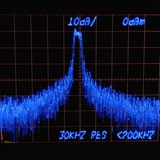
Fixed: Philips PM 3355 hybrid analog/digital oscilloscope. Data acquisition board suffered damage from leaking capacitors, including a broken trace that took some diagnosis and circuit analysis to find. Oh and the power supply was bad, too. Oscillating frequency…
You know, as cool as vintage test equipment is, it can be a real pain in the neck to keep running. That noise is internal to the scope. Guess the Philips THT electrolytics want replacing too now.
Bun's Lab
0.1% resistors cost about 50 cents each. Means it would cost me north of 15€ to replace those resistors. Guess I will be buying 1% resistors instead, but 100 of each value and then grade them and pick the best ones to get the accuracy needed.
There was some discussion if the distribution of the 1% parts should become bimodal when due to binning those parts that fall within the 0.1% spec are removed from the 1% percent population.
Did a little googling on that just now:
http://www.kerrywong.com/2013/02/01/100k-5-carbon-film-resistor-value-distribution/
"So clearly, these resistors were not binned as some of the examples we saw from other sources. One possible explanation is that the manufacturing costs for these carbon film resistors are so low, it actually would cost more to bin them based on value deviations. The manufacturing process is also mature enough to guarantee that the resistor values stay well within the desired tolerance intervals. "
More: https://lambdafox.com/resistor-tolerances/
Did a little googling on that just now:
http://www.kerrywong.com/2013/02/01/100k-5-carbon-film-resistor-value-distribution/
"So clearly, these resistors were not binned as some of the examples we saw from other sources. One possible explanation is that the manufacturing costs for these carbon film resistors are so low, it actually would cost more to bin them based on value deviations. The manufacturing process is also mature enough to guarantee that the resistor values stay well within the desired tolerance intervals. "
More: https://lambdafox.com/resistor-tolerances/
LambdaFox
Resistor Tolerances and Statistical Distribution Thereof
In this article we discuss the statistical distribution of 1% metal film and 5% carbon film resistors.
Bun's Lab
This is the board to the right with the oscillator for the SMPS.
We got the transistors!
Testing them by hand because the China tester struggles with them.
Testing them by hand because the China tester struggles with them.