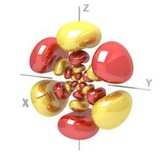
Chemist shows that intermolecular interactions can attain previously unknown dimensions
https://phys.org/news/2022-08-chemist-intermolecular-interactions-previously-unknown.html
https://phys.org/news/2022-08-chemist-intermolecular-interactions-previously-unknown.html
phys.org
Chemist shows that intermolecular interactions can attain previously unknown dimensions
Intermolecular interactions are the forces that pertain between molecules. In general, these interactions scarcely extend beyond the boundaries of molecules. For the most part, they are effective over ...
🔥3
Emerging DFT Methods and Their Importance for Challenging Molecular Systems with Orbital Degeneracy
https://www.mdpi.com/2079-3197/7/4/62/htm
https://www.mdpi.com/2079-3197/7/4/62/htm
MDPI
Emerging DFT Methods and Their Importance for Challenging Molecular Systems with Orbital Degeneracy
We briefly present some of the most modern and outstanding non-conventional density-functional theory (DFT) methods, which have largely broadened the field of applications with respect to more traditional calculations. The results of these ongoing efforts…
👍1
Open Access - Roadmap on Machine learning in electronic structure
In recent years, we have been witnessing a paradigm shift in computational materials science. In fact, traditional methods, mostly developed in the second half of the XXth century, are being complemented, extended, and sometimes even completely replaced by faster, simpler, and often more accurate approaches. The new approaches, that we collectively label by machine learning, have their origins in the fields of informatics and artificial intelligence, but are making rapid inroads in all other branches of science. With this in mind, this Roadmap article, consisting of multiple contributions from experts across the field, discusses the use of machine learning in materials science, and share perspectives on current and future challenges in problems as diverse as the prediction of materials properties, the construction of force-fields, the development of exchange correlation functionals for density-functional theory, the solution of the many-body problem, and more. In spite of the already numerous and exciting success stories, we are just at the beginning of a long path that will reshape materials science for the many challenges of the XXIth century.
https://iopscience.iop.org/article/10.1088/2516-1075/ac572f
In recent years, we have been witnessing a paradigm shift in computational materials science. In fact, traditional methods, mostly developed in the second half of the XXth century, are being complemented, extended, and sometimes even completely replaced by faster, simpler, and often more accurate approaches. The new approaches, that we collectively label by machine learning, have their origins in the fields of informatics and artificial intelligence, but are making rapid inroads in all other branches of science. With this in mind, this Roadmap article, consisting of multiple contributions from experts across the field, discusses the use of machine learning in materials science, and share perspectives on current and future challenges in problems as diverse as the prediction of materials properties, the construction of force-fields, the development of exchange correlation functionals for density-functional theory, the solution of the many-body problem, and more. In spite of the already numerous and exciting success stories, we are just at the beginning of a long path that will reshape materials science for the many challenges of the XXIth century.
https://iopscience.iop.org/article/10.1088/2516-1075/ac572f
👍4
Quantum Chemistry in the Age of Quantum Computing
Practical challenges in simulating quantum systems on classical computers have been widely recognized in the quantum physics and quantum chemistry communities over the past century. Although many approximation methods have been introduced, the complexity of quantum mechanics remains hard to appease. The advent of quantum computation brings new pathways to navigate this challenging and complex landscape. By manipulating quantum states of matter and taking advantage of their unique features such as superposition and entanglement, quantum computers promise to efficiently deliver accurate results for many important problems in quantum chemistry, such as the electronic structure of molecules. In the past two decades, significant advances have been made in developing algorithms and physical hardware for quantum computing, heralding a revolution in simulation of quantum systems. This Review provides an overview of the algorithms and results that are relevant for quantum chemistry. The intended audience is both quantum chemists who seek to learn more about quantum computing and quantum computing researchers who would like to explore applications in quantum chemistry.
https://pubs.acs.org/doi/10.1021/acs.chemrev.8b00803
Practical challenges in simulating quantum systems on classical computers have been widely recognized in the quantum physics and quantum chemistry communities over the past century. Although many approximation methods have been introduced, the complexity of quantum mechanics remains hard to appease. The advent of quantum computation brings new pathways to navigate this challenging and complex landscape. By manipulating quantum states of matter and taking advantage of their unique features such as superposition and entanglement, quantum computers promise to efficiently deliver accurate results for many important problems in quantum chemistry, such as the electronic structure of molecules. In the past two decades, significant advances have been made in developing algorithms and physical hardware for quantum computing, heralding a revolution in simulation of quantum systems. This Review provides an overview of the algorithms and results that are relevant for quantum chemistry. The intended audience is both quantum chemists who seek to learn more about quantum computing and quantum computing researchers who would like to explore applications in quantum chemistry.
https://pubs.acs.org/doi/10.1021/acs.chemrev.8b00803
Superheavy element flerovium is likely to be a liquid at room temperature | Research | Chemistry World
https://www.chemistryworld.com/news/superheavy-element-flerovium-is-likely-to-be-a-liquid-at-room-temperature/4016171.article
https://www.chemistryworld.com/news/superheavy-element-flerovium-is-likely-to-be-a-liquid-at-room-temperature/4016171.article
Chemistry World
Superheavy element flerovium is likely to be a liquid at room ...
Element 114 predicted to be a volatile semiconductor with a melting point around 10°C
Physicists discover new rule for orbital formation in chemical reactions
https://phys.org/news/2022-09-physicists-orbital-formation-chemical-reactions.html
https://phys.org/news/2022-09-physicists-orbital-formation-chemical-reactions.html
phys.org
Physicists discover new rule for orbital formation in chemical reactions
Squeaky, cloudy or spherical—electron orbitals show where and how electrons move around atomic nuclei and molecules. In modern chemistry and physics, they have proven to be a useful model for quantum ...
Google AI Blog: Digitizing Smell: Using Molecular Maps to Understand Odor
https://ai.googleblog.com/2022/09/digitizing-smell-using-molecular-maps.html?m=1
https://ai.googleblog.com/2022/09/digitizing-smell-using-molecular-maps.html?m=1
research.google
Digitizing Smell: Using Molecular Maps to Understand Odor
Posted by Richard C. Gerkin, Google Research, and Alexander B. Wiltschko, Google Did you ever try to measure a smell? …Until you can measure their ...
A Web Tool for Calculating Substituent Denoscriptors Compatible with Hammett Sigma Constants
—
The electron-donating and -accepting power of organic substituents is an important parameter affecting many properties of parent molecules, most notably their reactivity and pKa of ionisable groups. These substituent properties are described by Hammett σ constants obtained by measuring ionization constants of substituted benzoic acids. Although values of the Hammett σ constants have been measured for the most common functional groups, data for many important substituents are not available. In the present study, a method to calculate substituent denoscriptors compatible with the Hammett σ constants using quantum-chemically derived parameters is described. On this basis, a free web tool allowing to calculate electronic and hydrophobic substituent denoscriptors is made available at the link below:
https://peter-ertl.com/molecular/substituents/sigmas.html
Theory here: https://chemistry-europe.onlinelibrary.wiley.com/doi/10.1002/cmtd.202200041
—
The electron-donating and -accepting power of organic substituents is an important parameter affecting many properties of parent molecules, most notably their reactivity and pKa of ionisable groups. These substituent properties are described by Hammett σ constants obtained by measuring ionization constants of substituted benzoic acids. Although values of the Hammett σ constants have been measured for the most common functional groups, data for many important substituents are not available. In the present study, a method to calculate substituent denoscriptors compatible with the Hammett σ constants using quantum-chemically derived parameters is described. On this basis, a free web tool allowing to calculate electronic and hydrophobic substituent denoscriptors is made available at the link below:
https://peter-ertl.com/molecular/substituents/sigmas.html
Theory here: https://chemistry-europe.onlinelibrary.wiley.com/doi/10.1002/cmtd.202200041
👍2
Orbital Optimized Density Functional Theory for Electronic Excited States
—-
Is this a revolution for theoretical excited-state chemistry?
https://pubs.acs.org/doi/10.1021/acs.jpclett.1c00744
—-
Is this a revolution for theoretical excited-state chemistry?
https://pubs.acs.org/doi/10.1021/acs.jpclett.1c00744
To publish in academia is hard (and there is bias involved to make it harder)
—-
In a new study, the same paper as subjected to 534 reviewers. The name of the main author was changed to a novice scientist or to a high level (Nobel laureate) scientist. Depending just on the author’s name THE SAME paper was well reviewed (if the author is famous) or rejected if the author is not famous.
Preprint here: https://papers.ssrn.com/sol3/papers.cfm?abstract_id=4190976
—-
In a new study, the same paper as subjected to 534 reviewers. The name of the main author was changed to a novice scientist or to a high level (Nobel laureate) scientist. Depending just on the author’s name THE SAME paper was well reviewed (if the author is famous) or rejected if the author is not famous.
Preprint here: https://papers.ssrn.com/sol3/papers.cfm?abstract_id=4190976
Ssrn
Nobel and Novice: Author Prominence Affects Peer Review
Peer-review is a well-established cornerstone of the scientific process, yet it is not immune to status bias. Merton identified the problem as one in which prom
👍4😱4
Breakthrough reported in machine learning-enhanced quantum chemistry
https://phys.org/news/2022-09-breakthrough-machine-learning-enhanced-quantum-chemistry.html
https://phys.org/news/2022-09-breakthrough-machine-learning-enhanced-quantum-chemistry.html
phys.org
Breakthrough reported in machine learning-enhanced quantum chemistry
In a new study, published in Proceedings of the National Academy of Sciences, researchers from Los Alamos National Laboratory have proposed incorporating more of the mathematics of quantum mechanics into ...
👍2
2 PhD positions theoretical & computational chemistr/physics @ University of Parma
Topics:
(a) Theoretical and computational approaches to molecular functional materials for application in organic electronics (mainly OLED): photophysics and environmental effects
(b) Theoretical and computational approaches to Chiral Induced Spin Selectivity (CISS) effect
Background: Master degree in chemistry, or in physics or in material science (or similar)
Duration: 3 years
Estimate starting date: January, 1st 2023
Monthly fellowship ≈ 1150€
For information: cristina.sissa@unipr.it; anna.painelli@unipr.it
Topics:
(a) Theoretical and computational approaches to molecular functional materials for application in organic electronics (mainly OLED): photophysics and environmental effects
(b) Theoretical and computational approaches to Chiral Induced Spin Selectivity (CISS) effect
Background: Master degree in chemistry, or in physics or in material science (or similar)
Duration: 3 years
Estimate starting date: January, 1st 2023
Monthly fellowship ≈ 1150€
For information: cristina.sissa@unipr.it; anna.painelli@unipr.it
👍7
OPEN ACCESS
Best-Practice DFT Protocols for Basic Molecular Computational Chemistry
—
Many chemical investigations are supported by routine calculations of molecular structures, reaction energies, barrier heights, and spectroscopic properties. Most of these quantum-chemical calculations apply various combinations of DFT-based methods. This Scientific Perspective provides best-practice protocols and guidance in the choice of robust method combinations to deal with many day-to-day challenges in computational chemistry and discusses representative examples.
https://onlinelibrary.wiley.com/doi/10.1002/anie.202205735
Best-Practice DFT Protocols for Basic Molecular Computational Chemistry
—
Many chemical investigations are supported by routine calculations of molecular structures, reaction energies, barrier heights, and spectroscopic properties. Most of these quantum-chemical calculations apply various combinations of DFT-based methods. This Scientific Perspective provides best-practice protocols and guidance in the choice of robust method combinations to deal with many day-to-day challenges in computational chemistry and discusses representative examples.
https://onlinelibrary.wiley.com/doi/10.1002/anie.202205735
👍9
First organic magnesium electride is stable at room temperature | Research | Chemistry World
https://www.chemistryworld.com/news/first-organic-magnesium-electride-is-stable-at-room-temperature/4016043.article
https://www.chemistryworld.com/news/first-organic-magnesium-electride-is-stable-at-room-temperature/4016043.article
Chemistry World
First organic magnesium electride is stable at room temperature
Molecule has potential in redox reactions, as it's highly soluble in organic solvents and easily stored in a glovebox
👍2
Forwarded from Lets Learn Bio-IT School 🇫🇷🇮🇳
#workshop #virtual #genomics #beginner #level
Virtual workshop on Introduction to fundamentals and Bash Scripting for Genomics.
This two-day workshop focuses on the basics of genomics and using Linux for genomics. Further, It will provide concepts, and hands-on training on Linux commands noscripts and basics of genomics, such as designing experiments, accessing datasets from different databases, and data uploading to resources like NCBI.
🎙Our speakers, Dr. Meenakshi I (NCBS, India) & Dr.Samdani A (ICOA, France), carry Ph.D. degrees in Bioinformatics with rich of experience in Genomics.
✍️Who can apply?
Anyone interested in learning the basics of Linux and genomics study design and managing sequencing data. The workshop assumes that learners have no or little experience with Linux systems
✳️It is free for Undergraduate students.
👨💻For more info & registration, visit our site at https://www.nyberman.com/internship-trainings/workshop
📢«««««««
Channel @llbschool
Forum @letslearnbioinformatics
Virtual workshop on Introduction to fundamentals and Bash Scripting for Genomics.
This two-day workshop focuses on the basics of genomics and using Linux for genomics. Further, It will provide concepts, and hands-on training on Linux commands noscripts and basics of genomics, such as designing experiments, accessing datasets from different databases, and data uploading to resources like NCBI.
🎙Our speakers, Dr. Meenakshi I (NCBS, India) & Dr.Samdani A (ICOA, France), carry Ph.D. degrees in Bioinformatics with rich of experience in Genomics.
✍️Who can apply?
Anyone interested in learning the basics of Linux and genomics study design and managing sequencing data. The workshop assumes that learners have no or little experience with Linux systems
✳️It is free for Undergraduate students.
👨💻For more info & registration, visit our site at https://www.nyberman.com/internship-trainings/workshop
📢«««««««
Channel @llbschool
Forum @letslearnbioinformatics
👍1
Artificial intelligence reduces a 100,000-equation quantum physics problem to only four equations
https://phys.org/news/2022-09-artificial-intelligence-equation-quantum-physics.html
https://phys.org/news/2022-09-artificial-intelligence-equation-quantum-physics.html
phys.org
Artificial intelligence reduces a 100,000-equation quantum physics problem to only four equations
Using artificial intelligence, physicists have compressed a daunting quantum problem that until now required 100,000 equations into a bite-size task of as few as four equations—all without sacrificing ...
🔥2
Quantum developer tools for chemistry - Q# Blog
https://devblogs.microsoft.com/qsharp/quantum-developer-tools-for-chemistry/
https://devblogs.microsoft.com/qsharp/quantum-developer-tools-for-chemistry/
Q# Blog
Quantum developer tools for chemistry
Learn how to use Microsoft's Q# libraries and developer tools to simulate the exact quantum nature of chemical systems with quantum computing.
A collective effort for building DFT | Nature Computational Science
https://www.nature.com/articles/s43588-022-00294-1
https://www.nature.com/articles/s43588-022-00294-1
Nature
A collective effort for building DFT
Nature Computational Science - Dr Lu Sham, Distinguished Professor Emeritus of Physics at the University of California, San Diego, talks with Nature Computational Science about his current...
👍1
Scientist resolves one of the holy grails of physical chemistry after 17 years of research
https://phys.org/news/2022-09-scientist-holy-grails-physical-chemistry.html
https://phys.org/news/2022-09-scientist-holy-grails-physical-chemistry.html
phys.org
Scientist resolves one of the holy grails of physical chemistry after 17 years of research
Prof. Ehud Pines is an iconoclast. What else can you call a scientist who spent 17 years doggedly pursuing the solution to an over 200-year-old chemistry problem which he felt never received a satisfying ...
🔥2