👌🏻 https://www.quantamagazine.org/the-beautiful-intelligence-of-bacteria-and-other-microbes-20171113/
Quanta Magazine
Seeing the Beautiful Intelligence of Microbes
Bacterial biofilms and slime molds are more than crude patches of goo. Detailed time-lapse microscopy reveals how they sense and explore their surroundings, communicate with their neighbors and…
😱 http://www.bbc.com/news/av/technology-41935721/why-these-faces-do-not-belong-to-real-people
Jaakko Lehtinen's interview on BBC is about the generative adversarial networks (GANs). This technique can generate photographs that look authentic to human observers. See for more information
http://research.nvidia.com/publication/2017-10_Progressive-Growing-of
Jaakko Lehtinen's interview on BBC is about the generative adversarial networks (GANs). This technique can generate photographs that look authentic to human observers. See for more information
http://research.nvidia.com/publication/2017-10_Progressive-Growing-of
Bbc
Why these faces do not belong to 'real' people
Nvidia has been developing algorithms to generate photorealistic faces.
🐘 گویا فیلها کمتر از حد انتظار سرطان میگیرن:
https://www.wired.com/story/a-zombie-gene-protects-elephants-from-cancer/amp
https://www.wired.com/story/a-zombie-gene-protects-elephants-from-cancer/amp
WIRED
A Zombie Gene Protects Elephants From Cancer
Elephants did not evolve to become huge animals until after they turned a bit of genetic junk into a unique defense against inevitable tumors.
💊 مدلسازی ریاضی داروی ایدز:
https://sinews.siam.org/Details-Page/mathematically-modeling-hiv-drug-pharmacodynamics
https://sinews.siam.org/Details-Page/mathematically-modeling-hiv-drug-pharmacodynamics
Forwarded from رادیوفیزیک 📣
This media is not supported in your browser
VIEW IN TELEGRAM
شبیهسازی ۴۱ آونگ سهتایی که با شرایط اولیه تقریبا مشابهی رها میشوند ولی تحول متفاوتی دارند.
#آشوب #حساس_بودن_به_شرایط_اولیه
#آشوب #حساس_بودن_به_شرایط_اولیه
Forwarded from رادیوفیزیک 📣
Chaos, Complexity, and Entropy.pdf
1.7 MB
Forwarded from Deleted Account [SCAM]
This media is not supported in your browser
VIEW IN TELEGRAM
The mesmerizing dynamics of sheep moving in these impressive drone footage
🔖 Beyond the thermodynamic limit: finite-size corrections to state interconversion rates
Christopher T. Chubb, Marco Tomamichel, Kamil Korzekwa
🔗 http://arxiv.org/pdf/1711.01193.pdf
📌 ABSTRACT
Thermodynamics is traditionally constrained to the study of macroscopic systems whose energy fluctuations are negligible compared to their average energy. Here, we push beyond this thermodynamic limit by developing a mathematical framework to rigorously address the problem of thermodynamic transformations of finite-size systems. More formally, we analyse state interconversion under thermal operations and between arbitrary energy-incoherent states. We find precise relations between the optimal rate at which interconversion can take place and the desired infidelity of the final state when the system size is sufficiently large. These so-called second-order asymptotics provide a bridge between the extreme cases of single-shot thermodynamics and the asymptotic limit of infinitely large systems. We illustrate the utility of our results with several examples. We first show how thermodynamic cycles are affected by irreversibility due to finite-size effects. We then provide a precise expression for the gap between the distillable work and work of formation that opens away from the thermodynamic limit. Finally, we explain how the performance of a heat engine gets affected when one of the heat baths it operates between is finite. We find that while perfect work cannot generally be extracted at Carnot efficiency, there are conditions under which these finite-size effects vanish. In deriving our results we also clarify relations between different notions of approximate majorisation.
Christopher T. Chubb, Marco Tomamichel, Kamil Korzekwa
🔗 http://arxiv.org/pdf/1711.01193.pdf
📌 ABSTRACT
Thermodynamics is traditionally constrained to the study of macroscopic systems whose energy fluctuations are negligible compared to their average energy. Here, we push beyond this thermodynamic limit by developing a mathematical framework to rigorously address the problem of thermodynamic transformations of finite-size systems. More formally, we analyse state interconversion under thermal operations and between arbitrary energy-incoherent states. We find precise relations between the optimal rate at which interconversion can take place and the desired infidelity of the final state when the system size is sufficiently large. These so-called second-order asymptotics provide a bridge between the extreme cases of single-shot thermodynamics and the asymptotic limit of infinitely large systems. We illustrate the utility of our results with several examples. We first show how thermodynamic cycles are affected by irreversibility due to finite-size effects. We then provide a precise expression for the gap between the distillable work and work of formation that opens away from the thermodynamic limit. Finally, we explain how the performance of a heat engine gets affected when one of the heat baths it operates between is finite. We find that while perfect work cannot generally be extracted at Carnot efficiency, there are conditions under which these finite-size effects vanish. In deriving our results we also clarify relations between different notions of approximate majorisation.
🦋 When it comes to computation, biology is vastly more efficient than technology.
https://santafe.edu/news-center/news/astonishing-efficiency-life
https://santafe.edu/news-center/news/astonishing-efficiency-life
santafe.edu
The astonishing efficiency of life
<p>SFI researchers quantify the thermodynamic efficiency of a fundamental biological computation. </p>
The Conflict Between Complex Systems.pdf
109 KB
The Conflict Between Complex Systems and Reductionism
Frogs resolve computing issues
https://www.sciencedaily.com/releases/2015/10/151007111130.htm
https://www.sciencedaily.com/releases/2015/10/151007111130.htm
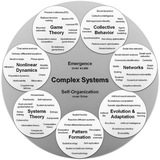
Complex Systems Studies
Frogs resolve computing issues https://www.sciencedaily.com/releases/2015/10/151007111130.htm
When male Japanese tree frogs sing at the same time, the females cannot differentiate between them in order to choose the best one. Therefore, the would-be suitors have come to an agreement and sing one by one. This natural lyrical desynchronisation has inspired the development of computational algorithms which can be used to design wireless systems and analyse social networks such as Facebook or Twitter.