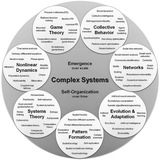
Complex Systems Studies
🎞 https://youtube.com/watch?feature=youtu.be&v=HOZiYYOZ1sE
Audio
imon DeDeo: From Atoms to Societies, Emergentism and Reductionism
we talk about the ways we can apply knowledge and mathematical models from Physics to the study of human social behavior ...
we talk about the ways we can apply knowledge and mathematical models from Physics to the study of human social behavior ...
New cheatsheet: how to deal with reviewers' comments! https://t.co/lilVsoxHey #phdchat
#سمینارهای_هفتگی مرکز شبکههای پیچیده و مردمشناسی دانشگاه شهید بهشتی
⏰ یکشنبه، ۲۵ آذر، ساعت ۱۶:۴۵
🏛 محل برگزاری: سالن ابن هیثم
@mhakim
⏰ یکشنبه، ۲۵ آذر، ساعت ۱۶:۴۵
🏛 محل برگزاری: سالن ابن هیثم
@mhakim
Forwarded from انجمن فیزیک ایران
روز فیزیک در دانشگاه قم
⏪ وبگاه انجمن فیزیک ایران:
🌍 http://www.psi.ir
✅ به کانال خبرى انجمن فیزیک ايران بپيوندید:
👇👇🏽👇👇🏽👇👇🏽👇
http://t.me/psinews
⏪ وبگاه انجمن فیزیک ایران:
🌍 http://www.psi.ir
✅ به کانال خبرى انجمن فیزیک ايران بپيوندید:
👇👇🏽👇👇🏽👇👇🏽👇
http://t.me/psinews
⭕️ #Hints:
Imagine you are watching a rocket take off nearby and measuring the distance it has traveled once each second. In the first couple of seconds your measurements may be accurate to the nearest centimeter, say. However, 5 minutes later as the rocket recedes into space, the accuracy of your measurements may only be good to 100 m, because of the increased distance, atmospheric distortion and a variety of other factors. The data you collect would exhibit (heteroscedasticity)[https://en.wikipedia.org/wiki/Heteroscedasticity].
In statistics, a collection of random variables is #heteroscedastic (or heteroskedastic;[a] from Ancient Greek hetero “different” and skedasis “dispersion”) if there are sub-populations that have different variabilities from others. Here "variability" could be quantified by the variance or any other measure of statistical dispersion. Thus heteroscedasticity is the absence of #homoscedasticity.
Imagine you are watching a rocket take off nearby and measuring the distance it has traveled once each second. In the first couple of seconds your measurements may be accurate to the nearest centimeter, say. However, 5 minutes later as the rocket recedes into space, the accuracy of your measurements may only be good to 100 m, because of the increased distance, atmospheric distortion and a variety of other factors. The data you collect would exhibit (heteroscedasticity)[https://en.wikipedia.org/wiki/Heteroscedasticity].
In statistics, a collection of random variables is #heteroscedastic (or heteroskedastic;[a] from Ancient Greek hetero “different” and skedasis “dispersion”) if there are sub-populations that have different variabilities from others. Here "variability" could be quantified by the variance or any other measure of statistical dispersion. Thus heteroscedasticity is the absence of #homoscedasticity.
Wikipedia
Homoscedasticity and heteroscedasticity
statistical property in which some subpopulations in a collection of random variables have different variabilities from others
The statistical mechanics of Twitter
Gavin Hall, William Bialek
https://arxiv.org/format/1812.07029
We build models for the distribution of social states in Twitter communities. States can be defined by the participation vs silence of individuals in conversations that surround key words, and we approximate the joint distribution of these binary variables using the maximum entropy principle, finding the least structured models that match the mean probability of individuals tweeting and their pairwise correlations. These models provide very accurate, quantitative denoscriptions of higher order structure in these social networks. The parameters of these models seem poised close to critical surfaces in the space of possible models, and we observe scaling behavior of the data under coarse-graining. These results suggest that simple models, grounded in statistical physics, may provide a useful point of view on the larger data sets now emerging from complex social systems.
Gavin Hall, William Bialek
https://arxiv.org/format/1812.07029
We build models for the distribution of social states in Twitter communities. States can be defined by the participation vs silence of individuals in conversations that surround key words, and we approximate the joint distribution of these binary variables using the maximum entropy principle, finding the least structured models that match the mean probability of individuals tweeting and their pairwise correlations. These models provide very accurate, quantitative denoscriptions of higher order structure in these social networks. The parameters of these models seem poised close to critical surfaces in the space of possible models, and we observe scaling behavior of the data under coarse-graining. These results suggest that simple models, grounded in statistical physics, may provide a useful point of view on the larger data sets now emerging from complex social systems.
Eternal fave, ⭐️ step-by-step w/ code:
"Static & dynamic network visualization w/ R" by @Ognyanova
https://t.co/C9H3pB6BOg #rstats #dataviz
"Static & dynamic network visualization w/ R" by @Ognyanova
https://t.co/C9H3pB6BOg #rstats #dataviz
🎞 Emergence and Minimal Models in Condensed Matter Physics and Biology
https://www.perimeterinstitute.ca/videos/emergence-and-minimal-models-condensed-matter-physics-and-biology
Nigel Goldenfeld
Abstract
Our ability to understand the physical world has to a large extent depended on the existence of emergent properties, and the separation of scales that permits effective field theory denoscriptions to be useful. Exploiting this fact, we can construct minimal models that enable efficient calculation of desired quantities, as long as they are insensitive to microscopic details. This works in many instances in physics, and I give some examples drawn from the kinetics of phase transitions mediated by topological defects. In other fields, such as biology, it is not so clear that these concepts are useful, and I will discuss to what extent emergence and effective theories might be useful.
https://www.perimeterinstitute.ca/videos/emergence-and-minimal-models-condensed-matter-physics-and-biology
Nigel Goldenfeld
Abstract
Our ability to understand the physical world has to a large extent depended on the existence of emergent properties, and the separation of scales that permits effective field theory denoscriptions to be useful. Exploiting this fact, we can construct minimal models that enable efficient calculation of desired quantities, as long as they are insensitive to microscopic details. This works in many instances in physics, and I give some examples drawn from the kinetics of phase transitions mediated by topological defects. In other fields, such as biology, it is not so clear that these concepts are useful, and I will discuss to what extent emergence and effective theories might be useful.
www.perimeterinstitute.ca
Emergence and Minimal Models in Condensed Matter Physics and Biology | Perimeter Institute
Our ability to understand the physical world has to a large extent depended on the existence of emergent properties, and the separation of scales that permits effective field theory denoscriptions to be useful. Exploiting this fact, we can construct minimal…
Complex Systems Studies
⭕️ https://www.quantamagazine.org/emergence-how-complex-wholes-emerge-from-simple-parts-20181220/
آپارات - سرویس اشتراک ویدیو
What Is Emergence?
How do extraordinarily complex emergent phenomena — like ants assembling themselves into living bridges, or tiny water and air molecules forming into swirling hurricanes — spontaneously arise from systems of much simpler elements? The answer often depends…
با سلام
نشست یکصدوشصتوچهارم باشگاه فیزیک تهران، ساعت ۱۷ روز دوشنبه 3 دیماه 1397، در سالن آمفی تئاتر دانشکده فیزیک دانشگاه تهران (انتهای خیابان کارگرشمالی، روبهروی کوچه نوزدهم) برگزار خواهد شد.
آقای دکتر غلامرضا جعفری، از دانشکده فیزیک دانشگاه شهید بهشتی در این باشگاه از «دادههای بزرگ، نظریه پیچیدگی و دوران پسامدرن» خواهند گفت. آقای علی فرنودی نیز در این باشگاه پرسش ماه را مطرح و خبر نشست را به آگاهی حاضران خواهند رساند.
مخاطبان این باشگاه، عموم علاقهمندان به فیزیک هستند. برای یادآوری به دوستان خود، با چاپ و نصب پوستر باشگاه در محل کار یا محل تحصیل خود، دیگر علاقهمندان فیزیک را آگاه کنید.
عضویت در #باشگاه_فیزیک و حضور در جلسات آن برای عموم علاقهمندان به علم فیزیک آزاد است.
با احترام
انجمن فیزیک ایران
نشست یکصدوشصتوچهارم باشگاه فیزیک تهران، ساعت ۱۷ روز دوشنبه 3 دیماه 1397، در سالن آمفی تئاتر دانشکده فیزیک دانشگاه تهران (انتهای خیابان کارگرشمالی، روبهروی کوچه نوزدهم) برگزار خواهد شد.
آقای دکتر غلامرضا جعفری، از دانشکده فیزیک دانشگاه شهید بهشتی در این باشگاه از «دادههای بزرگ، نظریه پیچیدگی و دوران پسامدرن» خواهند گفت. آقای علی فرنودی نیز در این باشگاه پرسش ماه را مطرح و خبر نشست را به آگاهی حاضران خواهند رساند.
مخاطبان این باشگاه، عموم علاقهمندان به فیزیک هستند. برای یادآوری به دوستان خود، با چاپ و نصب پوستر باشگاه در محل کار یا محل تحصیل خود، دیگر علاقهمندان فیزیک را آگاه کنید.
عضویت در #باشگاه_فیزیک و حضور در جلسات آن برای عموم علاقهمندان به علم فیزیک آزاد است.
با احترام
انجمن فیزیک ایران