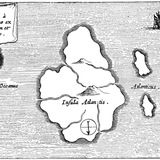
Library of Atlantis pinned «It appears that the earliest version of the Tripura myth ("three-city"; not to be confused with the real state of Tripura), appearing in the Krishna Yajurveda, does NOT have the different "citadels" of the city in different worlds, for example the highest…»
Library of Atlantis pinned «We find reference also to the "wealth of the Asuras which is to be won beyond the seven hills" Which reminded me of a curious reference to "seven metal mountains in the west" in the Book of Enoch, which are to be destroyed along with the fallen angels by a…»
Forwarded from Halls of the Hyperboreads
The following are some Telegram-based resources for e-books and other media in some very general topics we touch on. We cannot vouch for the general quality of their posts (frankly, some are rough) but you may find what you seek therein.
https://news.1rj.ru/str/+BPgAbgnBBD5hNDhk
https://news.1rj.ru/str/mythlib
https://news.1rj.ru/str/vault_of_secrets
https://news.1rj.ru/str/libraryofmagi
https://news.1rj.ru/str/BlackshirtLibrary
https://news.1rj.ru/str/jewflakeslibrary
https://news.1rj.ru/str/EsotericVault
https://news.1rj.ru/str/PoposLibrary
https://news.1rj.ru/str/hellenismbooksandresources
https://news.1rj.ru/str/OffTheGridOfficial
https://news.1rj.ru/str/datadistribution
https://news.1rj.ru/str/TheIntellectualAutist
https://news.1rj.ru/str/forbiddenbookclub
https://news.1rj.ru/str/RealBasedBooks
https://news.1rj.ru/str/Underground_University
If you know of other library/archive channels, please share so we may expand the list.
https://news.1rj.ru/str/+BPgAbgnBBD5hNDhk
https://news.1rj.ru/str/mythlib
https://news.1rj.ru/str/vault_of_secrets
https://news.1rj.ru/str/libraryofmagi
https://news.1rj.ru/str/BlackshirtLibrary
https://news.1rj.ru/str/jewflakeslibrary
https://news.1rj.ru/str/EsotericVault
https://news.1rj.ru/str/PoposLibrary
https://news.1rj.ru/str/hellenismbooksandresources
https://news.1rj.ru/str/OffTheGridOfficial
https://news.1rj.ru/str/datadistribution
https://news.1rj.ru/str/TheIntellectualAutist
https://news.1rj.ru/str/forbiddenbookclub
https://news.1rj.ru/str/RealBasedBooks
https://news.1rj.ru/str/Underground_University
If you know of other library/archive channels, please share so we may expand the list.
Telegram
The Cinnabar Library
First and foremost a library dedicated to the grathering, collection, and promotion of the works of Julius C. Evola, though by no means limited to this horizon.
Forwarded from Abraxas
"By killing the bull-- causing the precession of the equinoxes-- Mithras was in effect moving the entire universe. A god capable of performing such a tremendous deed would be eminently deserving of worship. Furthermore, the ability to move the cosmos would be seen as endowing Mithras with other powers as well, such as the ability to overcome the forces of fate residing in the stars and to guarantee the soul a safe passage through the planetary spheres after death.
Other Mithraic images indicate that Mithras was in fact believed to embody such cosmic power; there are scenes that show Mithras bearing on his shoulder the sphere of the universe or in which a youthful Mithras holds the cosmic sphere in one hand while with his other he rotates the zodiac. In several tauroctonies, the starry sky is shown contained beneath Mithras's cloak.
The status of Mithras as the motive force behind the precession of the equinox could also explain the secretive nature of the Mithraic mysteries. Adherents could well have believed that their knowledge constituted a powerful secret best kept to themselves and among selected initiates. For those chosen, an understanding of the complex astronomical structure underlying the nature of Mithras would have required a lengthy period of indoctrination. Only after acquiring the requisite knowledge could initiates properly appreciate this new god."
Other Mithraic images indicate that Mithras was in fact believed to embody such cosmic power; there are scenes that show Mithras bearing on his shoulder the sphere of the universe or in which a youthful Mithras holds the cosmic sphere in one hand while with his other he rotates the zodiac. In several tauroctonies, the starry sky is shown contained beneath Mithras's cloak.
The status of Mithras as the motive force behind the precession of the equinox could also explain the secretive nature of the Mithraic mysteries. Adherents could well have believed that their knowledge constituted a powerful secret best kept to themselves and among selected initiates. For those chosen, an understanding of the complex astronomical structure underlying the nature of Mithras would have required a lengthy period of indoctrination. Only after acquiring the requisite knowledge could initiates properly appreciate this new god."
Forwarded from T e c h n o s c i e n c e
Illustrations from "THE PHOENICIAN ORIGIN OF THE BRITONS, SCOTS & ANGLO-SAXONS" by L.A. Waddell
Forwarded from Spectral Valkyrie
The_Phoenician_Origin_of_Britons.pdf
14.1 MB
Forwarded from lady ⊱Âriyana🪽Anahita~Mazda
While Akhenaten of Egypt (14th century BCE) is often called the "first monotheist" because he promoted exclusive worship of Aten, the sun disk, his reforms were short-lived, politically enforced, and quickly reversed after his death. Atenism had no sacred noscripture, no moral code, no priesthood independent of the pharaoh, and it completely disappeared once Akhenaten died. There was no enduring tradition, no cultural transmission, and no spiritual legacy — not even his own son, Tutankhamun, continued it.
In contrast, Zarathustra (Zoroaster) in ancient Iran, likely between 1700–1200 BCE, taught a system based on Ahura Mazda, the one eternal, all-good Creator. This faith wasn’t about exclusive worship of a thing like the sun; it was a full-blown ethical monotheism. He introduced a moral cosmology, the eternal struggle between good (Asha) and evil (Druj), the importance of free will, the concept of heaven and hell, final judgment, and a savior figure (Saoshyant). His teachings were preserved in sacred texts — the Gathas, part of the Avesta — and this system not only endured but shaped three major world religions: Judaism, Christianity, and Islam.
Even after invasions and regime changes, Zoroastrianism persisted for over a thousand years as the state religion of major empires like the Achaemenids, Parthians, and Sasanians. Many core ideas from Zarathustra — such as angels, Satan, apocalypse, resurrection, and heaven/hell — were transferred into Abrahamic religions after the Babylonian Exile.
So, while Akhenaten may have had a monotheistic experiment, Zarathustra's Iran had the first successful, noscripturally preserved, morally rich, and enduring monotheism in history. The legacy of Zoroastrianism still echoes in religious, ethical, and philosophical systems across the world — something Atenism never achieved.
In contrast, Zarathustra (Zoroaster) in ancient Iran, likely between 1700–1200 BCE, taught a system based on Ahura Mazda, the one eternal, all-good Creator. This faith wasn’t about exclusive worship of a thing like the sun; it was a full-blown ethical monotheism. He introduced a moral cosmology, the eternal struggle between good (Asha) and evil (Druj), the importance of free will, the concept of heaven and hell, final judgment, and a savior figure (Saoshyant). His teachings were preserved in sacred texts — the Gathas, part of the Avesta — and this system not only endured but shaped three major world religions: Judaism, Christianity, and Islam.
Even after invasions and regime changes, Zoroastrianism persisted for over a thousand years as the state religion of major empires like the Achaemenids, Parthians, and Sasanians. Many core ideas from Zarathustra — such as angels, Satan, apocalypse, resurrection, and heaven/hell — were transferred into Abrahamic religions after the Babylonian Exile.
So, while Akhenaten may have had a monotheistic experiment, Zarathustra's Iran had the first successful, noscripturally preserved, morally rich, and enduring monotheism in history. The legacy of Zoroastrianism still echoes in religious, ethical, and philosophical systems across the world — something Atenism never achieved.
✍2
Forwarded from lady ⊱Âriyana🪽Anahita~Mazda
Achaemenid Silver Coin from the Fifth Century BC
Following Cyrus the Great's victory over Croesus in 546 BC, he embraced Lydia's most significant innovation: coinage.
The Achaemenid silver coin, often referred to as "stater," typically weighed around 8.4 grams and was made of high-purity silver. These coins were stamped with intricate designs, usually depicting a king or deity on one side and various symbols or animals on the other, which represented the empire's power and divine right to rule. The use of standardized coinage facilitated trade and economic integration within the vast territories of the Achaemenid Empire, which extended from the Indus Valley in the east to the Mediterranean in the west. The coins not only facilitated economic transactions but also served as a means of asserting the empire's authority and unity among diverse cultures and regions.
Following Cyrus the Great's victory over Croesus in 546 BC, he embraced Lydia's most significant innovation: coinage.
The Achaemenid silver coin, often referred to as "stater," typically weighed around 8.4 grams and was made of high-purity silver. These coins were stamped with intricate designs, usually depicting a king or deity on one side and various symbols or animals on the other, which represented the empire's power and divine right to rule. The use of standardized coinage facilitated trade and economic integration within the vast territories of the Achaemenid Empire, which extended from the Indus Valley in the east to the Mediterranean in the west. The coins not only facilitated economic transactions but also served as a means of asserting the empire's authority and unity among diverse cultures and regions.
Forwarded from lady ⊱Âriyana🪽Anahita~Mazda
Chogha Zanbil Ziggurat , Susa, Iran.
Chogha Zanbil Ziggurat is one of the most remarkable architectural achievements of the ancient world. Located in the Khuzestan province of southwestern Iran, near the ancient city of Susa, it stands as one of the few remaining examples of Elamite ziggurats — and is the best-preserved ziggurat outside Mesopotamia.
🔹 Key Facts:
Built by: Untash-Napirisha, Elamite king
Construction began: Around 1250 BCE
Original purpose: Religious complex dedicated to the god Inshushinak, patron deity of Susa
Structure type: Ziggurat — a terraced step-pyramid made of mud brick and baked brick
Original height: Estimated at 52 meters, currently about 25 meters
UNESCO World Heritage Site: Since 1979
🔹 Architectural Features:
The ziggurat has a square base (roughly 105 meters on each side).
Constructed in five receding levels, though today only two and a half remain.
Built using millions of mud bricks, with an exterior layer of baked bricks inscribed with cuneiform.
Surrounded by three concentric walls forming a large sacred complex.
Temples, altars, and a water management system (cisterns, drainage) were included in the broader complex.
🔹 Cultural Significance:
Chogha Zanbil reflects the fusion of Elamite and Mesopotamian religious practices.
The structure was never completed—possibly due to the death of the king or invasion.
It is among the earliest known examples of large-scale planned urban development in Iran.
Chogha Zanbil Ziggurat is one of the most remarkable architectural achievements of the ancient world. Located in the Khuzestan province of southwestern Iran, near the ancient city of Susa, it stands as one of the few remaining examples of Elamite ziggurats — and is the best-preserved ziggurat outside Mesopotamia.
🔹 Key Facts:
Built by: Untash-Napirisha, Elamite king
Construction began: Around 1250 BCE
Original purpose: Religious complex dedicated to the god Inshushinak, patron deity of Susa
Structure type: Ziggurat — a terraced step-pyramid made of mud brick and baked brick
Original height: Estimated at 52 meters, currently about 25 meters
UNESCO World Heritage Site: Since 1979
🔹 Architectural Features:
The ziggurat has a square base (roughly 105 meters on each side).
Constructed in five receding levels, though today only two and a half remain.
Built using millions of mud bricks, with an exterior layer of baked bricks inscribed with cuneiform.
Surrounded by three concentric walls forming a large sacred complex.
Temples, altars, and a water management system (cisterns, drainage) were included in the broader complex.
🔹 Cultural Significance:
Chogha Zanbil reflects the fusion of Elamite and Mesopotamian religious practices.
The structure was never completed—possibly due to the death of the king or invasion.
It is among the earliest known examples of large-scale planned urban development in Iran.
Forwarded from lady ⊱Âriyana🪽Anahita~Mazda
This striking rock relief depicts a meeting between two powerful figures: on the left, a Sasanian king—likely Ardashir I or Shapur I—adorned in elaborate royal attire and a distinctive crenellated crown, and on the right, a bearded, muscular man often identified as the Greco-Roman hero Heracles or the Iranian deity Verethragna, shown nude with a lion skin and club. Their handshake symbolizes diplomacy, alliance, or the fusion of cultural ideals, particularly strength and legitimacy. Carved in high relief, the composition bridges classical and Persian traditions, projecting the authority of the Sasanian ruler through mythical or heroic association.
Carved stone head from El Juyo, north Spain, dating to circa 12,000 BCE, contemporaneous with the Magdalenian III culture
https://www.google.com/amp/s/www.upi.com/amp/Archives/1981/11/28/A-cave-in-northern-Spain-has-yielded-what-scientists/7039375771600/
https://www.paleolithicartmagazine.org/pagina33.html
https://www.google.com/amp/s/www.upi.com/amp/Archives/1981/11/28/A-cave-in-northern-Spain-has-yielded-what-scientists/7039375771600/
https://www.paleolithicartmagazine.org/pagina33.html