When Imam Bukhari was 3 years of age, he lost his eyesight.
His mother promised herself that she would pray #tahajjud salah until Allah restores her son's eyesight back.
And that's exactly what she did. She prayed tahajjud every night until one night in a dream she saw Ibrahim (as) give her the good news that Imam Bukhari's eyesight had been restored. She ran to her son and when he awoke, he found himself with vision again.
Lessons for me: This mother didn't go into a state of helplessness after her young child lost his eyesight. Being a single mother, she didn't lose hope and become disheartened with the difficulty she would have to face with bringing up a son with a disability. She knew very well the power of dua. She knew the beauty that lies in praying tahajjud salah. She knew Allah comes down to the lowest heaven asking his servants to make dua to Him at this time. Her taqwa, her conviction in the Might of Allah is what led her to consistently pray. To pray tahajjud salah means you sacrifice your sleep. But she did it without fail. It wasn't a "sacrifice" on her behalf but a most needed task.
When we read about the life of Imam Bukhari or know what his contribution to Islamic history and education is, how can we not look back at the household he grew up in. The mother that raised him. The mother that made dua for him in the darkness of the night.
A widow, a single mother. But she had a wealth many of us fail to embrace. She devoted herself as a slave.
These women are our role models. These women are who we look up to. Not because we know how pretty or amazing they were in looks. But because in the face of tests, they remained close to Allah. With a history filled with women who brought up men like Imam Bukhari and others, how can we feel demotivated when it comes to our own children.
If we want good for our children, and see them grow up to be good slaves, we need to take the necessary steps to become a good slave too.
This reminder about this mother's dua came at such a perfect and apt time for me. A time when I've become extremely worried about my children. This reminded me that dua is no small thing.
His mother promised herself that she would pray #tahajjud salah until Allah restores her son's eyesight back.
And that's exactly what she did. She prayed tahajjud every night until one night in a dream she saw Ibrahim (as) give her the good news that Imam Bukhari's eyesight had been restored. She ran to her son and when he awoke, he found himself with vision again.
Lessons for me: This mother didn't go into a state of helplessness after her young child lost his eyesight. Being a single mother, she didn't lose hope and become disheartened with the difficulty she would have to face with bringing up a son with a disability. She knew very well the power of dua. She knew the beauty that lies in praying tahajjud salah. She knew Allah comes down to the lowest heaven asking his servants to make dua to Him at this time. Her taqwa, her conviction in the Might of Allah is what led her to consistently pray. To pray tahajjud salah means you sacrifice your sleep. But she did it without fail. It wasn't a "sacrifice" on her behalf but a most needed task.
When we read about the life of Imam Bukhari or know what his contribution to Islamic history and education is, how can we not look back at the household he grew up in. The mother that raised him. The mother that made dua for him in the darkness of the night.
A widow, a single mother. But she had a wealth many of us fail to embrace. She devoted herself as a slave.
These women are our role models. These women are who we look up to. Not because we know how pretty or amazing they were in looks. But because in the face of tests, they remained close to Allah. With a history filled with women who brought up men like Imam Bukhari and others, how can we feel demotivated when it comes to our own children.
If we want good for our children, and see them grow up to be good slaves, we need to take the necessary steps to become a good slave too.
This reminder about this mother's dua came at such a perfect and apt time for me. A time when I've become extremely worried about my children. This reminded me that dua is no small thing.
👍22
:) :) :)
Lovely message
*❤ Parents expectation from their child?*
____
*Mother:*
I fought with death when I was giving birth to you. I spent sleepless nights when you were sick and crying. I never ate without feeding you first. I bore so many pains to bring you to the stage that you are in today. _How will you repay me my child_?
*Child:*
When I grow up, I will find a good job and earn lots of money for you so you can enjoy the pleasures of this world.
*Mother:*
Your father is doing this already and I do not expect this from you too. By the time you are earning I will be old and will not be in need of any worldly luxuries.
*Son:*
I will find a pious lady and marry her so she can cook for you and take care of you.
*Mother:*
That is not her duty my son and neither should you marry for that reason. It is not compulsory on her to do any service to me, neither do I expect this from her. Your marriage should be for you, a companion and a comfort for you as you go through this journey of life.
*Child:*
Tell me mother how can I repay you then?
*Mother:*
(With tears in her eyes) Visit or call me often. A mother only requires this much from you while she is alive.
Then when I die give me your shoulder and bury me.
Whenever you perform prayers, supplicate for me.
Give out in charity for me.
Remember your every good deed will benefit me in the hereafter so be good and kind always.
Fulfill the rights of all those around you.
_The sleepless nights and pains I took to bring you up was not a favour to you but was for my creator. He blessed me with you as a beautiful gift and as a means for me to attain His pleasure. Your every good deed becomes my repayment._
Will you do it my child...?
*Child*: (Cannot speak and had tears in his eyes)
_Beautiful message for all the amazing Mothers out there._
https://news.1rj.ru/str/MuslimChildrenTips
Lovely message
*❤ Parents expectation from their child?*
____
*Mother:*
I fought with death when I was giving birth to you. I spent sleepless nights when you were sick and crying. I never ate without feeding you first. I bore so many pains to bring you to the stage that you are in today. _How will you repay me my child_?
*Child:*
When I grow up, I will find a good job and earn lots of money for you so you can enjoy the pleasures of this world.
*Mother:*
Your father is doing this already and I do not expect this from you too. By the time you are earning I will be old and will not be in need of any worldly luxuries.
*Son:*
I will find a pious lady and marry her so she can cook for you and take care of you.
*Mother:*
That is not her duty my son and neither should you marry for that reason. It is not compulsory on her to do any service to me, neither do I expect this from her. Your marriage should be for you, a companion and a comfort for you as you go through this journey of life.
*Child:*
Tell me mother how can I repay you then?
*Mother:*
(With tears in her eyes) Visit or call me often. A mother only requires this much from you while she is alive.
Then when I die give me your shoulder and bury me.
Whenever you perform prayers, supplicate for me.
Give out in charity for me.
Remember your every good deed will benefit me in the hereafter so be good and kind always.
Fulfill the rights of all those around you.
_The sleepless nights and pains I took to bring you up was not a favour to you but was for my creator. He blessed me with you as a beautiful gift and as a means for me to attain His pleasure. Your every good deed becomes my repayment._
Will you do it my child...?
*Child*: (Cannot speak and had tears in his eyes)
_Beautiful message for all the amazing Mothers out there._
https://news.1rj.ru/str/MuslimChildrenTips
👍18
One of the signs that a parent loves his child is that he makes sure that his child is getting proper education. So, he enrolls him in school/college, pays for his tuition fees, and provides for him with every amenity to make his life easier. But what does the son do? He squanders, wastes precious time and resources, and misses out on the opportunities that he received to excel in life.
And to Allaah belongs the highest examples.
The sign that Allaah loves us and cares for us is that He تعالى guided us towards Islaam, and He تعالى provided all the good things, like Salaah, Zakaah, Siyaam, Hajj, for our benefit in this life.
Now, it is up to us to use this opportunity and be successful in this world by being obedient to Him and worshiping Him alone, so that we get to the Jannah, or we squander this opportunity and suffer miserably in Hell.
🌴🌴🌴
Remember, if we fail, we still get opportunities in life to make amends. But when death approaches, then all the opportunities are gone. That is a regret that will not benefit. And when they see the suffering that awaits them, they will all be unable to express the full depth of their remorse. Rather, the people of Hell will try to conceal their regrets from each other.
Allaah تعالى says:
وَأَسَرُّوا النَّدَامَةَ لَمَّا رَأَوُا الْعَذَابَ
{And each of them will conceal their own regrets (for disobeying Allaah during this worldly life)}
📚[Surah Saba (34):33]
And to Allaah belongs the highest examples.
The sign that Allaah loves us and cares for us is that He تعالى guided us towards Islaam, and He تعالى provided all the good things, like Salaah, Zakaah, Siyaam, Hajj, for our benefit in this life.
Now, it is up to us to use this opportunity and be successful in this world by being obedient to Him and worshiping Him alone, so that we get to the Jannah, or we squander this opportunity and suffer miserably in Hell.
🌴🌴🌴
Remember, if we fail, we still get opportunities in life to make amends. But when death approaches, then all the opportunities are gone. That is a regret that will not benefit. And when they see the suffering that awaits them, they will all be unable to express the full depth of their remorse. Rather, the people of Hell will try to conceal their regrets from each other.
Allaah تعالى says:
وَأَسَرُّوا النَّدَامَةَ لَمَّا رَأَوُا الْعَذَابَ
{And each of them will conceal their own regrets (for disobeying Allaah during this worldly life)}
📚[Surah Saba (34):33]
👍10
Ibn ‘Umar, [may Allāh be pleased with him and his father], said:
“O’ you there! Teach and guide your son in cultivating good manners because, as a parent, you hold a responsibility for him, and in turn, he bears the responsibility of reflecting your kindness.”
Mawsū‘ah ibn Abi ad-Dunyah, 8/78 | Al-Imam ibn Abi Dunyah, [may Allāh bestow mercy upon him].
“O’ you there! Teach and guide your son in cultivating good manners because, as a parent, you hold a responsibility for him, and in turn, he bears the responsibility of reflecting your kindness.”
Mawsū‘ah ibn Abi ad-Dunyah, 8/78 | Al-Imam ibn Abi Dunyah, [may Allāh bestow mercy upon him].
👍11💯1
💎 Better to Us Than Our Own Parents 💎
The shaikh, Dr. ʿAbdullāh Al-Bukhārī, may Allāh protect him, said: “It has been established from Imam Al-Bukhārī that he conveyed from one of his companions his having said:
Ḥammād ibn Salamah visited Sufyān Al-Thawrī. Sufyān then said: “O Abā Salamah, do you think Allāh will forgive the likes of me?”
Ḥammād then said: “By Allāh, if I were to be given a choice between Allāh holding me to account and my parents holding me to account, I would pick being held to account by Allāh over being held to account by my parents, and that is [because] Allāh the All-High is kinder and more merciful to me than my [own] parents.”
Al-Ḥilyah, vol. 6, p. 251.
Source: twitter.com/dr_albukhary. 27 Nov 22.
https://tasfiyah.com/better-to-us-than-our-own-parents/
The shaikh, Dr. ʿAbdullāh Al-Bukhārī, may Allāh protect him, said: “It has been established from Imam Al-Bukhārī that he conveyed from one of his companions his having said:
Ḥammād ibn Salamah visited Sufyān Al-Thawrī. Sufyān then said: “O Abā Salamah, do you think Allāh will forgive the likes of me?”
Ḥammād then said: “By Allāh, if I were to be given a choice between Allāh holding me to account and my parents holding me to account, I would pick being held to account by Allāh over being held to account by my parents, and that is [because] Allāh the All-High is kinder and more merciful to me than my [own] parents.”
Al-Ḥilyah, vol. 6, p. 251.
Source: twitter.com/dr_albukhary. 27 Nov 22.
https://tasfiyah.com/better-to-us-than-our-own-parents/
👍7
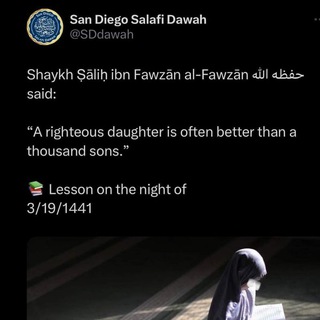
𝐋𝐨𝐯𝐞 𝐟𝐨𝐫 𝐃𝐚𝐮𝐠𝐡𝐭𝐞𝐫𝐬 𝐀𝐦𝐨𝐧𝐠 𝐭𝐡𝐞 𝐂𝐨𝐦𝐩𝐚𝐧𝐢𝐨𝐧𝐬
"The daughter of ʿAbd Allāh ibn Masʿūd رضي الله عنه came running, a young girl, so he hugged her to his chest, then kissed her, saying:
'Welcome, O protection of ʿAbd Allāh from the Fire.'"
📚 Makārim al Akhlaq, al Kharāiṭṭī 634
A beautiful example in this noble companion: that we shouldn’t see children as burdens, especially daughters, but rather as reasons to be saved from the hellfire. Because if we raised them correctly, we will be rewarded, and when we die, they’ll make Dua for us, as the Prophet ﷺ said:
إِذَا مَاتَ اَلْإِنْسَانُ اِنْقَطَعَ عَنْهُ عَمَلُهُ إِلَّا مِنْ ثَلَاثٍ: صَدَقَةٍ جَارِيَةٍ، أَوْ عِلْمٍ يُنْتَفَعُ بِهِ، أَوْ وَلَدٍ صَالَحٍ يَدْعُو لَهُ.
"When a person dies, their deeds come to an end except for three: ongoing charity, beneficial knowledge, 𝒐𝒓 𝒂 𝒓𝒊𝒈𝒉𝒕𝒆𝒐𝒖𝒔 𝒄𝒉𝒊𝒍𝒅 𝒘𝒉𝒐 𝒑𝒓𝒂𝒚𝒔 𝒇𝒐𝒓 𝒕𝒉𝒆𝒎."
📚 Narrated by Muslim.
And the Prophet ﷺ said about daughters specifically:
مَنْ عَالَ جَارِيَتَيْنِ حَتَّى تَبْلُغَا جَاءَ يَوْمَ الْقِيَامَةِ أَنَا وَهُوَ كَهَاتَيْنِ وَضَمَّ أَصَابِعَهُ.
"Whoever supports two girls till they attain maturity, he and I will come on the Day of Resurrection like this." Messenger of Allah ﷺ then joined his fingers, illustrating this.
📚 Narrated by Muslim.
Our daughters, if raised right, will be means of obtaining Paradise and avoiding the Hellfire. We should love them and cherish them.
https://x.com/sddawah/status/1781675761625346187?s=46
"The daughter of ʿAbd Allāh ibn Masʿūd رضي الله عنه came running, a young girl, so he hugged her to his chest, then kissed her, saying:
'Welcome, O protection of ʿAbd Allāh from the Fire.'"
📚 Makārim al Akhlaq, al Kharāiṭṭī 634
A beautiful example in this noble companion: that we shouldn’t see children as burdens, especially daughters, but rather as reasons to be saved from the hellfire. Because if we raised them correctly, we will be rewarded, and when we die, they’ll make Dua for us, as the Prophet ﷺ said:
إِذَا مَاتَ اَلْإِنْسَانُ اِنْقَطَعَ عَنْهُ عَمَلُهُ إِلَّا مِنْ ثَلَاثٍ: صَدَقَةٍ جَارِيَةٍ، أَوْ عِلْمٍ يُنْتَفَعُ بِهِ، أَوْ وَلَدٍ صَالَحٍ يَدْعُو لَهُ.
"When a person dies, their deeds come to an end except for three: ongoing charity, beneficial knowledge, 𝒐𝒓 𝒂 𝒓𝒊𝒈𝒉𝒕𝒆𝒐𝒖𝒔 𝒄𝒉𝒊𝒍𝒅 𝒘𝒉𝒐 𝒑𝒓𝒂𝒚𝒔 𝒇𝒐𝒓 𝒕𝒉𝒆𝒎."
📚 Narrated by Muslim.
And the Prophet ﷺ said about daughters specifically:
مَنْ عَالَ جَارِيَتَيْنِ حَتَّى تَبْلُغَا جَاءَ يَوْمَ الْقِيَامَةِ أَنَا وَهُوَ كَهَاتَيْنِ وَضَمَّ أَصَابِعَهُ.
"Whoever supports two girls till they attain maturity, he and I will come on the Day of Resurrection like this." Messenger of Allah ﷺ then joined his fingers, illustrating this.
📚 Narrated by Muslim.
Our daughters, if raised right, will be means of obtaining Paradise and avoiding the Hellfire. We should love them and cherish them.
https://x.com/sddawah/status/1781675761625346187?s=46
X (formerly Twitter)
San Diego Salafi Dawah (@SDdawah) on X
𝐋𝐨𝐯𝐞 𝐟𝐨𝐫 𝐃𝐚𝐮𝐠𝐡𝐭𝐞𝐫𝐬 𝐀𝐦𝐨𝐧𝐠 𝐭𝐡𝐞 𝐂𝐨𝐦𝐩𝐚𝐧𝐢𝐨𝐧𝐬
"The daughter of ʿAbd Allāh ibn Masʿūd رضي الله عنه came running, a young girl, so he hugged her to his chest, then kissed her, saying:
'Welcome, O protection of ʿAbd Allāh from the Fire.'"
📚 Makārim
"The daughter of ʿAbd Allāh ibn Masʿūd رضي الله عنه came running, a young girl, so he hugged her to his chest, then kissed her, saying:
'Welcome, O protection of ʿAbd Allāh from the Fire.'"
📚 Makārim
👍6
YOUR PARENTS...
The great Imaam, Muhammad bin al-Munkadir (d.130AH) رحمه الله said:
"My brother 'Umar spent the night in prayer (i.e. the tahajjud Salah) and I spent the night massaging my mother's feet, and I would NOT exchange my night with his night."
[Siyar 'Alaam an-Nubala 5/359]
An advice especially to our young, who are still living at home and not married. Make the most of your time with your parents, in being good to them and being at their service. When you start working, get married and have children إن شاء الله, you won't have the same opportunity and free time as you used to.
@MarkazMuaadh
The great Imaam, Muhammad bin al-Munkadir (d.130AH) رحمه الله said:
"My brother 'Umar spent the night in prayer (i.e. the tahajjud Salah) and I spent the night massaging my mother's feet, and I would NOT exchange my night with his night."
[Siyar 'Alaam an-Nubala 5/359]
An advice especially to our young, who are still living at home and not married. Make the most of your time with your parents, in being good to them and being at their service. When you start working, get married and have children إن شاء الله, you won't have the same opportunity and free time as you used to.
@MarkazMuaadh
👍32👎1
ARE YOUR PARENTS YOUR RESPONSIBILITY?
A few days ago, someone tweeted on X that your parents are not your responsibility. The tweet generated so much debates and reactions among fellow users. Some users agreed with the tweet, and some opposed it. Those who opposed it argued from religious and moral perspectives.
Some of those who agreed with the tweet submitted that it was the choice of the parents to birth their children, hence it becomes their responsibility to raise them. However, the children are not required to reciprocate the gesture because they never asked for it in the first place.
As Muslims, our thoughts and actions must always be guided by the dictates of the Sharī'ah and not by those of our whims. Some of the comments I read from supposed Muslims on the matter is disappointing and heartbreaking to say the least. So, if we all agree that the dictates of the Sharī'ah are our ultimate guide, what does it say about this issue?
Firstly, Islam commands 5 things when it comes to parents. These are:
1. Obedience: Every child owes his/her parents total obedience in all matters except where such obedience constitutes a disobedience to Allāh and His Messenger.
Disobedience to one's parents is a MAJOR sin in Islam. The Prophet ﷺ said: "A disobedient child will NOT enter Jannah."
2. Respect: Showing respect to one's parents is a fundamental principle of the Sharī'ah, to the extent that it is forbidden to ignore, disregard, cheat, lie to, or raise one's voice at them (Qur'ān 17:23)
3. Dutifulness: The Sharī‘ah obligates every child to be dutiful to his/her parents and submit himself/herself to them completely. Serve your parents is the second of the sacred commandments (Qur'ān 4:36, 17:23). During the lifetime of the Prophet ﷺ, a young man enlisted in the army for an expedition. The Prophet asked him, "are your parents alive?" He replied in the affirmative. The Prophet ﷺ directed him to go back home and take care of them. That, for him, was the Jihād.
4. Compassion: Being compassionate and empathetic to one's parents especially in their old or weak age is an obligation on every child. In Qur'ān 17:24, Allāh says:
"and spread over them humbly the wings of thy tenderness, and say: "O my Sustainer! Bestow Thy grace upon them, even as they cherished and reared me when I was a child!"
5. Charity: The Sharī‘ah obligates every child to spend on his parents first before extending his hand of generosity to others. In Qur'ān 2:215, Allāh says:
The people ask, "What should we spend?" Tell them, "Whatever you spend, spend for your parents, your relatives, orphans, the needy and the wayfarer; and whatever good you do, Allah has knowledge of it."
This brings us back to the question of whether or not a child is responsible for taking care of his/her parents. The simple answer is a capital YES! Your parents are your responsibility as highlighted above.
However, the degree of responsibility varies according to the capacity of both the parent and the child. What this means is that where the parents are financially comfortable and can take care of their own needs, the child is not obligated to provide for them. He is not sinful for not spending on them.
My father was so comfortable that even when he died, what he left in his account I am yet to have it even with my pension balance combined. This was a man that was supporting me with ₦100,000 every year for my postgraduate programme frok Masters to PhD until he died. Whatever one does for such a parent is considered as a form of charity to attract their affection and prayers.
However, if one's parents are destitute or weak and cannot fend for themselves or do not have enough to sustain themselves, it becomes OBLIGATORY on the child to provide for them after providing for himself, his wife, and kids. This is a matter of consensus among the scholars of Islam. Ibn Al-Mundhir said:
أجمع أهل العلم على أن نفقة الوالدين الفقيرين الذين لا كسب لهما ولا مال واجبة في مال الولد.
A few days ago, someone tweeted on X that your parents are not your responsibility. The tweet generated so much debates and reactions among fellow users. Some users agreed with the tweet, and some opposed it. Those who opposed it argued from religious and moral perspectives.
Some of those who agreed with the tweet submitted that it was the choice of the parents to birth their children, hence it becomes their responsibility to raise them. However, the children are not required to reciprocate the gesture because they never asked for it in the first place.
As Muslims, our thoughts and actions must always be guided by the dictates of the Sharī'ah and not by those of our whims. Some of the comments I read from supposed Muslims on the matter is disappointing and heartbreaking to say the least. So, if we all agree that the dictates of the Sharī'ah are our ultimate guide, what does it say about this issue?
Firstly, Islam commands 5 things when it comes to parents. These are:
1. Obedience: Every child owes his/her parents total obedience in all matters except where such obedience constitutes a disobedience to Allāh and His Messenger.
Disobedience to one's parents is a MAJOR sin in Islam. The Prophet ﷺ said: "A disobedient child will NOT enter Jannah."
2. Respect: Showing respect to one's parents is a fundamental principle of the Sharī'ah, to the extent that it is forbidden to ignore, disregard, cheat, lie to, or raise one's voice at them (Qur'ān 17:23)
3. Dutifulness: The Sharī‘ah obligates every child to be dutiful to his/her parents and submit himself/herself to them completely. Serve your parents is the second of the sacred commandments (Qur'ān 4:36, 17:23). During the lifetime of the Prophet ﷺ, a young man enlisted in the army for an expedition. The Prophet asked him, "are your parents alive?" He replied in the affirmative. The Prophet ﷺ directed him to go back home and take care of them. That, for him, was the Jihād.
4. Compassion: Being compassionate and empathetic to one's parents especially in their old or weak age is an obligation on every child. In Qur'ān 17:24, Allāh says:
"and spread over them humbly the wings of thy tenderness, and say: "O my Sustainer! Bestow Thy grace upon them, even as they cherished and reared me when I was a child!"
5. Charity: The Sharī‘ah obligates every child to spend on his parents first before extending his hand of generosity to others. In Qur'ān 2:215, Allāh says:
The people ask, "What should we spend?" Tell them, "Whatever you spend, spend for your parents, your relatives, orphans, the needy and the wayfarer; and whatever good you do, Allah has knowledge of it."
This brings us back to the question of whether or not a child is responsible for taking care of his/her parents. The simple answer is a capital YES! Your parents are your responsibility as highlighted above.
However, the degree of responsibility varies according to the capacity of both the parent and the child. What this means is that where the parents are financially comfortable and can take care of their own needs, the child is not obligated to provide for them. He is not sinful for not spending on them.
My father was so comfortable that even when he died, what he left in his account I am yet to have it even with my pension balance combined. This was a man that was supporting me with ₦100,000 every year for my postgraduate programme frok Masters to PhD until he died. Whatever one does for such a parent is considered as a form of charity to attract their affection and prayers.
However, if one's parents are destitute or weak and cannot fend for themselves or do not have enough to sustain themselves, it becomes OBLIGATORY on the child to provide for them after providing for himself, his wife, and kids. This is a matter of consensus among the scholars of Islam. Ibn Al-Mundhir said:
أجمع أهل العلم على أن نفقة الوالدين الفقيرين الذين لا كسب لهما ولا مال واجبة في مال الولد.
👍12