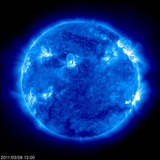
FARSIDE EXPLOSION: Yesterday, Aug. 15th (0508 UT), a gigantic filament of magnetism erupted from the farside of the sun: movie. SOHO saw a CME fly away from the blast site, but it will not hit Earth. The explosion is interesting because it signals the presence of an active region on the farside of the sun, which could turn to face us later this week.
Twitter
Halo CME
This morning there was an eruption from behind Sun's east limb, nicely captured in GOES-16 SUVI 304 A images. It resulted in a CME as observed by LASCO (not Earth-directed). We need to wait for STEREO-A data to locate the region where the eruption occurred.
Solar wind
speed: 447.3 km/sec
density: 3.6 protons/cm3
more data: ACE, DSCOVR
Updated: Today at 0758 UT
X-ray Solar Flares
6-hr max: A5 0205 UT Aug17
24-hr: B1 0927 UT Aug16
explanation | more data
Updated: Today at: 0805 UT
speed: 447.3 km/sec
density: 3.6 protons/cm3
more data: ACE, DSCOVR
Updated: Today at 0758 UT
X-ray Solar Flares
6-hr max: A5 0205 UT Aug17
24-hr: B1 0927 UT Aug16
explanation | more data
Updated: Today at: 0805 UT
Solar wind
speed: 433.5 km/sec
density: 4.0 protons/cm3
more data: ACE, DSCOVR
Updated: Today at 1915 UT
X-ray Solar Flares
6-hr max: A5 1323 UT Aug17
24-hr: A9 1101 UT Aug17
explanation | more data
Updated: Today at: 1920 UT
speed: 433.5 km/sec
density: 4.0 protons/cm3
more data: ACE, DSCOVR
Updated: Today at 1915 UT
X-ray Solar Flares
6-hr max: A5 1323 UT Aug17
24-hr: A9 1101 UT Aug17
explanation | more data
Updated: Today at: 1920 UT
Solar wind
speed: 444.5 km/sec
density: 4.1 protons/cm3
more data: ACE, DSCOVR
Updated: Today at 0508 UT
X-ray Solar Flares
6-hr max: A4 2305 UT Aug17
24-hr: A9 1101 UT Aug17
explanation | more data
Updated: Today at: 0515 UT
speed: 444.5 km/sec
density: 4.1 protons/cm3
more data: ACE, DSCOVR
Updated: Today at 0508 UT
X-ray Solar Flares
6-hr max: A4 2305 UT Aug17
24-hr: A9 1101 UT Aug17
explanation | more data
Updated: Today at: 0515 UT
Solar wind
speed: 334.1 km/sec
density: 3.1 protons/cm3
more data: ACE, DSCOVR
Updated: Today at 0620 UT
X-ray Solar Flares
6-hr max: A8 0247 UT Aug19
24-hr: B2 2007 UT Aug18
explanation | more data
Updated: Today at: 0625 UT
speed: 334.1 km/sec
density: 3.1 protons/cm3
more data: ACE, DSCOVR
Updated: Today at 0620 UT
X-ray Solar Flares
6-hr max: A8 0247 UT Aug19
24-hr: B2 2007 UT Aug18
explanation | more data
Updated: Today at: 0625 UT
NAKED-EYE NOVA UPDATE: It's not a naked-eye nova anymore. White dwarf star RS Oph, which exploded on Aug. 8th, has dimmed 16-fold to magnitude +7.5. For five days after the blast, the exploding star could be seen with the naked eye after sunset in the constellation Ophiuchus. Now a telescope is required.
Solar wind
speed: 321.6 km/sec
density: 7.8 protons/cm3
more data: ACE, DSCOVR
Updated: Today at 0544 UT
X-ray Solar Flares
6-hr max: B3 0547 UT Aug20
24-hr: B3 0547 UT Aug20
explanation | more data
Updated: Today at: 0550 UT
speed: 321.6 km/sec
density: 7.8 protons/cm3
more data: ACE, DSCOVR
Updated: Today at 0544 UT
X-ray Solar Flares
6-hr max: B3 0547 UT Aug20
24-hr: B3 0547 UT Aug20
explanation | more data
Updated: Today at: 0550 UT
Solar wind
speed: 317.2 km/sec
density: 7.6 protons/cm3
more data: ACE, DSCOVR
Updated: Today at 0610 UT
X-ray Solar Flares
6-hr max: B3 0410 UT Aug21
24-hr: C3 1557 UT Aug20
explanation | more data
Updated: Today at: 0615 UT
speed: 317.2 km/sec
density: 7.6 protons/cm3
more data: ACE, DSCOVR
Updated: Today at 0610 UT
X-ray Solar Flares
6-hr max: B3 0410 UT Aug21
24-hr: C3 1557 UT Aug20
explanation | more data
Updated: Today at: 0615 UT
Solar wind
speed: 309.1 km/sec
density: 12.7 protons/cm3
more data: ACE, DSCOVR
Updated: Today at 0615 UT
X-ray Solar Flares
6-hr max: C1 0414 UT Aug22
24-hr: C1 0414 UT Aug22
explanation | more data
Updated: Today at: 0620 UT
speed: 309.1 km/sec
density: 12.7 protons/cm3
more data: ACE, DSCOVR
Updated: Today at 0615 UT
X-ray Solar Flares
6-hr max: C1 0414 UT Aug22
24-hr: C1 0414 UT Aug22
explanation | more data
Updated: Today at: 0620 UT
THE SOLAR WIND IS COMING: A stream of solar wind is approaching Earth. ETA: Aug. 25th.
The gaseous material is flowing from a northern hole in the sun's atmosphere and could cause polar geomagnetic unrest when it arrives.
The gaseous material is flowing from a northern hole in the sun's atmosphere and could cause polar geomagnetic unrest when it arrives.
Solar wind
speed: 300.5 km/sec
density: 16.0 protons/cm3
more data: ACE, DSCOVR
Updated: Today at 1145 UT
X-ray Solar Flares
6-hr max: B1 1103 UT Aug23
24-hr: B6 1658 UT Aug22
explanation | more data
Updated: Today at: 1150 UT
speed: 300.5 km/sec
density: 16.0 protons/cm3
more data: ACE, DSCOVR
Updated: Today at 1145 UT
X-ray Solar Flares
6-hr max: B1 1103 UT Aug23
24-hr: B6 1658 UT Aug22
explanation | more data
Updated: Today at: 1150 UT
Solar wind
speed: 299.4 km/sec
density: 14.5 protons/cm3
more data: ACE, DSCOVR
Updated: Today at 0935 UT
X-ray Solar Flares
6-hr max: B1 0408 UT Aug24
24-hr: B1 1334 UT Aug23
explanation | more data
Updated: Today at: 0940 UT
speed: 299.4 km/sec
density: 14.5 protons/cm3
more data: ACE, DSCOVR
Updated: Today at 0935 UT
X-ray Solar Flares
6-hr max: B1 0408 UT Aug24
24-hr: B1 1334 UT Aug23
explanation | more data
Updated: Today at: 0940 UT
EARTH'S MAGNETIC FIELD IS ABOUT TO BE UPSET: A solar wind stream and, possibly, two CMEs are approaching Earth. A direct hit by the stream on Aug. 25th followed by near-misses (or glancing blows) from the CMEs on Aug. 26th could spark 2 to 3 days of polar geomagnetic unrest. That's exciting because the Arctic Circle is getting dark enough for auroras. Read on...
Solar wind
speed: 341.7 km/sec
density: 19.7 protons/cm3
more data: ACE, DSCOVR
Updated: Today at 2015 UT
X-ray Solar Flares
6-hr max: C1 1449 UT Aug24
24-hr: C1 1449 UT Aug24
explanation | more data
Updated: Today at: 2020 UT
speed: 341.7 km/sec
density: 19.7 protons/cm3
more data: ACE, DSCOVR
Updated: Today at 2015 UT
X-ray Solar Flares
6-hr max: C1 1449 UT Aug24
24-hr: C1 1449 UT Aug24
explanation | more data
Updated: Today at: 2020 UT
POSSIBLE CME IMPACT THIS WEEK: A coronal mass ejection (CME) might hit Earth on Aug. 26-27. It left the sun on Aug. 23rd when a magnetic filament in the sun's northern hemisphere exploded.
In SOHO images, the CME looks like a faint expanding halo--a sign that it is heading almost directly for our planet. Geomagnetic unrest, and maybe minor geomagnetic storms, are possible when the CME arrives.
In SOHO images, the CME looks like a faint expanding halo--a sign that it is heading almost directly for our planet. Geomagnetic unrest, and maybe minor geomagnetic storms, are possible when the CME arrives.
Solar wind
speed: 395.1 km/sec
density: 4.5 protons/cm3
more data: ACE, DSCOVR
Updated: Today at 1825 UT
X-ray Solar Flares
6-hr max: B4 1602 UT Aug25
24-hr: C1 0124 UT Aug25
explanation | more data
Updated: Today at: 1830 UT
speed: 395.1 km/sec
density: 4.5 protons/cm3
more data: ACE, DSCOVR
Updated: Today at 1825 UT
X-ray Solar Flares
6-hr max: B4 1602 UT Aug25
24-hr: C1 0124 UT Aug25
explanation | more data
Updated: Today at: 1830 UT
CHANCE OF STORMS, DOWNGRADED: NOAA analysts have determined that a CME launched by yesterday's "inky explosion" (described below) will sail east of the sun-Earth line, missing our planet. Another CME might still deliver a weak blow on Aug. 26-27. Overall, the chance of magnetic storms is less than before, albeit not zero.