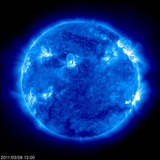
THE SOLAR WIND IS COMING: A stream of solar wind is approaching Earth. ETA: Aug. 25th.
The gaseous material is flowing from a northern hole in the sun's atmosphere and could cause polar geomagnetic unrest when it arrives.
The gaseous material is flowing from a northern hole in the sun's atmosphere and could cause polar geomagnetic unrest when it arrives.
Solar wind
speed: 300.5 km/sec
density: 16.0 protons/cm3
more data: ACE, DSCOVR
Updated: Today at 1145 UT
X-ray Solar Flares
6-hr max: B1 1103 UT Aug23
24-hr: B6 1658 UT Aug22
explanation | more data
Updated: Today at: 1150 UT
speed: 300.5 km/sec
density: 16.0 protons/cm3
more data: ACE, DSCOVR
Updated: Today at 1145 UT
X-ray Solar Flares
6-hr max: B1 1103 UT Aug23
24-hr: B6 1658 UT Aug22
explanation | more data
Updated: Today at: 1150 UT
Solar wind
speed: 299.4 km/sec
density: 14.5 protons/cm3
more data: ACE, DSCOVR
Updated: Today at 0935 UT
X-ray Solar Flares
6-hr max: B1 0408 UT Aug24
24-hr: B1 1334 UT Aug23
explanation | more data
Updated: Today at: 0940 UT
speed: 299.4 km/sec
density: 14.5 protons/cm3
more data: ACE, DSCOVR
Updated: Today at 0935 UT
X-ray Solar Flares
6-hr max: B1 0408 UT Aug24
24-hr: B1 1334 UT Aug23
explanation | more data
Updated: Today at: 0940 UT
EARTH'S MAGNETIC FIELD IS ABOUT TO BE UPSET: A solar wind stream and, possibly, two CMEs are approaching Earth. A direct hit by the stream on Aug. 25th followed by near-misses (or glancing blows) from the CMEs on Aug. 26th could spark 2 to 3 days of polar geomagnetic unrest. That's exciting because the Arctic Circle is getting dark enough for auroras. Read on...
Solar wind
speed: 341.7 km/sec
density: 19.7 protons/cm3
more data: ACE, DSCOVR
Updated: Today at 2015 UT
X-ray Solar Flares
6-hr max: C1 1449 UT Aug24
24-hr: C1 1449 UT Aug24
explanation | more data
Updated: Today at: 2020 UT
speed: 341.7 km/sec
density: 19.7 protons/cm3
more data: ACE, DSCOVR
Updated: Today at 2015 UT
X-ray Solar Flares
6-hr max: C1 1449 UT Aug24
24-hr: C1 1449 UT Aug24
explanation | more data
Updated: Today at: 2020 UT
POSSIBLE CME IMPACT THIS WEEK: A coronal mass ejection (CME) might hit Earth on Aug. 26-27. It left the sun on Aug. 23rd when a magnetic filament in the sun's northern hemisphere exploded.
In SOHO images, the CME looks like a faint expanding halo--a sign that it is heading almost directly for our planet. Geomagnetic unrest, and maybe minor geomagnetic storms, are possible when the CME arrives.
In SOHO images, the CME looks like a faint expanding halo--a sign that it is heading almost directly for our planet. Geomagnetic unrest, and maybe minor geomagnetic storms, are possible when the CME arrives.
Solar wind
speed: 395.1 km/sec
density: 4.5 protons/cm3
more data: ACE, DSCOVR
Updated: Today at 1825 UT
X-ray Solar Flares
6-hr max: B4 1602 UT Aug25
24-hr: C1 0124 UT Aug25
explanation | more data
Updated: Today at: 1830 UT
speed: 395.1 km/sec
density: 4.5 protons/cm3
more data: ACE, DSCOVR
Updated: Today at 1825 UT
X-ray Solar Flares
6-hr max: B4 1602 UT Aug25
24-hr: C1 0124 UT Aug25
explanation | more data
Updated: Today at: 1830 UT
CHANCE OF STORMS, DOWNGRADED: NOAA analysts have determined that a CME launched by yesterday's "inky explosion" (described below) will sail east of the sun-Earth line, missing our planet. Another CME might still deliver a weak blow on Aug. 26-27. Overall, the chance of magnetic storms is less than before, albeit not zero.
Solar wind
speed: 398.6 km/sec
density: 5.4 protons/cm3
more data: ACE, DSCOVR
Updated: Today at 0510 UT
X-ray Solar Flares
6-hr max: B2 2351 UT Aug25
24-hr: B4 1602 UT Aug25
explanation | more data
Updated: Today at: 0515 UT
speed: 398.6 km/sec
density: 5.4 protons/cm3
more data: ACE, DSCOVR
Updated: Today at 0510 UT
X-ray Solar Flares
6-hr max: B2 2351 UT Aug25
24-hr: B4 1602 UT Aug25
explanation | more data
Updated: Today at: 0515 UT
Solar wind
speed: 404.3 km/sec
density: 11.6 protons/cm3
more data: ACE, DSCOVR
Updated: Today at 0459 UT
X-ray Solar Flares
6-hr max: C3 2322 UT Aug26
24-hr: C3 2322 UT Aug26
explanation | more data
Updated: Today at: 0505 UT
speed: 404.3 km/sec
density: 11.6 protons/cm3
more data: ACE, DSCOVR
Updated: Today at 0459 UT
X-ray Solar Flares
6-hr max: C3 2322 UT Aug26
24-hr: C3 2322 UT Aug26
explanation | more data
Updated: Today at: 0505 UT
WEAK IMPACT: As predicted, a CME hit Earth's magnetic field on Aug. 27th (0100 UT). The impact was weak, lifting the solar wind speed by less than 50 km/s, and it did not cause a geomagnetic storm.
The CME was hurled in our direction by an unstable solar filament on Aug. 23rd.
The CME was hurled in our direction by an unstable solar filament on Aug. 23rd.
Solar wind
speed: 362.8 km/sec
density: 0.7 protons/cm3
more data: ACE, DSCOVR
Updated: Today at 0631 UT
X-ray Solar Flares
6-hr max: M4 0611 UT Aug28
24-hr: M4 0611 UT Aug28
explanation | more data
Updated: Today at: 0635 UT
speed: 362.8 km/sec
density: 0.7 protons/cm3
more data: ACE, DSCOVR
Updated: Today at 0631 UT
X-ray Solar Flares
6-hr max: M4 0611 UT Aug28
24-hr: M4 0611 UT Aug28
explanation | more data
Updated: Today at: 0635 UT
Solar wind
speed: 390.7 km/sec
density: 9.5 protons/cm3
more data: ACE, DSCOVR
Updated: Today at 1720 UT
X-ray Solar Flares
6-hr max: C2 1722 UT Aug29
24-hr: C8 1003 UT Aug29
explanation | more data
Updated: Today at: 1725 UT
speed: 390.7 km/sec
density: 9.5 protons/cm3
more data: ACE, DSCOVR
Updated: Today at 1720 UT
X-ray Solar Flares
6-hr max: C2 1722 UT Aug29
24-hr: C8 1003 UT Aug29
explanation | more data
Updated: Today at: 1725 UT
🚨 MINOR STORM WARNING: A CME hurled into space by Thursday's solar tsumani is expected to strike Earth later today (Aug. 29th) or tomorrow (Aug 30th). NOAA forecasters say there is a chance of minor G1-class geomagnetic storms when the CME arrives.
Spaceweather.com
Solar Tsunami and CME
Aug. 27, 2021: Sunspot AR2859 erupted on Aug. 26th, producing a C3-class solar flare: movie. The flare, however, was not the main attraction. The eruption also caused a massive “solar tsunami…
Solar wind
speed: 395.7 km/sec
density: 8.5 protons/cm3
more data: ACE, DSCOVR
Updated: Today at 0431 UT
X-ray Solar Flares
6-hr max: C1 0154 UT Aug30
24-hr: C8 1003 UT Aug29
explanation | more data
Updated: Today at: 0435 UT
speed: 395.7 km/sec
density: 8.5 protons/cm3
more data: ACE, DSCOVR
Updated: Today at 0431 UT
X-ray Solar Flares
6-hr max: C1 0154 UT Aug30
24-hr: C8 1003 UT Aug29
explanation | more data
Updated: Today at: 0435 UT
GEOMAGNETIC STORM WARNING: One and perhaps two CMEs are about to hit Earth. The first, hurled toward us by Thursday's solar tsumani (C3), is expected to arrive on Aug. 29-30.
The second, ejected by Saturday's solar flare (M4.7), could come on Aug. 31-Sept 1. Neither CME is particularly bright or powerful; however, they could combine to produce G1-class geomagnetic storms.
The second, ejected by Saturday's solar flare (M4.7), could come on Aug. 31-Sept 1. Neither CME is particularly bright or powerful; however, they could combine to produce G1-class geomagnetic storms.
Spaceweather.com
Solar Tsunami and CME
Aug. 27, 2021: Sunspot AR2859 erupted on Aug. 26th, producing a C3-class solar flare: movie. The flare, however, was not the main attraction. The eruption also caused a massive “solar tsunami…
Solar wind
speed: 384.7 km/sec
density: 5.0 protons/cm3
more data: ACE, DSCOVR
Updated: Today at 1830 UT
X-ray Solar Flares
6-hr max: C2 1624 UT Aug30
24-hr: C2 1624 UT Aug30
explanation | more data
Updated: Today at: 1835 UT
speed: 384.7 km/sec
density: 5.0 protons/cm3
more data: ACE, DSCOVR
Updated: Today at 1830 UT
X-ray Solar Flares
6-hr max: C2 1624 UT Aug30
24-hr: C2 1624 UT Aug30
explanation | more data
Updated: Today at: 1835 UT