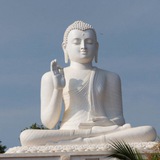
Namakāra Gāthā
Araham Sammā-Sambuddho Bhagavā,
Buddham Bhagavantam abhivādemi.
Svākkhāto Bhagavatā Dhammo,
Dhammam namassāmi.
Supaṭipanno Bhagavato sāvaka-sangho,
Sangham namāmi.
The Blessed One is the Arahant, the Perfectly and Fully Awakened One;
I pay homage to the Buddha, the Blessed One.
The Dhamma is well-expounded by the Blessed One;
I pay homage to the Dhamma.
The Saṅgha of the Blessed One's disciples has practiced well;
I pay homage to the Saṅgha.
Araham Sammā-Sambuddho Bhagavā,
Buddham Bhagavantam abhivādemi.
Svākkhāto Bhagavatā Dhammo,
Dhammam namassāmi.
Supaṭipanno Bhagavato sāvaka-sangho,
Sangham namāmi.
The Blessed One is the Arahant, the Perfectly and Fully Awakened One;
I pay homage to the Buddha, the Blessed One.
The Dhamma is well-expounded by the Blessed One;
I pay homage to the Dhamma.
The Saṅgha of the Blessed One's disciples has practiced well;
I pay homage to the Saṅgha.
❤1🥰1
Dhammapada Verse 122
Bilalapadakasetthi Vatthu
Mavamannetha punnassa
na mandam agamissati
udabindunipatena
udakumbhopi purati
dhiro purati punnassa
thokam thokampi acinam.
Verse 122: One should not think lightly of doing good, imagining 'A little will not affect me'; just as a water-jar is filled up by falling drops of rain, so also, the wise one is filled up with merit, by accumulating it little by little.
The Story of Bilalapadaka
While residing at the Jetavana monastery, the Buddha uttered Verse (122) of this book, with reference to Bilalapadaka, a rich man.
Once, a man from Savatthi, having heard a discourse given by the Buddha, was very much impressed, and decided to practise what was taught by the Buddha. The exhortation was to give in charity not only by oneself but also to get others to do so and that by so doing one would gain much merit and have a large number of followers in the next existence. So, that man invited the Buddha and all the resident bhikkhus in the Jetavana monastery for alms-food the next day. Then he went round to each one of the houses and informed the residents that alms-food would he offered the next day to the Buddha and other bhikkhus and so to contribute according to their wishes. The rich man Bilalapadaka seeing the man goings round from house to house disapproved of his behaviour and felt a strong dislike for him and murmured to himself, "O this wretched man! Why did he not invite as many bhikkhus as he could himself offer alms, instead of going round coaxing people?" So he asked the man to bring his bowl and into this bowl, he put only a little rice, only a little butter, only a little molass. These were taken away separately and not mixed with what others had given. The rich men could not understand why his things were kept separately, and he thought perhaps that man wanted others to know that a rich man like him had contributed very little and so put him to shame. Therefore, he sent a servant to find out.
The promoter of charity put a little of everything that was given by the rich man into various pots of rice and curry and sweetmeats so that the rich man may gain much merit. His servant reported what he had seen; but Bilalapadaka did not get the meaning and was not sure of the intention of the promoter of charity. However, the next day he went to the place where alms-food was being offered. At the same time, he took a knife with him, intending to kill the chief promoter of charity, if he were to reveal in public just how little a rich man like him had contributed.
But this promoter of charity said to the Buddha, "Venerable Sir, this charity is a joint offering of all; whether one has given much or little is of no account; each one of us has given in faith and generosity; so may all of us gain equal merit." When he heard those words, Bilalpadaka realized that he had wronged the man and pondered that if he were not to own up his mistake and ask the promoter of charity to pardon him, he would he reborn in one of the four lower worlds (apayas). So he said, "My friend, I have done you a great wrong by thinking ill of you; please forgive me." The Buddha heard the rich man asking for pardon, and on enquiry found out the reason. So, the Buddha said, "My disciple, you should not think lightly of a good deed, however small it may be, for small deeds will become big if you do them habitually."
Then the Buddha spoke in verse as follows:
Verse 122: One should not think lightly of doing good, imagining 'A little will not affect me'; just as a water-jar is filled up by falling drops of rain, so also, the wise one is filled up with merit, by accumulating it little by little.
At the end of the discourse, Bilalapadaka the rich man attained Sotapatti Fruition.
Dhammapada, beloved and favorite teachings of the Buddha channel:
https://news.1rj.ru/str/dhammapadas
====================
Bilalapadakasetthi Vatthu
Mavamannetha punnassa
na mandam agamissati
udabindunipatena
udakumbhopi purati
dhiro purati punnassa
thokam thokampi acinam.
Verse 122: One should not think lightly of doing good, imagining 'A little will not affect me'; just as a water-jar is filled up by falling drops of rain, so also, the wise one is filled up with merit, by accumulating it little by little.
The Story of Bilalapadaka
While residing at the Jetavana monastery, the Buddha uttered Verse (122) of this book, with reference to Bilalapadaka, a rich man.
Once, a man from Savatthi, having heard a discourse given by the Buddha, was very much impressed, and decided to practise what was taught by the Buddha. The exhortation was to give in charity not only by oneself but also to get others to do so and that by so doing one would gain much merit and have a large number of followers in the next existence. So, that man invited the Buddha and all the resident bhikkhus in the Jetavana monastery for alms-food the next day. Then he went round to each one of the houses and informed the residents that alms-food would he offered the next day to the Buddha and other bhikkhus and so to contribute according to their wishes. The rich man Bilalapadaka seeing the man goings round from house to house disapproved of his behaviour and felt a strong dislike for him and murmured to himself, "O this wretched man! Why did he not invite as many bhikkhus as he could himself offer alms, instead of going round coaxing people?" So he asked the man to bring his bowl and into this bowl, he put only a little rice, only a little butter, only a little molass. These were taken away separately and not mixed with what others had given. The rich men could not understand why his things were kept separately, and he thought perhaps that man wanted others to know that a rich man like him had contributed very little and so put him to shame. Therefore, he sent a servant to find out.
The promoter of charity put a little of everything that was given by the rich man into various pots of rice and curry and sweetmeats so that the rich man may gain much merit. His servant reported what he had seen; but Bilalapadaka did not get the meaning and was not sure of the intention of the promoter of charity. However, the next day he went to the place where alms-food was being offered. At the same time, he took a knife with him, intending to kill the chief promoter of charity, if he were to reveal in public just how little a rich man like him had contributed.
But this promoter of charity said to the Buddha, "Venerable Sir, this charity is a joint offering of all; whether one has given much or little is of no account; each one of us has given in faith and generosity; so may all of us gain equal merit." When he heard those words, Bilalpadaka realized that he had wronged the man and pondered that if he were not to own up his mistake and ask the promoter of charity to pardon him, he would he reborn in one of the four lower worlds (apayas). So he said, "My friend, I have done you a great wrong by thinking ill of you; please forgive me." The Buddha heard the rich man asking for pardon, and on enquiry found out the reason. So, the Buddha said, "My disciple, you should not think lightly of a good deed, however small it may be, for small deeds will become big if you do them habitually."
Then the Buddha spoke in verse as follows:
Verse 122: One should not think lightly of doing good, imagining 'A little will not affect me'; just as a water-jar is filled up by falling drops of rain, so also, the wise one is filled up with merit, by accumulating it little by little.
At the end of the discourse, Bilalapadaka the rich man attained Sotapatti Fruition.
Dhammapada, beloved and favorite teachings of the Buddha channel:
https://news.1rj.ru/str/dhammapadas
====================
Telegram
Dhammapada - Buddha Dharma Teachings
Daily teachings of the Dhammapada, beloved and favorite teachings of the Buddha
🏆2💯1
Dhammapada Verse 123
Mahadhanavanija Vatthu
Vanijova bhayam maggam
appasattho mahaddhano
visam jivitukamova
papani parivajjaye.
Verse 123: Just as a wealthy merchant with few attendants avoids a dangerous road, just as one who desires to go on living avoids poison, so also, one should avoid evil.
The Story of Mahadhana
While residing at the Jetavana monastery, the Buddha uttered Verse (123) of this book, with reference to Mahadhana the merchant.
Mahadhana was a rich merchant from Savatthi. On one occasion, five hundred robbers were planning to rob him, but thy did not get the chance to rob him. In the meantime, they heard that the merchant would soon be going out with five hundred carts loaded with valuable merchandise. The merchant Mahadhana also invited the bhikkhus who would like to go on the same journey to accompany him, and he promised to look to their needs on the way. So five hundred bhikkhus accompanied him. The robbers got news of the trip and went ahead to lie in wait for the caravan of the merchant. But the merchant stopped at the outskirts of the forest where the robbers were waiting. The caravan was to move on after camping there for a few days. The robbers got the news of the impending departure and made ready to loot the caravan; the merchant, in his turn, also got news of the movements of the bandits and he decided to return home. The bandits now heard that the merchant would go home; so they waited on the homeward way. Some villagers sent word to the merchant about the movements of the bandits, and the merchant finally decided to remain in the village for some time. When he told the bhikkhus about his decision, the bhikkhus returned to Savatthi by themselves.
On arrival at the Jetavana monastery they went to the Buddha and informed him about the cancellation of their trip. To then, the Buddha said, "Bhikkhus, Mahadhana keeps away from the journey beset with bandits; one who does not want to die keeps away from poison; so also, a wise bhikkhu, realizing that the three levels of existence* are like a journey beset with, danger, should strive to keep away from doing evil."
Then the Buddha spoke in verse as follows:
Verse 123: Just as a wealthy merchant with few attendants avoids a dangerous road, just as one who desires to go on living avoids poison, so also, one should avoid evil.
At the end of the discourse, those five hundred bhikkhus attained Sotapatti Fruition.
*The three levels of existence are:
(a) Kamabhava, the level of sensuous existence; comprising the eleven realms of sense desire;
(b) Rupahbava, the level of fine material existence: comprising sixteen of the realms of Brahmas;
(c) Arupahbava, the level of non-material existence; comprising four realms of the upper Brahmas.
Buddha dharma teachings channel:
https://invite.viber.com/?g2=AQAKw1y3rv%2F6sk61PI2W4izuIiaEZj8YZujhY1tSzL%2B07s7rFnVFDAd0bAYFaMLw
====================
Mahadhanavanija Vatthu
Vanijova bhayam maggam
appasattho mahaddhano
visam jivitukamova
papani parivajjaye.
Verse 123: Just as a wealthy merchant with few attendants avoids a dangerous road, just as one who desires to go on living avoids poison, so also, one should avoid evil.
The Story of Mahadhana
While residing at the Jetavana monastery, the Buddha uttered Verse (123) of this book, with reference to Mahadhana the merchant.
Mahadhana was a rich merchant from Savatthi. On one occasion, five hundred robbers were planning to rob him, but thy did not get the chance to rob him. In the meantime, they heard that the merchant would soon be going out with five hundred carts loaded with valuable merchandise. The merchant Mahadhana also invited the bhikkhus who would like to go on the same journey to accompany him, and he promised to look to their needs on the way. So five hundred bhikkhus accompanied him. The robbers got news of the trip and went ahead to lie in wait for the caravan of the merchant. But the merchant stopped at the outskirts of the forest where the robbers were waiting. The caravan was to move on after camping there for a few days. The robbers got the news of the impending departure and made ready to loot the caravan; the merchant, in his turn, also got news of the movements of the bandits and he decided to return home. The bandits now heard that the merchant would go home; so they waited on the homeward way. Some villagers sent word to the merchant about the movements of the bandits, and the merchant finally decided to remain in the village for some time. When he told the bhikkhus about his decision, the bhikkhus returned to Savatthi by themselves.
On arrival at the Jetavana monastery they went to the Buddha and informed him about the cancellation of their trip. To then, the Buddha said, "Bhikkhus, Mahadhana keeps away from the journey beset with bandits; one who does not want to die keeps away from poison; so also, a wise bhikkhu, realizing that the three levels of existence* are like a journey beset with, danger, should strive to keep away from doing evil."
Then the Buddha spoke in verse as follows:
Verse 123: Just as a wealthy merchant with few attendants avoids a dangerous road, just as one who desires to go on living avoids poison, so also, one should avoid evil.
At the end of the discourse, those five hundred bhikkhus attained Sotapatti Fruition.
*The three levels of existence are:
(a) Kamabhava, the level of sensuous existence; comprising the eleven realms of sense desire;
(b) Rupahbava, the level of fine material existence: comprising sixteen of the realms of Brahmas;
(c) Arupahbava, the level of non-material existence; comprising four realms of the upper Brahmas.
Buddha dharma teachings channel:
https://invite.viber.com/?g2=AQAKw1y3rv%2F6sk61PI2W4izuIiaEZj8YZujhY1tSzL%2B07s7rFnVFDAd0bAYFaMLw
====================
Viber
Buddha
Buddha dharma teachings from the suttas and commentaries from Theravada tradition
🏆2👍1💯1
Forwarded from Buddha Dharma books
Free Buddha Dharma ebook
The Buddha and His Dhamma
By Dr. Bhimrao Ramji Ambedkar
The Buddha and His Dhamma, is a 1957 treatise on Buddha's life and philosophy. It was the last work of Indian/Bharat statesman and scholar B. R. Ambedkar. The text is treated as noscripture for those who follow Navayana Buddhism.
Navayāna (Devanagari: नवयान, IAST: Navayāna, meaning "New Vehicle"), otherwise known as Navayāna Buddhism, refers to the modern re-interpretation of Buddhism founded and developed by the Indian jurist, social reformer, and scholar B. R. Ambedkar, it is otherwise called Neo-Buddhism and Ambedkarite Buddhism.
Free download available:
http://ftp.budaedu.org/ebooks/pdf/EN079.pdf
=============
The Buddha and His Dhamma
By Dr. Bhimrao Ramji Ambedkar
The Buddha and His Dhamma, is a 1957 treatise on Buddha's life and philosophy. It was the last work of Indian/Bharat statesman and scholar B. R. Ambedkar. The text is treated as noscripture for those who follow Navayana Buddhism.
Navayāna (Devanagari: नवयान, IAST: Navayāna, meaning "New Vehicle"), otherwise known as Navayāna Buddhism, refers to the modern re-interpretation of Buddhism founded and developed by the Indian jurist, social reformer, and scholar B. R. Ambedkar, it is otherwise called Neo-Buddhism and Ambedkarite Buddhism.
Free download available:
http://ftp.budaedu.org/ebooks/pdf/EN079.pdf
=============
❤2👍1
Dhammapada Verse 124
Kukkutamittanesada Vatthu
Panimhi ce vano nassa
hareyya panina visam
nibbanam visamanveti
natthi papam akubbato.
Verse 124: If there is no wound on the hand, one may handle poison; poison does not affect one who has no wound; there can be no evil for one who has no evil intention.
The Story of Kukkutamitta
While residing at the Veluvana monastery, the Buddha uttered Verse (124) of this book, with reference to the hunter Kukkutamitta and his family.
At Rajagaha there was once a rich man's daughter who had attained Sotapatti Fruition as a young girl. One day, Kukkutamitta, a hunter, came into town in a cart to sell venison. Seeing Kukkutamitta the hunter, the rich young lady fell in love with him immediately; she followed him, married him and lived with him in a small village. As a result of that marriage, seven sons were born to them and in course of time, all the sons got married. One day, the Buddha surveyed the world early in the morning with his supernormal power and found that the hunter, his seven sons and their wives were due for attainment of Sotapatti Fruition. So, the Buddha went to the place where the hunter had set his trap in the forest. He put his footprint close to the trap and seated himself under the shade of a bush, not far from the trap.
When the hunter came, he saw no animal in the trap; he saw the footprint and surmised that someone must have come before him and let cut the animal. So, when he saw the Buddha under the shade of the bush, he took him for the man who had freed the animal from his trap and flew into a rage. He took out his bow and arrow to shoot at the Buddha, but as he drew his bow, he became immobilized and remained fixed in that position like a statue. His sons followed and found their father; they also saw the Buddha at some distance and thought he must be the enemy of their father. All of them took out their bows and arrows to shoot at the Buddha, but they also became immobilized and remained fixed in their respective postures. When the hunter and his sons failed to return, the hunter's wife followed them into the forest, with her seven daughters-in-law. Seeing her husband and all her sons with their arrows aimed at the Buddha, she raised both her hands and shout: "Do not kill my father."
When her husband heard her words, he thought, "This must be my father-in-law", and her sons thought, "This must be our grandfather"; and thoughts of loving-kindness came into them. Then the lady said to them, ''Put away your bows and arrows and pay obeisance to my father". The Buddha realized that, by this time, the minds of the hunter and his son; had softened and so he willed that they should be able to move and to put away their bows and arrows. After putting away their bows and arrows, they paid obeisance to the Buddha and the Buddha expounded the Dhamma to them. In the end, the hunter, his seven sons and seven daughters-in-law, all fifteen of them, attained Sotapatti Fruition.
Then the Buddha returned to the monastery and told Thera Ananda and other bhikkhus about the hunter Kukkutamitta and his family attaining Sotapatti Fruition in the early part of the morning. The bhikkhus then asked the Buddha, "Venerable Sir, is the wife of the hunter who is a sotapanna, also not guilty of taking life, if she has been getting things like nets, bows and arrows for her husband when he goes out hunting?" To this question the Buddha answered, "Bhikkhus, the sotapannas do not kill, they do not wish others to get killed. The wife of the hunter was only obeying her husband in getting things for him. Just as the hand that has no wound is not affected by poison, so also, because she has no intention to do evil she is not doing any evil."
Kukkutamittanesada Vatthu
Panimhi ce vano nassa
hareyya panina visam
nibbanam visamanveti
natthi papam akubbato.
Verse 124: If there is no wound on the hand, one may handle poison; poison does not affect one who has no wound; there can be no evil for one who has no evil intention.
The Story of Kukkutamitta
While residing at the Veluvana monastery, the Buddha uttered Verse (124) of this book, with reference to the hunter Kukkutamitta and his family.
At Rajagaha there was once a rich man's daughter who had attained Sotapatti Fruition as a young girl. One day, Kukkutamitta, a hunter, came into town in a cart to sell venison. Seeing Kukkutamitta the hunter, the rich young lady fell in love with him immediately; she followed him, married him and lived with him in a small village. As a result of that marriage, seven sons were born to them and in course of time, all the sons got married. One day, the Buddha surveyed the world early in the morning with his supernormal power and found that the hunter, his seven sons and their wives were due for attainment of Sotapatti Fruition. So, the Buddha went to the place where the hunter had set his trap in the forest. He put his footprint close to the trap and seated himself under the shade of a bush, not far from the trap.
When the hunter came, he saw no animal in the trap; he saw the footprint and surmised that someone must have come before him and let cut the animal. So, when he saw the Buddha under the shade of the bush, he took him for the man who had freed the animal from his trap and flew into a rage. He took out his bow and arrow to shoot at the Buddha, but as he drew his bow, he became immobilized and remained fixed in that position like a statue. His sons followed and found their father; they also saw the Buddha at some distance and thought he must be the enemy of their father. All of them took out their bows and arrows to shoot at the Buddha, but they also became immobilized and remained fixed in their respective postures. When the hunter and his sons failed to return, the hunter's wife followed them into the forest, with her seven daughters-in-law. Seeing her husband and all her sons with their arrows aimed at the Buddha, she raised both her hands and shout: "Do not kill my father."
When her husband heard her words, he thought, "This must be my father-in-law", and her sons thought, "This must be our grandfather"; and thoughts of loving-kindness came into them. Then the lady said to them, ''Put away your bows and arrows and pay obeisance to my father". The Buddha realized that, by this time, the minds of the hunter and his son; had softened and so he willed that they should be able to move and to put away their bows and arrows. After putting away their bows and arrows, they paid obeisance to the Buddha and the Buddha expounded the Dhamma to them. In the end, the hunter, his seven sons and seven daughters-in-law, all fifteen of them, attained Sotapatti Fruition.
Then the Buddha returned to the monastery and told Thera Ananda and other bhikkhus about the hunter Kukkutamitta and his family attaining Sotapatti Fruition in the early part of the morning. The bhikkhus then asked the Buddha, "Venerable Sir, is the wife of the hunter who is a sotapanna, also not guilty of taking life, if she has been getting things like nets, bows and arrows for her husband when he goes out hunting?" To this question the Buddha answered, "Bhikkhus, the sotapannas do not kill, they do not wish others to get killed. The wife of the hunter was only obeying her husband in getting things for him. Just as the hand that has no wound is not affected by poison, so also, because she has no intention to do evil she is not doing any evil."
💯1🏆1
Then the Buddha spoke in verse as follows:
Verse 124: If there is no wound on the hand, one may handle poison; poison does not affect one who has no wound; there can be no evil for one who has no evil intention.
Words of the Buddha channel:
https://invite.viber.com/?g2=AQAFqzqlj7FmI061PX17rxWMAtZ%2BRuso%2FH2KmHKZSgnv7v9DD8X0bDkKnZDr9JDq
====================
Verse 124: If there is no wound on the hand, one may handle poison; poison does not affect one who has no wound; there can be no evil for one who has no evil intention.
Words of the Buddha channel:
https://invite.viber.com/?g2=AQAFqzqlj7FmI061PX17rxWMAtZ%2BRuso%2FH2KmHKZSgnv7v9DD8X0bDkKnZDr9JDq
====================
Viber
Words Of The Buddha
Daily teachings from Buddha Dharma
👍2💯1🏆1
Dear One, I Am Here for You
Using mantras as an expression of love
By Thich Nhat Hanh
In the springtime, thousands of different kinds of flowers bloom. Your heart can also bloom. You can let your heart open up to the world. Love is possible—do not be afraid of it. Love is indispensable to life, and if in the past you have suffered because of love, you can learn how to love again.
The practice of mindfulness will help you to love properly, in such a way that harmony, freedom, and joy are possible. The true declaration of love is, “Dear one, I am here for you,” because the most precious gift you can give to your loved one is your true presence, with body and mind united in solidity and freedom.
You also have to learn how to speak all over again. When you speak with 100 percent of your being, your speech becomes a mantra. In Buddhism, a mantra is a sacred formula that has the power to transform reality. You don’t need to practice mantras in some foreign language like Sanskrit or Tibetan. You can practice in your own beautiful language: for if your body and mind are unified in mindfulness, then whatever you say becomes a mantra.
After you have practiced walking meditation or mindfulness of the breath for two or three minutes, you are here, really alive, truly present. You look at the person you love with a smile, and you say the first mantra: “Dear one, I am here for you.” You know that if you are here, then your beloved is here also. Life, with all its miracles, is here, and among those miracles is the person before you, the one you love.
You can say this mantra a few times a day: “Dear one, I am here for you.” And now that you have the ability to recognize the presence of this other person, you can practice a second mantra: “Dear one, I know that you are here, alive, and that makes me very happy.” This mantra enables you to recognize the presence of the other person as something very precious, a miracle. It is the mantra of deep appreciation for his or her presence.
When people feel appreciated in this way—when they feel embraced by the mindful attention of another—then they will open and blossom like a flower. There is no doubt that you can make this happen through the energy of mindfulness. You can do it right away, even today, and you will see that the transformation it brings about is instantaneous. In order to love, we must be here, and then our presence will embrace the presence of the other person. Only then will they have the feeling of being loved. So you must recognize the presence of the other person with the energy of mindfulness, with the genuine presence of your body and mind in oneness.
If the person you love is suffering, you can say a third mantra: “Dear one, I know that you are suffering. That’s why I am here for you.” You are here, and you recognize the fact that your loved one is suffering. You don’t need to make a big deal about it; you just generate your own presence and say this mantra. That’s all. “Dear one, I know that you are suffering. That’s why I am here for you.” This is the essence of love—to be there for the one you love when she is suffering.
A mantra can be expressed not only through speech but by the mind and body as a whole. The fact that you are there with the energy of your presence and understanding, and the fact that you recognize the presence of the other person and their suffering, will give them a great deal of relief. Some people suffer deeply but are completely ignored by others. They are alone and isolated, so cut off from the rest of the world that their suffering becomes overwhelming. You must go to them and open the door to their heart so they can see the love that is there.
Our bodies and minds are sustained by the cosmos. The clouds in the sky nourish us; the light of the sun nourishes us. The cosmos offers us vitality and love in every moment. Despite this fact, some people feel isolated and alienated from the world.
Using mantras as an expression of love
By Thich Nhat Hanh
In the springtime, thousands of different kinds of flowers bloom. Your heart can also bloom. You can let your heart open up to the world. Love is possible—do not be afraid of it. Love is indispensable to life, and if in the past you have suffered because of love, you can learn how to love again.
The practice of mindfulness will help you to love properly, in such a way that harmony, freedom, and joy are possible. The true declaration of love is, “Dear one, I am here for you,” because the most precious gift you can give to your loved one is your true presence, with body and mind united in solidity and freedom.
You also have to learn how to speak all over again. When you speak with 100 percent of your being, your speech becomes a mantra. In Buddhism, a mantra is a sacred formula that has the power to transform reality. You don’t need to practice mantras in some foreign language like Sanskrit or Tibetan. You can practice in your own beautiful language: for if your body and mind are unified in mindfulness, then whatever you say becomes a mantra.
After you have practiced walking meditation or mindfulness of the breath for two or three minutes, you are here, really alive, truly present. You look at the person you love with a smile, and you say the first mantra: “Dear one, I am here for you.” You know that if you are here, then your beloved is here also. Life, with all its miracles, is here, and among those miracles is the person before you, the one you love.
You can say this mantra a few times a day: “Dear one, I am here for you.” And now that you have the ability to recognize the presence of this other person, you can practice a second mantra: “Dear one, I know that you are here, alive, and that makes me very happy.” This mantra enables you to recognize the presence of the other person as something very precious, a miracle. It is the mantra of deep appreciation for his or her presence.
When people feel appreciated in this way—when they feel embraced by the mindful attention of another—then they will open and blossom like a flower. There is no doubt that you can make this happen through the energy of mindfulness. You can do it right away, even today, and you will see that the transformation it brings about is instantaneous. In order to love, we must be here, and then our presence will embrace the presence of the other person. Only then will they have the feeling of being loved. So you must recognize the presence of the other person with the energy of mindfulness, with the genuine presence of your body and mind in oneness.
If the person you love is suffering, you can say a third mantra: “Dear one, I know that you are suffering. That’s why I am here for you.” You are here, and you recognize the fact that your loved one is suffering. You don’t need to make a big deal about it; you just generate your own presence and say this mantra. That’s all. “Dear one, I know that you are suffering. That’s why I am here for you.” This is the essence of love—to be there for the one you love when she is suffering.
A mantra can be expressed not only through speech but by the mind and body as a whole. The fact that you are there with the energy of your presence and understanding, and the fact that you recognize the presence of the other person and their suffering, will give them a great deal of relief. Some people suffer deeply but are completely ignored by others. They are alone and isolated, so cut off from the rest of the world that their suffering becomes overwhelming. You must go to them and open the door to their heart so they can see the love that is there.
Our bodies and minds are sustained by the cosmos. The clouds in the sky nourish us; the light of the sun nourishes us. The cosmos offers us vitality and love in every moment. Despite this fact, some people feel isolated and alienated from the world.
Telegram
Ajahn Chah - Theravada Thailand Buddhism
Collection of teachings of Venerable Ajahn Chah, a foremost meditation and Buddhist teacher from Thailand
👍2❤1🏆1