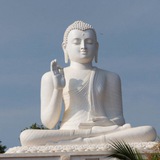
Dhammapada Verse 128
Suppabuddhasakya Vatthu
Na antalikkhe na samuddamajjhe
na pabbatanam vivaram pavissa
na vijjati so jagatippadeso
yatthatthitam nappasaheyya maccu.
Verse 128: Not in the sky, nor in the middle of the ocean, nor in the cave of a mountain, nor anywhere else, is there a place where one cannot be oppressed by Death.
The Story of King Suppabuddha
While residing at the Nigrodharama monastery, the Buddha uttered Verse (128) of this book, with reference to King Suppabuddha.
King Suppabuddha was the father of Devadatta and father-in-law of Prince Siddhattha who later became Gotama Buddha. King Suppabuddha was very antagonistic to the Buddha for two reasons. First, because as prince Siddhattha he had left his wife Yasodhara, the daughter of King Suppabuddha, to renounce the world; and secondly, because his son Devadatta, who was admitted into the Order by Gotama Buddha, had come to regard the Buddha as his arch enemy. One day, knowing that the Buddha would be coming for alms-food, he got himself drunk and blocked the way. When the Buddha and the bhikkhus came, Suppabuddha refused to make way, and sent a message saying, "I cannot give way to Samana Gotama, who is so much younger than me." Finding the road blocked, the Buddha and the bhikkhus turned back. Suppabuddha then sent someone to follow the Buddha secretly and find out what the Buddha said, and to report to him.
As the Buddha turned back, he said to Ananda, "Ananda, because King Suppabuddha had refused to give way to me, on the seventh day from now he would be swallowed up by the earth, at the foot of the steps leading to the pinnacled hall of his palace." The king's spy heard these words and reported to the king. And the king said that he would not go near those steps and would prove the words of the Buddha to be wrong. Further, he instructed his men to remove those steps, so that he would not be able to use them; he also kept some men on duty, with instructions to hold him back should he go in the direction of the stairs.
When the Buddha was told about the king's instructions to his men, he said, "Bhikkhus! Whether King Suppabuddha lives in a pinnacled tower, or up in the sky, or in an ocean, or in a cave, my word cannot go wrong; King Suppabuddha will be swallowed up by the earth at the very place I have told you."
Then the Buddha spoke in verse as follows:
Verse 128: Not in the sky, nor in the middle of the ocean, nor in the cave of a mountain, nor anywhere else, is there a place where one cannot be oppressed by Death.
On the seventh day, about the time of the alms meal the royal horse got frightened for some unknown reason and started neighing loudly and kicking about furiously. Hearing frightening noises from his horse, the king felt that he must handle his pet horse and forgetting all precautions, he started towards the door. The door opened of its own accord, the steps which had been pulled down earlier were also there, his men forgot to stop him from going down. So the king went down the stairs and as soon as he stepped on the earth, it opened and swallowed him up and dragged him right down to Avici Niraya.
End of Chapter Nine: Evil (Papavagga)
====================
Tibetan Buddhism - Vajrayana, Tantrayana and esoteric Buddhism channel:
https://news.1rj.ru/str/tibetanbuddha
Vajrayana Tantrayana Buddhism channel:
https://news.1rj.ru/str/tantrayanabuddhism
Suppabuddhasakya Vatthu
Na antalikkhe na samuddamajjhe
na pabbatanam vivaram pavissa
na vijjati so jagatippadeso
yatthatthitam nappasaheyya maccu.
Verse 128: Not in the sky, nor in the middle of the ocean, nor in the cave of a mountain, nor anywhere else, is there a place where one cannot be oppressed by Death.
The Story of King Suppabuddha
While residing at the Nigrodharama monastery, the Buddha uttered Verse (128) of this book, with reference to King Suppabuddha.
King Suppabuddha was the father of Devadatta and father-in-law of Prince Siddhattha who later became Gotama Buddha. King Suppabuddha was very antagonistic to the Buddha for two reasons. First, because as prince Siddhattha he had left his wife Yasodhara, the daughter of King Suppabuddha, to renounce the world; and secondly, because his son Devadatta, who was admitted into the Order by Gotama Buddha, had come to regard the Buddha as his arch enemy. One day, knowing that the Buddha would be coming for alms-food, he got himself drunk and blocked the way. When the Buddha and the bhikkhus came, Suppabuddha refused to make way, and sent a message saying, "I cannot give way to Samana Gotama, who is so much younger than me." Finding the road blocked, the Buddha and the bhikkhus turned back. Suppabuddha then sent someone to follow the Buddha secretly and find out what the Buddha said, and to report to him.
As the Buddha turned back, he said to Ananda, "Ananda, because King Suppabuddha had refused to give way to me, on the seventh day from now he would be swallowed up by the earth, at the foot of the steps leading to the pinnacled hall of his palace." The king's spy heard these words and reported to the king. And the king said that he would not go near those steps and would prove the words of the Buddha to be wrong. Further, he instructed his men to remove those steps, so that he would not be able to use them; he also kept some men on duty, with instructions to hold him back should he go in the direction of the stairs.
When the Buddha was told about the king's instructions to his men, he said, "Bhikkhus! Whether King Suppabuddha lives in a pinnacled tower, or up in the sky, or in an ocean, or in a cave, my word cannot go wrong; King Suppabuddha will be swallowed up by the earth at the very place I have told you."
Then the Buddha spoke in verse as follows:
Verse 128: Not in the sky, nor in the middle of the ocean, nor in the cave of a mountain, nor anywhere else, is there a place where one cannot be oppressed by Death.
On the seventh day, about the time of the alms meal the royal horse got frightened for some unknown reason and started neighing loudly and kicking about furiously. Hearing frightening noises from his horse, the king felt that he must handle his pet horse and forgetting all precautions, he started towards the door. The door opened of its own accord, the steps which had been pulled down earlier were also there, his men forgot to stop him from going down. So the king went down the stairs and as soon as he stepped on the earth, it opened and swallowed him up and dragged him right down to Avici Niraya.
End of Chapter Nine: Evil (Papavagga)
====================
Tibetan Buddhism - Vajrayana, Tantrayana and esoteric Buddhism channel:
https://news.1rj.ru/str/tibetanbuddha
Vajrayana Tantrayana Buddhism channel:
https://news.1rj.ru/str/tantrayanabuddhism
Telegram
Tibetan Buddhism Vajrayana Tantrayana esoteric tradition
Buddha Dharma teachings from the esoteric Vajrayana or Tantrayana Buddhism, includes all major schools Nyingma, Kagyu, Gelug, Sakya, Jonang and Bonpo.
👍1💯1🏆1
Forwarded from Buddha Dharma books
Free Buddha Dharma ebook
Dhammadayada Sutta
By Mahasi Sayadaw Gyi
The discourse on “Dhammadayada Sutta” was delivered by the Venerable Mahasi Sayadawgyi on the anniversary of the Ovada and Puja which fell on 1326 B.E. (December 1970) at the Fan-Yin Dhamma Hall of the Mahasi Meditation Centre. This discourse was again given on the anniversary of the Ovada and Puja of the following year in ( December 1971). However, the fair manunoscript was finally edited only in 1978. The first Myanmar Edition was published in June 1979 and the last Edition, the fourth, was published in 1993.
In order for the foreign yogis and meditators to study, the Buddha Sasana Nuggaha Organization had entrusted this discourse in Myanmar to Sayagyi U Aye Maung (2.2.1914 - 11.5.2002) to translate into English. The first abridged English translated work was published in January 1982. This is one of the five discourses translated into English by U Aye Maung. The other discourses are Ariyavasa, Sallekha Sutta, Sakkapanha Sutta and Paticcasamuppada.
Free download available:
http://www.mediafire.com/file/h0dfb91eju905o1/
=============
Dhammadayada Sutta
By Mahasi Sayadaw Gyi
The discourse on “Dhammadayada Sutta” was delivered by the Venerable Mahasi Sayadawgyi on the anniversary of the Ovada and Puja which fell on 1326 B.E. (December 1970) at the Fan-Yin Dhamma Hall of the Mahasi Meditation Centre. This discourse was again given on the anniversary of the Ovada and Puja of the following year in ( December 1971). However, the fair manunoscript was finally edited only in 1978. The first Myanmar Edition was published in June 1979 and the last Edition, the fourth, was published in 1993.
In order for the foreign yogis and meditators to study, the Buddha Sasana Nuggaha Organization had entrusted this discourse in Myanmar to Sayagyi U Aye Maung (2.2.1914 - 11.5.2002) to translate into English. The first abridged English translated work was published in January 1982. This is one of the five discourses translated into English by U Aye Maung. The other discourses are Ariyavasa, Sallekha Sutta, Sakkapanha Sutta and Paticcasamuppada.
Free download available:
http://www.mediafire.com/file/h0dfb91eju905o1/
=============
👍1💯1🏆1
Dhammapada Verse 129
Chabbaggiya Bhikkhu Vatthu
Sabbe tasanti dandassa
sabbe bhayanti maccuno
attanam upamam katva
na haneyya na ghataye.
Verse 129: All are afraid of the stick, all fear death. Putting oneself in another's place, one should not beat or kill others.
The Story of a Group of Six Bhikkhus
While residing at the Javana monastery, the Buddha uttered Verse (129) of this book, with reference to a group of six bhikkhus (chabbaggi) who picked a quarrel with another group comprising seventeen bhikkhus.
Once seventeen bhikkhus were cleaning up a building in the Jetavana monastery-complex with the intention of occupying it, when another group comprising six bhikkhus arrived on the scene. The group of six said to the first group, "We are senior to you, so you had better give way to us; we will take this place." The group of seventeen did not give in, so the chabbaggis beat up the other group who cried out in pain. The Buddha learning about this reprimanded them and laid down the disciplinary rule forbidding bhikkhus to beat others.
Then the Buddha spoke in verse as follows:
Verse 129: All are afraid of the stick, all fear death. Putting oneself in another's place, one should not beat or kill others.
====================
Words of the Buddha channel:
https://news.1rj.ru/str/wordsofbuddha
Chabbaggiya Bhikkhu Vatthu
Sabbe tasanti dandassa
sabbe bhayanti maccuno
attanam upamam katva
na haneyya na ghataye.
Verse 129: All are afraid of the stick, all fear death. Putting oneself in another's place, one should not beat or kill others.
The Story of a Group of Six Bhikkhus
While residing at the Javana monastery, the Buddha uttered Verse (129) of this book, with reference to a group of six bhikkhus (chabbaggi) who picked a quarrel with another group comprising seventeen bhikkhus.
Once seventeen bhikkhus were cleaning up a building in the Jetavana monastery-complex with the intention of occupying it, when another group comprising six bhikkhus arrived on the scene. The group of six said to the first group, "We are senior to you, so you had better give way to us; we will take this place." The group of seventeen did not give in, so the chabbaggis beat up the other group who cried out in pain. The Buddha learning about this reprimanded them and laid down the disciplinary rule forbidding bhikkhus to beat others.
Then the Buddha spoke in verse as follows:
Verse 129: All are afraid of the stick, all fear death. Putting oneself in another's place, one should not beat or kill others.
====================
Words of the Buddha channel:
https://news.1rj.ru/str/wordsofbuddha
Telegram
Words of the Buddha
Daily teachings of Buddha Dharma
👍1💯1🏆1
Forwarded from Buddha Dharma books
Free Buddha Dharma ebook
The Path of Purification
Visuddhimagga
By Bhadantacariya Buddhaghosa
Bhante Nanamoli
One of Buddhism’s foundational texts, the Visuddhimagga is a systematic examination and condensation of Buddhist doctrine and meditation technique. The various teachings of the Buddha found throughout the Pali canon are organized in a clear, comprehensive path leading to the final goal of nibbana, the state of complete purification. Originally composed in the fifth century, this new translation provides English speakers insights into this foundational text. In the course of this treatise full and detailed instructions are given on 40 subjects of meditation aimed at concentration, an elaborate account of Buddhist Abhidhamma philosophy, and explicit denoscriptions of the stages of insight culminating in final liberation.
Free download available:
http://ftp.budaedu.org/ebooks/pdf/EN081.pdf
=============
The Path of Purification
Visuddhimagga
By Bhadantacariya Buddhaghosa
Bhante Nanamoli
One of Buddhism’s foundational texts, the Visuddhimagga is a systematic examination and condensation of Buddhist doctrine and meditation technique. The various teachings of the Buddha found throughout the Pali canon are organized in a clear, comprehensive path leading to the final goal of nibbana, the state of complete purification. Originally composed in the fifth century, this new translation provides English speakers insights into this foundational text. In the course of this treatise full and detailed instructions are given on 40 subjects of meditation aimed at concentration, an elaborate account of Buddhist Abhidhamma philosophy, and explicit denoscriptions of the stages of insight culminating in final liberation.
Free download available:
http://ftp.budaedu.org/ebooks/pdf/EN081.pdf
=============
👍1💯1🏆1
Dhammapada Verse 130
Chabbaggiya Bhikkhu Vatthu
Sabbe tasanti dandassa
sabbesam jivitam piyam
attanam upamam katva
na haneyya na ghataye.
Verse 130: All are afraid of the stick, all hold their lives dear. Putting oneself in another's place, one should not beat or kill others.
The Story of a Group of Six Bhikkhus
While residing at the Jetavana monastery, the Buddha uttered Verse (130) of this book, with reference to a group of six bhikkhus.
After coming to blows the first time, the same two groups of bhikkhus quarrelled again over the same building. As the rule prohibiting beating others had already been laid down, the group of six threatened the other group with upraised hands. The group of seventeen, who were junior to the chabbaggis, cried out in fright. The Buddha hearing about this laid down the disciplinary rule forbidding the raising of hands in threat.
Then the Buddha spoke in verse as follows:
Verse 130: All are afraid of the stick, all hold their lives dear. Putting oneself in another's place, one should not beat or kill others.
====================
Dhammapada, beloved and favorite teachings of the Buddha channel:
https://news.1rj.ru/str/dhammapadas
Chabbaggiya Bhikkhu Vatthu
Sabbe tasanti dandassa
sabbesam jivitam piyam
attanam upamam katva
na haneyya na ghataye.
Verse 130: All are afraid of the stick, all hold their lives dear. Putting oneself in another's place, one should not beat or kill others.
The Story of a Group of Six Bhikkhus
While residing at the Jetavana monastery, the Buddha uttered Verse (130) of this book, with reference to a group of six bhikkhus.
After coming to blows the first time, the same two groups of bhikkhus quarrelled again over the same building. As the rule prohibiting beating others had already been laid down, the group of six threatened the other group with upraised hands. The group of seventeen, who were junior to the chabbaggis, cried out in fright. The Buddha hearing about this laid down the disciplinary rule forbidding the raising of hands in threat.
Then the Buddha spoke in verse as follows:
Verse 130: All are afraid of the stick, all hold their lives dear. Putting oneself in another's place, one should not beat or kill others.
====================
Dhammapada, beloved and favorite teachings of the Buddha channel:
https://news.1rj.ru/str/dhammapadas
Telegram
Dhammapada - Buddha Dharma Teachings
Daily teachings of the Dhammapada, beloved and favorite teachings of the Buddha
👍2💯1🏆1
Forwarded from Buddha Dharma books
Free Buddha Dharma ebook
Gems of Buddhist Wisdom
By Ven. Sri Dhammananda, Ven. Piyadassi Thera, Ven. Narada Mahathera, Ven. U Thittila, Bhikkhu Piyananda, Phra Sasana Sobhana and more.
Compiled by Buddhist Missionary Society
This book is not intended to be read from cover to cover at one sitting. It is hoped that the reader will go through each article mindfully, but at leisure, ponder the arguments presented by each writer before proceeding to another article. The articles are also not arranged in any strict logical sequence so that they may be read in any order and not necessarily as they are presented here.
The writers represented in this book are well-known authors of scholarly treatises on Buddhism who are highly respected in academic institutions all over the world. Yet, their great humility is reflected in their ability to write on the most serious aspects of our religion in a simple and straightforward manner, devoid of any pretentious, archaic or pompous literary style. Short articles, such as those printed in this book put the sublime Teachings of the Buddha within the reach of everyone. Many of them display a charming sense of humour and wit coupled with a very down-to-earth approach to the complex problems of humanity. Through the quotations used by the writers, the lay reader can also share the thoughts of great writers, both Western and Asian like Bertrand Russell and Radhakrishnan. It is hoped that these will encourage the readers to go to the original texts to partake of the great wisdom of mankind.
Free download here:
http://ftp.budaedu.org/ebooks/pdf/EN082.pdf
=============
Gems of Buddhist Wisdom
By Ven. Sri Dhammananda, Ven. Piyadassi Thera, Ven. Narada Mahathera, Ven. U Thittila, Bhikkhu Piyananda, Phra Sasana Sobhana and more.
Compiled by Buddhist Missionary Society
This book is not intended to be read from cover to cover at one sitting. It is hoped that the reader will go through each article mindfully, but at leisure, ponder the arguments presented by each writer before proceeding to another article. The articles are also not arranged in any strict logical sequence so that they may be read in any order and not necessarily as they are presented here.
The writers represented in this book are well-known authors of scholarly treatises on Buddhism who are highly respected in academic institutions all over the world. Yet, their great humility is reflected in their ability to write on the most serious aspects of our religion in a simple and straightforward manner, devoid of any pretentious, archaic or pompous literary style. Short articles, such as those printed in this book put the sublime Teachings of the Buddha within the reach of everyone. Many of them display a charming sense of humour and wit coupled with a very down-to-earth approach to the complex problems of humanity. Through the quotations used by the writers, the lay reader can also share the thoughts of great writers, both Western and Asian like Bertrand Russell and Radhakrishnan. It is hoped that these will encourage the readers to go to the original texts to partake of the great wisdom of mankind.
Free download here:
http://ftp.budaedu.org/ebooks/pdf/EN082.pdf
=============
❤1👍1💯1🏆1
Dhammapada Verses 131 and 132
Sambahula Kumaraka Vatthu
Sukhakamani bhutani
yo dandena vihimsati
attano sukhamesano
pecca so na labhate sukham.
Sukhakamani bhutani
yo dandena na himsati
attano sukhamesano
pecca so labbate sukhatm.
Verse 131: He who seeks his own happiness by oppressing others, who also desire to have happiness, will not find happiness in his next existence.
Verse 132: He who seeks his own happiness by not oppressing others, who also desire to have happiness, will find happiness in his next existence.
The Story of Many Youths
While residing at the Jetavana monastery, the Buddha uttered Verses (131) and (132) of this book, with reference to a number of youths.
Once, the Buddha was out on an alms-round at Savatthi when he came across a number of youths beating a snake with sticks. When questioned, the youths answered that they were beating the snake because they were afraid that the snake might bite them. To them the Buddha said, "If you do not want to be harmed, you should also not harm others: if you harm others, you will not find happiness in your next existence."
Then the Buddha spoke in verse as follows:
Verse 131: He who seeks his own happiness by oppressing others, who also desire to have happiness, will not find happiness in his next existence.
Verse 132: He who seeks his own happiness by not oppressing others, who also desire to have happiness, will find happiness in his next existence.
At the end of the discourse all the youths attained Sotapatti Fruition.
====================
Buddha dharma teachings channel:
https://invite.viber.com/?g2=AQAKw1y3rv%2F6sk61PI2W4izuIiaEZj8YZujhY1tSzL%2B07s7rFnVFDAd0bAYFaMLw
Sambahula Kumaraka Vatthu
Sukhakamani bhutani
yo dandena vihimsati
attano sukhamesano
pecca so na labhate sukham.
Sukhakamani bhutani
yo dandena na himsati
attano sukhamesano
pecca so labbate sukhatm.
Verse 131: He who seeks his own happiness by oppressing others, who also desire to have happiness, will not find happiness in his next existence.
Verse 132: He who seeks his own happiness by not oppressing others, who also desire to have happiness, will find happiness in his next existence.
The Story of Many Youths
While residing at the Jetavana monastery, the Buddha uttered Verses (131) and (132) of this book, with reference to a number of youths.
Once, the Buddha was out on an alms-round at Savatthi when he came across a number of youths beating a snake with sticks. When questioned, the youths answered that they were beating the snake because they were afraid that the snake might bite them. To them the Buddha said, "If you do not want to be harmed, you should also not harm others: if you harm others, you will not find happiness in your next existence."
Then the Buddha spoke in verse as follows:
Verse 131: He who seeks his own happiness by oppressing others, who also desire to have happiness, will not find happiness in his next existence.
Verse 132: He who seeks his own happiness by not oppressing others, who also desire to have happiness, will find happiness in his next existence.
At the end of the discourse all the youths attained Sotapatti Fruition.
====================
Buddha dharma teachings channel:
https://invite.viber.com/?g2=AQAKw1y3rv%2F6sk61PI2W4izuIiaEZj8YZujhY1tSzL%2B07s7rFnVFDAd0bAYFaMLw
Viber
Buddha
Buddha dharma teachings from the suttas and commentaries from Theravada tradition
👍1💯1🏆1